
How to find out if lines are parallel
Geometry · Learn by Concept
Help Questions
Geometry › How to find out if lines are parallel
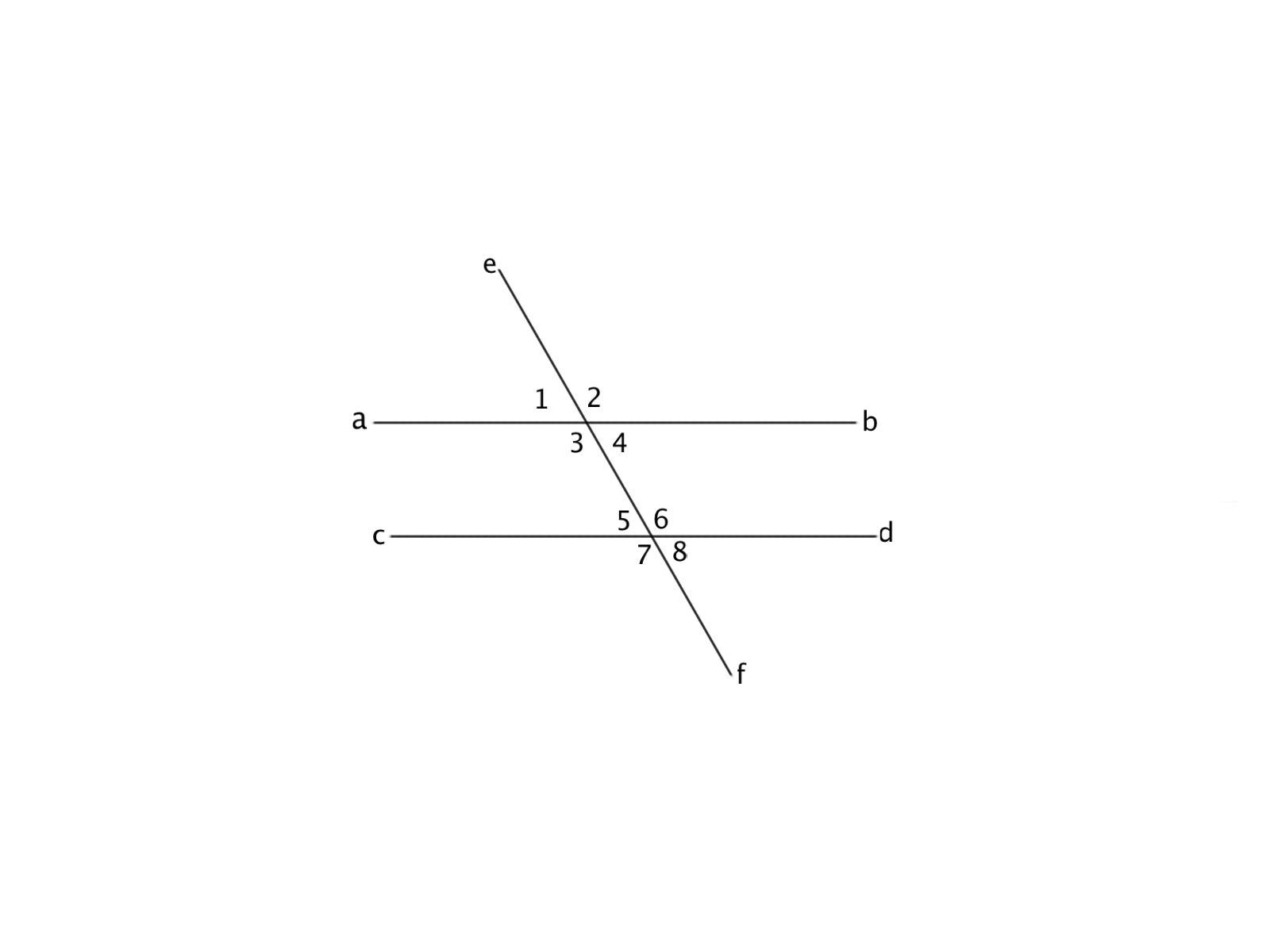
Which answer contains all the angles (other than itself) that are congruent to Angle 1?
Angles 4, 5, and 8
Angles 2 and 4
Angles 2 and 5
Angles 8 and 6
Angles 4 and 5
Explanation
Because of the Corresponding Angles Theorem (Angle 2 and Angle 5), Alternate Exterior Angles (Angle 2 and Angle 8), and Vertical Angles (Angle 2 and Angle 4).
Angles 2 and 3 are congruent based on which Theorem?
Vertical Angles
Alternate Interior Angles
Corresponding Angles
Consecutie Internior Angles
Alternate Exteriors Angles
Explanation
Veritcal angles means that the angles share the same vertex. Angles 2 and 3 are a vertical pair of angles, which mean that they are congruent.
One line on the coordinate plane has its intercepts at 


Perpendicular
Parallel
Neither
Explanation
To answer this question, we must determine the slopes of both lines. If a line has as its intercepts 


The first line has as its slope

The second line has as its slope

Two lines are parallel if and only if their slopes are equal; this is not the case.
They are perpendicular if and only if the product of their slopes is 

so they are perpendicular.
If angles 2 and 6 are congruent, lines AB and CD are parallel based on which theorem?
Corresponding Angles
Alternate Interior Angles
Alternate Exterior Angles
Vertical Angles
Consecutive Interior Angles
Explanation
Angles 2 and 6 are Corresponding Angles. If each of the set of angles were taken separately, angels 2 and 6 would occupy the same place and are thus corresponding angles.
What is the sum of Angle 3 and Angle 5?
180 deg
90 deg
360 deg
15 deg
45 deg
Explanation
Because of the Consecutive Interior Angle theorem, the sum of Angles 3 and 5 would be 180 deg.
A line which includes the point 

Which of these points is on that line?


Explanation
Write the given equation in slope-intercept form:


The given line has slope 
We can use the slope formula 


The only point whose inclusion yields a line with slope 

If lines AB and CD are parallel, angles 1 and 8 are congruent based on which theorem?
Alternate Exterior Angles
Vertical Angles
Alternate Interior Angles
Consecutive Interior Angles
Corresponding Angles
Explanation
Angles 1 and 8 are on the exterior of the parallel lines and are on opposite sides of the transversal. This means the Theorem is the Alternate Exterior Angle theorem.
Choose the equation that represents a line that is parallel to 


Explanation
Two lines are parallel if and only if they have the same slope. To find the slopes, we must put the equations into slope-intercept form, 


If Angles 2 and 7 are congruent, line AB and CD are __________.
parallel
perpendicular
skew
askance
Explanation
Lines AB and CD are parallel based on the Alternate Exterior Angle theorem.
Are the lines of the equations

and

parallel, perpendicular, or neither?
Parallel
Perpendicular
Neither
Explanation
Write each equation in the slope-intercept form 


The first equation,

is in the slope-intercept form 


The slope of the line of this equation is the 

The lines of both equations have the same slope, 