
How to find the perimeter of an equilateral triangle
ACT Math · Learn by Concept
Help Questions
ACT Math › How to find the perimeter of an equilateral triangle
Find the perimeter of an equilateral triangle given side length of 2.


Explanation
To solve, simply multiply the side length by 3 since they are all equal. Thus,

Find the perimeter of an equilateral triangle whose side length is 


Explanation
To solve, simply multiply the side length by 

Jill has an equilateral triangular garden with a base of 


Explanation
Since the triangle is equilateral, the base and the legs are equal, so the first step is to set the two equations equal to each other. Start with 




An equilateral triangle with a perimeter of 


Explanation
An equilateral triangle has 3 equal length sides.
Therefore the perimeter equation is as follows,

So divide the perimeter by 3 to find the length of each side.
Thus the answer is:


Find the perimeter of an equilateral triangle whose side length is


Explanation
To find perimeter of an quilateral triangle, simply multiply the side length by 

What is the perimeter of an equilateral triangle with an area of 


Explanation
Recall that from any vertex of an equilateral triangle, you can drop a height that is a bisector of that vertex as well as a bisector of the correlative side. This gives you the following figure:
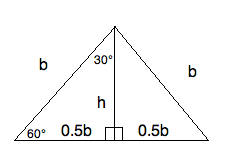
Notice that the small triangles within the larger triangle are both 

The ratio of the small base to the height is the same as 

This means that 
Now, the area of a triangle can be written:



Now, let's write that a bit more simply:
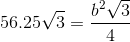
Solve for 


Divide each side by 

Finally, take the square root of both sides. This gives you 
