
Linear / Rational / Variable Equations - Algebra
Card 0 of 477
Solve for  :.
:.

Solve for
First factor the expression by pulling out  :
:


Factor the expression in parentheses by recognizing that it is a difference of squares:

Set each term equal to 0 and solve for the x values:


First factor the expression by pulling out
Factor the expression in parentheses by recognizing that it is a difference of squares:
Set each term equal to 0 and solve for the x values:
Compare your answer with the correct one above
Solve for :.
Solve for
First factor the expression by pulling out :
Factor the expression in parentheses by recognizing that it is a difference of squares:
Set each term equal to 0 and solve for the x values:
First factor the expression by pulling out
Factor the expression in parentheses by recognizing that it is a difference of squares:
Set each term equal to 0 and solve for the x values:
Compare your answer with the correct one above
Solve for :.
Solve for
First factor the expression by pulling out :
Factor the expression in parentheses by recognizing that it is a difference of squares:
Set each term equal to 0 and solve for the x values:
First factor the expression by pulling out
Factor the expression in parentheses by recognizing that it is a difference of squares:
Set each term equal to 0 and solve for the x values:
Compare your answer with the correct one above
Solve for :.
Solve for
First factor the expression by pulling out :
Factor the expression in parentheses by recognizing that it is a difference of squares:
Set each term equal to 0 and solve for the x values:
First factor the expression by pulling out
Factor the expression in parentheses by recognizing that it is a difference of squares:
Set each term equal to 0 and solve for the x values:
Compare your answer with the correct one above
Solve for :.
Solve for
First factor the expression by pulling out :
Factor the expression in parentheses by recognizing that it is a difference of squares:
Set each term equal to 0 and solve for the x values:
First factor the expression by pulling out
Factor the expression in parentheses by recognizing that it is a difference of squares:
Set each term equal to 0 and solve for the x values:
Compare your answer with the correct one above
Solve for :.
Solve for
First factor the expression by pulling out :
Factor the expression in parentheses by recognizing that it is a difference of squares:
Set each term equal to 0 and solve for the x values:
First factor the expression by pulling out
Factor the expression in parentheses by recognizing that it is a difference of squares:
Set each term equal to 0 and solve for the x values:
Compare your answer with the correct one above
Solve for :.
Solve for
First factor the expression by pulling out :
Factor the expression in parentheses by recognizing that it is a difference of squares:
Set each term equal to 0 and solve for the x values:
First factor the expression by pulling out
Factor the expression in parentheses by recognizing that it is a difference of squares:
Set each term equal to 0 and solve for the x values:
Compare your answer with the correct one above
Solve for :.
Solve for
First factor the expression by pulling out :
Factor the expression in parentheses by recognizing that it is a difference of squares:
Set each term equal to 0 and solve for the x values:
First factor the expression by pulling out
Factor the expression in parentheses by recognizing that it is a difference of squares:
Set each term equal to 0 and solve for the x values:
Compare your answer with the correct one above
Solve for :.
Solve for
First factor the expression by pulling out :
Factor the expression in parentheses by recognizing that it is a difference of squares:
Set each term equal to 0 and solve for the x values:
First factor the expression by pulling out
Factor the expression in parentheses by recognizing that it is a difference of squares:
Set each term equal to 0 and solve for the x values:
Compare your answer with the correct one above
Simplify:

Simplify:

Because the two rational expressions have the same denominator, we can simply add straight across the top. The denominator stays the same.
Therefore the answer is  .
.
Because the two rational expressions have the same denominator, we can simply add straight across the top. The denominator stays the same.
Therefore the answer is
Compare your answer with the correct one above
Solve for  :
:

Solve for
Multiply both sides by  :
:


Factor this using the  -method. We split the middle term using two integers whose sum is
  and whose product is
  . These integers are
  :
:


Set each factor equal to 0 and solve separately:


or


Multiply both sides by
Factor this using the
Set each factor equal to 0 and solve separately:
or
Compare your answer with the correct one above
Solve the equation: 
Solve the equation:
Notice that the end value is a negative. Any negative or positive value that is inside an absolute value sign must result to a positive value.
If we split the equation to its positive and negative solutions, we have:


Solve the first equation.


The answer to  is:
is: 
Solve the second equation.


The answer to  is:
is: 
If we substitute these two solutions back to the original equation, the results are positive answers and can never be equal to negative one.
The answer is no solution.
Notice that the end value is a negative. Any negative or positive value that is inside an absolute value sign must result to a positive value.
If we split the equation to its positive and negative solutions, we have:
Solve the first equation.
The answer to
Solve the second equation.
The answer to
If we substitute these two solutions back to the original equation, the results are positive answers and can never be equal to negative one.
The answer is no solution.
Compare your answer with the correct one above

What is  ?
?
What is
The key to solving this question is noticing that we can factor out a 2:
2_x_ + 6_y_ = 44 is the same as 2(x + 3_y_) = 44.
Therefore, x + 3_y_ = 22.
In this case, x + 3_y_ + 33 is the same as 22 + 33, or 55.
The key to solving this question is noticing that we can factor out a 2:
2_x_ + 6_y_ = 44 is the same as 2(x + 3_y_) = 44.
Therefore, x + 3_y_ = 22.
In this case, x + 3_y_ + 33 is the same as 22 + 33, or 55.
Compare your answer with the correct one above
Solve the rational equation:

Solve the rational equation:
With rational equations we must first note the domain, which is all real numbers except  and
and  . That is, these are the values of
  that will cause the equation to be undefined. Since the least common denominator of
  ,
,  , and
, and  is
is  , we can mulitply each term by the LCD to cancel out the denominators and reduce the equation to
  . Combining like terms, we end up with
  . Dividing both sides of the equation by the constant, we obtain an answer of
  . However, this solution is NOT in the domain. Thus, there is NO SOLUTION because
  is an extraneous answer.
With rational equations we must first note the domain, which is all real numbers except
Compare your answer with the correct one above
Solve for  :
:

Solve for
Combine like terms on each side of the equation:


Next, subtract  from both sides.

Then subtract  from both sides.


This is nonsensical; therefore, there is no solution to the equation.
Combine like terms on each side of the equation:
Next, subtract
Then subtract
This is nonsensical; therefore, there is no solution to the equation.
Compare your answer with the correct one above
Find the solution set:


Find the solution set:
Use the substitution method to solve for the solution set.
-

-

Solve equation 2 for y:

Substitute into equation 1:



If equation 1 was solved for a variable and then substituted into the second equation a similar result would be found. This is because these two equations have No solution. Change both equations into slope-intercept form and graph to visualize. These lines are parallel; they cannot intersect.
*Any method of finding the solution to this system of equations will result in a no solution answer.
Use the substitution method to solve for the solution set.
Solve equation 2 for y:
Substitute into equation 1:
If equation 1 was solved for a variable and then substituted into the second equation a similar result would be found. This is because these two equations have No solution. Change both equations into slope-intercept form and graph to visualize. These lines are parallel; they cannot intersect.
*Any method of finding the solution to this system of equations will result in a no solution answer.
Compare your answer with the correct one above
How many solutions does the equation below have?

How many solutions does the equation below have?
When finding how many solutions an equation has you need to look at the constants and coefficients.
The coefficients are the numbers alongside the variables.
The constants are the numbers alone with no variables.
If the coefficients are the same on both sides then the sides will not equal, therefore no solutions will occur.

Use distributive property on the right side first.



No solutions
When finding how many solutions an equation has you need to look at the constants and coefficients.
The coefficients are the numbers alongside the variables.
The constants are the numbers alone with no variables.
If the coefficients are the same on both sides then the sides will not equal, therefore no solutions will occur.
Use distributive property on the right side first.
No solutions
Compare your answer with the correct one above
Solve: 
Solve:
First factorize the numerator.

Rewrite the equation.
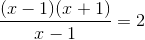
The  terms can be eliminated.

Subtract one on both sides.

However, let's substitute this answer back to the original equation to check whether if we will get  as an answer.

Simplify the left side.

The left side does not satisfy the equation because the fraction cannot be divided by zero.
Therefore,  is not valid.
The answer is: 
First factorize the numerator.
Rewrite the equation.
The
Subtract one on both sides.
However, let's substitute this answer back to the original equation to check whether if we will get
Simplify the left side.
The left side does not satisfy the equation because the fraction cannot be divided by zero.
Therefore,
The answer is:
Compare your answer with the correct one above
Solve the rational equation:

Solve the rational equation:
With rational equations we must first note the domain, which is all real numbers except  . (If
. (If  , then the term
  will be undefined.) Next, the least common denominator is
  , so we multiply every term by the LCD in order to cancel out the denominators. The resulting equation is
  . Subtract
  on both sides of the equation to collect all variables on one side:
  . Lastly, divide by the constant to isolate the variable, and the answer is
  . Be sure to double check that the solution is in the domain of our equation, which it is.
With rational equations we must first note the domain, which is all real numbers except
Compare your answer with the correct one above
Solve the rational equation:

Solve the rational equation:
With rational equations we must first note the domain, which is all real numbers except  . (Recall, the denominator cannot equal zero. Thus, to find the domain set each denominator equal to zero and solve for what the variable cannot be.)
The least common denominator or  and
and  is
is  . Multiply every term by the LCD to cancel out the denominators. The equation reduces to
  . We can FOIL to expand the equation to
  . Combine like terms and solve:
  . Factor the quadratic and set each factor equal to zero to obtain the solution, which is
  or
or  . These answers are valid because they are in the domain.
With rational equations we must first note the domain, which is all real numbers except
The least common denominator or
Compare your answer with the correct one above