
Functions as Graphs - Algebra 2
Card 1 of 112
Which graph depicts a function?
Which graph depicts a function?
Tap to reveal answer
A function may only have one y-value for each x-value.
The vertical line test can be used to identify the function. If at any point on the graph, a straight vertical line intersects the curve at more than one point, the curve is not a function.
A function may only have one y-value for each x-value.
The vertical line test can be used to identify the function. If at any point on the graph, a straight vertical line intersects the curve at more than one point, the curve is not a function.
← Didn't Know|Knew It →
Which analysis can be performed to determine if an equation is a function?
Which analysis can be performed to determine if an equation is a function?
Tap to reveal answer
The vertical line test can be used to determine if an equation is a function. In order to be a function, there must only be one  (or
(or  ) value for each value of
  . The vertical line test determines how many
  (or
(or  ) values are present for each value of
  . If a single vertical line passes through the graph of an equation more than once, it is not a function. If it passes through exactly once or not at all, then the equation is a function.
The horizontal line test can be used to determine if a function is one-to-one, that is, if only one  value exists for each
  (or
(or  ) value. Calculating zeroes, domain, and range can be useful for graphing an equation, but they do not tell if it is a function.
Example of a function: 
Example of an equation that is not a function: 
The vertical line test can be used to determine if an equation is a function. In order to be a function, there must only be one
The horizontal line test can be used to determine if a function is one-to-one, that is, if only one
Example of a function:
Example of an equation that is not a function:
← Didn't Know|Knew It →
The graph below is the graph of a piece-wise function in some interval. Identify, in interval notation, the decreasing interval.
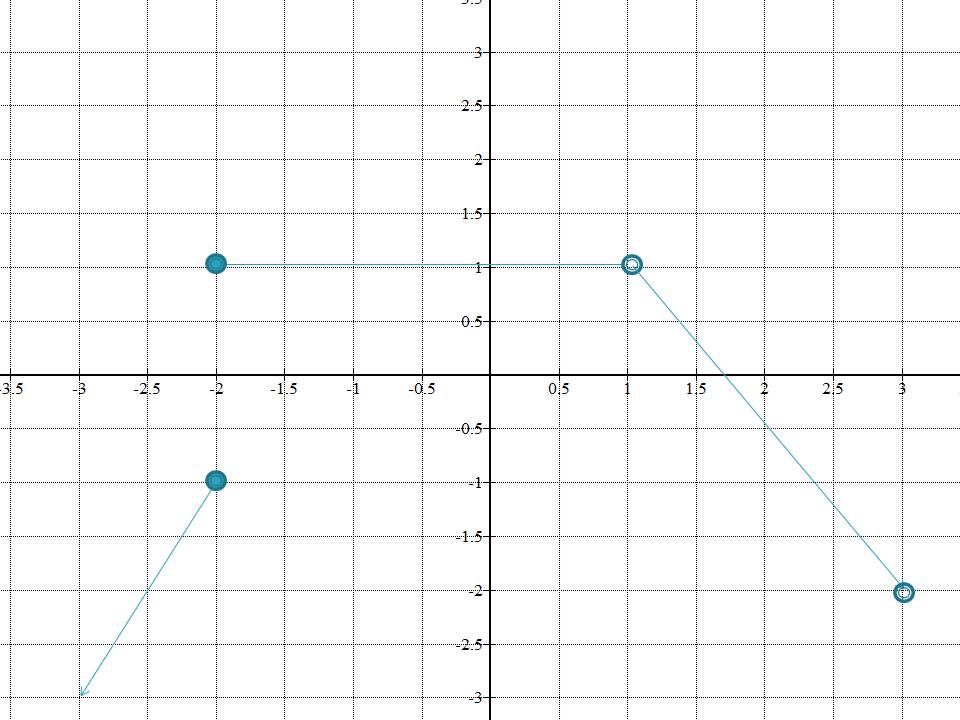
The graph below is the graph of a piece-wise function in some interval. Identify, in interval notation, the decreasing interval.
Tap to reveal answer
As is clear from the graph, in the interval between  (
( included) to
  , the
, the  is constant at
  and then from
  (
( not included) to
  (
( not included), the
  is a decreasing function.
As is clear from the graph, in the interval between
← Didn't Know|Knew It →
Without graphing, determine the relationship between the following two lines. Select the most appropriate answer.


Without graphing, determine the relationship between the following two lines. Select the most appropriate answer.
Tap to reveal answer
Perpendicular lines have slopes that are negative reciprocals. This is the case with these two lines. Although these lines interesect, this is not the most appropriate answer since it does not account for the fact that they are perpendicular.
Perpendicular lines have slopes that are negative reciprocals. This is the case with these two lines. Although these lines interesect, this is not the most appropriate answer since it does not account for the fact that they are perpendicular.
← Didn't Know|Knew It →
Find the slope from the following equation.

Find the slope from the following equation.
Tap to reveal answer
To find the slope of an equation first get the equation in slope intercept form.

where,
 represents the slope.


Thus

To find the slope of an equation first get the equation in slope intercept form.
where,
Thus
← Didn't Know|Knew It →

Tap to reveal answer
When determining how a the graph of a function will be translated, we know that anything that happens to x in the function will impact the graph horizontally, opposite of what is expressed in the function, whereas anything that is outside the function will impact the graph vertically the same as it is in the function notation.
For this graph:

The graph will move 3 spaces left, because that is the opposite sign of the what is connected to x directly.
Also, the graph will move down 2 spaces, because that is what is outside the function and the 2 is negative.
When determining how a the graph of a function will be translated, we know that anything that happens to x in the function will impact the graph horizontally, opposite of what is expressed in the function, whereas anything that is outside the function will impact the graph vertically the same as it is in the function notation.
For this graph:
The graph will move 3 spaces left, because that is the opposite sign of the what is connected to x directly.
Also, the graph will move down 2 spaces, because that is what is outside the function and the 2 is negative.
← Didn't Know|Knew It →
Which is a vertical asymptote of the graph of the function
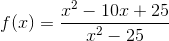 ?
?
(a) 
(b) 
Which is a vertical asymptote of the graph of the function
(a)
(b)
Tap to reveal answer
The vertical asymptote(s) of the graph of a rational function such as  can be found by evaluating the zeroes of the denominator after the rational expression is reduced.
First, factor the numerator and denominator.
The numerator is a perfect square trinomial and can be factored as such:

The denominator can be factored as the difference of squares:

Rewrite
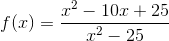
as
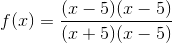
The expression can be reduced by cancelling  in both halves:
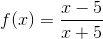
Set the denominator equal to 0 and solve:



The only asymptote is therefore the line of the equation  .
.
The vertical asymptote(s) of the graph of a rational function such as
First, factor the numerator and denominator.
The numerator is a perfect square trinomial and can be factored as such:
The denominator can be factored as the difference of squares:
Rewrite
as
The expression can be reduced by cancelling
Set the denominator equal to 0 and solve:
The only asymptote is therefore the line of the equation
← Didn't Know|Knew It →
Define a function  .
.
Is this function even, odd, or neither?
Define a function
Is this function even, odd, or neither?
Tap to reveal answer
To identify a function  as even odd, or neither, determine
  by replacing
  with
with  , then simplifying. If
  , the function is even; if
  is odd.
 ,
,
so

By the Power of a Product Property,


 ,
,
so  is an odd function
To identify a function
so
By the Power of a Product Property,
so
← Didn't Know|Knew It →
Define a function  .
.
Is this function even, odd, or neither?
Define a function
Is this function even, odd, or neither?
Tap to reveal answer
To identify a function  as even odd, or neither, determine
  by replacing
  with
with  , then simplifying. If
  , the function is even; if
  is odd.

so

By the Power of a Product Property,


 , so
, so  is not an even function.
 ,
,
 , so
, so  is not an odd function.
To identify a function
so
By the Power of a Product Property,
← Didn't Know|Knew It →
Define a function  .
.
Is this function even, odd, or neither?
Define a function
Is this function even, odd, or neither?
Tap to reveal answer
To identify a function  as even, odd, or neither, determine
  by replacing
  with
with  , then simplifying. If
  , the function is even; if
  is odd.


Since  ,
,  is an odd function.
To identify a function
Since
← Didn't Know|Knew It →
Define a function  .
.
Is this function even, odd, or neither?
Define a function
Is this function even, odd, or neither?
Tap to reveal answer
To identify a function as even, odd, or neither, determine by replacing with , then simplifying. If , the function is even; if is odd.


, so is an even function.
To identify a function
← Didn't Know|Knew It →
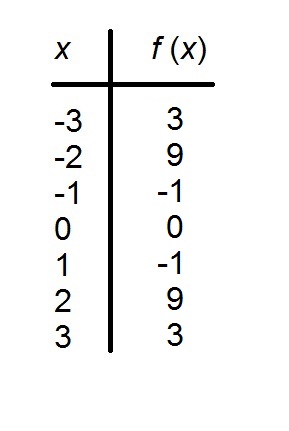
The above table refers to a function  with domain
  .
.
Is this function even, odd, or neither?
The above table refers to a function
Is this function even, odd, or neither?
Tap to reveal answer
A function  is odd if and only if, for every
  in its domain,
  ; it is even if and only if, for every
  in its domain,
  . We can see that



Of course,
 .
.
Therefore,  is even by definition.
A function
Of course,
Therefore,
← Didn't Know|Knew It →
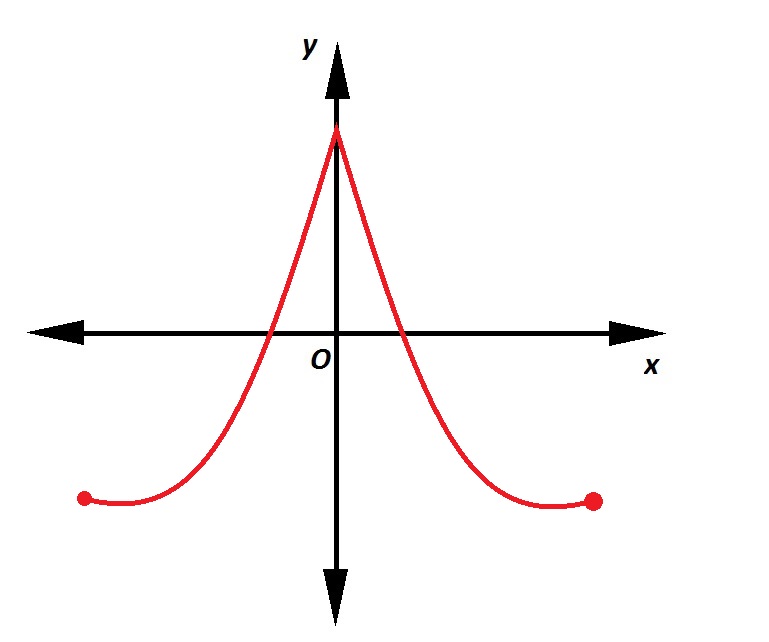
Which of the following is true of the relation graphed above?
Which of the following is true of the relation graphed above?
Tap to reveal answer
The relation graphed is a function, as it passes the vertical line test - no vertical line can pass through it more than once, as seen below:
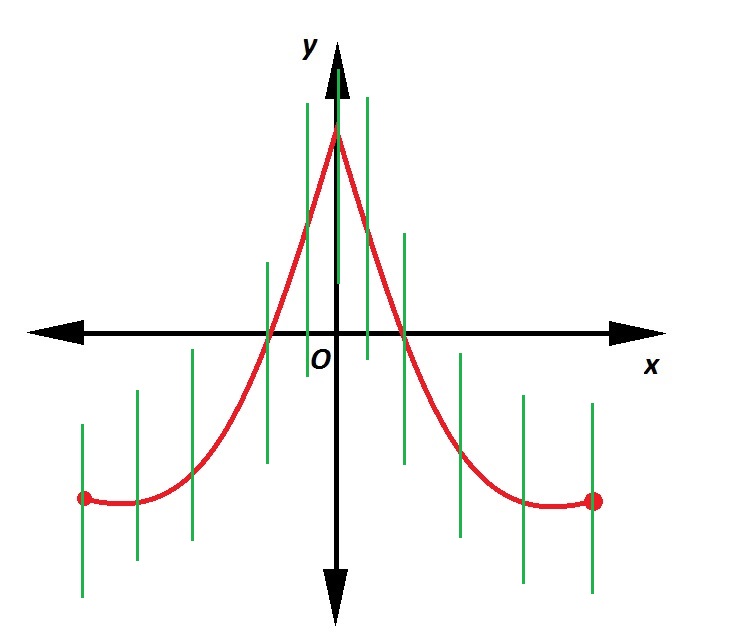
Also, it is seen to be symmetrical about the  -axis. This proves the function even.
The relation graphed is a function, as it passes the vertical line test - no vertical line can pass through it more than once, as seen below:
Also, it is seen to be symmetrical about the
← Didn't Know|Knew It →
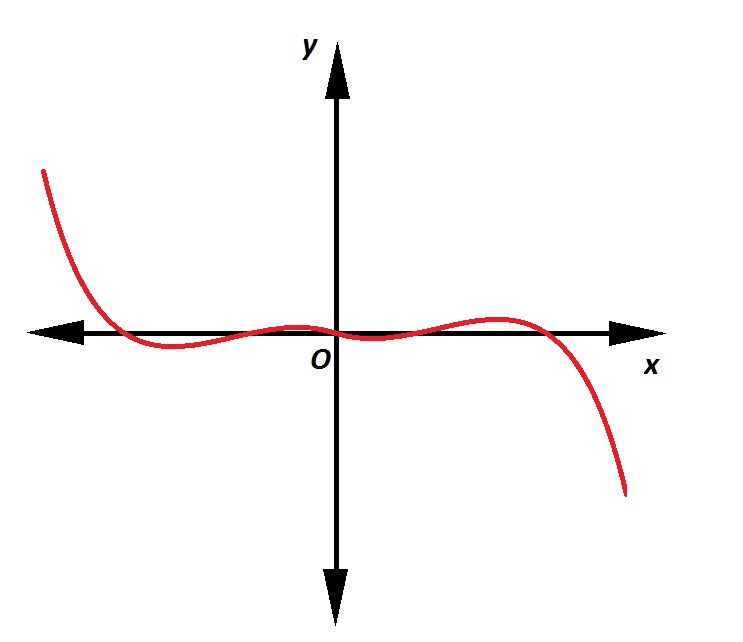
Which of the following is true of the relation graphed above?
Which of the following is true of the relation graphed above?
Tap to reveal answer
The relation graphed is a function, as it passes the vertical line test - no vertical line can pass through it more than once, as is demonstrated below:
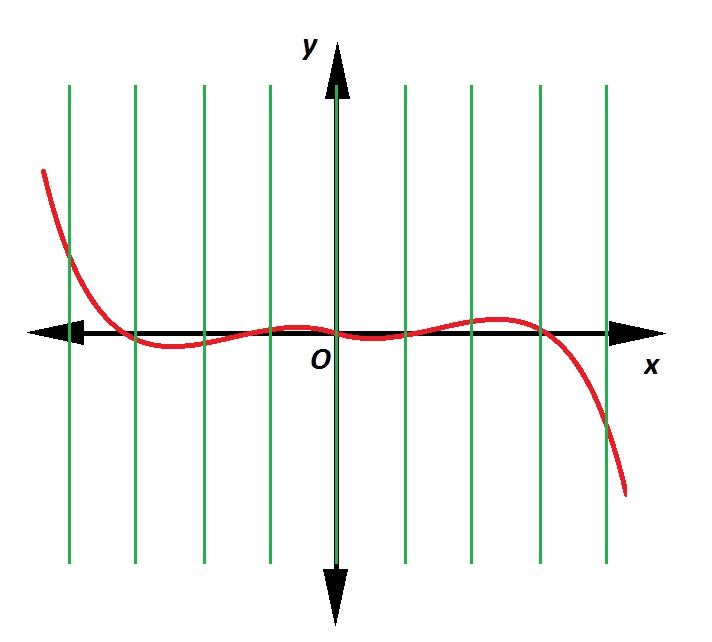
Also, it can be seen to be symmetrical about the origin. Consequently, for each  in the domain,
  - the function is odd.
The relation graphed is a function, as it passes the vertical line test - no vertical line can pass through it more than once, as is demonstrated below:
Also, it can be seen to be symmetrical about the origin. Consequently, for each
← Didn't Know|Knew It →
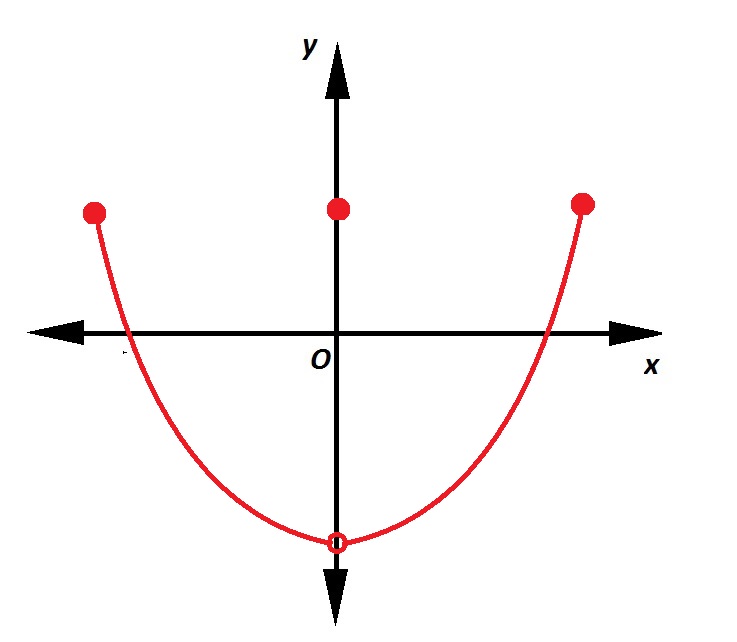
Which of the following is true of the relation graphed above?
Which of the following is true of the relation graphed above?
Tap to reveal answer
The relation graphed is a function, as it passes the vertical line test - no vertical line can pass through it more than once, as is demonstrated below:
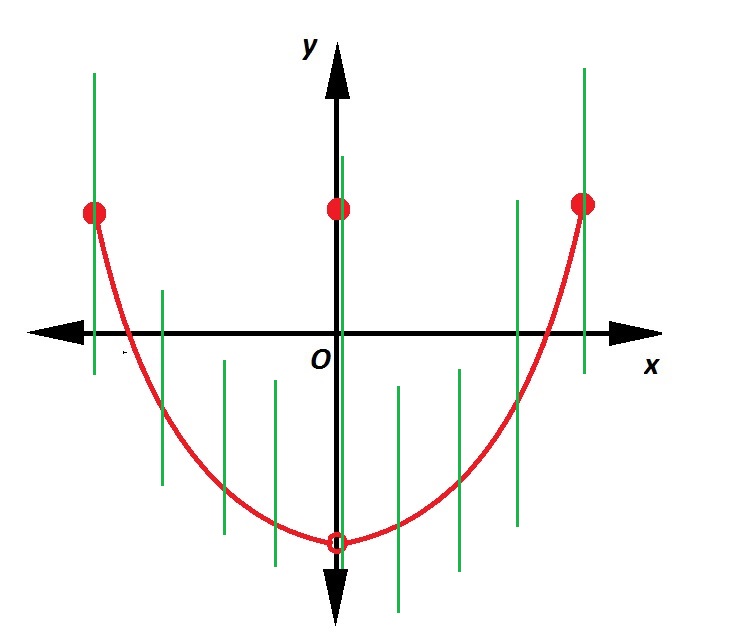
Also, it is seen to be symmetrical about the  -axis. Consequently, for each in the domain,
  - the function is even.
The relation graphed is a function, as it passes the vertical line test - no vertical line can pass through it more than once, as is demonstrated below:
Also, it is seen to be symmetrical about the
← Didn't Know|Knew It →
Which is a vertical asymptote of the graph of the function 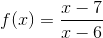 ?
?
(a) 
(b) 
Which is a vertical asymptote of the graph of the function
(a)
(b)
Tap to reveal answer
The vertical asymptote(s) of the graph of a rational function such as can be found by evaluating the zeroes of the denominator after the rational expression is reduced. The expression is in simplest form, so set the denominator equal to 0 and solve for  :
:


The graph of  has the line of the equation
  as its only vertical asymptote.
The vertical asymptote(s) of the graph of a rational function such as
The graph of
← Didn't Know|Knew It →
Which of the following is a vertical asymptote of the graph of the function 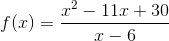 ?
?
(a) 
(b) 
Which of the following is a vertical asymptote of the graph of the function
(a)
(b)
Tap to reveal answer
The vertical asymptote(s) of the graph of a rational function such as can be found by evaluating the zeroes of the denominator after the rational expression is reduced.
First, factor the numerator. It is a quadratic trinomial with lead term  , so look to "reverse-FOIL" it as

by finding two integers with sum  and product 30. By trial and error, these integers can be found to be
  and
and  , so
, so

Therefore,  can be rewritten as
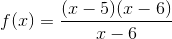 .
.
Cancelling  , this can be seen to be essentially a polynomial function:
 ,
,
which does not have a vertical asymptote.
The vertical asymptote(s) of the graph of a rational function such as
First, factor the numerator. It is a quadratic trinomial with lead term
by finding two integers with sum
Therefore,
Cancelling
which does not have a vertical asymptote.
← Didn't Know|Knew It →
True or false: The graph of 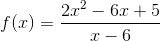 has as a horizontal asymptote the line of the equation
  .
.
True or false: The graph of
Tap to reveal answer
 is a rational function whose numerator is a polynomial with degree greater than that of the polynomial in its denominator (2 and 1, respectively). The graph of such a function does not have a horizontal asymptote.
← Didn't Know|Knew It →
True or false: The graph of 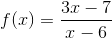 has as a horizontal asymptote the graph of the equation
  .
.
True or false: The graph of
Tap to reveal answer
 is a rational function whose numerator and denominator have the same degree (1). As such, it has as a horizontal asymptote the line of the equation
  , where
  is the quotient of the coefficients of the highest-degree terms of its numerator and denominator. Consequently, the horizontal asymptote of
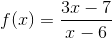
is
 ,
,
or
 .
.
is
or
← Didn't Know|Knew It →
True or false: The graph of 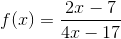 has as a horizontal asymptote the graph of the equation
  .
.
True or false: The graph of
Tap to reveal answer
 is a rational function whose numerator and denominator are polynomials of the same degree (1). As such, it has as a horizontal asymptote the line of the equation
  , where
  is the quotient of the coefficients of the highest-degree terms of its numerator and denominator. Consequently, the horizontal asymptote of
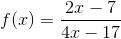
is

or
 .
.
is
or
← Didn't Know|Knew It →