
Mathematical Relationships and Basic Graphs - Algebra 2
Card 1 of 9568
Multiply these fractions:

Multiply these fractions:
Tap to reveal answer
When multiplying fractions, all we have to do is multiply the numerators together and multiply the denominators together:
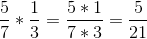
When multiplying fractions, all we have to do is multiply the numerators together and multiply the denominators together:
← Didn't Know|Knew It →
Simplify 
Simplify
Tap to reveal answer
First, combine exponents of like variables. This gives us 
First, combine exponents of like variables. This gives us
← Didn't Know|Knew It →
Simplify 
Simplify
Tap to reveal answer
First, combine exponents of like variables. This gives us  which simplifies to
First, combine exponents of like variables. This gives us
← Didn't Know|Knew It →
Multiply the fractions:

Multiply the fractions:
Tap to reveal answer
When multiplying fractions, multiply the numbers on the top together and the numbers on the bottom together. Then simplify accordingly.

When multiplying fractions, multiply the numbers on the top together and the numbers on the bottom together. Then simplify accordingly.
← Didn't Know|Knew It →
Expand: 
Expand:
Tap to reveal answer
To expand the exponent, we multiply the base by whatever the exponent is.

To expand the exponent, we multiply the base by whatever the exponent is.
← Didn't Know|Knew It →
Evaluate: 
Evaluate:
Tap to reveal answer
Although we have two variables, we do know that a number raised to a zero power is one. Therefore:

Although we have two variables, we do know that a number raised to a zero power is one. Therefore:
← Didn't Know|Knew It →
Simplify.

Simplify.
Tap to reveal answer
When multiplying exponents with the same base, you just have to add the exponents.

When multiplying exponents with the same base, you just have to add the exponents.
← Didn't Know|Knew It →
Simplify.

Simplify.
Tap to reveal answer
When dividing exponents with the same base, we just subtract the exponents.

When dividing exponents with the same base, we just subtract the exponents.
← Didn't Know|Knew It →
Simplify.

Simplify.
Tap to reveal answer
When dividing exponents with the same base, we just subtract the exponents.

When dividing exponents with the same base, we just subtract the exponents.
← Didn't Know|Knew It →
Simplify: 
Simplify:
Tap to reveal answer
When dividing exponents with the same base, we subtract the exponents and keep the base the same.

When dividing exponents with the same base, we subtract the exponents and keep the base the same.
← Didn't Know|Knew It →
Simplify: 
Simplify:
Tap to reveal answer
When multiplying exponents with the same base, we add the exponents and keep the base the same.

When multiplying exponents with the same base, we add the exponents and keep the base the same.
← Didn't Know|Knew It →
Divide the fractions:

Divide the fractions:
Tap to reveal answer
When dividing fractions, first we flip the second fraction in the problem. Then we multiply the numbers on the top together and the numbers on the bottom together. Finally simplify accordingly.

When dividing fractions, first we flip the second fraction in the problem. Then we multiply the numbers on the top together and the numbers on the bottom together. Finally simplify accordingly.
← Didn't Know|Knew It →
Simplify: 
Simplify:
Tap to reveal answer
When multiplying exponents with the same base, we add the exponents and keep the base the same.

When multiplying exponents with the same base, we add the exponents and keep the base the same.
← Didn't Know|Knew It →
Divide the fractions:

Divide the fractions:
Tap to reveal answer
When dividing fractions, first we flip the second fraction in the problem. Then we multiply the numbers on the top together and the numbers on the bottom together. Finally simplify accordingly.

When dividing fractions, first we flip the second fraction in the problem. Then we multiply the numbers on the top together and the numbers on the bottom together. Finally simplify accordingly.
← Didn't Know|Knew It →
Where would  fall on the number line?
Where would
Tap to reveal answer
Imaginary numbers do not fall on the number line-- they are by definition not real numbers.
** If the question asked where  falls on the number line, the answer would be to the left of 0, because
  .
.
Imaginary numbers do not fall on the number line-- they are by definition not real numbers.
** If the question asked where
← Didn't Know|Knew It →
Simplify: 
Simplify:
Tap to reveal answer
When multiplying exponents with the same base, we add the exponents and keep the base the same.

When multiplying exponents with the same base, we add the exponents and keep the base the same.
← Didn't Know|Knew It →
Divide the fractions:

Divide the fractions:
Tap to reveal answer
When dividing fractions, first we flip the second fraction in the problem. Then we multiply the numbers on the top together and the numbers on the bottom together. Finally simplify accordingly.

When dividing fractions, first we flip the second fraction in the problem. Then we multiply the numbers on the top together and the numbers on the bottom together. Finally simplify accordingly.
← Didn't Know|Knew It →
Simplify: 
Simplify:
Tap to reveal answer
When multiplying exponents with the same base, we just keep the base the same and add the exponents.

When multiplying exponents with the same base, we just keep the base the same and add the exponents.
← Didn't Know|Knew It →
Divide the fractions:

Divide the fractions:
Tap to reveal answer
When dividing fractions, first we flip the second fraction in the problem. Then we multiply the numbers on the top together and the numbers on the bottom together. Finally simplify accordingly.

When dividing fractions, first we flip the second fraction in the problem. Then we multiply the numbers on the top together and the numbers on the bottom together. Finally simplify accordingly.
← Didn't Know|Knew It →
Divide the fractions:

Divide the fractions:
Tap to reveal answer
When dividing fractions, first we flip the second fraction in the problem. Then we multiply the numbers on the top together and the numbers on the bottom together. Finally simplify accordingly.

When dividing fractions, first we flip the second fraction in the problem. Then we multiply the numbers on the top together and the numbers on the bottom together. Finally simplify accordingly.
← Didn't Know|Knew It →