
Fractions - Algebra 2
Card 1 of 1112
Simplify  .
.
Simplify
Tap to reveal answer
The problem can be made easier by first simplifying each fraction:  and
and  .
.
This brings our new problem to  .
.
Now, the numerators are multiplied by each other then the denomenators are multiplied by each other:  .
.
The problem can be made easier by first simplifying each fraction:
This brings our new problem to
Now, the numerators are multiplied by each other then the denomenators are multiplied by each other:
← Didn't Know|Knew It →
Simplify  .
.
Simplify
Tap to reveal answer
To solve, we must turn the division problem into a multiplication problem by "flipping" the second fraction (dividing by a fraction is the same as multiplying by its reciprocal):
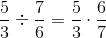 .
.
Then, we multiply the numerators followed by the denomenators:
 .
.
Lastly, the fraction must be simplified by a factor of 3:
 , which gives us our final answer.
To solve, we must turn the division problem into a multiplication problem by "flipping" the second fraction (dividing by a fraction is the same as multiplying by its reciprocal):
Then, we multiply the numerators followed by the denomenators:
Lastly, the fraction must be simplified by a factor of 3:
← Didn't Know|Knew It →
Solve the following equation to find  .
.
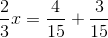
Solve the following equation to find
Tap to reveal answer
The first step in solving this equation is to add the fractions, giving us:

To solve for  , we need to divide both sides by
  .
.
Remember: When we divide a number by a fraction, we "switch" (find the reciprocal) of the fraction and mulitply it to the number.
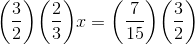
The right side of the equation cancels out leaving  alone:
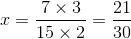
Notice: Both the numerator and denominator are divisble by  so we can simplify this further.

The first step in solving this equation is to add the fractions, giving us:
To solve for
Remember: When we divide a number by a fraction, we "switch" (find the reciprocal) of the fraction and mulitply it to the number.
The right side of the equation cancels out leaving
Notice: Both the numerator and denominator are divisble by
← Didn't Know|Knew It →
Multiply:
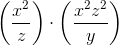
Multiply:
Tap to reveal answer
To multiply fractions, just multiply the numerators, then the denominators, and then simplify.
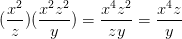
To multiply fractions, just multiply the numerators, then the denominators, and then simplify.
← Didn't Know|Knew It →
Multiply:
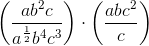
Multiply:
Tap to reveal answer
To multiply fractions, multiply the numerators and denominators together, then simplify.

To multiply fractions, multiply the numerators and denominators together, then simplify.
← Didn't Know|Knew It →
Multiply:
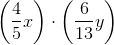
Multiply:
Tap to reveal answer
Multiply the numerators and denominators. Then, simplify.

Multiply the numerators and denominators. Then, simplify.
← Didn't Know|Knew It →
Multiply:
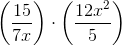
Multiply:
Tap to reveal answer
Multiply the numerators and denominators, then simplify.

Multiply the numerators and denominators, then simplify.
← Didn't Know|Knew It →
Simplify:
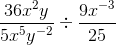
Simplify:
Tap to reveal answer
In order to divide fractions, you need to multiply the first fraction by the reciprocal of the second one.

Now, multiply the numerators and denominators together, then simplify.

In order to divide fractions, you need to multiply the first fraction by the reciprocal of the second one.
Now, multiply the numerators and denominators together, then simplify.
← Didn't Know|Knew It →
Simplify:
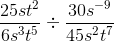
Simplify:
Tap to reveal answer
To divid fractions, you need to multiply the first fraction by the reciprocal of the second.

Now, multiply the numerators and denominators together, then simplify.

To divid fractions, you need to multiply the first fraction by the reciprocal of the second.
Now, multiply the numerators and denominators together, then simplify.
← Didn't Know|Knew It →
Simplify:
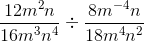
Simplify:
Tap to reveal answer
To divide fractions, you need to multiply the first fraction by the reciprocal of the second.

Now, multiply the numerators and denominators, then simplify.

To divide fractions, you need to multiply the first fraction by the reciprocal of the second.
Now, multiply the numerators and denominators, then simplify.
← Didn't Know|Knew It →
Evaluate: 
Evaluate:
Tap to reveal answer
Change all the fractions to improper fractions.
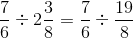
Convert the division sign to a multiplication sign, but flip the second term. Simplify.
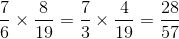
Change all the fractions to improper fractions.
Convert the division sign to a multiplication sign, but flip the second term. Simplify.
← Didn't Know|Knew It →
Divide and simplify:
 .
.
Divide and simplify:
Tap to reveal answer
Multiplying fractions is a two-step process. First, you must flip the second fraction (make it its reciprocal) and then set up the equation as a multiplication problem:
 .
.
Then, cross-reduce: 11 goes into both 11 and 22, so you can take that out so it looks like:
 .
.
Then, multiply straight across so that you get  .
.
You can't simplify any further, so that's your answer!
Multiplying fractions is a two-step process. First, you must flip the second fraction (make it its reciprocal) and then set up the equation as a multiplication problem:
Then, cross-reduce: 11 goes into both 11 and 22, so you can take that out so it looks like:
Then, multiply straight across so that you get
You can't simplify any further, so that's your answer!
← Didn't Know|Knew It →
Multiply and simplify:

Multiply and simplify:
Tap to reveal answer
Before multiplying straight across, I would start with some cross-reducing. Look diagonally and see what can be simplified.
Between  and
and  , you can take out a
Between  and
and  , you can take out a
  .
.
The simplified version looks like:

Before multiplying straight across, I would start with some cross-reducing. Look diagonally and see what can be simplified.
Between
Between
The simplified version looks like:
← Didn't Know|Knew It →
Multiply these fractions:

Multiply these fractions:
Tap to reveal answer
When multiplying fractions, all we have to do is multiply the numerators together and multiply the denominators together:
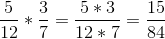
Simply the fraction to get the final answer:

When multiplying fractions, all we have to do is multiply the numerators together and multiply the denominators together:
Simply the fraction to get the final answer:
← Didn't Know|Knew It →
Multiply these fractions:

Multiply these fractions:
Tap to reveal answer
When multiplying fractions, all we have to do is multiply the numerators together and multiply the denominators together:
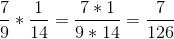
Simply the fraction to get the final answer:

When multiplying fractions, all we have to do is multiply the numerators together and multiply the denominators together:
Simply the fraction to get the final answer:
← Didn't Know|Knew It →
Multiply these fractions:

Multiply these fractions:
Tap to reveal answer
When multiplying fractions, all we have to do is multiply the numerators together and multiply the denominators together:
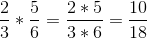
Simply the fraction to get the final answer:

When multiplying fractions, all we have to do is multiply the numerators together and multiply the denominators together:
Simply the fraction to get the final answer:
← Didn't Know|Knew It →
Multiply these fractions:

Multiply these fractions:
Tap to reveal answer
When multiplying fractions, all we have to do is multiply the numerators together and multiply the denominators together:
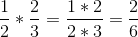
Simply the fraction to get the final answer:

When multiplying fractions, all we have to do is multiply the numerators together and multiply the denominators together:
Simply the fraction to get the final answer:
← Didn't Know|Knew It →
Multiply these fractions:

Multiply these fractions:
Tap to reveal answer
When multiplying fractions, all we have to do is multiply the numerators together and multiply the denominators together:
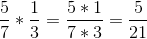
When multiplying fractions, all we have to do is multiply the numerators together and multiply the denominators together:
← Didn't Know|Knew It →
Multiply these fractions:

Multiply these fractions:
Tap to reveal answer
When multiplying fractions, all we have to do is multiply the numerators together and multiply the denominators together:

Simply the fraction to get the final answer:

When multiplying fractions, all we have to do is multiply the numerators together and multiply the denominators together:
Simply the fraction to get the final answer:
← Didn't Know|Knew It →
Multiply these fractions:

Multiply these fractions:
Tap to reveal answer
When multiplying fractions, all we have to do is multiply the numerators together and multiply the denominators together:

Simplify the fraction to get the final answer:

When multiplying fractions, all we have to do is multiply the numerators together and multiply the denominators together:
Simplify the fraction to get the final answer:
← Didn't Know|Knew It →