
Identifying artists, works, or schools of nineteenth-century 2D art - AP Art History
Card 1 of 236
Identify the artist who created this painting.
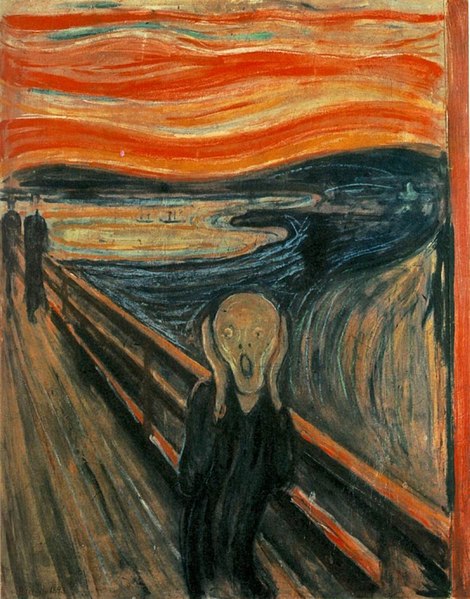
Identify the artist who created this painting.
Tap to reveal answer
This painting, The Scream, was created by Munch between 1893 and 1910. It is of the impressionist style that heavily influenced the expressionist movement that followed.
Though Manet and Van Gogh share similar styles to this painting, they both died before the turn of the 20th century. Morisot also died before the 1900s.
Image is in the public domain, accessed through Wikipedia Media Commons: https://commons.wikimedia.org/wiki/File:The\_Scream.jpg
This painting, The Scream, was created by Munch between 1893 and 1910. It is of the impressionist style that heavily influenced the expressionist movement that followed.
Though Manet and Van Gogh share similar styles to this painting, they both died before the turn of the 20th century. Morisot also died before the 1900s.
Image is in the public domain, accessed through Wikipedia Media Commons: https://commons.wikimedia.org/wiki/File:The\_Scream.jpg
← Didn't Know|Knew It →
Gustave Courbet is well known for developing and working in what style?
Gustave Courbet is well known for developing and working in what style?
Tap to reveal answer
Gustave Courbet (1819-1877) was a French painter who reacted to the previous generation's bold romanticism and his contemporary critics' love of history painting by developing what he termed "realism." Courbet wished to use his painting to comment on social issues and values, which he felt were valuable topics on which a painter might focus. Courbet sought out landscapes, portraits, and still lifes that depicted the everyday in rough, honest brushstrokes.
Gustave Courbet (1819-1877) was a French painter who reacted to the previous generation's bold romanticism and his contemporary critics' love of history painting by developing what he termed "realism." Courbet wished to use his painting to comment on social issues and values, which he felt were valuable topics on which a painter might focus. Courbet sought out landscapes, portraits, and still lifes that depicted the everyday in rough, honest brushstrokes.
← Didn't Know|Knew It →
Who was the French artist who spent the last years of his life living in Polynesia and painting its inhabitants?
Who was the French artist who spent the last years of his life living in Polynesia and painting its inhabitants?
Tap to reveal answer
Paul Gauguin was an important Post-Impressionist whose early work experimented with color and symbolism, but Gauguin's work took on a new form after visiting Tahiti in the 1880s. Gauguin began capturing the culture of Polynesia and started using symbols of Polynesia and images of Polynesians themselves in his art. In the 1890s, he permanently moved to the island of Punaauia in French Polynesia, and painted more and more symbolic paintings that played with color and structure.
Paul Gauguin was an important Post-Impressionist whose early work experimented with color and symbolism, but Gauguin's work took on a new form after visiting Tahiti in the 1880s. Gauguin began capturing the culture of Polynesia and started using symbols of Polynesia and images of Polynesians themselves in his art. In the 1890s, he permanently moved to the island of Punaauia in French Polynesia, and painted more and more symbolic paintings that played with color and structure.
← Didn't Know|Knew It →
The French painter who created large-scale history portraits in the Napoleonic era was .
The French painter who created large-scale history portraits in the Napoleonic era was .
Tap to reveal answer
Jacques-Louis David was Napoleon Bonaparte's official painter, and made both a famous portrait of an enthroned Napoleon and a large painting of Napoleon's coronation as Emperor. David came to prominence before the French Revolution, however, as a history painter depicting scenes from Ancient Rome on a grand scale. No matter his subject, David's work was well known for creating large pieces of art with extemely bold colors.
Jacques-Louis David was Napoleon Bonaparte's official painter, and made both a famous portrait of an enthroned Napoleon and a large painting of Napoleon's coronation as Emperor. David came to prominence before the French Revolution, however, as a history painter depicting scenes from Ancient Rome on a grand scale. No matter his subject, David's work was well known for creating large pieces of art with extemely bold colors.
← Didn't Know|Knew It →
Which of the following grouping of artists were NOT part of the same art movement?
Which of the following grouping of artists were NOT part of the same art movement?
Tap to reveal answer
Vincent van Gogh, Henri Matisse, and Joan Miró were all connected as artists through their use of color and experimentation with forms. Nonetheless, each artist developed his own unique style that largely stood apart from other artists. Van Gogh's postimpressionistic style built on impressionism, while Matisse and Miro's deconstruction of form and representation exploded many of impressionism's notions of art.
Vincent van Gogh, Henri Matisse, and Joan Miró were all connected as artists through their use of color and experimentation with forms. Nonetheless, each artist developed his own unique style that largely stood apart from other artists. Van Gogh's postimpressionistic style built on impressionism, while Matisse and Miro's deconstruction of form and representation exploded many of impressionism's notions of art.
← Didn't Know|Knew It →
The American photographer notable for his images of the American Civil War was .
The American photographer notable for his images of the American Civil War was .
Tap to reveal answer
The discipline of photography was brand new when the American Civil War began in 1861, and saw increased usage during the conflict. The pioneer in this shift was Matthew Brady, who was already a notable photographer of portraits, but who during the war began spending time on the battlefields. The slow shutter speeds of nineteenth century cameras did not allow him to take action shots, but Brady did manage to make many image's of the carnage of the war in the aftermath of battles.
The discipline of photography was brand new when the American Civil War began in 1861, and saw increased usage during the conflict. The pioneer in this shift was Matthew Brady, who was already a notable photographer of portraits, but who during the war began spending time on the battlefields. The slow shutter speeds of nineteenth century cameras did not allow him to take action shots, but Brady did manage to make many image's of the carnage of the war in the aftermath of battles.
← Didn't Know|Knew It →
Which American artist is well-known for his paintings and sculptures of the American West?
Which American artist is well-known for his paintings and sculptures of the American West?
Tap to reveal answer
Frederic Remington was a native New Yorker who began his career as a painter and illustrator for magazines after the Civil War. After going on assignment to illustrate a magazine article on the Apache leader Geronimo in 1886, Remington began to paint and sculpt images of the American West exclusively. Remington's style was naturalistic and empathetic to his subjects, and also had a natural ability to capture accurate movement. Remington's images of the Old West are some of the most famous images of cowboys and Native Americans.
Frederic Remington was a native New Yorker who began his career as a painter and illustrator for magazines after the Civil War. After going on assignment to illustrate a magazine article on the Apache leader Geronimo in 1886, Remington began to paint and sculpt images of the American West exclusively. Remington's style was naturalistic and empathetic to his subjects, and also had a natural ability to capture accurate movement. Remington's images of the Old West are some of the most famous images of cowboys and Native Americans.
← Didn't Know|Knew It →
The Romantic painter who created the painting “The Wanderer Above the Sea of Fog” was .
The Romantic painter who created the painting “The Wanderer Above the Sea of Fog” was .
Tap to reveal answer
"The Wanderer Above the Sea of Fog," painted in 1818, is considered one of the chief examples of Romantic visual arts, and it is the most famous painting by Caspar David Friedrich. The painting, showing a young man looking out over mountains submerged in a bank of fog, speaks to many important themes of Romanticism, like a return to nature, a focus on the individual, and an adventurous spirit.
"The Wanderer Above the Sea of Fog," painted in 1818, is considered one of the chief examples of Romantic visual arts, and it is the most famous painting by Caspar David Friedrich. The painting, showing a young man looking out over mountains submerged in a bank of fog, speaks to many important themes of Romanticism, like a return to nature, a focus on the individual, and an adventurous spirit.
← Didn't Know|Knew It →
Which of the following artists was an important influence on the turn to Primitivism in the early twentieth century?
Which of the following artists was an important influence on the turn to Primitivism in the early twentieth century?
Tap to reveal answer
Paul Gauguin was involved with the Impressionists in Paris during the 1880s, but visited Polynesia in the 1890s repeatedly, eventually moving there. While in Polynesia, Gauguin kept painting and kept up his ties to the French art world. Gauguin's paintings of Polynesian women, culture, and scenes were hugely influential on younger artists, like Henri Matisse and Pablo Picasso, who moved towards "primitive art" in the early twentieth century.
Paul Gauguin was involved with the Impressionists in Paris during the 1880s, but visited Polynesia in the 1890s repeatedly, eventually moving there. While in Polynesia, Gauguin kept painting and kept up his ties to the French art world. Gauguin's paintings of Polynesian women, culture, and scenes were hugely influential on younger artists, like Henri Matisse and Pablo Picasso, who moved towards "primitive art" in the early twentieth century.
← Didn't Know|Knew It →
The painting of an elderly woman sitting in a black dress officially known as “Arrangement in Grey and Black, No. 1” is more popularly known as .
The painting of an elderly woman sitting in a black dress officially known as “Arrangement in Grey and Black, No. 1” is more popularly known as .
Tap to reveal answer
"Arrangement in Grey and Black, No. 1" is one of the most famous paintings in the world, but few people know its name, instead referring to it by the popular title of "Whistler's Mother." While the 1871 painting is indeed a portrait of the artist's mother sitting, James McNeill Whistler was annoyed when his work was called a "portrait." Whistler preferred to think of the painting as exactly what he called, a study in shades of grey and black which showed his ability with dark colors.
"Arrangement in Grey and Black, No. 1" is one of the most famous paintings in the world, but few people know its name, instead referring to it by the popular title of "Whistler's Mother." While the 1871 painting is indeed a portrait of the artist's mother sitting, James McNeill Whistler was annoyed when his work was called a "portrait." Whistler preferred to think of the painting as exactly what he called, a study in shades of grey and black which showed his ability with dark colors.
← Didn't Know|Knew It →
The artist who created a scandal with his 1863 paint Le Déjeuner sur l'herbe (The Luncheon on the Grass)was .
The artist who created a scandal with his 1863 paint Le Déjeuner sur l'herbe (The Luncheon on the Grass)was .
Tap to reveal answer
Édouard Manet's massive painting of a group of people having a luncheon picnic, which included a nude woman in the foreground, caused a massive scandal when it was presented to the 1863 Salon. The thematic content of the painting, which was both an everyday scene and featured a luxuriating nude, was only part of the issue. Manet's style differed greatly from the academic mastery of the previous generation of French painters, such as David, Cabanel, and Ingres, and greatly presaged Impressionism.
Édouard Manet's massive painting of a group of people having a luncheon picnic, which included a nude woman in the foreground, caused a massive scandal when it was presented to the 1863 Salon. The thematic content of the painting, which was both an everyday scene and featured a luxuriating nude, was only part of the issue. Manet's style differed greatly from the academic mastery of the previous generation of French painters, such as David, Cabanel, and Ingres, and greatly presaged Impressionism.
← Didn't Know|Knew It →
The Impressionists most clearly departed from earlier French painting by .
The Impressionists most clearly departed from earlier French painting by .
Tap to reveal answer
The Impressionists are most famous for their particular painting style, which used obvious brushwork to make a less-than-realistic depiction of a scene in order to portray movement and emotion. At the time of their emergence, the Impressionists were shocking to the academic French art world in their persistent use of everyday scenes and common items. Impressionists often showed people at cafés or in parks, and even their landscapes were usually quite small compared to previous images.
The Impressionists are most famous for their particular painting style, which used obvious brushwork to make a less-than-realistic depiction of a scene in order to portray movement and emotion. At the time of their emergence, the Impressionists were shocking to the academic French art world in their persistent use of everyday scenes and common items. Impressionists often showed people at cafés or in parks, and even their landscapes were usually quite small compared to previous images.
← Didn't Know|Knew It →
The nineteenth-century American art movement whose works focused on natural landscapes, dramatic use of light, and a romantic perspective was .
The nineteenth-century American art movement whose works focused on natural landscapes, dramatic use of light, and a romantic perspective was .
Tap to reveal answer
The Hudson River School was arguably the first well-known, distinctive American art movement, beginning in the 1820s and remaining influential through the post-Civil War Era. Thomas Cole was the progenitor of the style, as his trips through the Hudson River Valley encouraged him to paint sweeping landscapes in a realistic depiction of the sites. The Hudson River School's use of light and frequent inclusion of extreme weather showed their debt to the ideas and theories of romanticism.
The Hudson River School was arguably the first well-known, distinctive American art movement, beginning in the 1820s and remaining influential through the post-Civil War Era. Thomas Cole was the progenitor of the style, as his trips through the Hudson River Valley encouraged him to paint sweeping landscapes in a realistic depiction of the sites. The Hudson River School's use of light and frequent inclusion of extreme weather showed their debt to the ideas and theories of romanticism.
← Didn't Know|Knew It →

Pictured above is a work entitled Impression, Sunrise.
Most specifically, this style of art was born as a response to, and a break from, .
Pictured above is a work entitled Impression, Sunrise.
Most specifically, this style of art was born as a response to, and a break from, .
Tap to reveal answer
Impressionism grew out of the desire of nineteenth-century Parisian artists to move away from the outdated works of the Salon de Paris. Their work moved against tradition and was rejected by the Salon, causing a movement to form in response.
Impressionism grew out of the desire of nineteenth-century Parisian artists to move away from the outdated works of the Salon de Paris. Their work moved against tradition and was rejected by the Salon, causing a movement to form in response.
← Didn't Know|Knew It →
Which of the following works best captures the pointillist style?
Which of the following works best captures the pointillist style?
Tap to reveal answer
Seurat's ...La Grande Jatte is the most iconic work in the pointillist style. Leger's works had more in common with cubism than pointillism and Bosch's works were created during the Renaissance.
Seurat's ...La Grande Jatte is the most iconic work in the pointillist style. Leger's works had more in common with cubism than pointillism and Bosch's works were created during the Renaissance.
← Didn't Know|Knew It →

The artist of this work is .
The artist of this work is .
Tap to reveal answer
Given the intense brush style and treatment of landscape and subject, this piece is a van Gogh. Manet and Monet were impressionists, and this work is post-impressionist. Schiele does not fit the time period or the style.
Given the intense brush style and treatment of landscape and subject, this piece is a van Gogh. Manet and Monet were impressionists, and this work is post-impressionist. Schiele does not fit the time period or the style.
← Didn't Know|Knew It →

In what time period were these two paintings finished?
In what time period were these two paintings finished?
Tap to reveal answer
Van Gogh's Cypresses was painted in 1889 and Gauguin's Where Do We Come From? What Are We? Where Are We Going? was painted in 1897.
Van Gogh's Cypresses was painted in 1889 and Gauguin's Where Do We Come From? What Are We? Where Are We Going? was painted in 1897.
← Didn't Know|Knew It →
An American Impressionist known for her paintings of mothers with their children is .
An American Impressionist known for her paintings of mothers with their children is .
Tap to reveal answer
Dorothea Lange was a 20th century photographer. Georgia O'Keefe was a Precisionist known for her paintings of flowers and bones. Berthe Morisot is a French Impressionist. Mary Cassatt was born in Pennsylvania and moved to Europe to study art, where she met Degas and other Impressionists.
Dorothea Lange was a 20th century photographer. Georgia O'Keefe was a Precisionist known for her paintings of flowers and bones. Berthe Morisot is a French Impressionist. Mary Cassatt was born in Pennsylvania and moved to Europe to study art, where she met Degas and other Impressionists.
← Didn't Know|Knew It →
The American artist who first painted images of Native Americans in the nineteenth century was .
The American artist who first painted images of Native Americans in the nineteenth century was .
Tap to reveal answer
George Catlin was born in Pennsylvania in 1796, and first went to St. Louis and the then Western portion of the United States in 1830. For the next few years, Catlin would make the first serious paintings, rather than quick etchings or sketches, of Native Americans in traditional dress. Catlin's paintings became the indelible images of many Native American tribes throughout the nineteenth century.
George Catlin was born in Pennsylvania in 1796, and first went to St. Louis and the then Western portion of the United States in 1830. For the next few years, Catlin would make the first serious paintings, rather than quick etchings or sketches, of Native Americans in traditional dress. Catlin's paintings became the indelible images of many Native American tribes throughout the nineteenth century.
← Didn't Know|Knew It →
All of the following painters were Impressionists except .
All of the following painters were Impressionists except .
Tap to reveal answer
Impressionism was a significant artistic movement developed in France during the late nineteenth century that utilized visible brushstrokes, representations of natural light, and everyday scenes. Challenging traditional ideas of art, the movement was initially derided by critics, but proved hugely influential. Its leading artists included Éduouard Manet, Claude Monet, Pierre-Auguste Renoir, and Paul Cézanne. Henri Matisse was a full generation younger than the impressionists, and was highly influenced by them, but helped develop modern art in the early twentieth century.
Impressionism was a significant artistic movement developed in France during the late nineteenth century that utilized visible brushstrokes, representations of natural light, and everyday scenes. Challenging traditional ideas of art, the movement was initially derided by critics, but proved hugely influential. Its leading artists included Éduouard Manet, Claude Monet, Pierre-Auguste Renoir, and Paul Cézanne. Henri Matisse was a full generation younger than the impressionists, and was highly influenced by them, but helped develop modern art in the early twentieth century.
← Didn't Know|Knew It →