
Analyzing fourteenth- through sixteenth-century 2D art
AP Art History · Learn by Concept
Help Questions
AP Art History › Analyzing fourteenth- through sixteenth-century 2D art

Figure 1

Figure 2
Figure 1 features the dog as a possible symbol of __________.
the domestic life ahead of the couple
the beastly nature of marriage
humanity's animal nature
the failure of the marriage
Explanation
Many wealthy women in the middle ages and early modern era kept lap dogs as pets, which were seen as symbols of their motherly caring before they were married. Jan van Eyck places the dog in the middle of his Arnolfini Portrait, making it already a member of this new family.

The most likely original placement of this painting would have been in __________.
the altar of a church
the private rooms of a palace
the public space in a town center
the outer spaces of a church
Explanation
The Early Netherlandish painters with whom Hieronymus Bosch was associated painted a number of altarpieces and devotional works to be placed in churches. This portrait of John on Patmos shows the purported author of the Book of Revelation in a reverential stance. Additionally, his positioning indicates this was the far right end of a triptych, a three-fold piece of art that had multiple paintings on one, usually religious, theme. Triptychs were common in church altars in the Late Medieval/Early Modern period.
Image: St. John the Evangelist on Patmos by Hieronymus Bosch (1489)
In Christian hagiography, which figure is depicted as having a stone in his head?
Saint Stephen
Saint Paul
Saint Peter
John the Baptist
Jesus Christ
Explanation
Saint Stephen is traditionally considered the first martyr of Christianity, and his death by stoning is told in the biblical book of Acts. Due to the circumstances of his death, he was usually depicted with a stone implanted in his skull. Thanks to his position as "the first martyr," Saint Stephen very commonly depicted in Medieval art.
Figure 1
Figure 2
The man in red in the lower image is most likely __________.
Saint Luke
Saint John
Saint Mark
Saint Matthew
Explanation
In the Christian tradition, particularly in Medieval Christianity, the inventor of Christian icons and the first person to paint any images of Christ was the Evangelist Saint Luke. In his 1440 painting, "Saint Luke Drawing the Virgin, the early Netherlandish painter Rogier van der Weyden includes someone painting the Madonna and Child with a book open at his feet. Both of these clues indicate that the figure is Saint Luke.

The painting demonstrates _____________, which was introduced during the Renaissance.
the capturing of movement
the creation of female portraits
the inclusion of animals
the use of jewelry
Explanation
While da Vinci's "Lady with an Ermine" is an excellent portrait in its own right, the truly revolutionary aspect of the work is the small sense of motion in the painting. Da Vinci's subject is turning ever so slightly and is captured in a small amount of tension. The ability to capture movement was something introduced during the Renaissance.
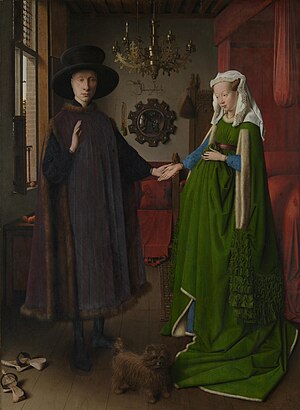
Pictured above is the Arnolfini Portrait, and can be found at the Website of National Gallery, London.
In what century was this work created?
The fifteenth century
The sixteenth century
The thirteenth century
The seventeenth century
The nineteenth century
Explanation
This is a work from the Northern European Renaissance, a movement that lasted throughout the 1400s, or the fifteenth century. This work was created in 1434.
Figure 1
Figure 2
The garden in the background of Figure 2 represents __________.
innocence
earthly pleasures
temptation
the natural world
Explanation
As an image of Christian devotion, Rogier van der Weyden's "Saint Luke Drawing the Virgin" is laced with important symbolism, including the small garden seen through the window in the painting's background. For Christians, any garden is a reference to the Garden of Eden, the earthly paradise where Adam and Eve were innocent before disobeying God. This notion of innocence is also reflected in the fact that this is a portrait of the Virgin Mary, who was believed to have never sinned.
The artist of the above work is __________.
Hieronymus Bosch
Roger van der Weiden
Jan van Eyck
Pieter Breugel the Elder
Explanation
This painting, with its use of perspective and iconographic imagery, can be called "Early Netherlandish." This work's strange imagery and collage-like background, however, place it as a strange and unique mixture, which was made by the Flemish painter Hieronymus Bosch. Bosch's work often portrayed religious themes, such as this painting's subject of St. John on Patmos, and used bizarre imagery, which is in both the upper left and lower right corners.
Image: St. John the Evangelist on Patmos by Hieronymus Bosch (1489)

The people depicted in the left panel of the Annunciation Triptych are most likely _________________.
the donors who commissioned the work
the priest of the church holding the work
the patron saints of Flanders
a self-portrait of the artist and his wife
Explanation
The figures in the left hand panel of Campin's Annunciation Triptych are those with the least symbolism surrounding them, while the figures also show the most reverence towards the center panel containing the Virgin Mary and the Archangel Gabriel. This indicates they are simply ardent believers, but for such believers to be included shows they are still people of significant importance. Most likely, such people would be the donors who funded the creation of the work of art to be placed in the church.
Image is in the public domain, accessed through Wikipedia Media Commons: https://commons.wikimedia.org/wiki/File:Robert\_Campin\_-\_Triptych\_with\_the\_Annunciation,\_known\_as\_the\_%22Merode\_Altarpiece%22\_-\_Google\_Art\_Project.jpg
Figure 1 Figure 2


Both images above were painted by __________.
Hans Holbein the Younger
Albrecht Dürer
Lucas Cranach the Elder
Sampson Strong
Explanation
Hans Holbein the Younger was the court painter in England throughout much of the reign of King Henry VIII, a position he was brought to from his native Augsburg through connections with humanists in Northern Europe. These portraits are of two of Henry's advisors, Sir Thomas More (on the left) and Thomas Cromwell. Both bear the distinct elements of Holbein's portrait style, with accessories telling of the subject's life and a sense of perspective providing a remarkable realism for the era.
Figure 1: Portrait of Sir Thomas More by Hans Holbein the Younger (1527)
Figure 2: Portrait of Thomas Cromwell by Hans Holbein the Younger (c. 1533)