
Answering other questions about fourteenth- through sixteenth-century 2D art
AP Art History · Learn by Concept
Help Questions
AP Art History › Answering other questions about fourteenth- through sixteenth-century 2D art
Southern European nations are more likely to possess pre-Renaissance religious art because __________.
more Northern European nations became Protestant and therefore were more likely to destroy images of saints
the weather in Southern Europe was more likely to preserve art over the centuries
more religious art was made in Southern Europe before the Renaissance
the religious art made in Southern Europe was more likely to find favor with the Catholic Church
Explanation
In Europe, the Renaissance and the Protestant Reformation occurred essentially simultaneously, with a revolution in art taking place at the same time as an upheaval in religion. The religious turmoil often affected art made before the time period, however, because many Protestants were iconoclasts who sought to destroy all religious imagery, especially those of saints and other intermediaries.
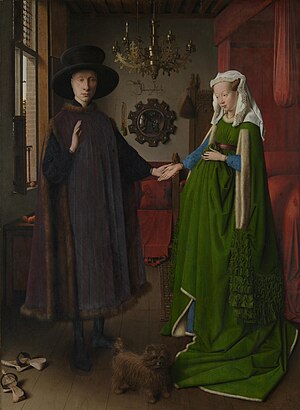
Pictured above is the Arnolfini Portrait, and can be found at the Website of National Gallery, London.
The medium of the work is __________.
oil
tempera
acrylic
fresco
Explanation
As is common in the Northern Renaissance tradition, Van Eyck takes advantage of the slow drying time of oil to get the level of detail he achieves.

The artist uses all of the following techniques in this painting except for _________________.
Prestezza
Grisaille
Underpainting
Hatching
Explanation
Grisaille, Hatching, and underpainting were all techniques commonly used by Vermeer and the early Dutch painters.
Image is in the public domain, accessed through Wikipedia Media Commons: https://commons.wikimedia.org/wiki/File:Johannes\_Vermeer\_-\_Woman\_Holding\_a\_Balance\_-\_Google\_Art\_Project.jpg
Pictured above is the Arnolfini Portrait, and can be found at the Website of National Gallery, London.
The painting's audience was likely __________.
the Arnolfini family
the Christian church
the local community
the artist
Explanation
The painting was commissioned by Giovanni Arnolfini for the purpose of private viewing in his house.
It has been speculated that the Bubonic Plague, also known as the Black Death, which occurred during the mid-14th century and claimed the lives of 30% to 60% of Europeans, sparked which artistic and scientific movement in its aftermath?
The Renaissance
Romanticism
Neoclassicism
Rococo
None of these
Explanation
It is speculated that in the aftermath of the Bubonic Plague, the citizens of Europe, and especially Italy, which was particularly devastated by the Plageu, began to think of life, spirituality, art, science, and the afterlife in a new way. This particularly traumatic event caused a social and economic upheaval in many parts of Europe, which changed the way of life and opportunities of many citizens.
These social, economic, religious and scientific changes in European culture may have sparked what is now known as the Renaissance.
Pictured above is the Arnolfini Portrait, and can be found at the Website of National Gallery, London.
The work depicts all of the following except __________.
the power of the Christian church
the subservience of women in the fourteenth-century Netherlands
the importance of status and tradition
the signature of the artist
Explanation
Jan van Eyck signed his painting above the mirror. As well, the placement of the wife near the bed suggests submission to the power of the man, while the stiff pose and dress is tradition for the time. There is nothing religious, though, about the painting.
Renaissance art made a dramatic departure from medieval art by __________.
using more realistic depictions of the human form
putting more focus on religious subjects
deemphasizing classical subjects
using fewer and less rich colors
None of the other answers
Explanation
During the Renaissance, with a renewed focus on classical art and scientific understanding, visual arts underwent a significant change. In particular, religious themes dwindled in importance in comparison to classical subjects, and deeper, more varied colors were used to represent more realistic depictions of the human form.
What two types of paint did da Vinci use to paint The Last Supper?

Oil and tempera
Oil and acrylic
Tempera and watercolor
Acrylic and ink
Oil and watercolor
Explanation
Da Vinci used oil and tempera paint to create The Last Supper. He also used a double layer of plaster with a white lead undercoat to make the colors brighter.
Image is in the public domain, accessed through Wikipedia Media Commons: https://en.wikipedia.org/wiki/The\_Last\_Supper\_(Leonardo\_da\_Vinci)#/media/File:%C3%9Altima\_Cena\_-\_Da\_Vinci\_5.jpg
Where is The Last Supper by Leonardo da Vinci located?
Santa Maria della Grazie church in Milan, Italy
The Vatican
Florence Cathedral, in Florence, Italy
Chartres Cathedral, in Chartres, France
Pazzi Chapel, in Florence, Italy
Explanation
The Last Supper is located in the Santa Maria della Grazie church in Milan, Italy. It is in the refectory, or the area where the monks would eat.
Image is in the public domain, accessed through Wikipedia Media Commons: https://en.wikipedia.org/wiki/The\_Last\_Supper\_(Leonardo\_da\_Vinci)#/media/File:%C3%9Altima\_Cena\_-\_Da\_Vinci\_5.jpg
What famous 16th century work depicts Aristotle and Plato at center?
The School of Athens
Transfiguration
Three Graces
La velata
The Parnassus
Explanation
The School of Athens by Raphael is the only painting of these five that depicts the two philosophers, as well as many other philosophers of Ancient Greece. The rest are other paintings by Raphael.