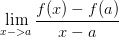
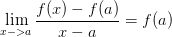
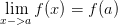
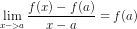
Concept of the Derivative - AP Calculus AB
Card 1 of 957
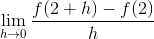
Evaluate:

The notation
is alluding to the fact that the limit is a function of
, not necessarily a "number."
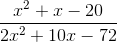
Evaluate:
The notation is alluding to the fact that the limit is a function of
, not necessarily a "number."
Tap to reveal answer

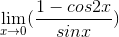
We are not going to evaluate this directly. Looking at the function, it seems very similar to the definition of a derivative of some kind of trigonometric function. We will look at the definition of a derivative to find a function that would have a derivative defined by this limit.
In otherwords, we wish to identify a function
such that its' derivative
is the function
.

Let's find
such that:

Compare corresponding terms in the numerators in the above expressions.


By inspection, these terms clearly indicate that our function
must be of the form:

Side note
If your confused by the inclusion of the arbitrary constant
, note that when we differentiate this function the constant term will vanish since the derivative of a constant is zero. You can also see that in applying the definition of a derivative, if I included the constant in the two terms in the numerator,


the constant "C" would vanish when we subtract the latter from the former,
.
Therefore, even if you didn't consider the constant
when working out the function, it would not have changed the result
Because we know that
,
Simply differentiate
to find
,

Therefore,

Or to put it another way,

We are not going to evaluate this directly. Looking at the function, it seems very similar to the definition of a derivative of some kind of trigonometric function. We will look at the definition of a derivative to find a function that would have a derivative defined by this limit.
In otherwords, we wish to identify a function such that its' derivative
is the function
.
Let's find such that:
Compare corresponding terms in the numerators in the above expressions.
By inspection, these terms clearly indicate that our function must be of the form:
Side note
If your confused by the inclusion of the arbitrary constant , note that when we differentiate this function the constant term will vanish since the derivative of a constant is zero. You can also see that in applying the definition of a derivative, if I included the constant in the two terms in the numerator,
the constant "C" would vanish when we subtract the latter from the former, .
Therefore, even if you didn't consider the constant when working out the function, it would not have changed the result
Because we know that
,
Simply differentiate to find
,
Therefore,
Or to put it another way,
← Didn't Know|Knew It →
Evaluate:

The notation
is alluding to the fact that the limit is a function of
, not necessarily a "number."
Evaluate:
The notation is alluding to the fact that the limit is a function of
, not necessarily a "number."
Tap to reveal answer

We are not going to evaluate this directly. Looking at the function, it seems very similar to the definition of a derivative of some kind of trigonometric function. We will look at the definition of a derivative to find a function that would have a derivative defined by this limit.
In otherwords, we wish to identify a function
such that its' derivative
is the function
.

Let's find
such that:

Compare corresponding terms in the numerators in the above expressions.


By inspection, these terms clearly indicate that our function
must be of the form:

Side note
If your confused by the inclusion of the arbitrary constant
, note that when we differentiate this function the constant term will vanish since the derivative of a constant is zero. You can also see that in applying the definition of a derivative, if I included the constant in the two terms in the numerator,


the constant "C" would vanish when we subtract the latter from the former,
.
Therefore, even if you didn't consider the constant
when working out the function, it would not have changed the result
Because we know that
,
Simply differentiate
to find
,

Therefore,

Or to put it another way,

We are not going to evaluate this directly. Looking at the function, it seems very similar to the definition of a derivative of some kind of trigonometric function. We will look at the definition of a derivative to find a function that would have a derivative defined by this limit.
In otherwords, we wish to identify a function such that its' derivative
is the function
.
Let's find such that:
Compare corresponding terms in the numerators in the above expressions.
By inspection, these terms clearly indicate that our function must be of the form:
Side note
If your confused by the inclusion of the arbitrary constant , note that when we differentiate this function the constant term will vanish since the derivative of a constant is zero. You can also see that in applying the definition of a derivative, if I included the constant in the two terms in the numerator,
the constant "C" would vanish when we subtract the latter from the former, .
Therefore, even if you didn't consider the constant when working out the function, it would not have changed the result
Because we know that
,
Simply differentiate to find
,
Therefore,
Or to put it another way,
← Didn't Know|Knew It →
Evaluate:

The notation
is alluding to the fact that the limit is a function of
, not necessarily a "number."
Evaluate:
The notation is alluding to the fact that the limit is a function of
, not necessarily a "number."
Tap to reveal answer

We are not going to evaluate this directly. Looking at the function, it seems very similar to the definition of a derivative of some kind of trigonometric function. We will look at the definition of a derivative to find a function that would have a derivative defined by this limit.
In otherwords, we wish to identify a function
such that its' derivative
is the function
.

Let's find
such that:

Compare corresponding terms in the numerators in the above expressions.


By inspection, these terms clearly indicate that our function
must be of the form:

Side note
If your confused by the inclusion of the arbitrary constant
, note that when we differentiate this function the constant term will vanish since the derivative of a constant is zero. You can also see that in applying the definition of a derivative, if I included the constant in the two terms in the numerator,


the constant "C" would vanish when we subtract the latter from the former,
.
Therefore, even if you didn't consider the constant
when working out the function, it would not have changed the result
Because we know that
,
Simply differentiate
to find
,

Therefore,

Or to put it another way,

We are not going to evaluate this directly. Looking at the function, it seems very similar to the definition of a derivative of some kind of trigonometric function. We will look at the definition of a derivative to find a function that would have a derivative defined by this limit.
In otherwords, we wish to identify a function such that its' derivative
is the function
.
Let's find such that:
Compare corresponding terms in the numerators in the above expressions.
By inspection, these terms clearly indicate that our function must be of the form:
Side note
If your confused by the inclusion of the arbitrary constant , note that when we differentiate this function the constant term will vanish since the derivative of a constant is zero. You can also see that in applying the definition of a derivative, if I included the constant in the two terms in the numerator,
the constant "C" would vanish when we subtract the latter from the former, .
Therefore, even if you didn't consider the constant when working out the function, it would not have changed the result
Because we know that
,
Simply differentiate to find
,
Therefore,
Or to put it another way,
← Didn't Know|Knew It →
Evaluate:

The notation
is alluding to the fact that the limit is a function of
, not necessarily a "number."
Evaluate:
The notation is alluding to the fact that the limit is a function of
, not necessarily a "number."
Tap to reveal answer

We are not going to evaluate this directly. Looking at the function, it seems very similar to the definition of a derivative of some kind of trigonometric function. We will look at the definition of a derivative to find a function that would have a derivative defined by this limit.
In otherwords, we wish to identify a function
such that its' derivative
is the function
.

Let's find
such that:

Compare corresponding terms in the numerators in the above expressions.


By inspection, these terms clearly indicate that our function
must be of the form:

Side note
If your confused by the inclusion of the arbitrary constant
, note that when we differentiate this function the constant term will vanish since the derivative of a constant is zero. You can also see that in applying the definition of a derivative, if I included the constant in the two terms in the numerator,


the constant "C" would vanish when we subtract the latter from the former,
.
Therefore, even if you didn't consider the constant
when working out the function, it would not have changed the result
Because we know that
,
Simply differentiate
to find
,

Therefore,

Or to put it another way,

We are not going to evaluate this directly. Looking at the function, it seems very similar to the definition of a derivative of some kind of trigonometric function. We will look at the definition of a derivative to find a function that would have a derivative defined by this limit.
In otherwords, we wish to identify a function such that its' derivative
is the function
.
Let's find such that:
Compare corresponding terms in the numerators in the above expressions.
By inspection, these terms clearly indicate that our function must be of the form:
Side note
If your confused by the inclusion of the arbitrary constant , note that when we differentiate this function the constant term will vanish since the derivative of a constant is zero. You can also see that in applying the definition of a derivative, if I included the constant in the two terms in the numerator,
the constant "C" would vanish when we subtract the latter from the former, .
Therefore, even if you didn't consider the constant when working out the function, it would not have changed the result
Because we know that
,
Simply differentiate to find
,
Therefore,
Or to put it another way,
← Didn't Know|Knew It →
Evaluate:

The notation
is alluding to the fact that the limit is a function of
, not necessarily a "number."
Evaluate:
The notation is alluding to the fact that the limit is a function of
, not necessarily a "number."
Tap to reveal answer

We are not going to evaluate this directly. Looking at the function, it seems very similar to the definition of a derivative of some kind of trigonometric function. We will look at the definition of a derivative to find a function that would have a derivative defined by this limit.
In otherwords, we wish to identify a function
such that its' derivative
is the function
.

Let's find
such that:

Compare corresponding terms in the numerators in the above expressions.


By inspection, these terms clearly indicate that our function
must be of the form:

Side note
If your confused by the inclusion of the arbitrary constant
, note that when we differentiate this function the constant term will vanish since the derivative of a constant is zero. You can also see that in applying the definition of a derivative, if I included the constant in the two terms in the numerator,


the constant "C" would vanish when we subtract the latter from the former,
.
Therefore, even if you didn't consider the constant
when working out the function, it would not have changed the result
Because we know that
,
Simply differentiate
to find
,

Therefore,

Or to put it another way,

We are not going to evaluate this directly. Looking at the function, it seems very similar to the definition of a derivative of some kind of trigonometric function. We will look at the definition of a derivative to find a function that would have a derivative defined by this limit.
In otherwords, we wish to identify a function such that its' derivative
is the function
.
Let's find such that:
Compare corresponding terms in the numerators in the above expressions.
By inspection, these terms clearly indicate that our function must be of the form:
Side note
If your confused by the inclusion of the arbitrary constant , note that when we differentiate this function the constant term will vanish since the derivative of a constant is zero. You can also see that in applying the definition of a derivative, if I included the constant in the two terms in the numerator,
the constant "C" would vanish when we subtract the latter from the former, .
Therefore, even if you didn't consider the constant when working out the function, it would not have changed the result
Because we know that
,
Simply differentiate to find
,
Therefore,
Or to put it another way,
← Didn't Know|Knew It →
Evaluate:

The notation
is alluding to the fact that the limit is a function of
, not necessarily a "number."
Evaluate:
The notation is alluding to the fact that the limit is a function of
, not necessarily a "number."
Tap to reveal answer

We are not going to evaluate this directly. Looking at the function, it seems very similar to the definition of a derivative of some kind of trigonometric function. We will look at the definition of a derivative to find a function that would have a derivative defined by this limit.
In otherwords, we wish to identify a function
such that its' derivative
is the function
.

Let's find
such that:

Compare corresponding terms in the numerators in the above expressions.


By inspection, these terms clearly indicate that our function
must be of the form:

Side note
If your confused by the inclusion of the arbitrary constant
, note that when we differentiate this function the constant term will vanish since the derivative of a constant is zero. You can also see that in applying the definition of a derivative, if I included the constant in the two terms in the numerator,


the constant "C" would vanish when we subtract the latter from the former,
.
Therefore, even if you didn't consider the constant
when working out the function, it would not have changed the result
Because we know that
,
Simply differentiate
to find
,

Therefore,

Or to put it another way,

We are not going to evaluate this directly. Looking at the function, it seems very similar to the definition of a derivative of some kind of trigonometric function. We will look at the definition of a derivative to find a function that would have a derivative defined by this limit.
In otherwords, we wish to identify a function such that its' derivative
is the function
.
Let's find such that:
Compare corresponding terms in the numerators in the above expressions.
By inspection, these terms clearly indicate that our function must be of the form:
Side note
If your confused by the inclusion of the arbitrary constant , note that when we differentiate this function the constant term will vanish since the derivative of a constant is zero. You can also see that in applying the definition of a derivative, if I included the constant in the two terms in the numerator,
the constant "C" would vanish when we subtract the latter from the former, .
Therefore, even if you didn't consider the constant when working out the function, it would not have changed the result
Because we know that
,
Simply differentiate to find
,
Therefore,
Or to put it another way,
← Didn't Know|Knew It →
Evaluate:

The notation
is alluding to the fact that the limit is a function of
, not necessarily a "number."
Evaluate:
The notation is alluding to the fact that the limit is a function of
, not necessarily a "number."
Tap to reveal answer

We are not going to evaluate this directly. Looking at the function, it seems very similar to the definition of a derivative of some kind of trigonometric function. We will look at the definition of a derivative to find a function that would have a derivative defined by this limit.
In otherwords, we wish to identify a function
such that its' derivative
is the function
.

Let's find
such that:

Compare corresponding terms in the numerators in the above expressions.


By inspection, these terms clearly indicate that our function
must be of the form:

Side note
If your confused by the inclusion of the arbitrary constant
, note that when we differentiate this function the constant term will vanish since the derivative of a constant is zero. You can also see that in applying the definition of a derivative, if I included the constant in the two terms in the numerator,


the constant "C" would vanish when we subtract the latter from the former,
.
Therefore, even if you didn't consider the constant
when working out the function, it would not have changed the result
Because we know that
,
Simply differentiate
to find
,

Therefore,

Or to put it another way,

We are not going to evaluate this directly. Looking at the function, it seems very similar to the definition of a derivative of some kind of trigonometric function. We will look at the definition of a derivative to find a function that would have a derivative defined by this limit.
In otherwords, we wish to identify a function such that its' derivative
is the function
.
Let's find such that:
Compare corresponding terms in the numerators in the above expressions.
By inspection, these terms clearly indicate that our function must be of the form:
Side note
If your confused by the inclusion of the arbitrary constant , note that when we differentiate this function the constant term will vanish since the derivative of a constant is zero. You can also see that in applying the definition of a derivative, if I included the constant in the two terms in the numerator,
the constant "C" would vanish when we subtract the latter from the former, .
Therefore, even if you didn't consider the constant when working out the function, it would not have changed the result
Because we know that
,
Simply differentiate to find
,
Therefore,
Or to put it another way,
← Didn't Know|Knew It →
Evaluate:

The notation
is alluding to the fact that the limit is a function of
, not necessarily a "number."
Evaluate:
The notation is alluding to the fact that the limit is a function of
, not necessarily a "number."
Tap to reveal answer

We are not going to evaluate this directly. Looking at the function, it seems very similar to the definition of a derivative of some kind of trigonometric function. We will look at the definition of a derivative to find a function that would have a derivative defined by this limit.
In otherwords, we wish to identify a function
such that its' derivative
is the function
.

Let's find
such that:

Compare corresponding terms in the numerators in the above expressions.


By inspection, these terms clearly indicate that our function
must be of the form:

Side note
If your confused by the inclusion of the arbitrary constant
, note that when we differentiate this function the constant term will vanish since the derivative of a constant is zero. You can also see that in applying the definition of a derivative, if I included the constant in the two terms in the numerator,


the constant "C" would vanish when we subtract the latter from the former,
.
Therefore, even if you didn't consider the constant
when working out the function, it would not have changed the result
Because we know that
,
Simply differentiate
to find
,

Therefore,

Or to put it another way,

We are not going to evaluate this directly. Looking at the function, it seems very similar to the definition of a derivative of some kind of trigonometric function. We will look at the definition of a derivative to find a function that would have a derivative defined by this limit.
In otherwords, we wish to identify a function such that its' derivative
is the function
.
Let's find such that:
Compare corresponding terms in the numerators in the above expressions.
By inspection, these terms clearly indicate that our function must be of the form:
Side note
If your confused by the inclusion of the arbitrary constant , note that when we differentiate this function the constant term will vanish since the derivative of a constant is zero. You can also see that in applying the definition of a derivative, if I included the constant in the two terms in the numerator,
the constant "C" would vanish when we subtract the latter from the former, .
Therefore, even if you didn't consider the constant when working out the function, it would not have changed the result
Because we know that
,
Simply differentiate to find
,
Therefore,
Or to put it another way,
← Didn't Know|Knew It →
Evaluate:

The notation
is alluding to the fact that the limit is a function of
, not necessarily a "number."
Evaluate:
The notation is alluding to the fact that the limit is a function of
, not necessarily a "number."
Tap to reveal answer

We are not going to evaluate this directly. Looking at the function, it seems very similar to the definition of a derivative of some kind of trigonometric function. We will look at the definition of a derivative to find a function that would have a derivative defined by this limit.
In otherwords, we wish to identify a function
such that its' derivative
is the function
.

Let's find
such that:

Compare corresponding terms in the numerators in the above expressions.


By inspection, these terms clearly indicate that our function
must be of the form:

Side note
If your confused by the inclusion of the arbitrary constant
, note that when we differentiate this function the constant term will vanish since the derivative of a constant is zero. You can also see that in applying the definition of a derivative, if I included the constant in the two terms in the numerator,


the constant "C" would vanish when we subtract the latter from the former,
.
Therefore, even if you didn't consider the constant
when working out the function, it would not have changed the result
Because we know that
,
Simply differentiate
to find
,

Therefore,

Or to put it another way,

We are not going to evaluate this directly. Looking at the function, it seems very similar to the definition of a derivative of some kind of trigonometric function. We will look at the definition of a derivative to find a function that would have a derivative defined by this limit.
In otherwords, we wish to identify a function such that its' derivative
is the function
.
Let's find such that:
Compare corresponding terms in the numerators in the above expressions.
By inspection, these terms clearly indicate that our function must be of the form:
Side note
If your confused by the inclusion of the arbitrary constant , note that when we differentiate this function the constant term will vanish since the derivative of a constant is zero. You can also see that in applying the definition of a derivative, if I included the constant in the two terms in the numerator,
the constant "C" would vanish when we subtract the latter from the former, .
Therefore, even if you didn't consider the constant when working out the function, it would not have changed the result
Because we know that
,
Simply differentiate to find
,
Therefore,
Or to put it another way,
← Didn't Know|Knew It →
Evaluate:

The notation
is alluding to the fact that the limit is a function of
, not necessarily a "number."
Evaluate:
The notation is alluding to the fact that the limit is a function of
, not necessarily a "number."
Tap to reveal answer

We are not going to evaluate this directly. Looking at the function, it seems very similar to the definition of a derivative of some kind of trigonometric function. We will look at the definition of a derivative to find a function that would have a derivative defined by this limit.
In otherwords, we wish to identify a function
such that its' derivative
is the function
.

Let's find
such that:

Compare corresponding terms in the numerators in the above expressions.


By inspection, these terms clearly indicate that our function
must be of the form:

Side note
If your confused by the inclusion of the arbitrary constant
, note that when we differentiate this function the constant term will vanish since the derivative of a constant is zero. You can also see that in applying the definition of a derivative, if I included the constant in the two terms in the numerator,


the constant "C" would vanish when we subtract the latter from the former,
.
Therefore, even if you didn't consider the constant
when working out the function, it would not have changed the result
Because we know that
,
Simply differentiate
to find
,

Therefore,

Or to put it another way,

We are not going to evaluate this directly. Looking at the function, it seems very similar to the definition of a derivative of some kind of trigonometric function. We will look at the definition of a derivative to find a function that would have a derivative defined by this limit.
In otherwords, we wish to identify a function such that its' derivative
is the function
.
Let's find such that:
Compare corresponding terms in the numerators in the above expressions.
By inspection, these terms clearly indicate that our function must be of the form:
Side note
If your confused by the inclusion of the arbitrary constant , note that when we differentiate this function the constant term will vanish since the derivative of a constant is zero. You can also see that in applying the definition of a derivative, if I included the constant in the two terms in the numerator,
the constant "C" would vanish when we subtract the latter from the former, .
Therefore, even if you didn't consider the constant when working out the function, it would not have changed the result
Because we know that
,
Simply differentiate to find
,
Therefore,
Or to put it another way,
← Didn't Know|Knew It →
Evaluate:

The notation
is alluding to the fact that the limit is a function of
, not necessarily a "number."
Evaluate:
The notation is alluding to the fact that the limit is a function of
, not necessarily a "number."
Tap to reveal answer

We are not going to evaluate this directly. Looking at the function, it seems very similar to the definition of a derivative of some kind of trigonometric function. We will look at the definition of a derivative to find a function that would have a derivative defined by this limit.
In otherwords, we wish to identify a function
such that its' derivative
is the function
.

Let's find
such that:

Compare corresponding terms in the numerators in the above expressions.


By inspection, these terms clearly indicate that our function
must be of the form:

Side note
If your confused by the inclusion of the arbitrary constant
, note that when we differentiate this function the constant term will vanish since the derivative of a constant is zero. You can also see that in applying the definition of a derivative, if I included the constant in the two terms in the numerator,


the constant "C" would vanish when we subtract the latter from the former,
.
Therefore, even if you didn't consider the constant
when working out the function, it would not have changed the result
Because we know that
,
Simply differentiate
to find
,

Therefore,

Or to put it another way,

We are not going to evaluate this directly. Looking at the function, it seems very similar to the definition of a derivative of some kind of trigonometric function. We will look at the definition of a derivative to find a function that would have a derivative defined by this limit.
In otherwords, we wish to identify a function such that its' derivative
is the function
.
Let's find such that:
Compare corresponding terms in the numerators in the above expressions.
By inspection, these terms clearly indicate that our function must be of the form:
Side note
If your confused by the inclusion of the arbitrary constant , note that when we differentiate this function the constant term will vanish since the derivative of a constant is zero. You can also see that in applying the definition of a derivative, if I included the constant in the two terms in the numerator,
the constant "C" would vanish when we subtract the latter from the former, .
Therefore, even if you didn't consider the constant when working out the function, it would not have changed the result
Because we know that
,
Simply differentiate to find
,
Therefore,
Or to put it another way,
← Didn't Know|Knew It →
Find the derivative of the following function:

Find the derivative of the following function:
Tap to reveal answer
We use the power rule on each term of the function.
The first term

becomes
.
The second term

becomes
.
The final term, 7, is a constant, so its derivative is simply zero.
We use the power rule on each term of the function.
The first term
becomes
.
The second term
becomes
.
The final term, 7, is a constant, so its derivative is simply zero.
← Didn't Know|Knew It →
What is the derivative of
?
What is the derivative of ?
Tap to reveal answer
To get
, we can use the power rule.
Since the exponent of the
is
, as
, we lower the exponent by one and then multiply the coefficient by that original exponent:


Anything to the
power is
.


To get , we can use the power rule.
Since the exponent of the is
, as
, we lower the exponent by one and then multiply the coefficient by that original exponent:
Anything to the power is
.
← Didn't Know|Knew It →
What is the derivative of
?
What is the derivative of ?
Tap to reveal answer
To solve this problem, we can use the power rule. That means we lower the exponent of the variable by one and multiply the variable by that original exponent.


Remember that anything to the zero power is one.


To solve this problem, we can use the power rule. That means we lower the exponent of the variable by one and multiply the variable by that original exponent.
Remember that anything to the zero power is one.
← Didn't Know|Knew It →
What is the derivative of
?
What is the derivative of ?
Tap to reveal answer
To solve this problem, we can use the power rule. That means we lower the exponent of the variable by one and multiply the variable by that original exponent.
We're going to treat
as
, as anything to the zero power is one.
That means this problem will look like this:

Notice that
, as anything times zero is zero.


Remember, anything to the zero power is one.


To solve this problem, we can use the power rule. That means we lower the exponent of the variable by one and multiply the variable by that original exponent.
We're going to treat as
, as anything to the zero power is one.
That means this problem will look like this:
Notice that , as anything times zero is zero.
Remember, anything to the zero power is one.
← Didn't Know|Knew It →
Tap to reveal answer
To solve this equation, we can use the power rule. To use the power rule, we lower the exponent on the variable and multiply by that exponent.
We're going to treat
as
since anything to the zero power is one.
)
Notice that
since anything times zero is zero.


To solve this equation, we can use the power rule. To use the power rule, we lower the exponent on the variable and multiply by that exponent.
We're going to treat as
since anything to the zero power is one.
Notice that since anything times zero is zero.
← Didn't Know|Knew It →
What is the derivative of
?
What is the derivative of ?
Tap to reveal answer
To solve this equation, we can use the power rule. To use the power rule, we lower the exponent on the variable and multiply by that exponent.
We're going to treat
as
since anything to the zero power is one.

Notice that
since anything times zero is zero.
That leaves us with
.
Simplify.


As stated earlier, anything to the zero power is one, leaving us with:

To solve this equation, we can use the power rule. To use the power rule, we lower the exponent on the variable and multiply by that exponent.
We're going to treat as
since anything to the zero power is one.
Notice that since anything times zero is zero.
That leaves us with .
Simplify.
As stated earlier, anything to the zero power is one, leaving us with:
← Didn't Know|Knew It →
What is the derivative of
?
What is the derivative of ?
Tap to reveal answer
To solve this equation, we can use the power rule. To use the power rule, we lower the exponent on the variable and multiply by that exponent.
We're going to treat
as
since anything to the zero power is one.
)
Notice that
since anything times zero is zero.


Just like it was mentioned earlier, anything to the zero power is one.


To solve this equation, we can use the power rule. To use the power rule, we lower the exponent on the variable and multiply by that exponent.
We're going to treat as
since anything to the zero power is one.
Notice that since anything times zero is zero.
Just like it was mentioned earlier, anything to the zero power is one.
← Didn't Know|Knew It →
What is the derivative of
?
What is the derivative of ?
Tap to reveal answer
To take the derivative of this equation, we can use the power rule. The power rule says that we lower the exponent of each variable by one and multiply that number by the original exponent.

Simplify.

Remember that anything to the zero power is equal to one.


To take the derivative of this equation, we can use the power rule. The power rule says that we lower the exponent of each variable by one and multiply that number by the original exponent.
Simplify.
Remember that anything to the zero power is equal to one.
← Didn't Know|Knew It →
What is the derivative of
?
What is the derivative of ?
Tap to reveal answer
To take the derivative of this equation, we can use the power rule. The power rule says that we lower the exponent of each variable by one and multiply that number by the original exponent.
We are going to treat
as
since anything to the zero power is one.

Notice that
since anything times zero is zero.

Simplify.

As stated before, anything to the zero power is one.


To take the derivative of this equation, we can use the power rule. The power rule says that we lower the exponent of each variable by one and multiply that number by the original exponent.
We are going to treat as
since anything to the zero power is one.
Notice that since anything times zero is zero.
Simplify.
As stated before, anything to the zero power is one.
← Didn't Know|Knew It →