
Fundamental Theorem of Calculus - AP Calculus AB
Card 1 of 363
Evaluate the integral 
Evaluate the integral
Tap to reveal answer
To evaluate a definite integral, that is to say an integral with an upper bound and lower bound, we will use the 2nd Fundamental Theorem of Calculus, which states,
, where
is the integral of
.
We will first integrate just like with any integration.
We will integrate each term individually.

First, the integral of the cosine is the sine. Doing this, we get
![[\sin(x)]|_0^{\pi/2} - \int_0^{\pi/2}2\sin(2x)dx](https://vt-vtwa-assets.varsitytutors.com/vt-vtwa/uploads/formula_image/image/1052613/gif.latex)
The
is just notation for "evaluated from
to
". It is simply a reminder to apply the 2nd Fundamental Theorem of Calculus. The
is the
from the theorem. Before moving to the second integral, we can apply this theorem.


So far, we have the following expression for the entire problem

The basic integral form for the remaining integral is ![\int_a^b \sin(u)du =[ -\cos(u)]|_0^{\pi/2}](https://vt-vtwa-assets.varsitytutors.com/vt-vtwa/uploads/formula_image/image/1052624/gif.latex)
Set
, since that is what is inside our sine. The derivative of this is
.
This perfectly accounts for the
in in front of the sine. Thus we can immediatly replace the entire integral with its basic integral form's result.
![1- [-\cos(2x)]|_0^{\pi/2}](https://vt-vtwa-assets.varsitytutors.com/vt-vtwa/uploads/formula_image/image/1052629/gif.latex)
Now we apply the 2nd Fundamental Theorem of Calculus again.
Plug in
. Plug in
and subtract.
![1- \{[-\cos(2\cdot \pi/2)]-[-\cos(2\cdot0)]\}](https://vt-vtwa-assets.varsitytutors.com/vt-vtwa/uploads/formula_image/image/1052632/gif.latex)
![1-\{[-\cos(\pi)]-[-\cos(0)]\}](https://vt-vtwa-assets.varsitytutors.com/vt-vtwa/uploads/formula_image/image/1052633/gif.latex)
![1- \{[-(-1)]-[-(1)]\}](https://vt-vtwa-assets.varsitytutors.com/vt-vtwa/uploads/formula_image/image/1052634/gif.latex)


This is our answer.
To evaluate a definite integral, that is to say an integral with an upper bound and lower bound, we will use the 2nd Fundamental Theorem of Calculus, which states,
, where
is the integral of
.
We will first integrate just like with any integration.
We will integrate each term individually.
First, the integral of the cosine is the sine. Doing this, we get
The is just notation for "evaluated from
to
". It is simply a reminder to apply the 2nd Fundamental Theorem of Calculus. The
is the
from the theorem. Before moving to the second integral, we can apply this theorem.
So far, we have the following expression for the entire problem
The basic integral form for the remaining integral is
Set , since that is what is inside our sine. The derivative of this is
.
This perfectly accounts for the in in front of the sine. Thus we can immediatly replace the entire integral with its basic integral form's result.
Now we apply the 2nd Fundamental Theorem of Calculus again.
Plug in . Plug in
and subtract.
This is our answer.
← Didn't Know|Knew It →
Evaluate the integral 
Evaluate the integral
Tap to reveal answer
To evaluate a definite integral, that is to say an integral with an upper bound and lower bound, we will use the 2nd Fundamental Theorem of Calculus, which states,
, where
is the integral of
.
We will first integrate just like with any integration.
We will integrate each term individually.

First, the integral of the cosine is the sine. Doing this, we get
![[\sin(x)]|_0^{\pi/2} - \int_0^{\pi/2}2\sin(2x)dx](https://vt-vtwa-assets.varsitytutors.com/vt-vtwa/uploads/formula_image/image/1052613/gif.latex)
The
is just notation for "evaluated from
to
". It is simply a reminder to apply the 2nd Fundamental Theorem of Calculus. The
is the
from the theorem. Before moving to the second integral, we can apply this theorem.


So far, we have the following expression for the entire problem

The basic integral form for the remaining integral is ![\int_a^b \sin(u)du =[ -\cos(u)]|_0^{\pi/2}](https://vt-vtwa-assets.varsitytutors.com/vt-vtwa/uploads/formula_image/image/1052624/gif.latex)
Set
, since that is what is inside our sine. The derivative of this is
.
This perfectly accounts for the
in in front of the sine. Thus we can immediatly replace the entire integral with its basic integral form's result.
![1- [-\cos(2x)]|_0^{\pi/2}](https://vt-vtwa-assets.varsitytutors.com/vt-vtwa/uploads/formula_image/image/1052629/gif.latex)
Now we apply the 2nd Fundamental Theorem of Calculus again.
Plug in
. Plug in
and subtract.
![1- \{[-\cos(2\cdot \pi/2)]-[-\cos(2\cdot0)]\}](https://vt-vtwa-assets.varsitytutors.com/vt-vtwa/uploads/formula_image/image/1052632/gif.latex)
![1-\{[-\cos(\pi)]-[-\cos(0)]\}](https://vt-vtwa-assets.varsitytutors.com/vt-vtwa/uploads/formula_image/image/1052633/gif.latex)
![1- \{[-(-1)]-[-(1)]\}](https://vt-vtwa-assets.varsitytutors.com/vt-vtwa/uploads/formula_image/image/1052634/gif.latex)


This is our answer.
To evaluate a definite integral, that is to say an integral with an upper bound and lower bound, we will use the 2nd Fundamental Theorem of Calculus, which states,
, where
is the integral of
.
We will first integrate just like with any integration.
We will integrate each term individually.
First, the integral of the cosine is the sine. Doing this, we get
The is just notation for "evaluated from
to
". It is simply a reminder to apply the 2nd Fundamental Theorem of Calculus. The
is the
from the theorem. Before moving to the second integral, we can apply this theorem.
So far, we have the following expression for the entire problem
The basic integral form for the remaining integral is
Set , since that is what is inside our sine. The derivative of this is
.
This perfectly accounts for the in in front of the sine. Thus we can immediatly replace the entire integral with its basic integral form's result.
Now we apply the 2nd Fundamental Theorem of Calculus again.
Plug in . Plug in
and subtract.
This is our answer.
← Didn't Know|Knew It →
Evaluate the integral 
Evaluate the integral
Tap to reveal answer
To evaluate a definite integral, that is to say an integral with an upper bound and lower bound, we will use the 2nd Fundamental Theorem of Calculus, which states,
, where
is the integral of
.
We will first integrate just like with any integration.
We will integrate each term individually.

First, the integral of the cosine is the sine. Doing this, we get
![[\sin(x)]|_0^{\pi/2} - \int_0^{\pi/2}2\sin(2x)dx](https://vt-vtwa-assets.varsitytutors.com/vt-vtwa/uploads/formula_image/image/1052613/gif.latex)
The
is just notation for "evaluated from
to
". It is simply a reminder to apply the 2nd Fundamental Theorem of Calculus. The
is the
from the theorem. Before moving to the second integral, we can apply this theorem.


So far, we have the following expression for the entire problem

The basic integral form for the remaining integral is ![\int_a^b \sin(u)du =[ -\cos(u)]|_0^{\pi/2}](https://vt-vtwa-assets.varsitytutors.com/vt-vtwa/uploads/formula_image/image/1052624/gif.latex)
Set
, since that is what is inside our sine. The derivative of this is
.
This perfectly accounts for the
in in front of the sine. Thus we can immediatly replace the entire integral with its basic integral form's result.
![1- [-\cos(2x)]|_0^{\pi/2}](https://vt-vtwa-assets.varsitytutors.com/vt-vtwa/uploads/formula_image/image/1052629/gif.latex)
Now we apply the 2nd Fundamental Theorem of Calculus again.
Plug in
. Plug in
and subtract.
![1- \{[-\cos(2\cdot \pi/2)]-[-\cos(2\cdot0)]\}](https://vt-vtwa-assets.varsitytutors.com/vt-vtwa/uploads/formula_image/image/1052632/gif.latex)
![1-\{[-\cos(\pi)]-[-\cos(0)]\}](https://vt-vtwa-assets.varsitytutors.com/vt-vtwa/uploads/formula_image/image/1052633/gif.latex)
![1- \{[-(-1)]-[-(1)]\}](https://vt-vtwa-assets.varsitytutors.com/vt-vtwa/uploads/formula_image/image/1052634/gif.latex)


This is our answer.
To evaluate a definite integral, that is to say an integral with an upper bound and lower bound, we will use the 2nd Fundamental Theorem of Calculus, which states,
, where
is the integral of
.
We will first integrate just like with any integration.
We will integrate each term individually.
First, the integral of the cosine is the sine. Doing this, we get
The is just notation for "evaluated from
to
". It is simply a reminder to apply the 2nd Fundamental Theorem of Calculus. The
is the
from the theorem. Before moving to the second integral, we can apply this theorem.
So far, we have the following expression for the entire problem
The basic integral form for the remaining integral is
Set , since that is what is inside our sine. The derivative of this is
.
This perfectly accounts for the in in front of the sine. Thus we can immediatly replace the entire integral with its basic integral form's result.
Now we apply the 2nd Fundamental Theorem of Calculus again.
Plug in . Plug in
and subtract.
This is our answer.
← Didn't Know|Knew It →
Evaluate the integral 
Evaluate the integral
Tap to reveal answer
To evaluate a definite integral, that is to say an integral with an upper bound and lower bound, we will use the 2nd Fundamental Theorem of Calculus, which states,
, where
is the integral of
.
We will first integrate just like with any integration.
We will integrate each term individually.

First, the integral of the cosine is the sine. Doing this, we get
![[\sin(x)]|_0^{\pi/2} - \int_0^{\pi/2}2\sin(2x)dx](https://vt-vtwa-assets.varsitytutors.com/vt-vtwa/uploads/formula_image/image/1052613/gif.latex)
The
is just notation for "evaluated from
to
". It is simply a reminder to apply the 2nd Fundamental Theorem of Calculus. The
is the
from the theorem. Before moving to the second integral, we can apply this theorem.


So far, we have the following expression for the entire problem

The basic integral form for the remaining integral is ![\int_a^b \sin(u)du =[ -\cos(u)]|_0^{\pi/2}](https://vt-vtwa-assets.varsitytutors.com/vt-vtwa/uploads/formula_image/image/1052624/gif.latex)
Set
, since that is what is inside our sine. The derivative of this is
.
This perfectly accounts for the
in in front of the sine. Thus we can immediatly replace the entire integral with its basic integral form's result.
![1- [-\cos(2x)]|_0^{\pi/2}](https://vt-vtwa-assets.varsitytutors.com/vt-vtwa/uploads/formula_image/image/1052629/gif.latex)
Now we apply the 2nd Fundamental Theorem of Calculus again.
Plug in
. Plug in
and subtract.
![1- \{[-\cos(2\cdot \pi/2)]-[-\cos(2\cdot0)]\}](https://vt-vtwa-assets.varsitytutors.com/vt-vtwa/uploads/formula_image/image/1052632/gif.latex)
![1-\{[-\cos(\pi)]-[-\cos(0)]\}](https://vt-vtwa-assets.varsitytutors.com/vt-vtwa/uploads/formula_image/image/1052633/gif.latex)
![1- \{[-(-1)]-[-(1)]\}](https://vt-vtwa-assets.varsitytutors.com/vt-vtwa/uploads/formula_image/image/1052634/gif.latex)


This is our answer.
To evaluate a definite integral, that is to say an integral with an upper bound and lower bound, we will use the 2nd Fundamental Theorem of Calculus, which states,
, where
is the integral of
.
We will first integrate just like with any integration.
We will integrate each term individually.
First, the integral of the cosine is the sine. Doing this, we get
The is just notation for "evaluated from
to
". It is simply a reminder to apply the 2nd Fundamental Theorem of Calculus. The
is the
from the theorem. Before moving to the second integral, we can apply this theorem.
So far, we have the following expression for the entire problem
The basic integral form for the remaining integral is
Set , since that is what is inside our sine. The derivative of this is
.
This perfectly accounts for the in in front of the sine. Thus we can immediatly replace the entire integral with its basic integral form's result.
Now we apply the 2nd Fundamental Theorem of Calculus again.
Plug in . Plug in
and subtract.
This is our answer.
← Didn't Know|Knew It →
Evaluate the integral 
Evaluate the integral
Tap to reveal answer
To evaluate a definite integral, that is to say an integral with an upper bound and lower bound, we will use the 2nd Fundamental Theorem of Calculus, which states,
, where
is the integral of
.
We will first integrate just like with any integration.
We will integrate each term individually.

First, the integral of the cosine is the sine. Doing this, we get
![[\sin(x)]|_0^{\pi/2} - \int_0^{\pi/2}2\sin(2x)dx](https://vt-vtwa-assets.varsitytutors.com/vt-vtwa/uploads/formula_image/image/1052613/gif.latex)
The
is just notation for "evaluated from
to
". It is simply a reminder to apply the 2nd Fundamental Theorem of Calculus. The
is the
from the theorem. Before moving to the second integral, we can apply this theorem.


So far, we have the following expression for the entire problem

The basic integral form for the remaining integral is ![\int_a^b \sin(u)du =[ -\cos(u)]|_0^{\pi/2}](https://vt-vtwa-assets.varsitytutors.com/vt-vtwa/uploads/formula_image/image/1052624/gif.latex)
Set
, since that is what is inside our sine. The derivative of this is
.
This perfectly accounts for the
in in front of the sine. Thus we can immediatly replace the entire integral with its basic integral form's result.
![1- [-\cos(2x)]|_0^{\pi/2}](https://vt-vtwa-assets.varsitytutors.com/vt-vtwa/uploads/formula_image/image/1052629/gif.latex)
Now we apply the 2nd Fundamental Theorem of Calculus again.
Plug in
. Plug in
and subtract.
![1- \{[-\cos(2\cdot \pi/2)]-[-\cos(2\cdot0)]\}](https://vt-vtwa-assets.varsitytutors.com/vt-vtwa/uploads/formula_image/image/1052632/gif.latex)
![1-\{[-\cos(\pi)]-[-\cos(0)]\}](https://vt-vtwa-assets.varsitytutors.com/vt-vtwa/uploads/formula_image/image/1052633/gif.latex)
![1- \{[-(-1)]-[-(1)]\}](https://vt-vtwa-assets.varsitytutors.com/vt-vtwa/uploads/formula_image/image/1052634/gif.latex)


This is our answer.
To evaluate a definite integral, that is to say an integral with an upper bound and lower bound, we will use the 2nd Fundamental Theorem of Calculus, which states,
, where
is the integral of
.
We will first integrate just like with any integration.
We will integrate each term individually.
First, the integral of the cosine is the sine. Doing this, we get
The is just notation for "evaluated from
to
". It is simply a reminder to apply the 2nd Fundamental Theorem of Calculus. The
is the
from the theorem. Before moving to the second integral, we can apply this theorem.
So far, we have the following expression for the entire problem
The basic integral form for the remaining integral is
Set , since that is what is inside our sine. The derivative of this is
.
This perfectly accounts for the in in front of the sine. Thus we can immediatly replace the entire integral with its basic integral form's result.
Now we apply the 2nd Fundamental Theorem of Calculus again.
Plug in . Plug in
and subtract.
This is our answer.
← Didn't Know|Knew It →
Evaluate the integral 
Evaluate the integral
Tap to reveal answer
To evaluate a definite integral, that is to say an integral with an upper bound and lower bound, we will use the 2nd Fundamental Theorem of Calculus, which states,
, where
is the integral of
.
We will first integrate just like with any integration.
We will integrate each term individually.

First, the integral of the cosine is the sine. Doing this, we get
![[\sin(x)]|_0^{\pi/2} - \int_0^{\pi/2}2\sin(2x)dx](https://vt-vtwa-assets.varsitytutors.com/vt-vtwa/uploads/formula_image/image/1052613/gif.latex)
The
is just notation for "evaluated from
to
". It is simply a reminder to apply the 2nd Fundamental Theorem of Calculus. The
is the
from the theorem. Before moving to the second integral, we can apply this theorem.


So far, we have the following expression for the entire problem

The basic integral form for the remaining integral is ![\int_a^b \sin(u)du =[ -\cos(u)]|_0^{\pi/2}](https://vt-vtwa-assets.varsitytutors.com/vt-vtwa/uploads/formula_image/image/1052624/gif.latex)
Set
, since that is what is inside our sine. The derivative of this is
.
This perfectly accounts for the
in in front of the sine. Thus we can immediatly replace the entire integral with its basic integral form's result.
![1- [-\cos(2x)]|_0^{\pi/2}](https://vt-vtwa-assets.varsitytutors.com/vt-vtwa/uploads/formula_image/image/1052629/gif.latex)
Now we apply the 2nd Fundamental Theorem of Calculus again.
Plug in
. Plug in
and subtract.
![1- \{[-\cos(2\cdot \pi/2)]-[-\cos(2\cdot0)]\}](https://vt-vtwa-assets.varsitytutors.com/vt-vtwa/uploads/formula_image/image/1052632/gif.latex)
![1-\{[-\cos(\pi)]-[-\cos(0)]\}](https://vt-vtwa-assets.varsitytutors.com/vt-vtwa/uploads/formula_image/image/1052633/gif.latex)
![1- \{[-(-1)]-[-(1)]\}](https://vt-vtwa-assets.varsitytutors.com/vt-vtwa/uploads/formula_image/image/1052634/gif.latex)


This is our answer.
To evaluate a definite integral, that is to say an integral with an upper bound and lower bound, we will use the 2nd Fundamental Theorem of Calculus, which states,
, where
is the integral of
.
We will first integrate just like with any integration.
We will integrate each term individually.
First, the integral of the cosine is the sine. Doing this, we get
The is just notation for "evaluated from
to
". It is simply a reminder to apply the 2nd Fundamental Theorem of Calculus. The
is the
from the theorem. Before moving to the second integral, we can apply this theorem.
So far, we have the following expression for the entire problem
The basic integral form for the remaining integral is
Set , since that is what is inside our sine. The derivative of this is
.
This perfectly accounts for the in in front of the sine. Thus we can immediatly replace the entire integral with its basic integral form's result.
Now we apply the 2nd Fundamental Theorem of Calculus again.
Plug in . Plug in
and subtract.
This is our answer.
← Didn't Know|Knew It →
Evaluate the integral 
Evaluate the integral
Tap to reveal answer
To evaluate a definite integral, that is to say an integral with an upper bound and lower bound, we will use the 2nd Fundamental Theorem of Calculus, which states,
, where
is the integral of
.
We will first integrate just like with any integration.
We will integrate each term individually.

First, the integral of the cosine is the sine. Doing this, we get
![[\sin(x)]|_0^{\pi/2} - \int_0^{\pi/2}2\sin(2x)dx](https://vt-vtwa-assets.varsitytutors.com/vt-vtwa/uploads/formula_image/image/1052613/gif.latex)
The
is just notation for "evaluated from
to
". It is simply a reminder to apply the 2nd Fundamental Theorem of Calculus. The
is the
from the theorem. Before moving to the second integral, we can apply this theorem.


So far, we have the following expression for the entire problem

The basic integral form for the remaining integral is ![\int_a^b \sin(u)du =[ -\cos(u)]|_0^{\pi/2}](https://vt-vtwa-assets.varsitytutors.com/vt-vtwa/uploads/formula_image/image/1052624/gif.latex)
Set
, since that is what is inside our sine. The derivative of this is
.
This perfectly accounts for the
in in front of the sine. Thus we can immediatly replace the entire integral with its basic integral form's result.
![1- [-\cos(2x)]|_0^{\pi/2}](https://vt-vtwa-assets.varsitytutors.com/vt-vtwa/uploads/formula_image/image/1052629/gif.latex)
Now we apply the 2nd Fundamental Theorem of Calculus again.
Plug in
. Plug in
and subtract.
![1- \{[-\cos(2\cdot \pi/2)]-[-\cos(2\cdot0)]\}](https://vt-vtwa-assets.varsitytutors.com/vt-vtwa/uploads/formula_image/image/1052632/gif.latex)
![1-\{[-\cos(\pi)]-[-\cos(0)]\}](https://vt-vtwa-assets.varsitytutors.com/vt-vtwa/uploads/formula_image/image/1052633/gif.latex)
![1- \{[-(-1)]-[-(1)]\}](https://vt-vtwa-assets.varsitytutors.com/vt-vtwa/uploads/formula_image/image/1052634/gif.latex)


This is our answer.
To evaluate a definite integral, that is to say an integral with an upper bound and lower bound, we will use the 2nd Fundamental Theorem of Calculus, which states,
, where
is the integral of
.
We will first integrate just like with any integration.
We will integrate each term individually.
First, the integral of the cosine is the sine. Doing this, we get
The is just notation for "evaluated from
to
". It is simply a reminder to apply the 2nd Fundamental Theorem of Calculus. The
is the
from the theorem. Before moving to the second integral, we can apply this theorem.
So far, we have the following expression for the entire problem
The basic integral form for the remaining integral is
Set , since that is what is inside our sine. The derivative of this is
.
This perfectly accounts for the in in front of the sine. Thus we can immediatly replace the entire integral with its basic integral form's result.
Now we apply the 2nd Fundamental Theorem of Calculus again.
Plug in . Plug in
and subtract.
This is our answer.
← Didn't Know|Knew It →
Evaluate the integral 
Evaluate the integral
Tap to reveal answer
To evaluate a definite integral, that is to say an integral with an upper bound and lower bound, we will use the 2nd Fundamental Theorem of Calculus, which states,
, where
is the integral of
.
We will first integrate just like with any integration.
We will integrate each term individually.

First, the integral of the cosine is the sine. Doing this, we get
![[\sin(x)]|_0^{\pi/2} - \int_0^{\pi/2}2\sin(2x)dx](https://vt-vtwa-assets.varsitytutors.com/vt-vtwa/uploads/formula_image/image/1052613/gif.latex)
The
is just notation for "evaluated from
to
". It is simply a reminder to apply the 2nd Fundamental Theorem of Calculus. The
is the
from the theorem. Before moving to the second integral, we can apply this theorem.


So far, we have the following expression for the entire problem

The basic integral form for the remaining integral is ![\int_a^b \sin(u)du =[ -\cos(u)]|_0^{\pi/2}](https://vt-vtwa-assets.varsitytutors.com/vt-vtwa/uploads/formula_image/image/1052624/gif.latex)
Set
, since that is what is inside our sine. The derivative of this is
.
This perfectly accounts for the
in in front of the sine. Thus we can immediatly replace the entire integral with its basic integral form's result.
![1- [-\cos(2x)]|_0^{\pi/2}](https://vt-vtwa-assets.varsitytutors.com/vt-vtwa/uploads/formula_image/image/1052629/gif.latex)
Now we apply the 2nd Fundamental Theorem of Calculus again.
Plug in
. Plug in
and subtract.
![1- \{[-\cos(2\cdot \pi/2)]-[-\cos(2\cdot0)]\}](https://vt-vtwa-assets.varsitytutors.com/vt-vtwa/uploads/formula_image/image/1052632/gif.latex)
![1-\{[-\cos(\pi)]-[-\cos(0)]\}](https://vt-vtwa-assets.varsitytutors.com/vt-vtwa/uploads/formula_image/image/1052633/gif.latex)
![1- \{[-(-1)]-[-(1)]\}](https://vt-vtwa-assets.varsitytutors.com/vt-vtwa/uploads/formula_image/image/1052634/gif.latex)


This is our answer.
To evaluate a definite integral, that is to say an integral with an upper bound and lower bound, we will use the 2nd Fundamental Theorem of Calculus, which states,
, where
is the integral of
.
We will first integrate just like with any integration.
We will integrate each term individually.
First, the integral of the cosine is the sine. Doing this, we get
The is just notation for "evaluated from
to
". It is simply a reminder to apply the 2nd Fundamental Theorem of Calculus. The
is the
from the theorem. Before moving to the second integral, we can apply this theorem.
So far, we have the following expression for the entire problem
The basic integral form for the remaining integral is
Set , since that is what is inside our sine. The derivative of this is
.
This perfectly accounts for the in in front of the sine. Thus we can immediatly replace the entire integral with its basic integral form's result.
Now we apply the 2nd Fundamental Theorem of Calculus again.
Plug in . Plug in
and subtract.
This is our answer.
← Didn't Know|Knew It →
Evaluate the integral 
Evaluate the integral
Tap to reveal answer
To evaluate a definite integral, that is to say an integral with an upper bound and lower bound, we will use the 2nd Fundamental Theorem of Calculus, which states,
, where
is the integral of
.
We will first integrate just like with any integration.
We will integrate each term individually.

First, the integral of the cosine is the sine. Doing this, we get
![[\sin(x)]|_0^{\pi/2} - \int_0^{\pi/2}2\sin(2x)dx](https://vt-vtwa-assets.varsitytutors.com/vt-vtwa/uploads/formula_image/image/1052613/gif.latex)
The
is just notation for "evaluated from
to
". It is simply a reminder to apply the 2nd Fundamental Theorem of Calculus. The
is the
from the theorem. Before moving to the second integral, we can apply this theorem.


So far, we have the following expression for the entire problem

The basic integral form for the remaining integral is ![\int_a^b \sin(u)du =[ -\cos(u)]|_0^{\pi/2}](https://vt-vtwa-assets.varsitytutors.com/vt-vtwa/uploads/formula_image/image/1052624/gif.latex)
Set
, since that is what is inside our sine. The derivative of this is
.
This perfectly accounts for the
in in front of the sine. Thus we can immediatly replace the entire integral with its basic integral form's result.
![1- [-\cos(2x)]|_0^{\pi/2}](https://vt-vtwa-assets.varsitytutors.com/vt-vtwa/uploads/formula_image/image/1052629/gif.latex)
Now we apply the 2nd Fundamental Theorem of Calculus again.
Plug in
. Plug in
and subtract.
![1- \{[-\cos(2\cdot \pi/2)]-[-\cos(2\cdot0)]\}](https://vt-vtwa-assets.varsitytutors.com/vt-vtwa/uploads/formula_image/image/1052632/gif.latex)
![1-\{[-\cos(\pi)]-[-\cos(0)]\}](https://vt-vtwa-assets.varsitytutors.com/vt-vtwa/uploads/formula_image/image/1052633/gif.latex)
![1- \{[-(-1)]-[-(1)]\}](https://vt-vtwa-assets.varsitytutors.com/vt-vtwa/uploads/formula_image/image/1052634/gif.latex)


This is our answer.
To evaluate a definite integral, that is to say an integral with an upper bound and lower bound, we will use the 2nd Fundamental Theorem of Calculus, which states,
, where
is the integral of
.
We will first integrate just like with any integration.
We will integrate each term individually.
First, the integral of the cosine is the sine. Doing this, we get
The is just notation for "evaluated from
to
". It is simply a reminder to apply the 2nd Fundamental Theorem of Calculus. The
is the
from the theorem. Before moving to the second integral, we can apply this theorem.
So far, we have the following expression for the entire problem
The basic integral form for the remaining integral is
Set , since that is what is inside our sine. The derivative of this is
.
This perfectly accounts for the in in front of the sine. Thus we can immediatly replace the entire integral with its basic integral form's result.
Now we apply the 2nd Fundamental Theorem of Calculus again.
Plug in . Plug in
and subtract.
This is our answer.
← Didn't Know|Knew It →
Evaluate the integral 
Evaluate the integral
Tap to reveal answer
To evaluate a definite integral, that is to say an integral with an upper bound and lower bound, we will use the 2nd Fundamental Theorem of Calculus, which states,
, where
is the integral of
.
We will first integrate just like with any integration.
We will integrate each term individually.

First, the integral of the cosine is the sine. Doing this, we get
![[\sin(x)]|_0^{\pi/2} - \int_0^{\pi/2}2\sin(2x)dx](https://vt-vtwa-assets.varsitytutors.com/vt-vtwa/uploads/formula_image/image/1052613/gif.latex)
The
is just notation for "evaluated from
to
". It is simply a reminder to apply the 2nd Fundamental Theorem of Calculus. The
is the
from the theorem. Before moving to the second integral, we can apply this theorem.


So far, we have the following expression for the entire problem

The basic integral form for the remaining integral is ![\int_a^b \sin(u)du =[ -\cos(u)]|_0^{\pi/2}](https://vt-vtwa-assets.varsitytutors.com/vt-vtwa/uploads/formula_image/image/1052624/gif.latex)
Set
, since that is what is inside our sine. The derivative of this is
.
This perfectly accounts for the
in in front of the sine. Thus we can immediatly replace the entire integral with its basic integral form's result.
![1- [-\cos(2x)]|_0^{\pi/2}](https://vt-vtwa-assets.varsitytutors.com/vt-vtwa/uploads/formula_image/image/1052629/gif.latex)
Now we apply the 2nd Fundamental Theorem of Calculus again.
Plug in
. Plug in
and subtract.
![1- \{[-\cos(2\cdot \pi/2)]-[-\cos(2\cdot0)]\}](https://vt-vtwa-assets.varsitytutors.com/vt-vtwa/uploads/formula_image/image/1052632/gif.latex)
![1-\{[-\cos(\pi)]-[-\cos(0)]\}](https://vt-vtwa-assets.varsitytutors.com/vt-vtwa/uploads/formula_image/image/1052633/gif.latex)
![1- \{[-(-1)]-[-(1)]\}](https://vt-vtwa-assets.varsitytutors.com/vt-vtwa/uploads/formula_image/image/1052634/gif.latex)


This is our answer.
To evaluate a definite integral, that is to say an integral with an upper bound and lower bound, we will use the 2nd Fundamental Theorem of Calculus, which states,
, where
is the integral of
.
We will first integrate just like with any integration.
We will integrate each term individually.
First, the integral of the cosine is the sine. Doing this, we get
The is just notation for "evaluated from
to
". It is simply a reminder to apply the 2nd Fundamental Theorem of Calculus. The
is the
from the theorem. Before moving to the second integral, we can apply this theorem.
So far, we have the following expression for the entire problem
The basic integral form for the remaining integral is
Set , since that is what is inside our sine. The derivative of this is
.
This perfectly accounts for the in in front of the sine. Thus we can immediatly replace the entire integral with its basic integral form's result.
Now we apply the 2nd Fundamental Theorem of Calculus again.
Plug in . Plug in
and subtract.
This is our answer.
← Didn't Know|Knew It →
Evaluate the integral 
Evaluate the integral
Tap to reveal answer
To evaluate a definite integral, that is to say an integral with an upper bound and lower bound, we will use the 2nd Fundamental Theorem of Calculus, which states,
, where
is the integral of
.
We will first integrate just like with any integration.
We will integrate each term individually.

First, the integral of the cosine is the sine. Doing this, we get
![[\sin(x)]|_0^{\pi/2} - \int_0^{\pi/2}2\sin(2x)dx](https://vt-vtwa-assets.varsitytutors.com/vt-vtwa/uploads/formula_image/image/1052613/gif.latex)
The
is just notation for "evaluated from
to
". It is simply a reminder to apply the 2nd Fundamental Theorem of Calculus. The
is the
from the theorem. Before moving to the second integral, we can apply this theorem.


So far, we have the following expression for the entire problem

The basic integral form for the remaining integral is ![\int_a^b \sin(u)du =[ -\cos(u)]|_0^{\pi/2}](https://vt-vtwa-assets.varsitytutors.com/vt-vtwa/uploads/formula_image/image/1052624/gif.latex)
Set
, since that is what is inside our sine. The derivative of this is
.
This perfectly accounts for the
in in front of the sine. Thus we can immediatly replace the entire integral with its basic integral form's result.
![1- [-\cos(2x)]|_0^{\pi/2}](https://vt-vtwa-assets.varsitytutors.com/vt-vtwa/uploads/formula_image/image/1052629/gif.latex)
Now we apply the 2nd Fundamental Theorem of Calculus again.
Plug in
. Plug in
and subtract.
![1- \{[-\cos(2\cdot \pi/2)]-[-\cos(2\cdot0)]\}](https://vt-vtwa-assets.varsitytutors.com/vt-vtwa/uploads/formula_image/image/1052632/gif.latex)
![1-\{[-\cos(\pi)]-[-\cos(0)]\}](https://vt-vtwa-assets.varsitytutors.com/vt-vtwa/uploads/formula_image/image/1052633/gif.latex)
![1- \{[-(-1)]-[-(1)]\}](https://vt-vtwa-assets.varsitytutors.com/vt-vtwa/uploads/formula_image/image/1052634/gif.latex)


This is our answer.
To evaluate a definite integral, that is to say an integral with an upper bound and lower bound, we will use the 2nd Fundamental Theorem of Calculus, which states,
, where
is the integral of
.
We will first integrate just like with any integration.
We will integrate each term individually.
First, the integral of the cosine is the sine. Doing this, we get
The is just notation for "evaluated from
to
". It is simply a reminder to apply the 2nd Fundamental Theorem of Calculus. The
is the
from the theorem. Before moving to the second integral, we can apply this theorem.
So far, we have the following expression for the entire problem
The basic integral form for the remaining integral is
Set , since that is what is inside our sine. The derivative of this is
.
This perfectly accounts for the in in front of the sine. Thus we can immediatly replace the entire integral with its basic integral form's result.
Now we apply the 2nd Fundamental Theorem of Calculus again.
Plug in . Plug in
and subtract.
This is our answer.
← Didn't Know|Knew It →
Write the domain of the function.

Write the domain of the function.
Tap to reveal answer
The answer is 
The denominator must not equal zero and anything under a radical must be a nonnegative number.
The answer is
The denominator must not equal zero and anything under a radical must be a nonnegative number.
← Didn't Know|Knew It →
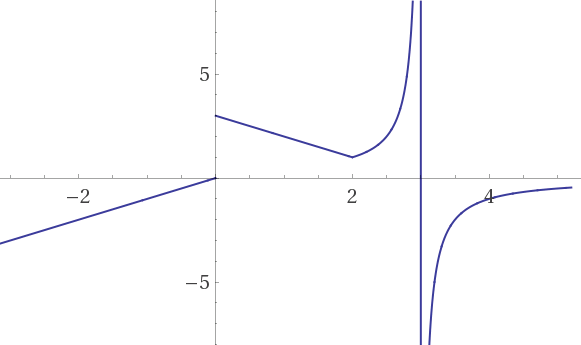
Find 

Find
Tap to reveal answer
The one side limits are not equal: left is 0 and right is 3
← Didn't Know|Knew It →

Which of the following is a vertical asymptote?

Which of the following is a vertical asymptote?
Tap to reveal answer
When
approaches 3,
approaches
.
Vertical asymptotes occur at
values. The horizontal asymptote occurs at
.
When approaches 3,
approaches
.
Vertical asymptotes occur at values. The horizontal asymptote occurs at
.
← Didn't Know|Knew It →
Evaluate the following limit:

Evaluate the following limit:
Tap to reveal answer
First, let's multiply the numerator and denominator of the fraction in the limit by
.


As
becomes increasingly large the
and
terms will tend to zero. This leaves us with the limit of
.
.
The answer is
.
First, let's multiply the numerator and denominator of the fraction in the limit by .
As becomes increasingly large the
and
terms will tend to zero. This leaves us with the limit of
.
.
The answer is .
← Didn't Know|Knew It →
Let
and
be inverse functions, and let
.
What is the value of
?
Let and
be inverse functions, and let
.
What is the value of ?
Tap to reveal answer
Since
and
are inverse functions,
. We can differentiate both sides of the equation
with respect to
to obtain the following:

We are asked to find
, which means that we will need to find
such that
. The given information tells us that
, which means that
. Thus, we will substitute 3 into the equation.

The given information tells us that
.
The equation then becomes
.
We can now solve for
.
.
The answer is
.
Since and
are inverse functions,
. We can differentiate both sides of the equation
with respect to
to obtain the following:
We are asked to find , which means that we will need to find
such that
. The given information tells us that
, which means that
. Thus, we will substitute 3 into the equation.
The given information tells us that.
The equation then becomes .
We can now solve for .
.
The answer is .
← Didn't Know|Knew It →
Using the fundamental theorem of calculus, find the integral of the function
from
to
.
Using the fundamental theorem of calculus, find the integral of the function from
to
.
Tap to reveal answer
The fundamental theorem of calculus is,
, now lets apply this to our situation.

We can use the inverse power rule to solve the integral, which is
.

![=\left[ \frac{1^4}{4}+1^2+9(1)\right]-\left[\frac{0^4}{4}+0^2+9(0) \right ]](https://vt-vtwa-assets.varsitytutors.com/vt-vtwa/uploads/formula_image/image/1002842/gif.latex)

The fundamental theorem of calculus is, , now lets apply this to our situation.
We can use the inverse power rule to solve the integral, which is .
← Didn't Know|Knew It →

What are the horizontal asymptotes of
?
What are the horizontal asymptotes of ?
Tap to reveal answer
Compute the limits of
as
approaches infinity.
Compute the limits of as
approaches infinity.
← Didn't Know|Knew It →
What is the value of the derivative of
at x=1?
What is the value of the derivative of at x=1?
Tap to reveal answer
First, find the derivative of the function, which is:

Then, plug in 1 for x:

The result is
.
First, find the derivative of the function, which is:
Then, plug in 1 for x:
The result is .
← Didn't Know|Knew It →
Evaluate

Evaluate
Tap to reveal answer
We will use the Fundamental Theorem of Calculus

and the rule

First we find the anti derivative

And then we evaluate, (upper minus lower)

(Remembering your logarithm rules)

We will use the Fundamental Theorem of Calculus
and the rule
First we find the anti derivative
And then we evaluate, (upper minus lower)
(Remembering your logarithm rules)
← Didn't Know|Knew It →