
Polynomial Approximations and Series - AP Calculus BC
Card 1 of 1140
Consider:  . Will the series converge or diverge? If converges, where does this coverge to?
Consider:
Tap to reveal answer
This is a geometric series. Use the following formula, where  is the first term of the series, and
  is the ratio that must be less than 1. If
  is greater than 1, the series diverges.

Rationalize the denominator.

This is a geometric series. Use the following formula, where
Rationalize the denominator.
← Didn't Know|Knew It →
Consider the following summation: 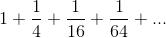 . Does this converge or diverge? If it converges, where does it approach?
Consider the following summation:
Tap to reveal answer
The problem can be reconverted using a summation symbol, and it can be seen that this is geometric.

Since the ratio is less than 1, this series will converge. The formula for geometric series is:

where  is the first term, and
  is the common ratio. Substitute these values and solve.
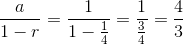
The problem can be reconverted using a summation symbol, and it can be seen that this is geometric.
Since the ratio is less than 1, this series will converge. The formula for geometric series is:
where
← Didn't Know|Knew It →
A worm crawls up a wall during the day and slides down slowly during the night. The first day the worm crawls one meter up the wall. The first night the worm slides down a third of a meter. The second day the worm regains one third of the lost progress and slides down one third of that distance regained on the second night. This pattern of motion continues...
Which of the following is a geometric sum representing the distance the worm has travelled after  12-hour periods of motion? (Assuming day and night are both 12 hour periods).
A worm crawls up a wall during the day and slides down slowly during the night. The first day the worm crawls one meter up the wall. The first night the worm slides down a third of a meter. The second day the worm regains one third of the lost progress and slides down one third of that distance regained on the second night. This pattern of motion continues...
Which of the following is a geometric sum representing the distance the worm has travelled after
Tap to reveal answer
The sum must be alternating, and after one period you should have the worm at 1m. After two periods, the worm should be at 2/3m. There is only one sum for which that is true.
The sum must be alternating, and after one period you should have the worm at 1m. After two periods, the worm should be at 2/3m. There is only one sum for which that is true.
← Didn't Know|Knew It →
Determine whether the following series converges or diverges. If it converges, what does it converge to?

Determine whether the following series converges or diverges. If it converges, what does it converge to?
Tap to reveal answer
First, we reduce the series into a simpler form.

We know this series converges because
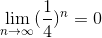
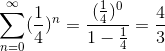
By the Geometric Series Theorem, the sum of this series is given by
First, we reduce the series into a simpler form.
We know this series converges because
By the Geometric Series Theorem, the sum of this series is given by
← Didn't Know|Knew It →
Calculate the sum of a geometric series with the following values: ,
, ,
, . Round the answer to the nearest integer.
Calculate the sum of a geometric series with the following values:
Tap to reveal answer
This is a geometric series.
The sum of a geometric series can be calculated with the following formula,
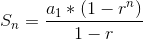 , where n is the number of terms to sum up, r is the common ratio, and
  is the value of the first term.
For this question, we are given all of the information we need.
Solution:
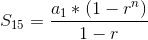
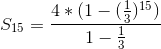
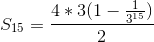
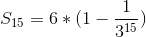

Rounding, 
This is a geometric series.
The sum of a geometric series can be calculated with the following formula,
For this question, we are given all of the information we need.
Solution:
Rounding,
← Didn't Know|Knew It →
Calculate the sum of a geometric series with the following values:
 ,
, ,
, ,
,
rounded to the nearest integer.
Calculate the sum of a geometric series with the following values:
rounded to the nearest integer.
Tap to reveal answer
This is a geometric series.
The sum of a geometric series can be calculated with the following formula,
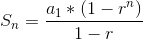 , where n is the number of terms to sum up, r is the common ratio, and
  is the value of the first term.
For this question, we are given all of the information we need.
Solution:
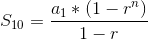
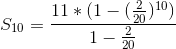

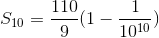

Rounding, 
This is a geometric series.
The sum of a geometric series can be calculated with the following formula,
For this question, we are given all of the information we need.
Solution:
Rounding,
← Didn't Know|Knew It →
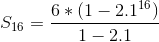
Calculate the sum, rounded to the nearest integer, of the first 16 terms of the following geometric series: 
Calculate the sum, rounded to the nearest integer, of the first 16 terms of the following geometric series:
Tap to reveal answer
This is a geometric series.
The sum of a geometric series can be calculated with the following formula,
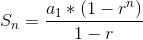 , where n is the number of terms to sum up, r is the common ratio, and
  is the value of the first term.
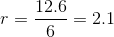
We have  and n and we just need to find r before calculating the sum.
Solution:



This is a geometric series.
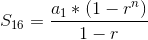
The sum of a geometric series can be calculated with the following formula,
We have
Solution:
← Didn't Know|Knew It →
Use the ratio test to determine if the series diverges or converges:

Use the ratio test to determine if the series diverges or converges:
Tap to reveal answer
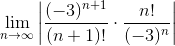
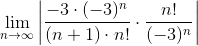
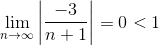
The series converges.
The series converges.
← Didn't Know|Knew It →
Determine what the following series converges to, and whether the series is Convergent, Divergent or Neither.

Determine what the following series converges to, and whether the series is Convergent, Divergent or Neither.
Tap to reveal answer
To determine if

is convergent, divergent or neither, we need to use the ratio test.
The ratio test is as follows.
Suppose we a series  . Then we define,
 .
.
If
 the series is absolutely convergent (and hence convergent).
 the series is divergent.
 the series may be divergent, conditionally convergent, or absolutely convergent.
Now lets apply this to our situtation.
Let

and

Now

We can rearrange the expression to be

We can simplify the expression to

When we evaluate the limit, we get.
 .
.
Since  , we have sufficient evidence to conclude that the series is Convergent.
To determine if
is convergent, divergent or neither, we need to use the ratio test.
The ratio test is as follows.
Suppose we a series
If
Now lets apply this to our situtation.
Let
and
Now
We can rearrange the expression to be
We can simplify the expression to
When we evaluate the limit, we get.
Since
← Didn't Know|Knew It →
Use the ratio test to determine if the series diverges or converges:

Use the ratio test to determine if the series diverges or converges:
Tap to reveal answer
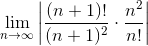
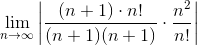

This limit is infinite, so the series diverges.
This limit is infinite, so the series diverges.
← Didn't Know|Knew It →
Use the ratio test to determine if this series diverges or converges:

Use the ratio test to determine if this series diverges or converges:
Tap to reveal answer
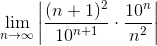
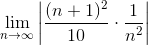
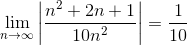
Since the limit is less than 1, the series converges.
Since the limit is less than 1, the series converges.
← Didn't Know|Knew It →
Which of these series cannot be tested for convergence/divergence properly using the ratio test? (Which of these series fails the ratio test?)
Which of these series cannot be tested for convergence/divergence properly using the ratio test? (Which of these series fails the ratio test?)
Tap to reveal answer
The ratio test fails when 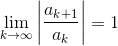 . Otherwise the series converges absolutely if
 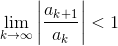 , and diverges if
 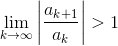 .
.
Testing the series  , we have

Hence the ratio test fails here. (It is likely obvious to the reader that this series diverges already. However, we must remember that all intuition in mathematics requires rigorous justification. We are attempting that here.)
The ratio test fails when
Testing the series
Hence the ratio test fails here. (It is likely obvious to the reader that this series diverges already. However, we must remember that all intuition in mathematics requires rigorous justification. We are attempting that here.)
← Didn't Know|Knew It →
We consider the following series:

Determine the nature of the convergence of the series.
We consider the following series:
Determine the nature of the convergence of the series.
Tap to reveal answer
We will use the comparison test to prove this result. We must note the following:
 is positive.
We have all natural numbers n:
 , this implies that
 .
.
Inverting we get :

Summing from 1 to  , we have
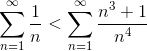
We know that the  is divergent. Therefore by the comparison test:

is divergent
We will use the comparison test to prove this result. We must note the following:
We have all natural numbers n:
Inverting we get :
Summing from 1 to
We know that the
is divergent
← Didn't Know|Knew It →
We know that :
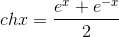 and
and 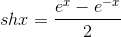
We consider the series having the general term:

Determine the nature of the series:

We know that :
We consider the series having the general term:
Determine the nature of the series:
Tap to reveal answer
We know that:
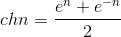 and therefore we deduce :
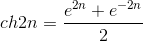
We will use the Comparison Test with this problem. To do this we will look at the function in general form  .
.
We can do this since,
 and
and  approach zero as n approaches infinity. The limit of our function becomes,
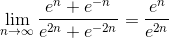
This last part gives us  .
.
Now we know that  and noting that
  is a geometric series that is convergent.
We deduce by the Comparison Test that the series
having general term  is convergent.
We know that:
We will use the Comparison Test with this problem. To do this we will look at the function in general form
We can do this since,
This last part gives us
Now we know that
We deduce by the Comparison Test that the series
having general term
← Didn't Know|Knew It →
Using the Limit Test, determine the nature of the series:

Using the Limit Test, determine the nature of the series:
Tap to reveal answer
We will use the Limit Comparison Test to study the nature of the series.
We note first that  , the series is positive.
We will compare the general term to  .
.
We note that by letting  and
and  , we have:
 .
.
Therefore the two series have the same nature, (they either converge or diverge at the same time).
We will use the Integral Test to deduce that the series having the general term:
 is convergent.
Note that we know that  is convergent if p>1 and in our case p=8 .
This shows that the series having general term  is convergent.
By the Limit Test, the series having general term  is convergent.
This shows that our series is convergent.
We will use the Limit Comparison Test to study the nature of the series.
We note first that
We will compare the general term to
We note that by letting
Therefore the two series have the same nature, (they either converge or diverge at the same time).
We will use the Integral Test to deduce that the series having the general term:
Note that we know that
This shows that the series having general term
By the Limit Test, the series having general term
This shows that our series is convergent.
← Didn't Know|Knew It →
Use the ratio test to determine if the series  converges or diverges.
Use the ratio test to determine if the series
Tap to reveal answer

The series diverges.
The series diverges.
← Didn't Know|Knew It →
We consider the following series:

Determine the nature of the convergence of the series.
We consider the following series:
Determine the nature of the convergence of the series.
Tap to reveal answer
We will use the Comparison Test to prove this result. We must note the following:
 is positive.
We have all natural numbers n:
 , this implies that
 .
.
Inverting we get :

Summing from 1 to  , we have

We know that the  is divergent. Therefore by the Comparison Test:
 is divergent.
We will use the Comparison Test to prove this result. We must note the following:
We have all natural numbers n:
Inverting we get :
Summing from 1 to
We know that the
← Didn't Know|Knew It →
Using the ratio test,
what can we say about the series.
 where
where  is an integer that satisfies:

Using the ratio test,
what can we say about the series.
Tap to reveal answer
Let  be the general term of the series. We will use the ratio test to check the convergence of the series.
The Ratio Test states:
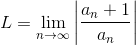
then if,
-
L<1 the series converges absolutely.
-
L>1 the series diverges.
-
L=1 the series either converges or diverges.
Therefore we need to evaluate,

we have,
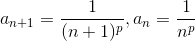
therefore:
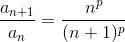 .
.
We know that
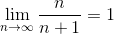
and therefore,
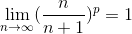
This means that :
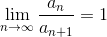
By the ratio test we can't conclude about the nature of the series. We will have to use another test.
Let
The Ratio Test states:
then if,
-
L<1 the series converges absolutely.
-
L>1 the series diverges.
-
L=1 the series either converges or diverges.
Therefore we need to evaluate,
we have,
therefore:
We know that
and therefore,
This means that :
By the ratio test we can't conclude about the nature of the series. We will have to use another test.
← Didn't Know|Knew It →
Assuming that  ,
,  . Using the ratio test, what can we say about the series:

Assuming that
Tap to reveal answer
As required by this question we will have to use the ratio test. 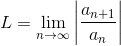 if L<1 the series converges absolutely, L>1 the series diverges, and if L=1 the series could either converge or diverge.
To do so, we will need to compute :  . In our case:

Therefore
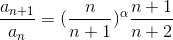 .
.
We know that 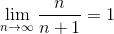
This means that

Since L=1 by the ratio test, we can't conclude about the convergence of the series.
As required by this question we will have to use the ratio test.
To do so, we will need to compute :
Therefore
We know that
This means that
Since L=1 by the ratio test, we can't conclude about the convergence of the series.
← Didn't Know|Knew It →
Consider the following series :
 where
where  is given by:
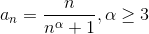 . Using the ratio test, find the nature of the series.
Consider the following series :
Tap to reveal answer
Let  be the general term of the series. We will use the ratio test to check the convergence of the series.
if L<1 the series converges absolutely, L>1 the series diverges, and if L=1 the series could either converge or diverge.
We need to evaluate,
 we have:
 .
.
Therefore:
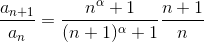 . We know that,
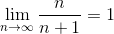 and therefore
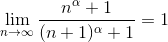
This means that :
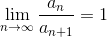 .
.
By the ratio test we can't conclude about the nature of the series. We will have to use another test.
Let
We need to evaluate,
Therefore:
This means that :
By the ratio test we can't conclude about the nature of the series. We will have to use another test.
← Didn't Know|Knew It →