
Vector Form - AP Calculus BC
Card 1 of 266
Find the vector form of  to
to  .
.
Find the vector form of
Tap to reveal answer
When we are trying to find the vector form we need to remember the formula which states to take the difference between the ending and starting point.
Thus we would get:
Given  and
and 

In our case we have ending point at  and our starting point at
  .
.
Therefore we would set up the following and simplify.

When we are trying to find the vector form we need to remember the formula which states to take the difference between the ending and starting point.
Thus we would get:
Given
In our case we have ending point at
Therefore we would set up the following and simplify.
← Didn't Know|Knew It →

Tap to reveal answer
In general:
If  ,
,
then 
Derivative rules that will be needed here:
- Taking a derivative on a term, or using the power rule, can be done by doing the following:

- Special rule when differentiating an exponential function:
 , where k is a constant.
In this problem, 


Put it all together to get 

In general:
If
then
Derivative rules that will be needed here:
- Taking a derivative on a term, or using the power rule, can be done by doing the following:
- Special rule when differentiating an exponential function:
In this problem,
Put it all together to get
← Didn't Know|Knew It →

Calculate 
Calculate
Tap to reveal answer
Calculate the sum of vectors.
In general,


Solution:


Calculate the sum of vectors.
In general,
Solution:
← Didn't Know|Knew It →
Given points  and
and  , what is the vector form of the distance between the points?
Given points
Tap to reveal answer
In order to derive the vector form of the distance between two points, we must find the difference between the  ,
,  , and
, and  elements of the points.
That is, for any point
 and
and  ,
,
the distance is the vector
 .
.
Subbing in our original points  and
and  , we get:


In order to derive the vector form of the distance between two points, we must find the difference between the
That is, for any point
the distance is the vector
Subbing in our original points
← Didn't Know|Knew It →
Given points  and
and  , what is the vector form of the distance between the points?
Given points
Tap to reveal answer
In order to derive the vector form of the distance between two points, we must find the difference between the , , and elements of the points.
That is, for any point and , the distance is the vector .
Subbing in our original points  and
and  , we get:


In order to derive the vector form of the distance between two points, we must find the difference between the
That is, for any point
Subbing in our original points
← Didn't Know|Knew It →
The graph of the vector function 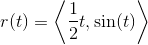 can also be represented by the graph of which of the following functions in rectangular form?
The graph of the vector function
Tap to reveal answer
We can find the graph of 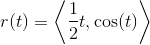 in rectangular form by mapping the parametric coordinates to Cartesian coordinates
  :
:


We can now use this value to solve for  :
:


We can find the graph of
We can now use this value to solve for
← Didn't Know|Knew It →
The graph of the vector function  can also be represented by the graph of which of the following functions in rectangular form?
The graph of the vector function
Tap to reveal answer
We can find the graph of  in rectangular form by mapping the parametric coordinates to Cartesian coordinates :


We can now use this value to solve for :
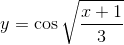
We can find the graph of
We can now use this value to solve for
← Didn't Know|Knew It →
What is the vector form of  ?
?
What is the vector form of
Tap to reveal answer
In order to derive the vector form, we must map the  ,
,  ,
,  -coordinates to their corresponding
  ,
,  , and
, and  coefficients. That is, given
 , the vector form is
  . So for
  , we can derive the vector form
  .
.
In order to derive the vector form, we must map the
← Didn't Know|Knew It →
What is the vector form of  ?
?
What is the vector form of
Tap to reveal answer
In order to derive the vector form, we must map the , , -coordinates to their corresponding , , and coefficients. That is, given, the vector form is . So for  , we can derive the vector form
  .
.
In order to derive the vector form, we must map the
← Didn't Know|Knew It →
What is the vector form of  ?
?
What is the vector form of
Tap to reveal answer
In order to derive the vector form, we must map the , , -coordinates to their corresponding , , and coefficients. That is, given, the vector form is . So for  , we can derive the vector form
  .
.
In order to derive the vector form, we must map the
← Didn't Know|Knew It →
What is the vector form of  ?
?
What is the vector form of
Tap to reveal answer
In order to derive the vector form, we must map the , , -coordinates to their corresponding , , and coefficients.
That is, given , the vector form is .
So for  , we can derive the vector form
  .
.
In order to derive the vector form, we must map the
That is, given
So for
← Didn't Know|Knew It →
What is the vector form of  ?
?
What is the vector form of
Tap to reveal answer
In order to derive the vector form, we must map the , , -coordinates to their corresponding , , and coefficients.
That is, given , the vector form is .
So for  , we can derive the vector form
  .
.
In order to derive the vector form, we must map the
That is, given
So for
← Didn't Know|Knew It →
What is the vector form of  ?
?
What is the vector form of
Tap to reveal answer
In order to derive the vector form, we must map the , , -coordinates to their corresponding , , and coefficients.
That is, given , the vector form is .
So for  , we can derive the vector form
  .
.
In order to derive the vector form, we must map the
That is, given
So for
← Didn't Know|Knew It →
Assume that Billy fired himself out of a circus cannon at a velocity of  at an elevation angle of
  degrees. Write this in vector component form.
Assume that Billy fired himself out of a circus cannon at a velocity of
Tap to reveal answer
The firing of the cannon has both x and y components.
Write the formula that distinguishes the x and y direction and substitute.

Ensure that the calculator is in degree mode before you solve.

The firing of the cannon has both x and y components.
Write the formula that distinguishes the x and y direction and substitute.
Ensure that the calculator is in degree mode before you solve.
← Didn't Know|Knew It →
Express  in vector form.
Express
Tap to reveal answer
In order to express  in vector form, we will need to map its
  ,
,  , and
, and  coefficients to its
  -,
-,  -, and
  -coordinates.
Thus, its vector form is
 .
.
In order to express
Thus, its vector form is
← Didn't Know|Knew It →
What is the vector form of  ?
?
What is the vector form of
Tap to reveal answer
In order to derive the vector form, we must map the , , -coordinates to their corresponding , , and coefficients.
That is, given , the vector form is .
So for  , we can derive the vector form
  .
.
In order to derive the vector form, we must map the
That is, given
So for
← Didn't Know|Knew It →
What is the vector form of  ?
?
What is the vector form of
Tap to reveal answer
In order to derive the vector form, we must map the , , -coordinates to their corresponding , , and coefficients.
That is, given , the vector form is .
So for  , we can derive the vector form
  .
.
In order to derive the vector form, we must map the
That is, given
So for
← Didn't Know|Knew It →
Express  in vector form.
Express
Tap to reveal answer
The correct form of x,y, and z of a vector is represented in the order of i, j, and k, respectively. The coefficients of i,j, and k are used to write the vector form.

The correct form of x,y, and z of a vector is represented in the order of i, j, and k, respectively. The coefficients of i,j, and k are used to write the vector form.
← Didn't Know|Knew It →
Express  in vector form.
Express
Tap to reveal answer
The x,y, and z of a vector is represented in the order of i, j, and k, respectively. Use the coefficients of i,j, and k to write the vector form.

The x,y, and z of a vector is represented in the order of i, j, and k, respectively. Use the coefficients of i,j, and k to write the vector form.
← Didn't Know|Knew It →
Find the vector form of to .
Find the vector form of
Tap to reveal answer
When we are trying to find the vector form we need to remember the formula which states to take the difference between the ending and starting point.
Thus we would get:
Given and
In our case we have ending point at and our starting point at .
Therefore we would set up the following and simplify.
When we are trying to find the vector form we need to remember the formula which states to take the difference between the ending and starting point.
Thus we would get:
Given
In our case we have ending point at
Therefore we would set up the following and simplify.
← Didn't Know|Knew It →