
Gases and Gas Laws - AP Chemistry
Card 0 of 172
A family leaves for summer vacation by driving on the highway. The car’s tires start the trip with a pressure of  at a temperature of
  and a volume of
  . What is the pressure of the tires after driving, when the temperature within the tire increases to
  ?
?
A family leaves for summer vacation by driving on the highway. The car’s tires start the trip with a pressure of
We can assume that the volume of the tires remains constant. This allows us to apply Gay-Lussac's law, which related pressure and temperature:

We know both the initial and final temperatures, but we must convert to Kelvin in order to use SI units.


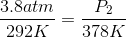
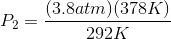
Using these temperatures and the initial pressure, we can solve for the final pressure.

We can assume that the volume of the tires remains constant. This allows us to apply Gay-Lussac's law, which related pressure and temperature:
We know both the initial and final temperatures, but we must convert to Kelvin in order to use SI units.
Using these temperatures and the initial pressure, we can solve for the final pressure.
Compare your answer with the correct one above
If the temperature of a gas increases, what happens to the pressure?
If the temperature of a gas increases, what happens to the pressure?
According to Gay-Lussac's law, the attributes of pressure and temperature vary by direct proportionality. As temperature increases, pressure increases as well.

According to Gay-Lussac's law, the attributes of pressure and temperature vary by direct proportionality. As temperature increases, pressure increases as well.
Compare your answer with the correct one above
A closed flask contains gas at STP. If the temperature is raised to  what will the pressure be in mmHg?
A closed flask contains gas at STP. If the temperature is raised to
Since we have information about temperature and we are interested in changes in pessure, Gay-Lussac's Law will be used. This says that

The initial temperature and pressure are given (STP) meaning a temperature of  and a pressure of
  . There are other values for standard pressure but they have different units and since the problems requests an answer in units of
  we must use the value of standard pressure with those units. Solving for the final pressure gives

Plugging in our variables gives

We want 3 significant figures since the temperature given has 3, so the final answer is

Since we have information about temperature and we are interested in changes in pessure, Gay-Lussac's Law will be used. This says that
The initial temperature and pressure are given (STP) meaning a temperature of
Plugging in our variables gives
We want 3 significant figures since the temperature given has 3, so the final answer is
Compare your answer with the correct one above
Which of the following is a condition of the ideal gas law?
Which of the following is a condition of the ideal gas law?
The ideal gas law has some conditions that must be met, conditions that certainly cannot be met in the real world. These conditions include that the gases cannot interact with one another, gases must be moving in a random straight-line fashion, gas molecules must not take up any space, and gases must be in perfect elastic collisions with the walls of the container. These conditions minimize the effect that gas molecules have on one other, allowing a prediction based on completely random and unimpeded molecular movement. In reality, these conditions are impossible. All real gas molecules have a molecular volume and some degree of intermolecular attraction forces.
The ideal gas law has some conditions that must be met, conditions that certainly cannot be met in the real world. These conditions include that the gases cannot interact with one another, gases must be moving in a random straight-line fashion, gas molecules must not take up any space, and gases must be in perfect elastic collisions with the walls of the container. These conditions minimize the effect that gas molecules have on one other, allowing a prediction based on completely random and unimpeded molecular movement. In reality, these conditions are impossible. All real gas molecules have a molecular volume and some degree of intermolecular attraction forces.
Compare your answer with the correct one above
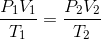
Which law is represented by the following formula?
Which law is represented by the following formula?
The combined gas law takes Boyle's, Charles's, and Gay-Lussac's law and combines it into one law.
It is able to relate temperature, pressure, and volume of one system when the parameters for any of the three change.
Boyle's law relates pressure and volume: 
Charles's law relates temperature and volume: 
Gay-Lussac's law relates temperature and pressure: 
The ideal gas law relates temperature, pressure, volume, and moles in coordination with the ideal gas constant: 
The combined gas law takes Boyle's, Charles's, and Gay-Lussac's law and combines it into one law.
It is able to relate temperature, pressure, and volume of one system when the parameters for any of the three change.
Boyle's law relates pressure and volume:
Charles's law relates temperature and volume:
Gay-Lussac's law relates temperature and pressure:
The ideal gas law relates temperature, pressure, volume, and moles in coordination with the ideal gas constant:
Compare your answer with the correct one above
A scuba diver uses compressed air to breath under water. He starts with an air volume of  at sea level (
 ) at a temperature of
  . What is the volume of air in his tank at a depth of
  (
( ) and a temperature of
  ?
?
A scuba diver uses compressed air to breath under water. He starts with an air volume of
This question requires the combined equation of the individual gas laws:

To use this equation, we first need to convert the given temperatures to Kelvin.


We now know the initial pressure, volume, and temperature, allowing us to solve the left side of the equation.


Use the given values for the final temperature and pressure to solve for the final volume.


This question requires the combined equation of the individual gas laws:
To use this equation, we first need to convert the given temperatures to Kelvin.
We now know the initial pressure, volume, and temperature, allowing us to solve the left side of the equation.
Use the given values for the final temperature and pressure to solve for the final volume.
Compare your answer with the correct one above
A  sample of helium gas at
  and a pressure of
  is used to inflate a balloon. What is the volume this gas occupies when the temperature reaches
  at a pressure of
  during the inflation?
A
This question requires s to use the combined gas law:

We know the initial pressure, temperature, and volume, allowing us to solve for the left side of the equation.


We are also given the final pressure and temperature. Using these values on the right side of the equation we can solve for the final volume.


This question requires s to use the combined gas law:
We know the initial pressure, temperature, and volume, allowing us to solve for the left side of the equation.
We are also given the final pressure and temperature. Using these values on the right side of the equation we can solve for the final volume.
Compare your answer with the correct one above
A  container of gas has a pressure of
  at a temperature of
  . The container is expanded to
  , and the temperature is increased to
  .
.
What is the final pressure of the container?
A
What is the final pressure of the container?
In this case, two variables are changed between the initial and final containers: volume and temperature. Since we are looking for the final pressure on the container, we can use the combined gas law in order to solve for the final pressure:

When using the ideal gas law, remember that temperature must be in Kelvin, not Celsius, so we will need to convert.


Use the given values to solve for the final pressure.


In this case, two variables are changed between the initial and final containers: volume and temperature. Since we are looking for the final pressure on the container, we can use the combined gas law in order to solve for the final pressure:
When using the ideal gas law, remember that temperature must be in Kelvin, not Celsius, so we will need to convert.
Use the given values to solve for the final pressure.
Compare your answer with the correct one above
 of an unknown gas are contained in a
  container. The container has a pressure of
  at a temperature of
  .
.
Based on this information and the periodic table, which of the following gases is in the container?

Based on this information and the periodic table, which of the following gases is in the container?
In order to determine the gas being contained, we are going to need to rewrite the ideal gas law. The ideal gas law is written as follows:

The number of moles of a gas can be rewritten as the mass of the gas divided by its molar mass. Knowing this, we can rewrite the equation, and solve for the molar mass of the gas.


Use the given values in this equation to solve for the molar mass. Remember to first convert degree Celsius to Kelvin!


Now that we have solved for the molar mass, we can see which gas has this molar mass on the periodic table. Argon has a molar mass of 39.95 grams per mole, so we can determine that argon is the gas in the container.
In order to determine the gas being contained, we are going to need to rewrite the ideal gas law. The ideal gas law is written as follows:
The number of moles of a gas can be rewritten as the mass of the gas divided by its molar mass. Knowing this, we can rewrite the equation, and solve for the molar mass of the gas.
Use the given values in this equation to solve for the molar mass. Remember to first convert degree Celsius to Kelvin!
Now that we have solved for the molar mass, we can see which gas has this molar mass on the periodic table. Argon has a molar mass of 39.95 grams per mole, so we can determine that argon is the gas in the container.
Compare your answer with the correct one above
At STP, an unknown gas has a density of  .
.
Based on this information and the periodic table, what is the identity of the gas in the container?

At STP, an unknown gas has a density of
Based on this information and the periodic table, what is the identity of the gas in the container?
Once again, we can use the ideal gas law in order to solve for the unknown gas. We will start again with the ideal gas law:

Density has the units of mass over volume, which means that we can rearrange the ideal gas law so that density is on one side of the equation. However, we need to substitute one of the values so mass is also in the equation. Remember that moles are equal to mass divided by molar mass, so we can rewrite "n" in order to solve for density:


STP means that the container is at 1 atmosphere of pressure and 273 Kelvin. Knowing this, we can solve for molar mass:


Fluorine gas has a molar mass of 38.00 grams per mol. As a result, we determine that fluorine gas is the unknown gas in the container.
Once again, we can use the ideal gas law in order to solve for the unknown gas. We will start again with the ideal gas law:
Density has the units of mass over volume, which means that we can rearrange the ideal gas law so that density is on one side of the equation. However, we need to substitute one of the values so mass is also in the equation. Remember that moles are equal to mass divided by molar mass, so we can rewrite "n" in order to solve for density:
STP means that the container is at 1 atmosphere of pressure and 273 Kelvin. Knowing this, we can solve for molar mass:
Fluorine gas has a molar mass of 38.00 grams per mol. As a result, we determine that fluorine gas is the unknown gas in the container.
Compare your answer with the correct one above
Below is the ideal gas law.

What does each letter of the ideal gas law represent?
Below is the ideal gas law.
What does each letter of the ideal gas law represent?
The ideal gas law is used to identify values in a given state (for the values of pressure, volume, number of moles, and temperature) for an ideal, hypothetical gas. Because no gases are truly ideal, this only works as an approximation, and some gases are more ideal than others.
The ideal gas law is used to identify values in a given state (for the values of pressure, volume, number of moles, and temperature) for an ideal, hypothetical gas. Because no gases are truly ideal, this only works as an approximation, and some gases are more ideal than others.
Compare your answer with the correct one above
A gas in a  container is at STP. How many moles of gas are in the container?
A gas in a
First we need to remember what STP means since it's important. This is "standard temperature and pressure". Because we are looking for the number of moles we need the ideal gas law.

At STP we will take the temperature to be  and the pressure to be
  . Solving for the number of moles gives


Notice that the units of the gas constant R mean we must have a volume in liters. The volume was given in mL and therefore had to be converted.
First we need to remember what STP means since it's important. This is "standard temperature and pressure". Because we are looking for the number of moles we need the ideal gas law.
At STP we will take the temperature to be
Notice that the units of the gas constant R mean we must have a volume in liters. The volume was given in mL and therefore had to be converted.
Compare your answer with the correct one above
A gas at STP has a volume of  . The gas is compressed to
  and heated to
  . What is the new pressure of the gas in atm?
A gas at STP has a volume of
We have a lot going on in this problem. Since both temperature and volume change and we want to know the final pressure, the combined gas law will be used:

Since the gas is at STP to start we know the pressure ( ) and the temperature (
 ). Standard pressure has multiple values depending on the units, but we want pressure in atm for our final answer so we will choose the appropriate value and units for STP. Solving for the final pressure gives:

Plugging in everything gives:

We expect that raising the temperature will increase the pressure as well as reducing the volume. Since both actions will increase the pressure we must have a final pressure greater than the initial pressure.
We have a lot going on in this problem. Since both temperature and volume change and we want to know the final pressure, the combined gas law will be used:
Since the gas is at STP to start we know the pressure (
Plugging in everything gives:
We expect that raising the temperature will increase the pressure as well as reducing the volume. Since both actions will increase the pressure we must have a final pressure greater than the initial pressure.
Compare your answer with the correct one above
Which of the following gases will diffuse the quickest through a small hole?
Which of the following gases will diffuse the quickest through a small hole?
Gases with high higher molecular weights are going to move at slower velocities. At a given temperature, all gases have the same average kinetic energy. For this to remain true, larger molecules must move slower since they have greater masses.
The gas to diffuse quickest will have the smallest molecular weight. In this case, that gas is hydrogen.
Gases with high higher molecular weights are going to move at slower velocities. At a given temperature, all gases have the same average kinetic energy. For this to remain true, larger molecules must move slower since they have greater masses.
The gas to diffuse quickest will have the smallest molecular weight. In this case, that gas is hydrogen.
Compare your answer with the correct one above
Which of the following is a physical property of gases?
Which of the following is a physical property of gases?
There are six primary properties of gases: expansion, fluidity, low density, compressibility, diffusion, and effusion.
Expansion suggests that gases have no defined shape and will expand to fill a given space, without significant intermolecular interaction. Fluidity is a property of both gases and liquids and describes the relatively low attraction between particles. This allows the gas molecules to move past one another, creating the "fluid" nature of the gas. Low density of gases is linked to gas expansion. Gases will expand to the greatest extent possible, resulting in low mass per unit volume ratios. Compressibility is also linked to expansion and the indefinite shape of the gas, essentially suggesting that the distance between particles can be reduced if pressure is increased. Diffusion and effusion are both linked to the movement of gases. Diffusion means that gases can spread out and mix within a given space, while effusion means that gases can pass through a small opening at a given rate.
Some of these properties are unique to gases, while others are shared between gases and liquids. Gases have virtually no physical properties in common with solids.
There are six primary properties of gases: expansion, fluidity, low density, compressibility, diffusion, and effusion.
Expansion suggests that gases have no defined shape and will expand to fill a given space, without significant intermolecular interaction. Fluidity is a property of both gases and liquids and describes the relatively low attraction between particles. This allows the gas molecules to move past one another, creating the "fluid" nature of the gas. Low density of gases is linked to gas expansion. Gases will expand to the greatest extent possible, resulting in low mass per unit volume ratios. Compressibility is also linked to expansion and the indefinite shape of the gas, essentially suggesting that the distance between particles can be reduced if pressure is increased. Diffusion and effusion are both linked to the movement of gases. Diffusion means that gases can spread out and mix within a given space, while effusion means that gases can pass through a small opening at a given rate.
Some of these properties are unique to gases, while others are shared between gases and liquids. Gases have virtually no physical properties in common with solids.
Compare your answer with the correct one above
Which of the following gas laws can be used to determine the total pressure of a mixture of gases?
Which of the following gas laws can be used to determine the total pressure of a mixture of gases?
Each gas in a mixture of gases exerts its own pressure independently of the other gases present; therefore the pressure of each gas within a mixture is called the partial pressure of the gas.
Dalton's law of partial pressures states that the total pressure of a mixture of gases is equal to the sum of the partial pressures of the component gases. This can be expressed mathematically as follows:

Boyle's law and Gay-Lussac's law can help determine pressure in varying volumes and temperatures, respectively, but can only be useful with regard to the total pressure of the system. The second law of thermodynamics is not related to gas properties, and states that the entropy of the universe is constantly increasing.
Each gas in a mixture of gases exerts its own pressure independently of the other gases present; therefore the pressure of each gas within a mixture is called the partial pressure of the gas.
Dalton's law of partial pressures states that the total pressure of a mixture of gases is equal to the sum of the partial pressures of the component gases. This can be expressed mathematically as follows:
Boyle's law and Gay-Lussac's law can help determine pressure in varying volumes and temperatures, respectively, but can only be useful with regard to the total pressure of the system. The second law of thermodynamics is not related to gas properties, and states that the entropy of the universe is constantly increasing.
Compare your answer with the correct one above
Which of the following is not a characteristic of gases?
Which of the following is not a characteristic of gases?
Gases are able to effuse though small pinhole openings, and diffuse into empty spaces from high to low concentrations. The kinetic energy of gas molecules is dependent on temperature. Higher temperatures cause in increase in the kinetic energy of the particles.
Gases have very low densities. Density is a measure of mass per unit volume. Since the gas molecules are spread out over a much larger distance compared to liquids and solids, their densities are very low.
Gases are able to effuse though small pinhole openings, and diffuse into empty spaces from high to low concentrations. The kinetic energy of gas molecules is dependent on temperature. Higher temperatures cause in increase in the kinetic energy of the particles.
Gases have very low densities. Density is a measure of mass per unit volume. Since the gas molecules are spread out over a much larger distance compared to liquids and solids, their densities are very low.
Compare your answer with the correct one above
A container filled with fluorine gas and neon gas and has a total pressure of  . There are
  of fluorine gas in the container, and the fluorine gas exerts a pressure of
  .
.
Based on this, what is the mass of neon in the container?
A container filled with fluorine gas and neon gas and has a total pressure of
Based on this, what is the mass of neon in the container?
The partial pressures of each gas are not dependent on their masses, but the total number of moles of gas in the container. Since we know how much pressure the fluorine gas exerts on the container, we can solve for the molar fraction of fluorine gas in the container.



In other words, 62.5% of the gas in the container is fluorine gas. Knowing this, we can solve for how many moles of neon gas are in the container.
50 grams of fluorine gas is equal to 1.32 moles of fluorine gas. If this molar amount accounts for 62.5% of the gas in the container, we can solve for the total number of moles in the container:


Since there are only two gases in the container, we can solve for the number of moles of neon gas in the container.

Since there are .79 moles of neon gas, we can multiply by the molar mass and find the toal mass of the neon gas in the container:

The partial pressures of each gas are not dependent on their masses, but the total number of moles of gas in the container. Since we know how much pressure the fluorine gas exerts on the container, we can solve for the molar fraction of fluorine gas in the container.
In other words, 62.5% of the gas in the container is fluorine gas. Knowing this, we can solve for how many moles of neon gas are in the container.
50 grams of fluorine gas is equal to 1.32 moles of fluorine gas. If this molar amount accounts for 62.5% of the gas in the container, we can solve for the total number of moles in the container:
Since there are only two gases in the container, we can solve for the number of moles of neon gas in the container.
Since there are .79 moles of neon gas, we can multiply by the molar mass and find the toal mass of the neon gas in the container:
Compare your answer with the correct one above
Assume air contains 21% oxygen and 79% nitrogen.
If air is compressed to 5.5atm, what is the partial pressure of the oxygen?
Assume air contains 21% oxygen and 79% nitrogen.
If air is compressed to 5.5atm, what is the partial pressure of the oxygen?
Use Dalton's law of partial pressure:

Where  is the partial pressure of oxygen and
  is the mole fraction of oxygen. Plug in known values and solve.

Use Dalton's law of partial pressure:
Where
Compare your answer with the correct one above
Mass density is the grams of gas per volume, while number density is the number of molecules per volume.
Which of the following has the highest number density, if each gas occupies the same volume?
Mass density is the grams of gas per volume, while number density is the number of molecules per volume.
Which of the following has the highest number density, if each gas occupies the same volume?
Divide each component by their molecular weight to obtain the number of moles. The hydrogen gas has the most moles that occupy the same volume. Remember that of the answer choices, hydrogen, and oxygen are both diatomic gasses, which needs to be taken into account when calculating the number of moles. For simplicity, let's assume we have 1L of each gas.


As an example, let's calculate the number density for oxygen to show that it is indeed less than that for hydrogen.


Divide each component by their molecular weight to obtain the number of moles. The hydrogen gas has the most moles that occupy the same volume. Remember that of the answer choices, hydrogen, and oxygen are both diatomic gasses, which needs to be taken into account when calculating the number of moles. For simplicity, let's assume we have 1L of each gas.
As an example, let's calculate the number density for oxygen to show that it is indeed less than that for hydrogen.
Compare your answer with the correct one above