
Reactions and Equilibrium - AP Chemistry
Card 1 of 2660
You are in chemistry lab performing a titration. You were given 15 mL of an aqueous solution with an unknown concentration of acetic acid,  to solve through titration with concentrated sodium hydroxide,
  . You know that the pKa of acetic acid is 4.75 and that your titrant is 0.1 M sodium hydroxide,
  .
.
The endpoint was determined at 10 mL of sodium hydroxide,  . What is the pH after 5 mL of
  was added?
You are in chemistry lab performing a titration. You were given 15 mL of an aqueous solution with an unknown concentration of acetic acid,
The endpoint was determined at 10 mL of sodium hydroxide,
Tap to reveal answer
At the half end point, the  . This can be determined by the Henderson-Hasselbalch equation if it is not clear.
Since the endpoint of the titration is that there are 10 mL of 0.1 M NaOH added, that means that there are 0.001 moles of acetic acid.
When 5 mL of NaOH is added, there are 0.0005 moles of acetic acid and 0.0005 moles of acetate formed.


Therefore pH= pKa
At the half end point, the
Since the endpoint of the titration is that there are 10 mL of 0.1 M NaOH added, that means that there are 0.001 moles of acetic acid.
When 5 mL of NaOH is added, there are 0.0005 moles of acetic acid and 0.0005 moles of acetate formed.
Therefore pH= pKa
← Didn't Know|Knew It →
Determine which of these solution combinations form a buffer.
Determine which of these solution combinations form a buffer.
Tap to reveal answer
First to go through why the other ones are wrong:
Strong base + strong acid neutralizes and does not form a buffer solution
Strong base + weak base does not form a buffer - would need an acid
Strong base + weak acid = all weak acid converted to conjugate base
The correct answer is:
Strong base + weak acid = half converted to conjugate base with half leftover as weak acid, with all the components for a buffer
First to go through why the other ones are wrong:
Strong base + strong acid neutralizes and does not form a buffer solution
Strong base + weak base does not form a buffer - would need an acid
Strong base + weak acid = all weak acid converted to conjugate base
The correct answer is:
Strong base + weak acid = half converted to conjugate base with half leftover as weak acid, with all the components for a buffer
← Didn't Know|Knew It →
Determine which combination of solutions would create a buffer solution.
Determine which combination of solutions would create a buffer solution.
Tap to reveal answer
For all the other options there is no ammonium leftover with which to serve as the weak acid in the buffer system, the ammonium is all used up and converted to ammonia. However in the correct answer choice, there is enough ammonium leftover after the reaction with the sodium hydroxide.
For all the other options there is no ammonium leftover with which to serve as the weak acid in the buffer system, the ammonium is all used up and converted to ammonia. However in the correct answer choice, there is enough ammonium leftover after the reaction with the sodium hydroxide.
← Didn't Know|Knew It →
Which combination(s) would create a buffer solution?
I. Weak acid
II. Weak acid's conjugate base
III. Strong acid
IV. Strong base
V. Weak base
VI. Weak base's conjugate acid
Which combination(s) would create a buffer solution?
I. Weak acid
II. Weak acid's conjugate base
III. Strong acid
IV. Strong base
V. Weak base
VI. Weak base's conjugate acid
Tap to reveal answer
A buffer solution is formed from the equilibrium of a weak acid and its conjugate base, or from a weak base and its conjugate acid. It's ability to "buffer" the pH or keep it from changing in large amounts in from the switching between these two forms weak and its conjugate.
A buffer solution is formed from the equilibrium of a weak acid and its conjugate base, or from a weak base and its conjugate acid. It's ability to "buffer" the pH or keep it from changing in large amounts in from the switching between these two forms weak and its conjugate.
← Didn't Know|Knew It →
Determine the pH of an aqueous solution of 0.01 M acetic acid,  . The pKa of acetic acid is 4.75.
Determine the pH of an aqueous solution of 0.01 M acetic acid,
Tap to reveal answer
Since acetic acid is a weak acid, it has a Ka that is rather small, we have to do a RICE table to determine the equilibrium amount of hydronium, H3O+ to then determine the pH.
R 
I 0.1 M - 0 0
C -x +x +x
E 0.1 -x x x
So first we need to change our pKa to a Ka
where  therefore

 =
= 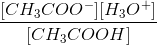 =
= 
If we assume that x is very small compared to 0.1...
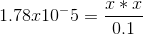
Where 
(note: when solving using the quadratic we come up with the same answer)
So if 

Since acetic acid is a weak acid, it has a Ka that is rather small, we have to do a RICE table to determine the equilibrium amount of hydronium, H3O+ to then determine the pH.
R
I 0.1 M - 0 0
C -x +x +x
E 0.1 -x x x
So first we need to change our pKa to a Ka
where
If we assume that x is very small compared to 0.1...
Where
(note: when solving using the quadratic we come up with the same answer)
So if
← Didn't Know|Knew It →
Determine which solution(s) will yield a buffer solution.
I. 10 mL of 0.5 M HCl + 20 mL of 0.5 M acetate
II. 10 mL of 0.5 M HCl + 10 mL of 0.5 M acetate
III. 10 mL of 0.5 M HCl + 10 mL of 1.0 M acetate
IV. 10 mL of 0.5 M HCl + 10 mL of 1.5 M acetate
Determine which solution(s) will yield a buffer solution.
I. 10 mL of 0.5 M HCl + 20 mL of 0.5 M acetate
II. 10 mL of 0.5 M HCl + 10 mL of 0.5 M acetate
III. 10 mL of 0.5 M HCl + 10 mL of 1.0 M acetate
IV. 10 mL of 0.5 M HCl + 10 mL of 1.5 M acetate
Tap to reveal answer
These answers are correct because the two components needed to create a buffer solution are a weak acid and its conjugate base, or a weak base and its conjugate acid. In these cases, the first reaction to occur upon addition of the strong acid is the formation of the conjugate acid, acetic acid.

If the amount of initial  is greater than HCl, then we will have some
  left over to act as a buffer with the created conjugate acid. This can be through a greater volume, or through a higher concentration as shown in the correct answers.
These answers are correct because the two components needed to create a buffer solution are a weak acid and its conjugate base, or a weak base and its conjugate acid. In these cases, the first reaction to occur upon addition of the strong acid is the formation of the conjugate acid, acetic acid.
If the amount of initial
← Didn't Know|Knew It →
Which of the following acid and base pairs are capable of acting as a buffer?
Which of the following acid and base pairs are capable of acting as a buffer?
Tap to reveal answer
In this question, we're presented with a variety of acid/base pairs and we're asked to identify which one could act as a buffer.
Remember that a buffer is a pair of acid and its conjugate base that acts to resist substantial changes in pH. In order for a buffer to work, the acid base pair needs to exist in equilibrium. This way, when the pH of the solution changes, the equilibrium of the acid/base reaction will shift, such that the pH will not change drastically.
To have an acid/base pair in equilibrium, we'll need to look for a pair that contains a weak acid. Acids like  and
and  are so strong that they will dissociate completely. Of the answer choices shown, only the carbonic acid/bicarbonate system (
 and
and  ) exists in equilibrium. Thus, this is the correct answer.
In this question, we're presented with a variety of acid/base pairs and we're asked to identify which one could act as a buffer.
Remember that a buffer is a pair of acid and its conjugate base that acts to resist substantial changes in pH. In order for a buffer to work, the acid base pair needs to exist in equilibrium. This way, when the pH of the solution changes, the equilibrium of the acid/base reaction will shift, such that the pH will not change drastically.
To have an acid/base pair in equilibrium, we'll need to look for a pair that contains a weak acid. Acids like
← Didn't Know|Knew It →
Which of the following techniques will decrease the pH of a solution?
Which of the following techniques will decrease the pH of a solution?
Tap to reveal answer
Increasing the concentration of protons of a solution will make the solution more acidic; therefore, it lowers the solution’s pH. Decreasing the concentration of protons will make the solution more basic, raising the pH. Adding more acid of the same molarity of the original solution will not increase the concentration of protons and will not increase acidity or lower the pH. Increasing the amount of hydroxide ions will make the solution more basic and raise the pH. Increasing the amount of solvent will lower the concentration, affecting molarity and not lowering the pH.
Increasing the concentration of protons of a solution will make the solution more acidic; therefore, it lowers the solution’s pH. Decreasing the concentration of protons will make the solution more basic, raising the pH. Adding more acid of the same molarity of the original solution will not increase the concentration of protons and will not increase acidity or lower the pH. Increasing the amount of hydroxide ions will make the solution more basic and raise the pH. Increasing the amount of solvent will lower the concentration, affecting molarity and not lowering the pH.
← Didn't Know|Knew It →
Determine the pH of a solution that is  .
.
Determine the pH of a solution that is
Tap to reveal answer
Since  is a strong acid, the concentration of
  is equal to the concentration of the acid itself.
Thus,  .
.
Recall how to find the pH of a solution:

Plug in the given hydronium ion concentration to find the pH of the given solution.

Remember to maintain the correct number of significant figures.
Since
Thus,
Recall how to find the pH of a solution:
Plug in the given hydronium ion concentration to find the pH of the given solution.
Remember to maintain the correct number of significant figures.
← Didn't Know|Knew It →
Find the pH for a solution that is 
 by mass. Assume a density of
  for the solution.
Find the pH for a solution that is
Tap to reveal answer
Start by assuming that there is  liter of the solution. From this, we can use the given density to find the mass of the solution.

Next, find the mass of  that is present in the solution.

Now, find the number of moles of  that is present in the solution.

Since we initially assumed that we had  liter of the solution, we now also know the concentration of
  in this solution.

Since  is a strong acid, the concentration of hydronium ions in the solution will be the same as the concentration of
  .
.

Recall how to find the pH of a solution.


Start by assuming that there is
Next, find the mass of
Now, find the number of moles of
Since we initially assumed that we had
Since
Recall how to find the pH of a solution.
← Didn't Know|Knew It →
Find the pH of a solution that is  by mass. Assume a density of
  for the solution.
Find the pH of a solution that is
Tap to reveal answer
Start by assuming that there is  liter of the solution. From this, we can use the given density to find the mass of the solution.

Next, find the mass of  that is present in the solution.

Now, find the number of moles of  that is present in the solution.

Since we initially assumed that we had  liter of the solution, we now also know the concentration of
  in this solution.

Since  is a strong acid, the concentration of hydronium ions in the solution will be the same as the concentration of
  .
.

Recall how to find the pH of a solution.


Start by assuming that there is
Next, find the mass of
Now, find the number of moles of
Since we initially assumed that we had
Since
Recall how to find the pH of a solution.
← Didn't Know|Knew It →
Consider the following equation at equilibrium:

What would happen if more  were added into the equation?
Consider the following equation at equilibrium:
What would happen if more
Tap to reveal answer
Recall Le Chatelier's principle: A chemical system at equilibrium will shift in the direction that minimizes the disturbance to the system.
Before the addition of  , the system is in equilibrium, meaning the reaction quotient is equal to the equilibrium constant;
  .
.
However, after the addition of  , a reactant, the reaction quotient is now less than the equilibrium constant;
  .
.
In order to maintain equilibrium, the reaction will then shift right of favor the formation of more products.
Recall Le Chatelier's principle: A chemical system at equilibrium will shift in the direction that minimizes the disturbance to the system.
Before the addition of
However, after the addition of
In order to maintain equilibrium, the reaction will then shift right of favor the formation of more products.
← Didn't Know|Knew It →
Consider the following equation at equilibrium:

What would happen if more  were added to the system?
Consider the following equation at equilibrium:
What would happen if more
Tap to reveal answer
Recall Le Chatelier's principle: A chemical system at equilibrium will shift in the direction that minimizes the disturbance to the system.
Before the addition of  , the system is in equilibrium, meaning the reaction quotient is equal to the equilibrium constant;
  .
.
However, after the addition of  , a product, the reaction quotient is now less than the equilibrium constant;
  .
.
In order to maintain equilibrium, the reaction will then shift left to favor the reactants in this chemical system.
Recall Le Chatelier's principle: A chemical system at equilibrium will shift in the direction that minimizes the disturbance to the system.
Before the addition of
However, after the addition of
In order to maintain equilibrium, the reaction will then shift left to favor the reactants in this chemical system.
← Didn't Know|Knew It →
Consider the following exothermic equation:

Which of the following actions will cause the products to be favored?
Consider the following exothermic equation:
Which of the following actions will cause the products to be favored?
Tap to reveal answer
Since the equation is exothermic, you can think of heat as another product of the reaction:

Apply LeChatelier's principle to this equation.
If the temperature at which the reaction is decreased, that is akin to decreasing the amount of product made, thus causing the reaction to shift towards the products.
Since the equation is exothermic, you can think of heat as another product of the reaction:
Apply LeChatelier's principle to this equation.
If the temperature at which the reaction is decreased, that is akin to decreasing the amount of product made, thus causing the reaction to shift towards the products.
← Didn't Know|Knew It →
Put the following in order of INCREASING acid strength: H2Se, KH, AsH3, HBr.
Put the following in order of INCREASING acid strength: H2Se, KH, AsH3, HBr.
Tap to reveal answer
Acid strength increases going across a period.
Acid strength increases going across a period.
← Didn't Know|Knew It →
What is the pH of a solution that has \[OH-\] 1 X 10⁻⁴ M?
What is the pH of a solution that has \[OH-\] 1 X 10⁻⁴ M?
Tap to reveal answer
pOH would be 4 (use –log \[OH–\]) and pH would be 14–pOH = 14 – 4 = 10
pOH would be 4 (use –log \[OH–\]) and pH would be 14–pOH = 14 – 4 = 10
← Didn't Know|Knew It →
What is the pH of a solution with \[OH-\] = 4 X 10⁻⁶
What is the pH of a solution with \[OH-\] = 4 X 10⁻⁶
Tap to reveal answer
\[OH-\] = 4 X 10⁻⁶
pOH = 5.4 — use –log \[OH–\] to find pOH
pH = 14– pOH = 8.6
\[OH-\] = 4 X 10⁻⁶
pOH = 5.4 — use –log \[OH–\] to find pOH
pH = 14– pOH = 8.6
← Didn't Know|Knew It →
Which of the following will produce the solution with the lowest pH?
Which of the following will produce the solution with the lowest pH?
Tap to reveal answer
NaOH is a base, so that won't produce an acidic solution. Of the remaining acids, HCl and HI are strong acids, and HF is weak. HI is at a higher molarity, so it will produce the most acidic solution.
NaOH is a base, so that won't produce an acidic solution. Of the remaining acids, HCl and HI are strong acids, and HF is weak. HI is at a higher molarity, so it will produce the most acidic solution.
← Didn't Know|Knew It →
In the following equation, which is the conjugate base of HClO4?
HClO4 + H2O → ClO4– + H3O+
In the following equation, which is the conjugate base of HClO4?
HClO4 + H2O → ClO4– + H3O+
Tap to reveal answer
The conjugate base of an acid will be the same compound, short one H atom. ClO4– is the only one that meets this criterion.
The conjugate base of an acid will be the same compound, short one H atom. ClO4– is the only one that meets this criterion.
← Didn't Know|Knew It →
Which of the following is a Lewis base?
Which of the following is a Lewis base?
Tap to reveal answer
A Lewis base is an electron-pair donor. Only PH3 has a pair of nonbonding electrons and can act as a donor.
A Lewis base is an electron-pair donor. Only PH3 has a pair of nonbonding electrons and can act as a donor.
← Didn't Know|Knew It →