
Thermochemistry and Kinetics - AP Chemistry
Card 1 of 2017
The overall reaction can only proceed as quickly as the .
The overall reaction can only proceed as quickly as the .
Tap to reveal answer
The rate-determining step in a reaction mechanism is a kinetic bottleneck, in that it prevents the overall reaction from proceeding; thus, it is what determines how quickly the overall reaction can proceed.
The rate-determining step in a reaction mechanism is a kinetic bottleneck, in that it prevents the overall reaction from proceeding; thus, it is what determines how quickly the overall reaction can proceed.
← Didn't Know|Knew It →
Calculate the standard cell potential of the following reaction:
Zn (s) + 2 Ag1+ (aq) -> Zn2+ (aq) + 2 Ag (s)
Given:
Zn2+(aq)+ 2 e--> Zn (s) Eo = -0.76 V
Ag1+(aq)+ 1 e--> Ag (s) Eo = 0.80 V
Calculate the standard cell potential of the following reaction:
Zn (s) + 2 Ag1+ (aq) -> Zn2+ (aq) + 2 Ag (s)
Given:
Zn2+(aq)+ 2 e--> Zn (s) Eo = -0.76 V
Ag1+(aq)+ 1 e--> Ag (s) Eo = 0.80 V
Tap to reveal answer
Eocell = Eo cathode - Eoanode
Eocell = 0.80 – (-0.76) = 1.56 V
Eocell = Eo cathode - Eoanode
Eocell = 0.80 – (-0.76) = 1.56 V
← Didn't Know|Knew It →
Calculate the standard cell potential of the following reaction:
3 F2 (g) + 2 Au (s) -> 6 F- (aq) + 2 Au3+
Given:
F2 (g) + 2 e- -> 2 F- (aq) Eo = 2.87 V
Au3+(aq)+ 3 e--> Au (s) Eo = 1.50 V
Calculate the standard cell potential of the following reaction:
3 F2 (g) + 2 Au (s) -> 6 F- (aq) + 2 Au3+
Given:
F2 (g) + 2 e- -> 2 F- (aq) Eo = 2.87 V
Au3+(aq)+ 3 e--> Au (s) Eo = 1.50 V
Tap to reveal answer
Eocell = Eo cathode - Eoanode
Eocell = 2.87 – (1.50) = 1.37 V
Eocell = Eo cathode - Eoanode
Eocell = 2.87 – (1.50) = 1.37 V
← Didn't Know|Knew It →
Which of the following is true of catalysts?
Which of the following is true of catalysts?
Tap to reveal answer
Catalysts are substances that increase reaction rates without being consumed in the reaction. They decrease the activation energy needed, and they do not always need to be in the same phase as the reactants. In heterogeneous catalysis, the catalyst is in a different phase than the reactants. Equilibrium concentrations of both reactants and products are unchanged by the addition of a catalyst.
Catalysts are substances that increase reaction rates without being consumed in the reaction. They decrease the activation energy needed, and they do not always need to be in the same phase as the reactants. In heterogeneous catalysis, the catalyst is in a different phase than the reactants. Equilibrium concentrations of both reactants and products are unchanged by the addition of a catalyst.
← Didn't Know|Knew It →
Which of the following is not true of catalysts?
Which of the following is not true of catalysts?
Tap to reveal answer
All of the choices are true, except that catalysts can be in distinct phases than the reactants. These are known as heterogenous catalysts.
All of the choices are true, except that catalysts can be in distinct phases than the reactants. These are known as heterogenous catalysts.
← Didn't Know|Knew It →
How does adding a catalyst affect a reaction?
How does adding a catalyst affect a reaction?
Tap to reveal answer
A catalyst is a substance that increases the rate of a reaction, typically by lowering the activation energy required to initiate a reaction. The catalyst does not affect the equilibrium of a reaction, and is not consumed during the reaction.
A catalyst is a substance that increases the rate of a reaction, typically by lowering the activation energy required to initiate a reaction. The catalyst does not affect the equilibrium of a reaction, and is not consumed during the reaction.
← Didn't Know|Knew It →
A catalyst increases the rate of a reaction by which of the following mechanisms?
A catalyst increases the rate of a reaction by which of the following mechanisms?
Tap to reveal answer
A catalyst has no effect on the relative stability of the reactants or products, nor does it effect the temperature of a reaction.
Instead, catalysts lower the energy of transition states, increasing their stability, to lower the overall activation energy of the reaction. When the reaction requires less energy, it proceeds at a faster rate.
A catalyst has no effect on the relative stability of the reactants or products, nor does it effect the temperature of a reaction.
Instead, catalysts lower the energy of transition states, increasing their stability, to lower the overall activation energy of the reaction. When the reaction requires less energy, it proceeds at a faster rate.
← Didn't Know|Knew It →
Name the catalyst in each reaction.
I. 
II. 
Name the catalyst in each reaction.
I.
II.
Tap to reveal answer
A catalyst will not be consumed during a reaction, so the catalyst will be whichever chemical is found both on the reactant side of the equation and on the product side.


For equation 1 that is compound Z; for equation 2 that is compound A.
A catalyst will not be consumed during a reaction, so the catalyst will be whichever chemical is found both on the reactant side of the equation and on the product side.
For equation 1 that is compound Z; for equation 2 that is compound A.
← Didn't Know|Knew It →
What is the function of a catalyst in a chemical reaction?
What is the function of a catalyst in a chemical reaction?
Tap to reveal answer
Catalysts increase the reaction rate without being consumed during the reaction. They don't cause the reaction to make more product, but since the catalyst won't be used up in the reaction.
Catalysts increase the reaction rate without being consumed during the reaction. They don't cause the reaction to make more product, but since the catalyst won't be used up in the reaction.
← Didn't Know|Knew It →
Enzymes are very physiologically and industrially important molecules. From cheese-making to the metabolism of toxins, we need enzymes for life and society as we know it.
Which of the following is not true of enzymes?
Enzymes are very physiologically and industrially important molecules. From cheese-making to the metabolism of toxins, we need enzymes for life and society as we know it.
Which of the following is not true of enzymes?
Tap to reveal answer
Enzymes function by forming complexes with their substrates at active sites. This interaction is often thought of as a lock and key mechanism, in the sense that the active site is shaped to fit a substrate.
Enzymes are biological catalysts and therefore they work to lower the energy barrier or activation energy that prevents a reaction from proceeding to equilibrium. In other words: enzymes and catalysts in general make a reaction reach equilibrium faster.
Therefore enzymes do not change the equilibrium product concentration, just the time it takes to get to equilibrium.
Enzymes function by forming complexes with their substrates at active sites. This interaction is often thought of as a lock and key mechanism, in the sense that the active site is shaped to fit a substrate.
Enzymes are biological catalysts and therefore they work to lower the energy barrier or activation energy that prevents a reaction from proceeding to equilibrium. In other words: enzymes and catalysts in general make a reaction reach equilibrium faster.
Therefore enzymes do not change the equilibrium product concentration, just the time it takes to get to equilibrium.
← Didn't Know|Knew It →
Which of the following statements regarding catalysts is true?
Which of the following statements regarding catalysts is true?
Tap to reveal answer

Note that when catalyst decreases the activation energy (Ea),  will not be affected. The step in a reaction with the largest activation energy usually is the slow step, which catalysts facilitate. Catalysts do not affect the thermodynamic quantities
  . Since catalysts are not consumed in the reaction, they do not appear in the net equation of the reaction.
Note that when catalyst decreases the activation energy (Ea),
← Didn't Know|Knew It →
The rate constant for a second-order reaction is 0.15 M-1s-1. If the initial concentration of the reactant is 0.30 M, how long does it take for the concentration to decrease to 0.15 M?
The rate constant for a second-order reaction is 0.15 M-1s-1. If the initial concentration of the reactant is 0.30 M, how long does it take for the concentration to decrease to 0.15 M?
Tap to reveal answer


← Didn't Know|Knew It →
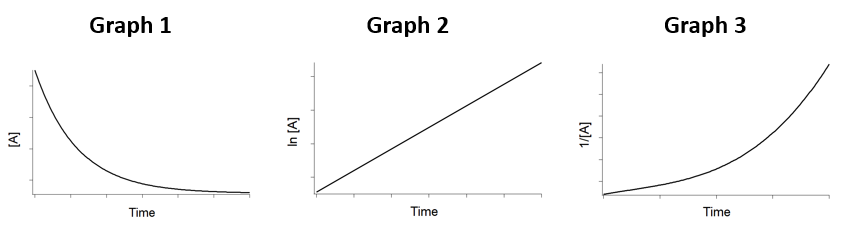
Based on the figure above, what is the order of reaction?
Based on the figure above, what is the order of reaction?
Tap to reveal answer
For a first order reaction, the ln \[A\]t is linear with t.
For a first order reaction, the ln \[A\]t is linear with t.
← Didn't Know|Knew It →
A compound decomposes by a first-order process. If 25.0% of the compound decomposes in 60 minutes, the half-life of the compound is?
A compound decomposes by a first-order process. If 25.0% of the compound decomposes in 60 minutes, the half-life of the compound is?
Tap to reveal answer


← Didn't Know|Knew It →
Cyclopentane is unstable and decomposes by a first order reaction. The rate constant for this reaction is 9.5 s-1. What is the half life of the reaction?
Cyclopentane is unstable and decomposes by a first order reaction. The rate constant for this reaction is 9.5 s-1. What is the half life of the reaction?
Tap to reveal answer

← Didn't Know|Knew It →
The half life of a first order reaction is 1.5 hours. What is the rate constant of this reaction?
The half life of a first order reaction is 1.5 hours. What is the rate constant of this reaction?
Tap to reveal answer


← Didn't Know|Knew It →
Which of the following is not an assumption of the kinetic molecular theory of gases?
Which of the following is not an assumption of the kinetic molecular theory of gases?
Tap to reveal answer
The kinetic molecular theory of gases states that the average kinetic energy of gas particles is proportional to temperature, and it is the same for all gases at a given temperature. This is the opposite of what is stated in the answer choice.
The kinetic molecular theory of gases states that the average kinetic energy of gas particles is proportional to temperature, and it is the same for all gases at a given temperature. This is the opposite of what is stated in the answer choice.
← Didn't Know|Knew It →
Two moles of nitrogen gas are kept in a glass container. The temperature of the gas is 400K.
What is the kinetic energy of the gas?
Two moles of nitrogen gas are kept in a glass container. The temperature of the gas is 400K.
What is the kinetic energy of the gas?
Tap to reveal answer
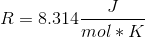
Using the equation 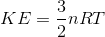 , n being the number of moles, R being 8.314, and T being the temperature in Kelvin, we can find the kinetic energy of two moles of gas in a container.


Using the equation
← Didn't Know|Knew It →
Why does a higher temperature result in a faster reaction?
Why does a higher temperature result in a faster reaction?
Tap to reveal answer
The temperature of a system can be manipulated to increase the reaction rate. The temperature affects the rate of the reaction because as temperature increases, so does the average kinetic energy. This means that molecules (reactants) are moving around more quickly, resulting in more frequent molecular collisions, resulting in an increased rate of product formation.
The temperature of a system can be manipulated to increase the reaction rate. The temperature affects the rate of the reaction because as temperature increases, so does the average kinetic energy. This means that molecules (reactants) are moving around more quickly, resulting in more frequent molecular collisions, resulting in an increased rate of product formation.
← Didn't Know|Knew It →
Which of the following statements in not an assumption made in kinetic molecular theory?
Which of the following statements in not an assumption made in kinetic molecular theory?
Tap to reveal answer
The average kinetic energy is considered to be a sole function of temperature; pressure is not a factor. All of the other statements are assumptions of kinetic molecular theory.
The average kinetic energy is considered to be a sole function of temperature; pressure is not a factor. All of the other statements are assumptions of kinetic molecular theory.
← Didn't Know|Knew It →