
Representations of Solutions
AP Chemistry · Learn by Concept
Help Questions
AP Chemistry › Representations of Solutions
Which of the following would most likely form a homogeneous solution?
Water and benzene (C6H6)
NaNO3 and octanol (C8H18O)
NH4Cl and water
A and B
All would form homogeneous solutions
Explanation
Like dissolves like. The NH4Cl and water mixture involves an ionic solid and a polar solvent. Examples a and b involve mixing polar/non-polar solvents and ionic and non-polar solvents.
Which of these solutions can be separated via chromatography?
Soil and water
Ethanol and water
A homogeneous solution of organic solvents
B and C
None of the above
Explanation
Chromatography is the physical separation of components of a mixture. Answers b and c can be separated by chromatography due to their homogeneous nature. The soil and water example would be separated by filtration.
What would be the best solvent would you choose to dissolve C31H64?
Water
Acetone (C3H6O)
Ethanol (C2H5OH)
Toluene (C7H8)
All of the above
Explanation
C31H64 is a non-polar substance and would dissolve best in a non-polar solvent like Toluene.
If 50g of NaCl are dissolved in 5 L of water what is the solute and what is the solvent?
NaCl is the solute and H2O is the solvent
NaCl is the solvent and H2O is the solute
Both are solutes since they are mixed together
They both are solvents because they dissolve into each other
NaCl can not be dissolved in water because NaCl is ionic and water is a polar solvent
Explanation
The solvent is what you the most off. In this case water is the solvent and sodium chloride is the solute.
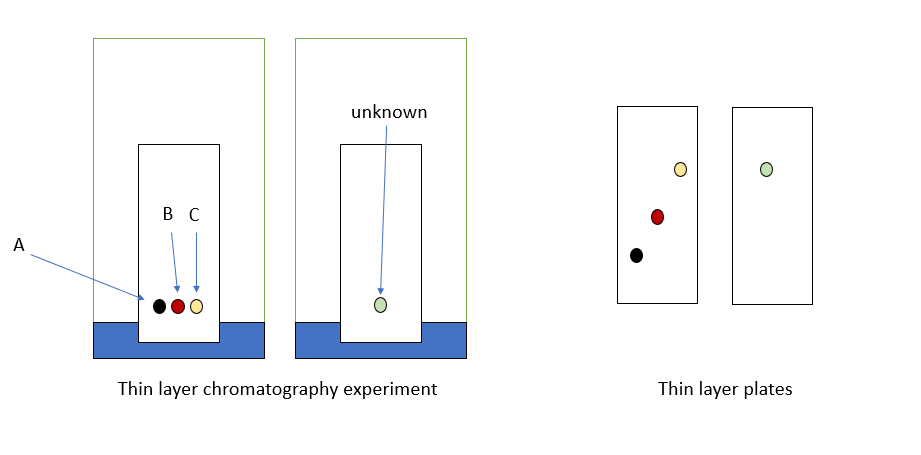
A student investigates a series of compounds in a thin layer chromatography experiment. The student has a sample of three organic compounds labeled A, B, and C as well as an unknown compound. The student performs the experiment as shown on the left above and gets the results shown on the right. What organic compound is in the unknown sample?
Sample A
Sample B
Sample C
Sample A + B + C
None of the above
Explanation
The unknown sample gives a single spot that has migrated to the same amount as Sample C.