
Mechanics Exam - AP Physics C: Electricity and Magnetism
Card 1 of 1815
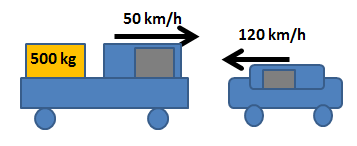
A 5000kg pickup truck with a 500kg load is traveling at a velocity of  . It crashes with a 3000kg car traveling in the opposite direction with a velocity of
  . The truck (together with its load) and the car stick together after they crash. What is their velocity after the collision?
A 5000kg pickup truck with a 500kg load is traveling at a velocity of
Tap to reveal answer
We need to use conservation of momentum to solve this problem.
Initially, the pickup truck moves at  . The load moves together with the truck so the load is also moving at
  .
.
We can calculate the truck-load momentum as follows:

Note that this is the sum of the truck's momentum AND the load's momentum. We are looking at is as a whole since they are moving together.
The car moves at  . Be careful with signs here! The problem says it moves in the opposite direction. We used a positive velocity for the truck/load, so the velocity of the car should be negative if it is moving in the opposite direction. We can also see from the diagram that the car is moving to the left.
Therefore, we have that the momentum for the car as:

We can find the initial momentum of the system (truck, load, and car) via simple addition:

After the collision, we know that all three objects move together, so they all move with the same velocity. Therefore we can express the momentum of the system after the collision as follows:

 is the velocity of the objects after the collision. This is the sum of the momentum of all three objects; we were able to simplify the equation because they all move with the same velocity.

By conservation of momentum we know that the momentum of the system before the collision is equal to the momentum of the system after the collision.

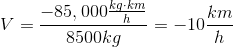
Use this to solve for the final velocity.

We need to use conservation of momentum to solve this problem.
Initially, the pickup truck moves at
We can calculate the truck-load momentum as follows:
Note that this is the sum of the truck's momentum AND the load's momentum. We are looking at is as a whole since they are moving together.
The car moves at
Therefore, we have that the momentum for the car as:
We can find the initial momentum of the system (truck, load, and car) via simple addition:
After the collision, we know that all three objects move together, so they all move with the same velocity. Therefore we can express the momentum of the system after the collision as follows:
By conservation of momentum we know that the momentum of the system before the collision is equal to the momentum of the system after the collision.
Use this to solve for the final velocity.
← Didn't Know|Knew It →
Two identical atoms, A and B, are at rest some distance apart in a vacuum.
If atom A moves at a constant velocity,  , toward atom B, which of the following is most likely to be true?
Two identical atoms, A and B, are at rest some distance apart in a vacuum.
If atom A moves at a constant velocity,
Tap to reveal answer
Assuming the atoms have the same mass, a collision between atoms in a vacuum is most nearly an elastic collision. This means the kinetic energy of the system is conserved and when they collide, all of the kinetic energy in atom A will be transferred perfectly to atom B. So just after collision, atom A will have velocity  and atom B will have velocity
  . Note that momentum is always conserved.
Assuming the atoms have the same mass, a collision between atoms in a vacuum is most nearly an elastic collision. This means the kinetic energy of the system is conserved and when they collide, all of the kinetic energy in atom A will be transferred perfectly to atom B. So just after collision, atom A will have velocity
← Didn't Know|Knew It →
A pickup truck with a mass of  is travelling along a highway at a velocity of
  when the brakes suddenly give out. In order to slow the vehicle, a mass of sand will be dumped into the back of the pickup truck by another vehicle.
Assuming no outside forces are acting on the system, how many  of sand would need to be dumped in the rear of the pickup truck to reduce its speed to
  ?
?
A pickup truck with a mass of
Assuming no outside forces are acting on the system, how many
Tap to reveal answer
Because of conservation of momentum, the product of the initial mass and velocity should equal the final mass and velocity. The equation for conservation of momentum is:

The initial mass of the truck is 
The initial velocty is 
The final velocity is 
Plug in known values to the conservation of momentum equation.

Simplify.


Note that while necessary, the final mass is not our final answer. The final mass,  , is the mass of the truck,
  , and the mass of the sand added to the truck,
  .
.
The mass of the truck is known so set up an equation and solve for the mass of sand added to the truck.



Because of conservation of momentum, the product of the initial mass and velocity should equal the final mass and velocity. The equation for conservation of momentum is:
The initial mass of the truck is
The initial velocty is
The final velocity is
Plug in known values to the conservation of momentum equation.
Simplify.
Note that while necessary, the final mass is not our final answer. The final mass,
The mass of the truck is known so set up an equation and solve for the mass of sand added to the truck.
← Didn't Know|Knew It →
A pickup truck with a mass of  is travelling along a highway at a velocity of
  when the brakes suddenly give out. In order to slow the vehicle, a mass of sand will be dumped into the back of the pickup truck by another vehicle.
It turns out the truck can only take on an additional  payload without risking structural damage. By how much will the speed of the truck be reduced after
  of sand is dumped in the truck bed?
A pickup truck with a mass of
It turns out the truck can only take on an additional
Tap to reveal answer
The equation for conservation of momentum is:

Given:



Plug in given values into the conservation of momentum equation.

Simplify.



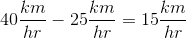
Subtract the final velocity from the initial velocity to find change in speed (since these velocities are in the same direction).
 .
.
The equation for conservation of momentum is:
Given:
Plug in given values into the conservation of momentum equation.
Simplify.
Subtract the final velocity from the initial velocity to find change in speed (since these velocities are in the same direction).
← Didn't Know|Knew It →
A pitcher throws a 0.15kg baseball at  towards the batter and the batter hits the ball with his bat. The ball leaves the bat in the opposite direction at a speed of
  . Calculate the impulse experienced by the baseball.
A pitcher throws a 0.15kg baseball at
Tap to reveal answer
To calculate the impulse, know that it is equal to the change in momentum.

Write the impulse equation in terms of mass and velocity.

In our case, the initial velocity of the baseball is  and its final velocity is
  , where the negative sign indicates that the ball is traveling in the opposite direction. Also, m = 0.15kg. The impulse on the ball can be calculated below.

The negative sign tells that the force on the baseball is opposed to the original momentum.
To calculate the impulse, know that it is equal to the change in momentum.
Write the impulse equation in terms of mass and velocity.
In our case, the initial velocity of the baseball is
The negative sign tells that the force on the baseball is opposed to the original momentum.
← Didn't Know|Knew It →
Which of the following could be used as units of impulse?
Which of the following could be used as units of impulse?
Tap to reveal answer
Relevant equations:


Impulse is defined as change in momentum, so has the same units as momentum. These units can easily be found using the given equations.


Relevant equations:
Impulse is defined as change in momentum, so has the same units as momentum. These units can easily be found using the given equations.
← Didn't Know|Knew It →
A baseball player hits a  baseball initially moving at
  , returning it at a speed of
  along the same path. If the ball was in contact with the bat for
  , what magnitude of force did the ball experience during the moment of contact?
A baseball player hits a
Tap to reveal answer
Relevant equations:


Evaluate the impulse based on the mass and change of velocity.

Use the total impulse and time in the second equation.


Solve for the average force.

Relevant equations:
Evaluate the impulse based on the mass and change of velocity.
Use the total impulse and time in the second equation.
Solve for the average force.
← Didn't Know|Knew It →
In an inelastic collision, which combination of quantities is conserved?
In an inelastic collision, which combination of quantities is conserved?
Tap to reveal answer
In a perfectly inelastic collision, the two colliding objects stick together; the two colliding objects deform, but mass is still conserved. Momentum is conserved during collisions of any sort, including inelastic collisions.
Kinetic energy is reduced during an inelastic collision, and is only conserved in elastic collisions. During inelastic collisions, some kinetic energy is lost to the environment in the form of heat or sound.
The problem does not give any information regarding position, and thus we cannot comment on any changes or lack of changes in potential energy.
In a perfectly inelastic collision, the two colliding objects stick together; the two colliding objects deform, but mass is still conserved. Momentum is conserved during collisions of any sort, including inelastic collisions.
Kinetic energy is reduced during an inelastic collision, and is only conserved in elastic collisions. During inelastic collisions, some kinetic energy is lost to the environment in the form of heat or sound.
The problem does not give any information regarding position, and thus we cannot comment on any changes or lack of changes in potential energy.
← Didn't Know|Knew It →
In an elastic collision, what combination of quantities is conserved?
In an elastic collision, what combination of quantities is conserved?
Tap to reveal answer
The primary difference between elastic and inelastic collisions is the conservation of kinetic energy. Kinetic energy is conserved in elastic collisions, but is not conserved in inelastic collisions. Momentum is always conserved, regardless of collision type. Mass is conserved regardless of collision type as well, but the mass may be deformed by an inelastic collision, resulting in the two original masses being stuck together.
There is no description in the problem reagrding position, so we cannot comment on potential energy.
The primary difference between elastic and inelastic collisions is the conservation of kinetic energy. Kinetic energy is conserved in elastic collisions, but is not conserved in inelastic collisions. Momentum is always conserved, regardless of collision type. Mass is conserved regardless of collision type as well, but the mass may be deformed by an inelastic collision, resulting in the two original masses being stuck together.
There is no description in the problem reagrding position, so we cannot comment on potential energy.
← Didn't Know|Knew It →
A 200kg car is traveling west at  . It collides with a 150kg car that was at rest. Following the collision, the second car moves with a velocity of
  west. Assuming that the collision is elastic, what is the velocity of the first car after the collision?
A 200kg car is traveling west at
Tap to reveal answer
The collision is assumed to be elastic, so both momentum and kinetic energy are conserved. Use the law of conservation of momentum:
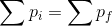
Momentum is the product of velocity and mass:

We can expand the summation for the initial and final conditions:

Use the given values to fill in the equation and solve for  :
:



Since the final velocity is positive, we know that the car is still traveling toward the west.
The collision is assumed to be elastic, so both momentum and kinetic energy are conserved. Use the law of conservation of momentum:
Momentum is the product of velocity and mass:
We can expand the summation for the initial and final conditions:
Use the given values to fill in the equation and solve for
Since the final velocity is positive, we know that the car is still traveling toward the west.
← Didn't Know|Knew It →
Two train cars, each with a mass of 2400 kg, are traveling along the same track. One car is traveling with a velocity of  east, while the other travels with a velocity of
  west. The two cars collide and stick together as one mass. What is the magnitude and direction of the resulting velocity?
Two train cars, each with a mass of 2400 kg, are traveling along the same track. One car is traveling with a velocity of
Tap to reveal answer
Use the law of conservation of momentum:
Momentum is the product of velocity and mass:
We can expand the summation for the initial and final conditions:
Note that we are working with an inelastic collision, meaning that the two masses stick together after the collision. Because of this, they will have the same final velocity:


Use the given values to fill in the equation and solve for  . Keep in mind that we must designate a positive direction and a negative direction. We will use east as positive and west as negative.


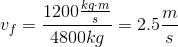
Since the final velocity is positive, we can determine that they train cars are traveling toward the east.
Use the law of conservation of momentum:
Momentum is the product of velocity and mass:
We can expand the summation for the initial and final conditions:
Note that we are working with an inelastic collision, meaning that the two masses stick together after the collision. Because of this, they will have the same final velocity:
Use the given values to fill in the equation and solve for
Since the final velocity is positive, we can determine that they train cars are traveling toward the east.
← Didn't Know|Knew It →
A  bullet is fired at
  at a block of wood that is moving in the opposite direction at a speed of
  . The bullet passes through the block and emerges with the speed of
  , while the block ends up at rest.
What is the mass of the block?
A
What is the mass of the block?
Tap to reveal answer
This problem is a conservation of momentum problem. When doing these types of problems, the equation to jump to is:

It is given to us that  is
is  or
or  ,
,  is
is  ,
,  is unknown,
  is
is  .
.
 is
is  and
and  is
is  .
.
With all this information given, the only unknown is  .
.
Plugging everything in, we get:

This problem is a conservation of momentum problem. When doing these types of problems, the equation to jump to is:
It is given to us that
With all this information given, the only unknown is
Plugging everything in, we get:
← Didn't Know|Knew It →
We have two balls. The first ball has mass 0.54kg and is traveling 7.1m/s to the right. It collides head-on elastically with a second ball of mass 0.95kg traveling 2.8m/s to the left. After the collision, what is the speed and direction of each ball?


We have two balls. The first ball has mass 0.54kg and is traveling 7.1m/s to the right. It collides head-on elastically with a second ball of mass 0.95kg traveling 2.8m/s to the left. After the collision, what is the speed and direction of each ball?
Tap to reveal answer
We must use conservation of momentum to tackle this problem.

We are to find  and
and  , the velocities of the balls after the collision. We know the following for the first ball:


and we know the following for the second ball:

 .
.
After plugging these values into our conservation of momentum equation, it is clear that we can't use this equation alone to find  and
and  ; however, since we are dealing with an elastic collision, we can use the relation below.

This relation can be derived using conservation of momentum and conservation of kinetic energy equations. Remember that kinetic energy is only conserved if the collision is elastic. We can use this relation to eliminate either  or
or  in our conservation of momentum equation.

Plug this into our conservation of momentum equation.

So now  is eliminated and we can solve for
  .
.


This is the speed of the second ball, and it is traveling to the right because of the positive value. Use this positive value to find  by using the relation we found earlier.


This is the speed of the first ball and it is traveling to the left due to the negative sign.
We must use conservation of momentum to tackle this problem.
We are to find
and we know the following for the second ball:
After plugging these values into our conservation of momentum equation, it is clear that we can't use this equation alone to find
This relation can be derived using conservation of momentum and conservation of kinetic energy equations. Remember that kinetic energy is only conserved if the collision is elastic. We can use this relation to eliminate either
Plug this into our conservation of momentum equation.
So now
This is the speed of the second ball, and it is traveling to the right because of the positive value. Use this positive value to find
This is the speed of the first ball and it is traveling to the left due to the negative sign.
← Didn't Know|Knew It →
A 30kg cart travels at 9m/s and it hits another cart of mass 46kg traveling at 4m/s in the opposite direction. After the collision, they stick together to form one cart. Find the speed of this cart
A 30kg cart travels at 9m/s and it hits another cart of mass 46kg traveling at 4m/s in the opposite direction. After the collision, they stick together to form one cart. Find the speed of this cart
Tap to reveal answer
For the 30 kg cart, we know


and for the 46 g cart, we know

 .
.
After the collision, we have  .
.
Use conservation of momentum to solve this problem.


For the 30 kg cart, we know
and for the 46 g cart, we know
After the collision, we have
Use conservation of momentum to solve this problem.
← Didn't Know|Knew It →
There are two skaters. The male skater with mass 68kg travels 15m/s North. He approaches a 60kg female skater who is travel 12m/s East; they approach each other at right angles. When they meet, they hold on to each other. At what direction and speed do they move after they meet?
There are two skaters. The male skater with mass 68kg travels 15m/s North. He approaches a 60kg female skater who is travel 12m/s East; they approach each other at right angles. When they meet, they hold on to each other. At what direction and speed do they move after they meet?
Tap to reveal answer
This is a two-dimensional inelastic collision problem and we use conservation of momentum to solve. We know the following.
Male skater:  ,
, 
Female skater:  ,
,
First, write down two equations representing conservation of momentum. One equation represents momentum in the x-direction (East-West direction), which is  ,and the other gives the momentum in the y-direction (North-South direction),
  .
.
Take the y-direction of momentum and divide it by the x-direction momentum.

Simplify.


Plug in the numbers to find the angle


To find the speed at which they move at this angle we can use one of the momentum equations.

Solve for v.


This is a two-dimensional inelastic collision problem and we use conservation of momentum to solve. We know the following.
Male skater:
Female skater:
First, write down two equations representing conservation of momentum. One equation represents momentum in the x-direction (East-West direction), which is
Take the y-direction of momentum and divide it by the x-direction momentum.
Simplify.
Plug in the numbers to find the angle
To find the speed at which they move at this angle we can use one of the momentum equations.
Solve for v.
← Didn't Know|Knew It →
Object A has mass  and initially moves to the right at
  . It then collides with object B, which has mass
  and was initially moving to the right at
  . If the two objects stick together after the collision, what percentage of the initial kinetic energy has been dissipated?
Object A has mass
Tap to reveal answer
Relevant equations:


Use conservation of momentum to determine the final velocity of the objects.


Calculate the total initial kinetic energy of the two objects.


Calculate the total final kinetic energy of the two objects.


Find the difference in kinetic energy.

This is the amount of kinetic energy lost during the inelastic collision. Express this amount as a percentage of the initial kinetic energy.

Relevant equations:
Use conservation of momentum to determine the final velocity of the objects.
Calculate the total initial kinetic energy of the two objects.
Calculate the total final kinetic energy of the two objects.
Find the difference in kinetic energy.
This is the amount of kinetic energy lost during the inelastic collision. Express this amount as a percentage of the initial kinetic energy.
← Didn't Know|Knew It →
A man runs with a velocity described by the function below.

What is the function for his acceleration?
A man runs with a velocity described by the function below.
What is the function for his acceleration?
Tap to reveal answer
The function for acceleration is the derivative of the function for velocity.


The function for acceleration is the derivative of the function for velocity.
← Didn't Know|Knew It →
A man runs with a velocity as described by the function below.

How far does he travel in 1 minute?
A man runs with a velocity as described by the function below.
How far does he travel in 1 minute?
Tap to reveal answer
Distance is given by the integral of a velocity function. For this question, we will need to integrate over the interval of 0s to 60s.
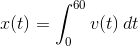


Distance is given by the integral of a velocity function. For this question, we will need to integrate over the interval of 0s to 60s.
← Didn't Know|Knew It →
A particle traveling in a straight line accelerates uniformly from rest to  in
in  and then continues at constant speed for an additional for an additional
  . What is the total distance traveled by the particle during the
  ?
?
A particle traveling in a straight line accelerates uniformly from rest to
Tap to reveal answer
First off we have to convert  to meters per second.

Next we have to calculate the distance the object traveled the first 5 seconds, when it was starting from rest. We are given time, initial speed to be  . The acceleration of the object at this time can be calculated using:
 , substituting the values, we get:

Next, we use the distance equation to find the distance in the first 5 seconds:
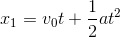
 because the initial speed is
  .
.
If we plug in  ,
,  , we get:
Next we have to find the distance the the object travels at constant speed for 3 seconds. We can use the equation:

 in this case is not equal to
  , it is equal to
  and
and 
Plugging in the equation, we get 
Adding  and
and  we get the total distance to be
First off we have to convert
Next we have to calculate the distance the object traveled the first 5 seconds, when it was starting from rest. We are given time, initial speed to be
Next, we use the distance equation to find the distance in the first 5 seconds:
If we plug in
Next we have to find the distance the the object travels at constant speed for 3 seconds. We can use the equation:
Plugging in the equation, we get
Adding
← Didn't Know|Knew It →
A  ball is thrown horizontally from the top of a
  high building. It has an initial velocity of
  and lands on the ground
  away from the base of the building. Assuming air resistance is negligible, which of the following changes would cause the range of this projectile to increase?
I. Increasing the initial horizontal velocity
II. Decreasing the mass of the ball
III. Throwing the ball from an identical building on the moon
A
I. Increasing the initial horizontal velocity
II. Decreasing the mass of the ball
III. Throwing the ball from an identical building on the moon
Tap to reveal answer
Relevant equations:
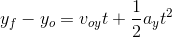

Choice I is true because  is proportional to the range
  , so increasing
  increases
  if
if  is constant. This relationship is given by the equation:

Choice II is false because the motion of a projectile is independent of mass.
Choice III is true because the vertical acceleration on the moon  would be less. Decreasing
  increases the time the ball is in the air, thereby increasing
  if
if  is constant. This relationship is also shown in the equation:

Relevant equations:
Choice I is true because
Choice II is false because the motion of a projectile is independent of mass.
Choice III is true because the vertical acceleration on the moon
← Didn't Know|Knew It →