
Work, Energy, and Power - AP Physics C: Electricity and Magnetism
Card 1 of 297
A train car with a mass of 2400 kg starts from rest at the top of a 150 meter-high hill. What will its velocity be when it reaches the bottom of the hill, assuming that the bottom of the hill is the reference level.
A train car with a mass of 2400 kg starts from rest at the top of a 150 meter-high hill. What will its velocity be when it reaches the bottom of the hill, assuming that the bottom of the hill is the reference level.
Tap to reveal answer
The law of conservation of energy states:

If the car starts at rest, then the initial kinetic energy = 0 J.
If the car ends at the reference height, the final potential energy = 0 J.
Subsituting these values, the equation becomes:

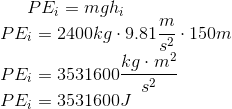
The initial potential energy can be determined by:
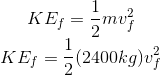
The final kinetic energy equation is:
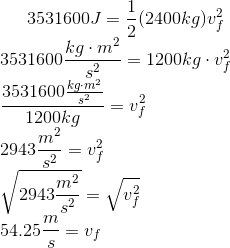
Substituting the initial potential energy and final kinetic energy into our modified conservation of energy equation, we get:
The law of conservation of energy states:
If the car starts at rest, then the initial kinetic energy = 0 J.
If the car ends at the reference height, the final potential energy = 0 J.
Subsituting these values, the equation becomes:
The initial potential energy can be determined by:
The final kinetic energy equation is:
Substituting the initial potential energy and final kinetic energy into our modified conservation of energy equation, we get:
← Didn't Know|Knew It →
A 120kg box has a kinetic energy of 2300J. What is its velocity?
A 120kg box has a kinetic energy of 2300J. What is its velocity?
Tap to reveal answer
The formula for kinetic energy of an object is:

The problem gives us the mass and the kinetic energy, and asks for the velocity, so we can rearrange the equation:

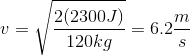
Use our given values for kinetic energy and mass to solve:
The formula for kinetic energy of an object is:
The problem gives us the mass and the kinetic energy, and asks for the velocity, so we can rearrange the equation:
Use our given values for kinetic energy and mass to solve:
← Didn't Know|Knew It →
An object has a mass of 5kg and has a position described by the given function:

What is the object's kinetic energy after two seconds?
An object has a mass of 5kg and has a position described by the given function:
What is the object's kinetic energy after two seconds?
Tap to reveal answer
Kinetic energy is defined by the equation:

Taking the derivative of the position function allows us to obtain the velocity function:

We can now determine the velocity after two seconds:

Now that we know our velocity, we can solve for the kinetic energy.

Kinetic energy is defined by the equation:
Taking the derivative of the position function allows us to obtain the velocity function:
We can now determine the velocity after two seconds:
Now that we know our velocity, we can solve for the kinetic energy.
← Didn't Know|Knew It →
An object starts from rest and accelerates at a rate of  . If the object has a mass of 10kg, what is its kinetic energy after three seconds?
An object starts from rest and accelerates at a rate of
Tap to reveal answer
Kinetic energy is given by the equation:

We can find the velocity using the given acceleration and time:


Use this velocity to find the kinetic energy after three seconds:

Kinetic energy is given by the equation:
We can find the velocity using the given acceleration and time:
Use this velocity to find the kinetic energy after three seconds:
← Didn't Know|Knew It →
Calculate how much potential energy a vertical standing spring gains if someone puts a 4kg box on top of it. Take the spring constant to be 120N/s.
Calculate how much potential energy a vertical standing spring gains if someone puts a 4kg box on top of it. Take the spring constant to be 120N/s.
Tap to reveal answer
First, find out how much the spring compresses when the 4kg box is put on top of it. To find this, consider what forces are acting on the box when it is resting on the spring. The forces acting on it are the upward spring force,  , and the downward gravitational force,
 ; thus, the net force acting on the box is given by the equation below.

We have chosen the upward direction to be positive and the downward direction to be negative. The net force is equal to zero because the box is at rest. Solve for x.

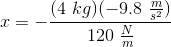

Then use this value to find the potential energy of the spring.



So when the box is placed on top of the spring, the spring gains a potential energy of 6.5J.
First, find out how much the spring compresses when the 4kg box is put on top of it. To find this, consider what forces are acting on the box when it is resting on the spring. The forces acting on it are the upward spring force,
We have chosen the upward direction to be positive and the downward direction to be negative. The net force is equal to zero because the box is at rest. Solve for x.
Then use this value to find the potential energy of the spring.
So when the box is placed on top of the spring, the spring gains a potential energy of 6.5J.
← Didn't Know|Knew It →
A man throws a 5kg ball straight up. At the top of its trajectory, the ball has a potential energy of 160 Joules. At what velocity does the man initially throw the ball?
A man throws a 5kg ball straight up. At the top of its trajectory, the ball has a potential energy of 160 Joules. At what velocity does the man initially throw the ball?
Tap to reveal answer
We can use conservation of energy to find the velocity required to launch the ball.




We can use conservation of energy to find the velocity required to launch the ball.
← Didn't Know|Knew It →
A man throws a 5kg ball straight up. At the top of its trajectory, the ball has a potential energy of 160 Joules. What is the highest point the ball reaches if it is thrown from the level of the ground?

A man throws a 5kg ball straight up. At the top of its trajectory, the ball has a potential energy of 160 Joules. What is the highest point the ball reaches if it is thrown from the level of the ground?
Tap to reveal answer
The equation for potential energy is:

We can rearrange to solve for the height:

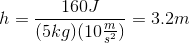
Plug in our given values to solve:
The equation for potential energy is:
We can rearrange to solve for the height:
Plug in our given values to solve:
← Didn't Know|Knew It →

A man launches a 5kg ball straight up from sea level. Disregarding drag, if the man would like to launch the ball into an escape trajectory from earth's gravity, approximately how fast must he launch the ball (in meters per second)?


A man launches a 5kg ball straight up from sea level. Disregarding drag, if the man would like to launch the ball into an escape trajectory from earth's gravity, approximately how fast must he launch the ball (in meters per second)?
Tap to reveal answer
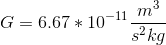
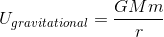
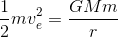
In order to launch the ball at a velocity that escapes Earth's gravity, the kinetic energy must overcome the gravitational pull of the Earth. We can use conservation of energy to make the kinetic energy and gravitational potential energies equivalent.
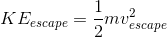

Rearrange to solve for the escape velocity:
Finally, plug in our values and solve.


In order to launch the ball at a velocity that escapes Earth's gravity, the kinetic energy must overcome the gravitational pull of the Earth. We can use conservation of energy to make the kinetic energy and gravitational potential energies equivalent.
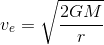
Rearrange to solve for the escape velocity:
Finally, plug in our values and solve.
← Didn't Know|Knew It →
A train car with a mass of 2400 kg starts from rest at the top of a 150 meter-high hill. What will its velocity be when it reaches the bottom of the hill, assuming that the bottom of the hill is the reference level.
A train car with a mass of 2400 kg starts from rest at the top of a 150 meter-high hill. What will its velocity be when it reaches the bottom of the hill, assuming that the bottom of the hill is the reference level.
Tap to reveal answer
The law of conservation of energy states:
If the car starts at rest, then the initial kinetic energy = 0 J.
If the car ends at the reference height, the final potential energy = 0 J.
Subsituting these values, the equation becomes:
The initial potential energy can be determined by:
The final kinetic energy equation is:
Substituting the initial potential energy and final kinetic energy into our modified conservation of energy equation, we get:
The law of conservation of energy states:
If the car starts at rest, then the initial kinetic energy = 0 J.
If the car ends at the reference height, the final potential energy = 0 J.
Subsituting these values, the equation becomes:
The initial potential energy can be determined by:
The final kinetic energy equation is:
Substituting the initial potential energy and final kinetic energy into our modified conservation of energy equation, we get:
← Didn't Know|Knew It →
A 120kg box has a kinetic energy of 2300J. What is its velocity?
A 120kg box has a kinetic energy of 2300J. What is its velocity?
Tap to reveal answer
The formula for kinetic energy of an object is:
The problem gives us the mass and the kinetic energy, and asks for the velocity, so we can rearrange the equation:
Use our given values for kinetic energy and mass to solve:
The formula for kinetic energy of an object is:
The problem gives us the mass and the kinetic energy, and asks for the velocity, so we can rearrange the equation:
Use our given values for kinetic energy and mass to solve:
← Didn't Know|Knew It →
An object has a mass of 5kg and has a position described by the given function:
What is the object's kinetic energy after two seconds?
An object has a mass of 5kg and has a position described by the given function:
What is the object's kinetic energy after two seconds?
Tap to reveal answer
Kinetic energy is defined by the equation:
Taking the derivative of the position function allows us to obtain the velocity function:
We can now determine the velocity after two seconds:
Now that we know our velocity, we can solve for the kinetic energy.
Kinetic energy is defined by the equation:
Taking the derivative of the position function allows us to obtain the velocity function:
We can now determine the velocity after two seconds:
Now that we know our velocity, we can solve for the kinetic energy.
← Didn't Know|Knew It →
An object starts from rest and accelerates at a rate of . If the object has a mass of 10kg, what is its kinetic energy after three seconds?
An object starts from rest and accelerates at a rate of
Tap to reveal answer
Kinetic energy is given by the equation:
We can find the velocity using the given acceleration and time:
Use this velocity to find the kinetic energy after three seconds:
Kinetic energy is given by the equation:
We can find the velocity using the given acceleration and time:
Use this velocity to find the kinetic energy after three seconds:
← Didn't Know|Knew It →
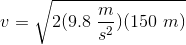
A 0.8kg ball is dropped from rest from a cliff that is 150m high. Use conservation of energy to find the vertical velocity of the ball right before it hits the bottom of the cliff.
A 0.8kg ball is dropped from rest from a cliff that is 150m high. Use conservation of energy to find the vertical velocity of the ball right before it hits the bottom of the cliff.
Tap to reveal answer
The conservation of energy equation is  .
.
The ball starts from rest so  . It starts at a height of 150m, so
  . When the ball reaches the bottom, height is zero and thus,
  and
and  . The conservation of energy equation can be adjusted below.

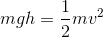
Solve for v.


The conservation of energy equation is
The ball starts from rest so
Solve for v.
← Didn't Know|Knew It →
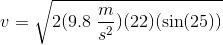
Starting from rest, a skateboarder travels down a 25o incline that's 22m long. Using conservation of energy, calculate the skateboarder's speed when he reaches the bottom. Ignore friction.
Starting from rest, a skateboarder travels down a 25o incline that's 22m long. Using conservation of energy, calculate the skateboarder's speed when he reaches the bottom. Ignore friction.
Tap to reveal answer
Conservation of energy states that  .
.
The skateboarder starts from rest; thus,  and
and  . At the bottom of the incline,
  and
and  .
.

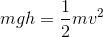
Solve for v.

Using trigonometry,  .
.

Conservation of energy states that
The skateboarder starts from rest; thus,
Solve for v.
Using trigonometry,
← Didn't Know|Knew It →
A  bowling ball is dropped from
  above the ground. What will its velocity be when it is
  above the ground?
A
Tap to reveal answer
Relevant equations:



Determine initial kinetic and potential energies when the ball is dropped.


Determine final kinetic and potential energies, when the ball has fallen to  above the ground.
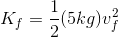

Use conservation of energy to equate initial and final energy sums.

Solve for the final velocity.

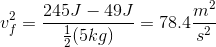
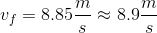
Relevant equations:
Determine initial kinetic and potential energies when the ball is dropped.
Determine final kinetic and potential energies, when the ball has fallen to
Use conservation of energy to equate initial and final energy sums.
Solve for the final velocity.
← Didn't Know|Knew It →
A solid metal object with mass of  is dropped from rest at the surface of a lake that is
  deep. The water exerts a drag force on the object as it sinks. If the total work done by the drag force is -
 , what is the speed of the object when it hits the sand at the bottom of the lake?
A solid metal object with mass of
Tap to reveal answer
This is a conservation of energy problem. First we have to find the work done by gravity. This can be found using:

It is given to us that the work done by the drag force is  which means that work is done in the opposite direction. We take the net work by adding the two works together we get,
  of net work done on the block.
Since this is a conservation of energy problem, we set the net work equal to the kinetic energy equation:

 is the mass of the block and we are trying to solve for
  .
.
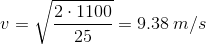
This is a conservation of energy problem. First we have to find the work done by gravity. This can be found using:
It is given to us that the work done by the drag force is
Since this is a conservation of energy problem, we set the net work equal to the kinetic energy equation:
← Didn't Know|Knew It →
If a roller coaster car is traveling at  when it is
  above the ground, how fast is it going when
  above the ground?
If a roller coaster car is traveling at
Tap to reveal answer
This is a classic conservation of energy problem. We know that potential energy and kinetic energy both have to conserve. So we use the following equation:

What this equations says is, the sum of kinetic and potential energy is same at varying heights and velocities.
We can simplify this equation by cancelling out all the m terms.
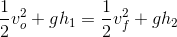
We know all the terms except for  , which is the final speed we are trying to solve for
  , which is
  ,
,  is
is  and
and  is
is  .
.
If we plug in all the numbers and solve for  , we get
  .
.
This is a classic conservation of energy problem. We know that potential energy and kinetic energy both have to conserve. So we use the following equation:
What this equations says is, the sum of kinetic and potential energy is same at varying heights and velocities.
We can simplify this equation by cancelling out all the m terms.
We know all the terms except for
If we plug in all the numbers and solve for
← Didn't Know|Knew It →
A 25kg child climbs up a tree. How much work is required for him to climb up this tree to a height of three meters?
A 25kg child climbs up a tree. How much work is required for him to climb up this tree to a height of three meters?
Tap to reveal answer
The forces acting on the child are the force of gravity and the upward force provided by the child himself. Choosing the upward direction as positive, Newton's second law applied to the child gives the following equation.


To calculate the work done by the child to bring himself three meters up the tree, we use the work equation below.

The forces acting on the child are the force of gravity and the upward force provided by the child himself. Choosing the upward direction as positive, Newton's second law applied to the child gives the following equation.
To calculate the work done by the child to bring himself three meters up the tree, we use the work equation below.
← Didn't Know|Knew It →
A force of 27N is applied horizontally to a box resting on a level surface. The surface exerts a friction force of 2N as the box moves. If it moves a total of 3.7m, how much work was done on the box?
A force of 27N is applied horizontally to a box resting on a level surface. The surface exerts a friction force of 2N as the box moves. If it moves a total of 3.7m, how much work was done on the box?
Tap to reveal answer
The net force on the box is the applied force minus the friction force, since friction acts in the direction opposite motion.

Consequently, the net force is:

The formula for work is:

Substituting in our net force and distance, we find that the work done on the box is:


The net force on the box is the applied force minus the friction force, since friction acts in the direction opposite motion.
Consequently, the net force is:
The formula for work is:
Substituting in our net force and distance, we find that the work done on the box is:
← Didn't Know|Knew It →
An object is pushed across a rough surface with a force of 53N. The rough surface exerts a frictional force of 3.47N on the object. If the object is pushed 7.9m, how much work is done on the object?
An object is pushed across a rough surface with a force of 53N. The rough surface exerts a frictional force of 3.47N on the object. If the object is pushed 7.9m, how much work is done on the object?
Tap to reveal answer
The defintion of work is:

The net force on this object is:

We can calculate this term using the given values:

The distance is given. Substituting these values:

The defintion of work is:
The net force on this object is:
We can calculate this term using the given values:
The distance is given. Substituting these values:
← Didn't Know|Knew It →