Understanding Linear-Rotational Equivalents
AP Physics C: Electricity and Magnetism · Learn by Concept
Help Questions
AP Physics C: Electricity and Magnetism › Understanding Linear-Rotational Equivalents
In rotational kinematics equations, what quantity is analogous to force in linear kinematics equations?
Torque
Impulse
Moment of inertia
Angular acceleration
Explanation
Just as force causes linear acceleration, torque causes angular acceleration. This can be seen most in the linear-rotational comparison of Newton's second law:


What is the rotational equivalent of mass?
Moment of inertia
Torque
Angular momentum
Radius
Explanation
The correct answer is moment of inertia. For linear equations, mass is what resists force and causes lower linear accelerations. Similarly, in rotational equations, moment of inertia resists torque and causes lower angular accelerations.
A boot is put in a 


Explanation
Linear (tangential) velocity, 

Here, 


Solve.


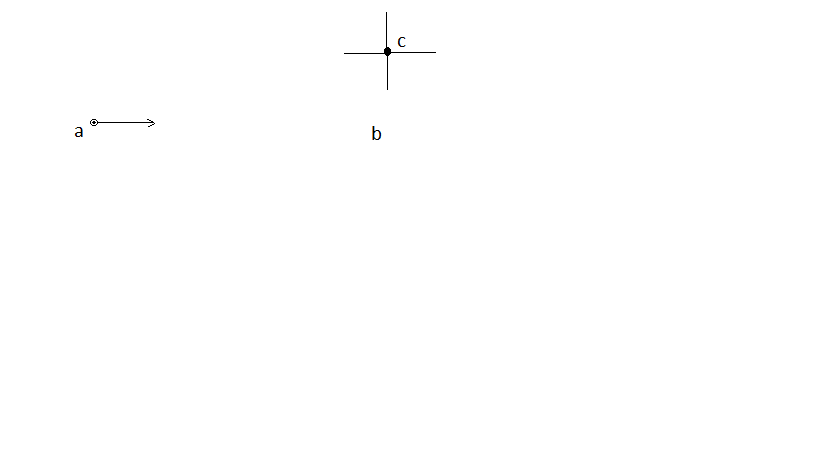
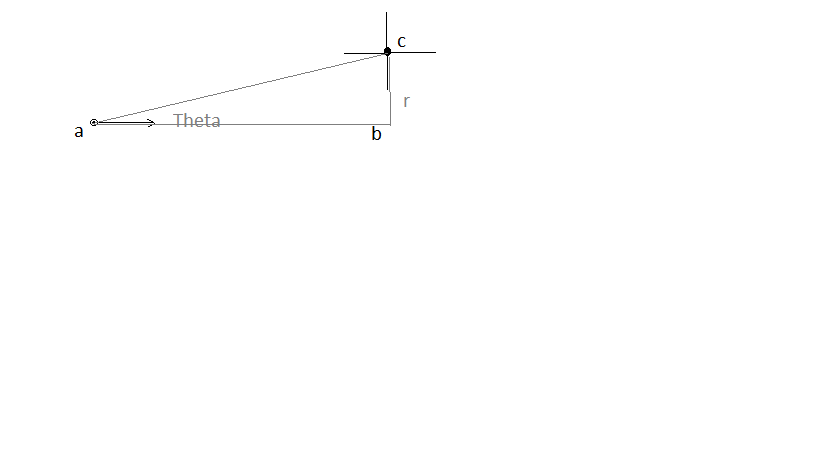
A particle is moving at constant speed in a straight line past a fixed point in space, c. How does the angular momentum of the particle about the fixed point in space change as the particle moves from point a to point b?
The angular momentum does not change
The angular momentum increases
The angular momentum decreases
The particle does not have angular momentum since it is not rotating
It cannot be determined without knowing the mass of the particle
Explanation
The angular momentum of a particle about a fixed axis is