
Understand Functions: CCSS.Math.Content.8.F.A.1 - 8th Grade Math
Card 0 of 80
Solve for  :
:

Solve for
To factor this equation, first find two numbers that multiply to 35 and sum to 12. These numbers are 5 and 7. Split up 12x using these two coefficients:


To factor this equation, first find two numbers that multiply to 35 and sum to 12. These numbers are 5 and 7. Split up 12x using these two coefficients:
Compare your answer with the correct one above
Which of the following equations represents a one-to-one function:


Which of the following equations represents a one-to-one function:
Only equation B maps each value of  into a unique value of
  and in a similar way each and every value of
  maps into one and only one value of
  .
.
Only equation B maps each value of
Compare your answer with the correct one above

Find  .
.
Find
This question demonstrates that complicated functions are not complicated at every point.
To solve the function at x=1, all that is necessary is familiarity with the operations used.


This question demonstrates that complicated functions are not complicated at every point.
To solve the function at x=1, all that is necessary is familiarity with the operations used.
Compare your answer with the correct one above
Solve for  :
:

Solve for
To find  , we must factor the quadratic function:


To find
Compare your answer with the correct one above
Solve for  :
:

Solve for
To find  , we want to factor the quadratic function:


To find
Compare your answer with the correct one above
Define  .
.
Evaluate  .
.
Define
Evaluate
To evaluate  substitute six in for every x in the equation.

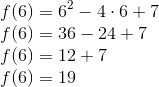
To evaluate
Compare your answer with the correct one above
Define 
Which of the following is equivalent to  ?
?
Define
Which of the following is equivalent to
To solve this problem replace every x in  with
with  .
.

Therefore,




To solve this problem replace every x in
Therefore,
Compare your answer with the correct one above
Select the table that properly represents a function.
Select the table that properly represents a function.
Each of the tables provided contains sets of ordered pairs. The input column represents the x-variables, and the output column represents the y-variables. We can tell if a set of ordered pairs represents a function when we match x-values to y-values.
In order for a table to represents a function, there must be one and only one input for every output. This means that our correct answer will have all unique input values:

Functions cannot have more than one input value that is the same; thus, the following tables do not represent a function:


Each of the tables provided contains sets of ordered pairs. The input column represents the x-variables, and the output column represents the y-variables. We can tell if a set of ordered pairs represents a function when we match x-values to y-values.
In order for a table to represents a function, there must be one and only one input for every output. This means that our correct answer will have all unique input values:
Functions cannot have more than one input value that is the same; thus, the following tables do not represent a function:
Compare your answer with the correct one above
Select the table that properly represents a function.
Select the table that properly represents a function.
Each of the tables provided contains sets of ordered pairs. The input column represents the x-variables, and the output column represents the y-variables. We can tell if a set of ordered pairs represents a function when we match x-values to y-values.
In order for a table to represents a function, there must be one and only one input for every output. This means that our correct answer will have all unique input values:

Functions cannot have more than one input value that is the same; thus, the following tables do not represent a function:


Each of the tables provided contains sets of ordered pairs. The input column represents the x-variables, and the output column represents the y-variables. We can tell if a set of ordered pairs represents a function when we match x-values to y-values.
In order for a table to represents a function, there must be one and only one input for every output. This means that our correct answer will have all unique input values:
Functions cannot have more than one input value that is the same; thus, the following tables do not represent a function:
Compare your answer with the correct one above
Select the table that properly represents a function.
Select the table that properly represents a function.
Each of the tables provided contains sets of ordered pairs. The input column represents the x-variables, and the output column represents the y-variables. We can tell if a set of ordered pairs represents a function when we match x-values to y-values.
In order for a table to represents a function, there must be one and only one input for every output. This means that our correct answer will have all unique input values:

Functions cannot have more than one input value that is the same; thus, the following tables do not represent a function:


Each of the tables provided contains sets of ordered pairs. The input column represents the x-variables, and the output column represents the y-variables. We can tell if a set of ordered pairs represents a function when we match x-values to y-values.
In order for a table to represents a function, there must be one and only one input for every output. This means that our correct answer will have all unique input values:
Functions cannot have more than one input value that is the same; thus, the following tables do not represent a function:
Compare your answer with the correct one above
Select the table that properly represents a function.
Select the table that properly represents a function.
Each of the tables provided contains sets of ordered pairs. The input column represents the x-variables, and the output column represents the y-variables. We can tell if a set of ordered pairs represents a function when we match x-values to y-values.
In order for a table to represents a function, there must be one and only one input for every output. This means that our correct answer will have all unique input values:

Functions cannot have more than one input value that is the same; thus, the following tables do not represent a function:


Each of the tables provided contains sets of ordered pairs. The input column represents the x-variables, and the output column represents the y-variables. We can tell if a set of ordered pairs represents a function when we match x-values to y-values.
In order for a table to represents a function, there must be one and only one input for every output. This means that our correct answer will have all unique input values:
Functions cannot have more than one input value that is the same; thus, the following tables do not represent a function:
Compare your answer with the correct one above
Select the table that properly represents a function.
Select the table that properly represents a function.
Each of the tables provided contains sets of ordered pairs. The input column represents the x-variables, and the output column represents the y-variables. We can tell if a set of ordered pairs represents a function when we match x-values to y-values.
In order for a table to represents a function, there must be one and only one input for every output. This means that our correct answer will have all unique input values:

Functions cannot have more than one input value that is the same; thus, the following tables do not represent a function:


Each of the tables provided contains sets of ordered pairs. The input column represents the x-variables, and the output column represents the y-variables. We can tell if a set of ordered pairs represents a function when we match x-values to y-values.
In order for a table to represents a function, there must be one and only one input for every output. This means that our correct answer will have all unique input values:
Functions cannot have more than one input value that is the same; thus, the following tables do not represent a function:
Compare your answer with the correct one above
Select the table that properly represents a function.
Select the table that properly represents a function.
Each of the tables provided contains sets of ordered pairs. The input column represents the x-variables, and the output column represents the y-variables. We can tell if a set of ordered pairs represents a function when we match x-values to y-values.
In order for a table to represents a function, there must be one and only one input for every output. This means that our correct answer will have all unique input values:

Functions cannot have more than one input value that is the same; thus, the following tables do not represent a function:


Each of the tables provided contains sets of ordered pairs. The input column represents the x-variables, and the output column represents the y-variables. We can tell if a set of ordered pairs represents a function when we match x-values to y-values.
In order for a table to represents a function, there must be one and only one input for every output. This means that our correct answer will have all unique input values:
Functions cannot have more than one input value that is the same; thus, the following tables do not represent a function:
Compare your answer with the correct one above
Select the table that properly represents a function.
Select the table that properly represents a function.
Each of the tables provided contains sets of ordered pairs. The input column represents the x-variables, and the output column represents the y-variables. We can tell if a set of ordered pairs represents a function when we match x-values to y-values.
In order for a table to represents a function, there must be one and only one input for every output. This means that our correct answer will have all unique input values:

Functions cannot have more than one input value that is the same; thus, the following tables do not represent a function:
Each of the tables provided contains sets of ordered pairs. The input column represents the x-variables, and the output column represents the y-variables. We can tell if a set of ordered pairs represents a function when we match x-values to y-values.
In order for a table to represents a function, there must be one and only one input for every output. This means that our correct answer will have all unique input values:
Functions cannot have more than one input value that is the same; thus, the following tables do not represent a function:
Compare your answer with the correct one above
Select the table that properly represents a function.
Select the table that properly represents a function.
Each of the tables provided contains sets of ordered pairs. The input column represents the x-variables, and the output column represents the y-variables. We can tell if a set of ordered pairs represents a function when we match x-values to y-values.
In order for a table to represents a function, there must be one and only one input for every output. This means that our correct answer will have all unique input values:

Functions cannot have more than one input value that is the same; thus, the following tables do not represent a function:
Each of the tables provided contains sets of ordered pairs. The input column represents the x-variables, and the output column represents the y-variables. We can tell if a set of ordered pairs represents a function when we match x-values to y-values.
In order for a table to represents a function, there must be one and only one input for every output. This means that our correct answer will have all unique input values:
Functions cannot have more than one input value that is the same; thus, the following tables do not represent a function:
Compare your answer with the correct one above
Select the table that properly represents a function.
Select the table that properly represents a function.
Each of the tables provided contains sets of ordered pairs. The input column represents the x-variables, and the output column represents the y-variables. We can tell if a set of ordered pairs represents a function when we match x-values to y-values.
In order for a table to represents a function, there must be one and only one input for every output. This means that our correct answer will have all unique input values:

Functions cannot have more than one input value that is the same; thus, the following tables do not represent a function:
Each of the tables provided contains sets of ordered pairs. The input column represents the x-variables, and the output column represents the y-variables. We can tell if a set of ordered pairs represents a function when we match x-values to y-values.
In order for a table to represents a function, there must be one and only one input for every output. This means that our correct answer will have all unique input values:
Functions cannot have more than one input value that is the same; thus, the following tables do not represent a function:
Compare your answer with the correct one above
Select the table that properly represents a function.
Select the table that properly represents a function.
Each of the tables provided contains sets of ordered pairs. The input column represents the x-variables, and the output column represents the y-variables. We can tell if a set of ordered pairs represents a function when we match x-values to y-values.
In order for a table to represents a function, there must be one and only one input for every output. This means that our correct answer will have all unique input values:

Functions cannot have more than one input value that is the same; thus, the following tables do not represent a function:
Each of the tables provided contains sets of ordered pairs. The input column represents the x-variables, and the output column represents the y-variables. We can tell if a set of ordered pairs represents a function when we match x-values to y-values.
In order for a table to represents a function, there must be one and only one input for every output. This means that our correct answer will have all unique input values:
Functions cannot have more than one input value that is the same; thus, the following tables do not represent a function:
Compare your answer with the correct one above
Select the table that properly represents a function.
Select the table that properly represents a function.
Each of the tables provided contains sets of ordered pairs. The input column represents the x-variables, and the output column represents the y-variables. We can tell if a set of ordered pairs represents a function when we match x-values to y-values.
In order for a table to represents a function, there must be one and only one input for every output. This means that our correct answer will have all unique input values:

Functions cannot have more than one input value that is the same; thus, the following tables do not represent a function:
Each of the tables provided contains sets of ordered pairs. The input column represents the x-variables, and the output column represents the y-variables. We can tell if a set of ordered pairs represents a function when we match x-values to y-values.
In order for a table to represents a function, there must be one and only one input for every output. This means that our correct answer will have all unique input values:
Functions cannot have more than one input value that is the same; thus, the following tables do not represent a function:
Compare your answer with the correct one above
Select the table that properly represents a function.
Select the table that properly represents a function.
Each of the tables provided contains sets of ordered pairs. The input column represents the x-variables, and the output column represents the y-variables. We can tell if a set of ordered pairs represents a function when we match x-values to y-values.
In order for a table to represents a function, there must be one and only one input for every output. This means that our correct answer will have all unique input values:

Functions cannot have more than one input value that is the same; thus, the following tables do not represent a function:
Each of the tables provided contains sets of ordered pairs. The input column represents the x-variables, and the output column represents the y-variables. We can tell if a set of ordered pairs represents a function when we match x-values to y-values.
In order for a table to represents a function, there must be one and only one input for every output. This means that our correct answer will have all unique input values:
Functions cannot have more than one input value that is the same; thus, the following tables do not represent a function:
Compare your answer with the correct one above
Solve for :
Solve for
To factor this equation, first find two numbers that multiply to 35 and sum to 12. These numbers are 5 and 7. Split up 12x using these two coefficients:
To factor this equation, first find two numbers that multiply to 35 and sum to 12. These numbers are 5 and 7. Split up 12x using these two coefficients:
Compare your answer with the correct one above