
Transforms of Periodic Functions - Differential Equations
Card 1 of 4
Find the Laplace transform of the periodic function.

Find the Laplace transform of the periodic function.
Tap to reveal answer
This particular piecewise function is called a square wave. The period of this function is the length at which it takes the function to return to its starting point.
For this particular function
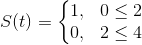
it has a period of
 .
.
and furthermore,

Using the Transform of a Periodic Function Theorem which states,

the problem can be solved as follows.

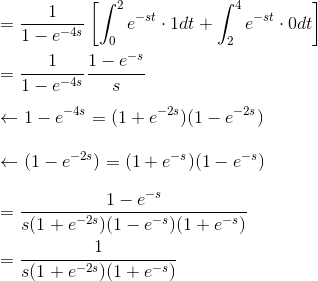
This particular piecewise function is called a square wave. The period of this function is the length at which it takes the function to return to its starting point.
For this particular function
it has a period of
and furthermore,
Using the Transform of a Periodic Function Theorem which states,
the problem can be solved as follows.
← Didn't Know|Knew It →
Find the Laplace transform of the periodic function.
Find the Laplace transform of the periodic function.
Tap to reveal answer
This particular piecewise function is called a square wave. The period of this function is the length at which it takes the function to return to its starting point.
For this particular function
it has a period of
.
and furthermore,
Using the Transform of a Periodic Function Theorem which states,
the problem can be solved as follows.
This particular piecewise function is called a square wave. The period of this function is the length at which it takes the function to return to its starting point.
For this particular function
it has a period of
and furthermore,
Using the Transform of a Periodic Function Theorem which states,
the problem can be solved as follows.
← Didn't Know|Knew It →
Find the Laplace transform of the periodic function.
Find the Laplace transform of the periodic function.
Tap to reveal answer
This particular piecewise function is called a square wave. The period of this function is the length at which it takes the function to return to its starting point.
For this particular function
it has a period of
.
and furthermore,
Using the Transform of a Periodic Function Theorem which states,
the problem can be solved as follows.
This particular piecewise function is called a square wave. The period of this function is the length at which it takes the function to return to its starting point.
For this particular function
it has a period of
and furthermore,
Using the Transform of a Periodic Function Theorem which states,
the problem can be solved as follows.
← Didn't Know|Knew It →
Find the Laplace transform of the periodic function.
Find the Laplace transform of the periodic function.
Tap to reveal answer
This particular piecewise function is called a square wave. The period of this function is the length at which it takes the function to return to its starting point.
For this particular function
it has a period of
.
and furthermore,
Using the Transform of a Periodic Function Theorem which states,
the problem can be solved as follows.
This particular piecewise function is called a square wave. The period of this function is the length at which it takes the function to return to its starting point.
For this particular function
it has a period of
and furthermore,
Using the Transform of a Periodic Function Theorem which states,
the problem can be solved as follows.
← Didn't Know|Knew It →