
Mathematics - FTCE
Card 1 of 64
What is the likelihood, expressed as a percentage, of rolling 2 straight 2s using one 6-sided dice?
What is the likelihood, expressed as a percentage, of rolling 2 straight 2s using one 6-sided dice?
Tap to reveal answer
The likelihood of rolling any given number on a 6-sided dice is 16.6%, to get the likelihood of that even happening twice in a row, simply multiply 16.6% by itself, to get 2.7%, rounded up to 3%
The likelihood of rolling any given number on a 6-sided dice is 16.6%, to get the likelihood of that even happening twice in a row, simply multiply 16.6% by itself, to get 2.7%, rounded up to 3%
← Didn't Know|Knew It →
A set of ten scores has mean 30.
Nine of the scores are given below, with the circle representing the tenth.

What is the tenth score?
A set of ten scores has mean 30.
Nine of the scores are given below, with the circle representing the tenth.
What is the tenth score?
Tap to reveal answer
The mean of a group of scores  is equal to their sum
  divided by the number of scores
  , or,
, or,

Set  and
and  , and solve for
 :
:

Multiply both sides by 10 to reverse division by 10:
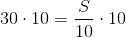

The sum of the scores must be 300. Add the known scores:

Subtract this sum from 300:
 ,
,
the missing tenth score.
The mean of a group of scores
Set
Multiply both sides by 10 to reverse division by 10:
The sum of the scores must be 300. Add the known scores:
Subtract this sum from 300:
the missing tenth score.
← Didn't Know|Knew It →
What is the likelihood, expressed as a percentage, of rolling 2 straight 2s using one 6-sided dice?
What is the likelihood, expressed as a percentage, of rolling 2 straight 2s using one 6-sided dice?
Tap to reveal answer
The likelihood of rolling any given number on a 6-sided dice is 16.6%, to get the likelihood of that even happening twice in a row, simply multiply 16.6% by itself, to get 2.7%, rounded up to 3%
The likelihood of rolling any given number on a 6-sided dice is 16.6%, to get the likelihood of that even happening twice in a row, simply multiply 16.6% by itself, to get 2.7%, rounded up to 3%
← Didn't Know|Knew It →
A set of ten scores has mean 30.
Nine of the scores are given below, with the circle representing the tenth.
What is the tenth score?
A set of ten scores has mean 30.
Nine of the scores are given below, with the circle representing the tenth.
What is the tenth score?
Tap to reveal answer
The mean of a group of scores is equal to their sum divided by the number of scores , or,
Set and , and solve for :
Multiply both sides by 10 to reverse division by 10:
The sum of the scores must be 300. Add the known scores:
Subtract this sum from 300:
,
the missing tenth score.
The mean of a group of scores
Set
Multiply both sides by 10 to reverse division by 10:
The sum of the scores must be 300. Add the known scores:
Subtract this sum from 300:
the missing tenth score.
← Didn't Know|Knew It →
What is the likelihood, expressed as a percentage, of rolling 2 straight 2s using one 6-sided dice?
What is the likelihood, expressed as a percentage, of rolling 2 straight 2s using one 6-sided dice?
Tap to reveal answer
The likelihood of rolling any given number on a 6-sided dice is 16.6%, to get the likelihood of that even happening twice in a row, simply multiply 16.6% by itself, to get 2.7%, rounded up to 3%
The likelihood of rolling any given number on a 6-sided dice is 16.6%, to get the likelihood of that even happening twice in a row, simply multiply 16.6% by itself, to get 2.7%, rounded up to 3%
← Didn't Know|Knew It →
A set of ten scores has mean 30.
Nine of the scores are given below, with the circle representing the tenth.
What is the tenth score?
A set of ten scores has mean 30.
Nine of the scores are given below, with the circle representing the tenth.
What is the tenth score?
Tap to reveal answer
The mean of a group of scores is equal to their sum divided by the number of scores , or,
Set and , and solve for :
Multiply both sides by 10 to reverse division by 10:
The sum of the scores must be 300. Add the known scores:
Subtract this sum from 300:
,
the missing tenth score.
The mean of a group of scores
Set
Multiply both sides by 10 to reverse division by 10:
The sum of the scores must be 300. Add the known scores:
Subtract this sum from 300:
the missing tenth score.
← Didn't Know|Knew It →
One mile per minute equals approximately kilometers per hour.
One mile per minute equals approximately kilometers per hour.
Tap to reveal answer
First convert 1 mile per minute into miles per hour by multiplying by 60, then simply convert 60 miles per hour to km per hour by 1.6 to get 96.6, rounded up to 97.
First convert 1 mile per minute into miles per hour by multiplying by 60, then simply convert 60 miles per hour to km per hour by 1.6 to get 96.6, rounded up to 97.
← Didn't Know|Knew It →
Which of the following is a measure of volume?
Which of the following is a measure of volume?
Tap to reveal answer
Fluid ounces are the only provided measure of volume. Volume is measured in liquid displaced by an object. Kilometers are a measure of distance, and pounds are a measure of weight, which is related to, but not the same as, volume.
Fluid ounces are the only provided measure of volume. Volume is measured in liquid displaced by an object. Kilometers are a measure of distance, and pounds are a measure of weight, which is related to, but not the same as, volume.
← Didn't Know|Knew It →
Of what is a "Joule (J)" a unit of measurement?
Of what is a "Joule (J)" a unit of measurement?
Tap to reveal answer
Joules are units of measurement used to describe energy (kinetic or potential). While "electricity" may be a tempting option here, "energy" is more correct; while electrical energy can be measured in Joules, not all energy measured in Joules is electrical in nature.
Joules are units of measurement used to describe energy (kinetic or potential). While "electricity" may be a tempting option here, "energy" is more correct; while electrical energy can be measured in Joules, not all energy measured in Joules is electrical in nature.
← Didn't Know|Knew It →
Which of the given statements about finding the perimeter of a triangle is accurate?
Which of the given statements about finding the perimeter of a triangle is accurate?
Tap to reveal answer
This is a basic, clear geometric rule that all students must know: for a standard triangle the sum of the sides is equal to the perimeter. No other answer was acceptable.
This is a basic, clear geometric rule that all students must know: for a standard triangle the sum of the sides is equal to the perimeter. No other answer was acceptable.
← Didn't Know|Knew It →
A square has area 196 square feet. Give its perimeter.
A square has area 196 square feet. Give its perimeter.
Tap to reveal answer
The area of the square is equal to the length of a side multiplied by itself. Thus, the length of a side is equal to the square root of 196. Since  , 196 is the square of 14, and 14 is the square root of 196; it follows that the square has four sides of measure 14 feet. The perimeter of a square is four times the length of a side, so the perimeter of this square is
  feet.
feet.
The area of the square is equal to the length of a side multiplied by itself. Thus, the length of a side is equal to the square root of 196. Since
← Didn't Know|Knew It →

The area of a triangle with height  and base of length 12 is what?
The area of a triangle with height
Tap to reveal answer
To solve for  in the equation
 ,
,
subtract 3 from both sides to reverse the addition of 3:


The height of a triangle is  , and the length of its base is
  . The area of a triangle with base
  and height
  is
is
 ,
,
so, substituting these values,
 ,
,
the correct response.
To solve for
subtract 3 from both sides to reverse the addition of 3:
The height of a triangle is
so, substituting these values,
the correct response.
← Didn't Know|Knew It →

What value of  makes this a true statement?
What value of
Tap to reveal answer
Isolate the  on the left side of the equation by performing the same steps on both sides. These steps should be the opposite of the operations performed on
  , as follows:

Multiplication precedes subtraction in the order of operations, so reverse the subtraction of 12 by adding 12 to both sides:


Now reverse multiplication by 2 by dividing by 2:

 .
.
Isolate the
Multiplication precedes subtraction in the order of operations, so reverse the subtraction of 12 by adding 12 to both sides:
Now reverse multiplication by 2 by dividing by 2:
← Didn't Know|Knew It →
 and
and  .
.
If  , then evaluate
  .
.
If
Tap to reveal answer
If  , then
  can be determined from the equation

first by substituting 18 for  :
:

then by dividing both sides by 18 to isolate the  :
:


Now, in the other equation, substitute 4 for  :
:

Divide both sides by 4 to isolate the  :
:

 ,
,
the correct choice.
If
first by substituting 18 for
then by dividing both sides by 18 to isolate the
Now, in the other equation, substitute 4 for
Divide both sides by 4 to isolate the
the correct choice.
← Didn't Know|Knew It →
Which of the following equations does not describe a line through the point  ?
?
Which of the following equations does not describe a line through the point
Tap to reveal answer
If the line of an equation passes through  , then, if
  and
and  , the equation should be true. Therefore, we can identify the correct choice by substituting 2 and 6 for
  and
and  , respectively, in each equation.


True


True


True


True


False
The correct choice is
 .
.
If the line of an equation passes through
True
True
True
True
False
The correct choice is
← Didn't Know|Knew It →
Give the next number in the sequence:

Give the next number in the sequence:
Tap to reveal answer
The sequence of numbers is formed by starting with 5, and, for each consecutive term, adding a quantity that increases by 1 each time. The sequence is


 ,
,
the missing entry.
The sequence of numbers is formed by starting with 5, and, for each consecutive term, adding a quantity that increases by 1 each time. The sequence is
the missing entry.
← Didn't Know|Knew It →
Evaluate:

Evaluate:
Tap to reveal answer
In the order of operations, any operation within parentheses is always performed first. First, add 12 and 25:


Multiplication takes precedence over subtraction. Multiply 13 by 8 next:

Now subtract:

In the order of operations, any operation within parentheses is always performed first. First, add 12 and 25:
Multiplication takes precedence over subtraction. Multiply 13 by 8 next:
Now subtract:
← Didn't Know|Knew It →
Calculate

and round the result to the nearest hundredth.
Calculate
and round the result to the nearest hundredth.
Tap to reveal answer
Add the decimals vertically by aligning the decimal points, and adding the digits without regard to the decimal point:

Round to the nearest hundredth (second place after the decimal point) by examining the next digit to the right. This digit is an 8, so round the hundredths digit up to 7. This makes the correct choice 0.67.
Add the decimals vertically by aligning the decimal points, and adding the digits without regard to the decimal point:
Round to the nearest hundredth (second place after the decimal point) by examining the next digit to the right. This digit is an 8, so round the hundredths digit up to 7. This makes the correct choice 0.67.
← Didn't Know|Knew It →


How many elements are in  ?
?
How many elements are in
Tap to reveal answer
 denotes the union of
  and
and  , the set of all elements that are in
  ,
,  , or both. To find this set, first, collect the elements in both sets:


Arranging:

Removing duplicates:

There are 12 elements in this set.
Arranging:
Removing duplicates:
There are 12 elements in this set.
← Didn't Know|Knew It →


How many elements are in  ?
?
How many elements are in
Tap to reveal answer
 denotes the intersection of
  and
and  , the set of all elements the two sets have in common. These elements are underlined below:


 is a set with three elements.
← Didn't Know|Knew It →