
Square Roots and Radicals - GED Math
Card 1 of 160
Simplify:

Simplify:
Tap to reveal answer

← Didn't Know|Knew It →
Simplify:

Simplify:
Tap to reveal answer

← Didn't Know|Knew It →
Simplify:

Simplify:
Tap to reveal answer

← Didn't Know|Knew It →
Simplify:

Simplify:
Tap to reveal answer

An alternate solution is:

An alternate solution is:
← Didn't Know|Knew It →
Simplify:

Simplify:
Tap to reveal answer

← Didn't Know|Knew It →
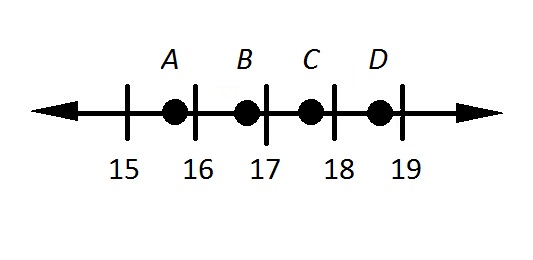
Refer to the above number line. What point most likely represents the square root of 280?
Do not use a calculator.
Refer to the above number line. What point most likely represents the square root of 280?
Do not use a calculator.
Tap to reveal answer

Therefore,  ,
,
making the correct choice  .
.
Therefore,
making the correct choice
← Didn't Know|Knew It →
Simplify:

Do not use a calculator.
Simplify:
Do not use a calculator.
Tap to reveal answer
The prime factorization of 42 is
 .
.
Since 42 is the product of distinct primes, it has no perfect square factors, and, therefore, its square root cannot be simplified further. It is already in simplifed form.
The prime factorization of 42 is
Since 42 is the product of distinct primes, it has no perfect square factors, and, therefore, its square root cannot be simplified further. It is already in simplifed form.
← Didn't Know|Knew It →
Simplify:

Do not use a calculator.
Simplify:
Do not use a calculator.
Tap to reveal answer
The prime factorization of 48 is
 .
.
Rewrite, and use the product of radicals property to simplify:





The prime factorization of 48 is
Rewrite, and use the product of radicals property to simplify:
← Didn't Know|Knew It →
Factor: 
Factor:
Tap to reveal answer
In order to factor the radical, we will need to rewrite 120 as multiples of perfect squares.

Reduce the known term

The value of  cannot be factored any further.
The answer is: 
In order to factor the radical, we will need to rewrite 120 as multiples of perfect squares.
Reduce the known term
The value of
The answer is:
← Didn't Know|Knew It →
Factor: 
Factor:
Tap to reveal answer
Rewrite the root 40 in factors of perfect squares.

The answer is: 
Rewrite the root 40 in factors of perfect squares.
The answer is:
← Didn't Know|Knew It →
Factor: 
Factor:
Tap to reveal answer
In order to factor this, we will need to rewrite root 88 by factoring using values of perfect squares.

The answer is: 
In order to factor this, we will need to rewrite root 88 by factoring using values of perfect squares.
The answer is:
← Didn't Know|Knew It →
Rationalize: 
Rationalize:
Tap to reveal answer
In order to rationalize the radical, we will need to multiply both the top and bottom by square root two.

The answer is: 
In order to rationalize the radical, we will need to multiply both the top and bottom by square root two.
The answer is:
← Didn't Know|Knew It →
Rationalize: 
Rationalize:
Tap to reveal answer
In order to eliminate the radical on the denominator, we will need to multiply root five on the top and bottom of the fraction.

The answer is: 
In order to eliminate the radical on the denominator, we will need to multiply root five on the top and bottom of the fraction.
The answer is:
← Didn't Know|Knew It →
Rationalize: 
Rationalize:
Tap to reveal answer
Simplify the denominator by factoring using perfect squares.

Rewrite the fraction.

Multiply the top and bottom by root 5.

The answer is: 
Simplify the denominator by factoring using perfect squares.
Rewrite the fraction.
Multiply the top and bottom by root 5.
The answer is:
← Didn't Know|Knew It →
Rationalize: 
Rationalize:
Tap to reveal answer
Factor the denominator by factors of perfect squares.

Replace the term.

Multiply by root three on the top and bottom.

The answer is: 
Factor the denominator by factors of perfect squares.
Replace the term.
Multiply by root three on the top and bottom.
The answer is:
← Didn't Know|Knew It →
Rationalize: 
Rationalize:
Tap to reveal answer
Multiply by root 14 on the top and bottom of the fraction.

The fraction becomes: 
Simplify the radical with factors of perfect squares.

Reduce the fraction.
The answer is: 
Multiply by root 14 on the top and bottom of the fraction.
The fraction becomes:
Simplify the radical with factors of perfect squares.
Reduce the fraction.
The answer is:
← Didn't Know|Knew It →
Rationalize the radical: 
Rationalize the radical:
Tap to reveal answer
Multiply the radical on the top and bottom of the given fraction.

Simplify the fraction.
The answer is: 
Multiply the radical on the top and bottom of the given fraction.
Simplify the fraction.
The answer is:
← Didn't Know|Knew It →
Rationalize: 
Rationalize:
Tap to reveal answer
Multiply the radical on the top and bottom of the fraction.

Reduce the fraction.
The answer is: 
Multiply the radical on the top and bottom of the fraction.
Reduce the fraction.
The answer is:
← Didn't Know|Knew It →
Rationalize: 
Rationalize:
Tap to reveal answer
Multiply the denominator on the top and bottom.

The answer is: 
Multiply the denominator on the top and bottom.
The answer is:
← Didn't Know|Knew It →
Simplify the following expression:

Simplify the following expression:
Tap to reveal answer
Start by analyzing each given term.
 cannot be reduced any further, so leave it alone.
Notice that  can be rewritten as
Next, notice that  can be rewritten as
Now, rewrite the original equation:

Start by analyzing each given term.
Notice that
Next, notice that
Now, rewrite the original equation:
← Didn't Know|Knew It →