
Solid Geometry - Geometry
Card 1 of 360
What is the surface area of the following tetrahedron? Assume the figure is a regular tetrahedron.

What is the surface area of the following tetrahedron? Assume the figure is a regular tetrahedron.
Tap to reveal answer
A tetrahedron is a three-dimensonal figure where each side is an equilateral triangle. Therefore, each angle in the triangle is  .
.
In the figure, we know the value of the side  and the value of the base
  . Since dividing the triangle by half creates a
  triangle, we know the value of
  must be
  .
.
Therefore, the area of one side of the tetrahedron is:

Since there are four sides of a tetrahedron, the surface area is:

A tetrahedron is a three-dimensonal figure where each side is an equilateral triangle. Therefore, each angle in the triangle is
In the figure, we know the value of the side
Therefore, the area of one side of the tetrahedron is:
Since there are four sides of a tetrahedron, the surface area is:
← Didn't Know|Knew It →
A regular tetrahedron has side lengths  . What is the surface area of the described solid?
A regular tetrahedron has side lengths
Tap to reveal answer
The area of one face of the triangle can be found either through trigonometry or the Pythagorean Theorem.
Since all the sides of the triangle are  , the height is then
 , so the area of each face is:

There are four faces, so the area of the tetrahedron is:

The area of one face of the triangle can be found either through trigonometry or the Pythagorean Theorem.
Since all the sides of the triangle are
There are four faces, so the area of the tetrahedron is:
← Didn't Know|Knew It →
If the edge length of a tetrahedron is  , what is the surface area of the tetrahedron?
If the edge length of a tetrahedron is
Tap to reveal answer
Write the formula for finding the surface area of a tetrahedron.

Substitute the edge and solve.

Write the formula for finding the surface area of a tetrahedron.
Substitute the edge and solve.
← Didn't Know|Knew It →
Find the surface area of a regular tetrahedron with a side length of  .
.
Find the surface area of a regular tetrahedron with a side length of
Tap to reveal answer
Use the following formula to find the surface area of a regular tetrahedron.

Now, substitute in the value of the side length into the equation.

Use the following formula to find the surface area of a regular tetrahedron.
Now, substitute in the value of the side length into the equation.
← Didn't Know|Knew It →
Find the surface area of a regular tetrahedron with a side length of  .
.
Find the surface area of a regular tetrahedron with a side length of
Tap to reveal answer
Use the following formula to find the surface area of a regular tetrahedron.

Now, substitute in the value of the side length into the equation.

Use the following formula to find the surface area of a regular tetrahedron.
Now, substitute in the value of the side length into the equation.
← Didn't Know|Knew It →
Find the surface area of a regular tetrahedron with a side length of  .
.
Find the surface area of a regular tetrahedron with a side length of
Tap to reveal answer
Use the following formula to find the surface area of a regular tetrahedron.

Now, substitute in the value of the side length into the equation.

Use the following formula to find the surface area of a regular tetrahedron.
Now, substitute in the value of the side length into the equation.
← Didn't Know|Knew It →
In terms of  , find the surface area of a regular tetrahedron that has a side length of
  .
.
In terms of
Tap to reveal answer
Use the following formula to find the surface area of a regular tetrahedron.

Now, substitute in the value of the side length into the equation.

Use the following formula to find the surface area of a regular tetrahedron.
Now, substitute in the value of the side length into the equation.
← Didn't Know|Knew It →
In terms of  , find the surface area of a regular tetrahedron with a side length of
  .
.
In terms of
Tap to reveal answer
Use the following formula to find the surface area of a regular tetrahedron.

Now, substitute in the value of the side length into the equation.

Use the following formula to find the surface area of a regular tetrahedron.
Now, substitute in the value of the side length into the equation.
← Didn't Know|Knew It →
In terms of  , find the surface area of a regular tetrahedron with side lengths of
  .
.
In terms of
Tap to reveal answer
Use the following formula to find the surface area of a regular tetrahedron.

Now, substitute in the value of the side length into the equation.

Use the following formula to find the surface area of a regular tetrahedron.
Now, substitute in the value of the side length into the equation.
← Didn't Know|Knew It →
The surface area of a regular tetrahedron is  . If each side length is
  , find the value of
  .
.
The surface area of a regular tetrahedron is
Tap to reveal answer
Use the following formula to find the surface area of a regular tetrahedron.

Now, substitute in the value of the side length into the equation.

Now, solve for  .
.


Use the following formula to find the surface area of a regular tetrahedron.
Now, substitute in the value of the side length into the equation.
Now, solve for
← Didn't Know|Knew It →
The surface area of a regular tetrahedron is  . If the length of each side is
  , find the value of
  .
.
The surface area of a regular tetrahedron is
Tap to reveal answer
Use the following formula to find the surface area of a regular tetrahedron.

Now, substitute in the value of the side length into the equation.

Now, solve for  .
.


Use the following formula to find the surface area of a regular tetrahedron.
Now, substitute in the value of the side length into the equation.
Now, solve for
← Didn't Know|Knew It →
The surface area of a regular tetrahedron is  . If each side length is
  , find the value of
  . Round to the nearest tenths place.
The surface area of a regular tetrahedron is
Tap to reveal answer
Use the following formula to find the surface area of a regular tetrahedron.

Now, substitute in the value of the side length into the equation.

Solve for  .
.


Use the following formula to find the surface area of a regular tetrahedron.
Now, substitute in the value of the side length into the equation.
Solve for
← Didn't Know|Knew It →
The surface area of a regular tetrahedron is  . If each side length is
  , find the value of
  . Round to the nearest tenths place.
The surface area of a regular tetrahedron is
Tap to reveal answer
Use the following formula to find the surface area of a regular tetrahedron.

Now, substitute in the value of the side length into the equation.


Use the following formula to find the surface area of a regular tetrahedron.
Now, substitute in the value of the side length into the equation.
← Didn't Know|Knew It →
The surface area of a regular tetrahedron is  . If each side length is
  , find the value of
  .
.
The surface area of a regular tetrahedron is
Tap to reveal answer
Use the following formula to find the surface area of a regular tetrahedron.

Now, substitute in the value of the side length into the equation and solve for  .
.


Since we are dealing with a 3-dimensional shape, only  is valid.
Use the following formula to find the surface area of a regular tetrahedron.
Now, substitute in the value of the side length into the equation and solve for
Since we are dealing with a 3-dimensional shape, only
← Didn't Know|Knew It →
In terms of  , find the surface area of a regular tetrahedron with side lengths
  .
.
In terms of
Tap to reveal answer
Use the following formula to find the surface area of a regular tetrahedron.

Now, substitute in the value of the side length into the equation.

Use the following formula to find the surface area of a regular tetrahedron.
Now, substitute in the value of the side length into the equation.
← Didn't Know|Knew It →
Each of the faces of a regular tetrahedron has a base of  and a height of
  . What is the surface area of this tetrahedron?
Each of the faces of a regular tetrahedron has a base of
Tap to reveal answer
The surface area is the area of all of the faces of the tetrahedron. To begin, we must find the area of one of the faces. Because a tetrahedron is made up of triangles, we simply plug the given values for base and height into the formula for the area of a triangle:

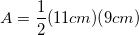

Therefore, the area of one of the faces of the tetrahedron is  . However, because a tetrahedron has 4 faces, in order to find the surface area, we must multiply this number by 4:


Therefore, the surface area of the tetrahedron is  .
.
The surface area is the area of all of the faces of the tetrahedron. To begin, we must find the area of one of the faces. Because a tetrahedron is made up of triangles, we simply plug the given values for base and height into the formula for the area of a triangle:
Therefore, the area of one of the faces of the tetrahedron is
Therefore, the surface area of the tetrahedron is
← Didn't Know|Knew It →
What is the surface area of a regular tetrahedron with a slant height of  ?
?
What is the surface area of a regular tetrahedron with a slant height of
Tap to reveal answer
If this is a regular tetrahedron, then all four triangles are equilateral triangles.
If the slant height is  , then that equates to the height of any of the triangles being
  .
.
In order to solve for the surface area, we can use the formula

where  in this case is the measure of the edge.
The problem has not given the edge; however, it has provided information that will allow us to solve for the edge and therefore the surface area.
Picture an equilateral triangle with a height  .
.
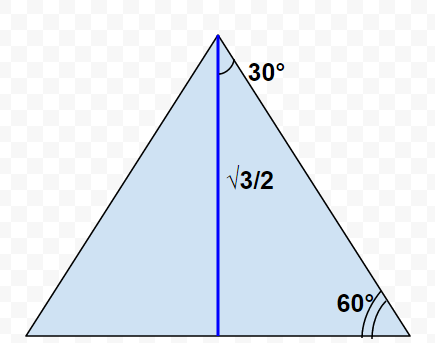
Drawing in the height will divide the equilateral triangle into two 30/60/90 right triangles. Because this is an equilateral triangle, we can deduce that finding the measure of the hypotenuse will suffice to solve for the edge length ( ).
).
In order to solve for the hypotenuse of one of the right triangles, either trig functions or the rules of the special 30/60/90 triangle can be used.
Using trig functions, one option is using 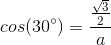 .
.
Rearranging the equation to solve for  ,
,
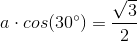


Now that  has been solved for, it can be substituted into the surface area equation.



If this is a regular tetrahedron, then all four triangles are equilateral triangles.
If the slant height is
In order to solve for the surface area, we can use the formula
where
The problem has not given the edge; however, it has provided information that will allow us to solve for the edge and therefore the surface area.
Picture an equilateral triangle with a height
Drawing in the height will divide the equilateral triangle into two 30/60/90 right triangles. Because this is an equilateral triangle, we can deduce that finding the measure of the hypotenuse will suffice to solve for the edge length (
In order to solve for the hypotenuse of one of the right triangles, either trig functions or the rules of the special 30/60/90 triangle can be used.
Using trig functions, one option is using
Rearranging the equation to solve for
Now that
← Didn't Know|Knew It →
What is the surface area of a regular tetrahedron when its volume is 27?
What is the surface area of a regular tetrahedron when its volume is 27?
Tap to reveal answer
The problem is essentially asking us to go from a three-dimensional measurement to a two-dimensional one. In order to approach the problem, it's helpful to see how volume and surface area are related.
This can be done by comparing the formulas for surface area and volume:


We can see that both calculation revolve around the edge length.
That means, if we can solve for  (edge length) using volume, we can solve for the surface area.




Now that we know  , we can substitute this value in for the surface area formula:



The problem is essentially asking us to go from a three-dimensional measurement to a two-dimensional one. In order to approach the problem, it's helpful to see how volume and surface area are related.
This can be done by comparing the formulas for surface area and volume:
We can see that both calculation revolve around the edge length.
That means, if we can solve for
Now that we know
← Didn't Know|Knew It →
Give the surface area of a regular tetrahedron with edges of length 60.
Give the surface area of a regular tetrahedron with edges of length 60.
Tap to reveal answer
A tetrahedron comprises four triangular surfaces; if the tetrahedron is regular, then each surface is an equilateral triangle. The area of an equilateral triangle with sides of length  can be computed using the formula
 ;
;
The total surface area of the tetrahedron is four times this, or

Set  and substitute:
 .
.
A tetrahedron comprises four triangular surfaces; if the tetrahedron is regular, then each surface is an equilateral triangle. The area of an equilateral triangle with sides of length
The total surface area of the tetrahedron is four times this, or
Set
← Didn't Know|Knew It →
A tetrahedron has a volume that is twice the surface area times the edge. What is the length of the edge? (In the answer choices,  represents edge.)
A tetrahedron has a volume that is twice the surface area times the edge. What is the length of the edge? (In the answer choices,
Tap to reveal answer
The problem states that the volume is:

The point of the problem is to solve for the length of the edge. Becasuse there are no numbers, the final answer will be an expression.
In order to solve for it, we will have to rearrange the formula for volume in terms of  .
.



The problem states that the volume is:
The point of the problem is to solve for the length of the edge. Becasuse there are no numbers, the final answer will be an expression.
In order to solve for it, we will have to rearrange the formula for volume in terms of
← Didn't Know|Knew It →