
Data-Sufficiency Questions - GMAT Quantitative
Card 1 of 10527

Four candidates - two boys named Patrick and Quincy, and two girls named Rhonda and Sally - ran for student body president. By the rules, the candidate who wins more than half the ballots cast wins the election outright; if no candidate wins more than half, there must be a runoff between the two top vote-getters. You may assume that no other names were written in.
As can be seen in the figure above, which reflects the share of the vote each candidate won, there will be a runoff. Which two candidates will face each other?
Statement 1: Candidates A and B are both girls.
Statement 2: Candidate B and C are Rhonda and Patrick, respectively.
Four candidates - two boys named Patrick and Quincy, and two girls named Rhonda and Sally - ran for student body president. By the rules, the candidate who wins more than half the ballots cast wins the election outright; if no candidate wins more than half, there must be a runoff between the two top vote-getters. You may assume that no other names were written in.
As can be seen in the figure above, which reflects the share of the vote each candidate won, there will be a runoff. Which two candidates will face each other?
Statement 1: Candidates A and B are both girls.
Statement 2: Candidate B and C are Rhonda and Patrick, respectively.
Tap to reveal answer
Candidates A and B are the top two vote-getters, so we must establish which two candidates are A and B.
Statement 1 does just that by identifying them as Rhonda and Sally. It does not identify which one is which, but it is not necessary to know that.
Statement 2 identifies Rhonda as Candidate B, but only Patrick can be eliminated as Candidate A.
Candidates A and B are the top two vote-getters, so we must establish which two candidates are A and B.
Statement 1 does just that by identifying them as Rhonda and Sally. It does not identify which one is which, but it is not necessary to know that.
Statement 2 identifies Rhonda as Candidate B, but only Patrick can be eliminated as Candidate A.
← Didn't Know|Knew It →
A fair coin is tossed a given number of times. What is the probability that three or more of the tosses will come up heads?
-
The number of times the coin is tossed is four.
-
The previous day, the coin was tossed ten times, and heads came up eight times.
A fair coin is tossed a given number of times. What is the probability that three or more of the tosses will come up heads?
-
The number of times the coin is tossed is four.
-
The previous day, the coin was tossed ten times, and heads came up eight times.
Tap to reveal answer
This is a binomial probability experiment.
The probability that a fair coin will come up heads in any single toss is  .
.
If the coin is tossed four times, then the probability that heads will appear three times is:

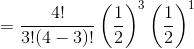
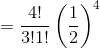
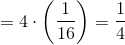
The probability that heads will appear four times is:

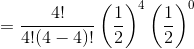
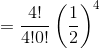
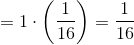
So the probability that heads will appear at least three times is

The second statement is irrelevant; the result of a previous trial has no influence on that of the current trial. It has already been established in the problem that the coin is fair.
The answer is that Statement 1 alone is sufficient to answer the question, but not Statement 2.
This is a binomial probability experiment.
The probability that a fair coin will come up heads in any single toss is
If the coin is tossed four times, then the probability that heads will appear three times is:
The probability that heads will appear four times is:
So the probability that heads will appear at least three times is
The second statement is irrelevant; the result of a previous trial has no influence on that of the current trial. It has already been established in the problem that the coin is fair.
The answer is that Statement 1 alone is sufficient to answer the question, but not Statement 2.
← Didn't Know|Knew It →
A monster is holding a brown paper bag filled with cookies. Inside the bag there are two types of cookies, chocolate chip and oatmeal raisin. If the monster pulls one cookie out at random, what is the probability that he pulls out a chocolate chip cookie.
1. There are a total of 24 cookies in the bag.
2. There are 8 more chocolate chip cookies in the bag than oatmeal raisin cookies.
A monster is holding a brown paper bag filled with cookies. Inside the bag there are two types of cookies, chocolate chip and oatmeal raisin. If the monster pulls one cookie out at random, what is the probability that he pulls out a chocolate chip cookie.
1. There are a total of 24 cookies in the bag.
2. There are 8 more chocolate chip cookies in the bag than oatmeal raisin cookies.
Tap to reveal answer
We need both statements to get the answer.
Statement 1 alone is not enough. Having 24 total cookies does not tell us the proportions of each type of cookie. We could have 1 chocolate chip cookie and 23 oatmeal raisin, or vice versa.
Statement 2 alone is not sufficient either. Knowing that there are 8 more chocolate chip cookies than oatmeal raisin without knowing the total amount in the bag does not help. It could be 1 oatmeal raisin cookie and 9 chocolate chip, or it could be 100 oatmeal raisin cookies and 108 chocolate chip cookies (although that is a pretty big bag!)
Only by having both statements together can we find the right proportion. If we let  be the number of chocolate chip cookies, and
  be the number of oatmeal raisin, we can set two equations and find the right ratio. We know that

from statement 1, and

from statement 2.
Substituting  into the first equation we get



Therefore, we get 8 oatmeal raisin cookies, and 16 chocolate chip cookies. The answer is

or 66.67% chance that the monster pulls out a chocolate chip cookie.
We need both statements to get the answer.
Statement 1 alone is not enough. Having 24 total cookies does not tell us the proportions of each type of cookie. We could have 1 chocolate chip cookie and 23 oatmeal raisin, or vice versa.
Statement 2 alone is not sufficient either. Knowing that there are 8 more chocolate chip cookies than oatmeal raisin without knowing the total amount in the bag does not help. It could be 1 oatmeal raisin cookie and 9 chocolate chip, or it could be 100 oatmeal raisin cookies and 108 chocolate chip cookies (although that is a pretty big bag!)
Only by having both statements together can we find the right proportion. If we let
from statement 1, and
from statement 2.
Substituting
Therefore, we get 8 oatmeal raisin cookies, and 16 chocolate chip cookies. The answer is
or 66.67% chance that the monster pulls out a chocolate chip cookie.
← Didn't Know|Knew It →
Choose the answer that best describes sufficient data to solve the problem.
A student body is polled regarding their favorite campus food. Of those who answered "Pizza" half were male and half were female. Pizza received 24 votes from men.
I. Pizza received the votes of 1 out of every 5 men and 3 out of every 10 women.
II. The student population was found to be 60% male and 40% female
How many students altogether were polled?
Choose the answer that best describes sufficient data to solve the problem.
A student body is polled regarding their favorite campus food. Of those who answered "Pizza" half were male and half were female. Pizza received 24 votes from men.
I. Pizza received the votes of 1 out of every 5 men and 3 out of every 10 women.
II. The student population was found to be 60% male and 40% female
How many students altogether were polled?
Tap to reveal answer
Pizza received 24 votes from men. Since half of those who responded pizza were women, there must be 24 votes from women.
If 1 out of 5 men voted for pizza, this means we have  men. If 3 out of 10 women voted for pizza, we have
  women for a total of 200 people polled.
If our population is instead given as 60% male and 40% female, we still have 24 men and 24 women that voted for pizza, but while we can determine the ratio of people who voted, we cannot get a precise number. For example, while 80 women and 120 men works, we could also have 160 women and 240 men as our total poll (with 1 out of 10 men and 3 out of 20 women voting pizza).
Thus the first condition is sufficient while the second is not.
Pizza received 24 votes from men. Since half of those who responded pizza were women, there must be 24 votes from women.
If 1 out of 5 men voted for pizza, this means we have
If our population is instead given as 60% male and 40% female, we still have 24 men and 24 women that voted for pizza, but while we can determine the ratio of people who voted, we cannot get a precise number. For example, while 80 women and 120 men works, we could also have 160 women and 240 men as our total poll (with 1 out of 10 men and 3 out of 20 women voting pizza).
Thus the first condition is sufficient while the second is not.
← Didn't Know|Knew It →
Find the probability.
Statement 1): Given that the last  flips of a coin were heads, the next coin flip is heads.
Statement 2): Given that the last  days were sunny skies, the next day is sunny.
Find the probability.
Statement 1): Given that the last
Statement 2): Given that the last
Tap to reveal answer
This question deals with conditional probability.
Statement 1) consists of independent events. The past trials will not affect the future trials of the coin. The odds of flipping a coin and land on heads will be  .
.
Statement 2) also consists of independent events. However, given that the previous 10 days were sunny does not necessarily indicate that the next day will guarantee that it will be a sunny day. The probability is unknown because the statement does not give any information about the percentage of a sunny sky on any particular day.
This question deals with conditional probability.
Statement 1) consists of independent events. The past trials will not affect the future trials of the coin. The odds of flipping a coin and land on heads will be
Statement 2) also consists of independent events. However, given that the previous 10 days were sunny does not necessarily indicate that the next day will guarantee that it will be a sunny day. The probability is unknown because the statement does not give any information about the percentage of a sunny sky on any particular day.
← Didn't Know|Knew It →
Jenkins has a box of 36 guitar picks. Each pick is one of three colors: blue, black, or orange.
I) There are 14 more orange picks than blue picks.
II) There are 12 black picks.
What are the odds of randomly selecting a black pick, followed by a blue pick, followed by an orange pick?
Jenkins has a box of 36 guitar picks. Each pick is one of three colors: blue, black, or orange.
I) There are 14 more orange picks than blue picks.
II) There are 12 black picks.
What are the odds of randomly selecting a black pick, followed by a blue pick, followed by an orange pick?
Tap to reveal answer
To find the probability of several events, we need to find the probability of each event separately. First, we need to know how many there are of each color pick.
Statement I relates the number of orange and blue picks.
Statement II tells us the number of black picks.

From Statement I:

From Statement II:

Using Statement I, Statement II, and the given info, we can substitute  from Statement I into Statement II for
  and get the following:

We can then solve for  :
:



Since we are told in Statement I that there are 14 more blue picks than orange picks, we can then find the number of orange picks:



So, to find the odds of multiple events, multiply the probability of each event together:

To find the probability of several events, we need to find the probability of each event separately. First, we need to know how many there are of each color pick.
Statement I relates the number of orange and blue picks.
Statement II tells us the number of black picks.
From Statement I:
From Statement II:
Using Statement I, Statement II, and the given info, we can substitute
We can then solve for
Since we are told in Statement I that there are 14 more blue picks than orange picks, we can then find the number of orange picks:
So, to find the odds of multiple events, multiply the probability of each event together:
← Didn't Know|Knew It →
Below is a menu of the drinks served at Moonbucks Coffee:
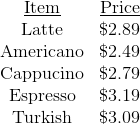
Today and today only, there is a special - buy two espressos and get any third drink free. There are no other specials.
Ralph and Janet are each ordering three beverages from this menu. Who, if either, will pay more?
Statement 1: Two of Ralph's drinks are espressos.
Statement 2: Two of Janet's drinks are cappucinos.
Below is a menu of the drinks served at Moonbucks Coffee:
Today and today only, there is a special - buy two espressos and get any third drink free. There are no other specials.
Ralph and Janet are each ordering three beverages from this menu. Who, if either, will pay more?
Statement 1: Two of Ralph's drinks are espressos.
Statement 2: Two of Janet's drinks are cappucinos.
Tap to reveal answer
Each statement alone gives information about only one order, so at the very least, both statements will be necessary.
From Statement 1, it is known that Ralph will pay  for his drinks, since he will only pay for the two espressos.
From Statement 2, it cannot be determined exactly what Janet will pay. However, she will pay for all three drinks, two of which are cappucinos; the least she will spend is the price of two cappucinos and an Americano, which is  .
.
From both statements together, it is definite that Janet will pay more.
Each statement alone gives information about only one order, so at the very least, both statements will be necessary.
From Statement 1, it is known that Ralph will pay
From Statement 2, it cannot be determined exactly what Janet will pay. However, she will pay for all three drinks, two of which are cappucinos; the least she will spend is the price of two cappucinos and an Americano, which is
From both statements together, it is definite that Janet will pay more.
← Didn't Know|Knew It →
Below is a menu of the drinks served at Moonbucks Coffee:
Patty and Mickey each order three beverages from the menu. Who, if either, will pay more (disregard tax)?
Statement 1: All three of Patty's drinks are Turkish coffees.
Statement 2: One of Mickey's drinks is an Americano.
Below is a menu of the drinks served at Moonbucks Coffee:
Patty and Mickey each order three beverages from the menu. Who, if either, will pay more (disregard tax)?
Statement 1: All three of Patty's drinks are Turkish coffees.
Statement 2: One of Mickey's drinks is an Americano.
Tap to reveal answer
From Statement 1 alone, you know that Patty spent  . It is possible, however, that Mickey spent more (for three espressos, for example), just as much (on three Turkish coffees), or less (for three cappucinos, for example). Statement 2 alone gives you even more scant information, since it only tells you one beverage Mickey bought.
Suppose you know both statements. Then you know Patty spent  . You do not know how much Mickey spent, but the most he could have spent was
  (for an Americano and two esperessos). Therefore, the two statements together are necessary and sufficient to answer the question.
From Statement 1 alone, you know that Patty spent
Suppose you know both statements. Then you know Patty spent
← Didn't Know|Knew It →
Below are the results of the initial election for senior class president.
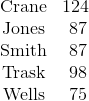
No candidate won a majority, so Crane and Trask faced each other in a runoff. Every student in the senior class voted in both the initial election and the runoff. Every student who voted for Crane in the initial election voted for Crane in the runoff, and every student who voted for Trask in the initial election voted for Trask in the runoff.
Who got the most votes in the runoff, Crane or Trask?
Statement 1: All of the students who voted for Jones in the initial election voted for Crane.
Statement 2: Two-thirds of the students who voted for Wells in the initial election voted for Trask.
Below are the results of the initial election for senior class president.
No candidate won a majority, so Crane and Trask faced each other in a runoff. Every student in the senior class voted in both the initial election and the runoff. Every student who voted for Crane in the initial election voted for Crane in the runoff, and every student who voted for Trask in the initial election voted for Trask in the runoff.
Who got the most votes in the runoff, Crane or Trask?
Statement 1: All of the students who voted for Jones in the initial election voted for Crane.
Statement 2: Two-thirds of the students who voted for Wells in the initial election voted for Trask.
Tap to reveal answer
 students voted, so 236 votes were necessary to win a simple majority.
From Statement 1 alone it can be determined that Crane won at least  votes (his own initial votes plus all of the votes that previously went to Jones), and Trask won at least 98 (his own initial votes).
From Statement 2 alone, it can be determined that Crane won at least  (his own initial votes plus one-third of the votes that previously went to Wells), and Trask won at least
  votes (his own initial votes plus two-thirds of the votes that previously went to Wells).
Neither statement alone will prove a majority vote. From Statement 1 and 2 together, however, it is known that Crane won at least his own initial votes, all of Jones' votes, and one-third of Wells' votes - a minimum of
 votes. Therefore Crane is the winner, and both statements are needed to prove this.
From Statement 1 alone it can be determined that Crane won at least
From Statement 2 alone, it can be determined that Crane won at least
Neither statement alone will prove a majority vote. From Statement 1 and 2 together, however, it is known that Crane won at least his own initial votes, all of Jones' votes, and one-third of Wells' votes - a minimum of
← Didn't Know|Knew It →
The table below gives the population of the city of Renfrow for each of six census years.
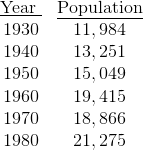
Did Renfrow have a greater population in 1965 or 1975?
Statement 1: The population of Renfrow decreased every year from 1960 to 1970.
Statement 2: The population of Renfrow increased every year from 1970 to 1980.
The table below gives the population of the city of Renfrow for each of six census years.
Did Renfrow have a greater population in 1965 or 1975?
Statement 1: The population of Renfrow decreased every year from 1960 to 1970.
Statement 2: The population of Renfrow increased every year from 1970 to 1980.
Tap to reveal answer
From the two statements together, it can only be surmised that the population in both 1965 and 1975 exceeded the 1970 population. No conclusions can be drawn about the size of the 1965 population relative to the size of the 1975 population.
From the two statements together, it can only be surmised that the population in both 1965 and 1975 exceeded the 1970 population. No conclusions can be drawn about the size of the 1965 population relative to the size of the 1975 population.
← Didn't Know|Knew It →
Data sufficiency question- do not actually solve the question
Find the area of a square.
1. The length of one side of the square is 4.
2. The length of the diagonal of the square is 12.
Data sufficiency question- do not actually solve the question
Find the area of a square.
1. The length of one side of the square is 4.
2. The length of the diagonal of the square is 12.
Tap to reveal answer
Because all 4 sides of a square are equal, knowing the length of one side is sufficient to answer the question. Using the Pythagorean Theorem, you can calculate the length of 1 side of a square by knowing the length of a diagonal and then calculate the area.
Because all 4 sides of a square are equal, knowing the length of one side is sufficient to answer the question. Using the Pythagorean Theorem, you can calculate the length of 1 side of a square by knowing the length of a diagonal and then calculate the area.
← Didn't Know|Knew It →
The table below gives the population of the city of Renfrow for each of six census years.
Did Renfrow have a larger population in 1945 or 1955?
Statement 1: The population rose every year from 1940 to 1950.
Statement 2: The population rose every year from 1950 to 1960.
The table below gives the population of the city of Renfrow for each of six census years.
Did Renfrow have a larger population in 1945 or 1955?
Statement 1: The population rose every year from 1940 to 1950.
Statement 2: The population rose every year from 1950 to 1960.
Tap to reveal answer
Statement 1 alone tells us that the population of Renfrow in 1945 was between 13,251 and 15,049, but says nothing about the population in 1955.
Similarly, Statement 2 alone tells us that the population in 1955 was between 15,049 and 19,415, but says nothing about the population in 1945.
The two statements together, however, tell us that the population rose every year from 1940 to 1960, so the population in 1955 had to have been greater than the population in 1945.
Statement 1 alone tells us that the population of Renfrow in 1945 was between 13,251 and 15,049, but says nothing about the population in 1955.
Similarly, Statement 2 alone tells us that the population in 1955 was between 15,049 and 19,415, but says nothing about the population in 1945.
The two statements together, however, tell us that the population rose every year from 1940 to 1960, so the population in 1955 had to have been greater than the population in 1945.
← Didn't Know|Knew It →
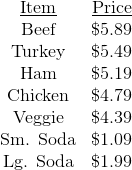
The above is the menu at Monorail Sandwich Shop.
Julie and Janice are each ordering four sandwiches from the above menu. Julie works at Monorail and is entitled to a 25% employee discount; Janice does not work at Monorail.
Who will pay more for her sandwiches, ignoring tax?
Statement 1: Janice is ordering four veggie sandwiches.
Statement 2: Julie is ordering four beef sandwiches.
The above is the menu at Monorail Sandwich Shop.
Julie and Janice are each ordering four sandwiches from the above menu. Julie works at Monorail and is entitled to a 25% employee discount; Janice does not work at Monorail.
Who will pay more for her sandwiches, ignoring tax?
Statement 1: Janice is ordering four veggie sandwiches.
Statement 2: Julie is ordering four beef sandwiches.
Tap to reveal answer
DO NOT calculate how much Janice and Julie will pay! It's extra work that will slow you down on test day. We don't actually need to determine which of the two women will pay more - we only need to decide if it is possible to figure out who will pay more. Obviously neither statement alone tells us enough. Together, however, the two statements tell us exactly what Janice and Julie ordered. Therefore, using both statements, we have enough information to answer the question.
DO NOT calculate how much Janice and Julie will pay! It's extra work that will slow you down on test day. We don't actually need to determine which of the two women will pay more - we only need to decide if it is possible to figure out who will pay more. Obviously neither statement alone tells us enough. Together, however, the two statements tell us exactly what Janice and Julie ordered. Therefore, using both statements, we have enough information to answer the question.
← Didn't Know|Knew It →
Four candidates - Anya, Barry, Carla, and David - ran for student body president. By the rules, the candidate who wins more than half the ballots cast wins the election outright; if no candidate wins more than half, there must be a runoff between the two top vote-getters. You may assume that no other names were written in.
As can be seen in the figure above, which reflects the share of the vote each candidate won, there will be a runoff. Which two candidates will face each other?
Statement 1: Neither Barry nor Carla is Candidate D.
Statement 2: Anya is candidate C.
Four candidates - Anya, Barry, Carla, and David - ran for student body president. By the rules, the candidate who wins more than half the ballots cast wins the election outright; if no candidate wins more than half, there must be a runoff between the two top vote-getters. You may assume that no other names were written in.
As can be seen in the figure above, which reflects the share of the vote each candidate won, there will be a runoff. Which two candidates will face each other?
Statement 1: Neither Barry nor Carla is Candidate D.
Statement 2: Anya is candidate C.
Tap to reveal answer
Candidates A and B are the top two vote-getters, so we must establish which two candidates are A and B.
Neither statement alone is sufficient to answer the question.
Assume Statement 1 alone. Barry and Carla could be Candidates A and B, respectively, in which case they would be the runoff candidates; also they could be Candidates B and C, respectively, in which case, Barry and one of the other two would be the runoff candidates.
Statement 2 alone only knocks Anya out of the runoff election; it leaves the other three as possible candidates.
Assume both statements to be true. Anya is Candidate C. Candidate D, being neither Barry nor Carla, is David. Therefore, Candidates A and B are Barry and Carla; it is unclear which is which, but it is irrelevant; either way, they are the top two vote-getters, and they will participate in the runoff.
Candidates A and B are the top two vote-getters, so we must establish which two candidates are A and B.
Neither statement alone is sufficient to answer the question.
Assume Statement 1 alone. Barry and Carla could be Candidates A and B, respectively, in which case they would be the runoff candidates; also they could be Candidates B and C, respectively, in which case, Barry and one of the other two would be the runoff candidates.
Statement 2 alone only knocks Anya out of the runoff election; it leaves the other three as possible candidates.
Assume both statements to be true. Anya is Candidate C. Candidate D, being neither Barry nor Carla, is David. Therefore, Candidates A and B are Barry and Carla; it is unclear which is which, but it is irrelevant; either way, they are the top two vote-getters, and they will participate in the runoff.
← Didn't Know|Knew It →
Four candidates - two boys named Mickey and Oswald, and two girls named Nora and Phyllis - ran for student body president. By the rules, the candidate who wins more than half the ballots cast wins the election outright; if no candidate wins more than half, there must be a runoff between the two top vote-getters. You may assume that no other names were written in.
As can be seen in the figure above, which reflects the share of the vote each candidate won, there will be a runoff. Which two candidates will face each other?
Statement 1: Nora is candidate B and Oswald is Candidate C.
Statement 2: Candidates A and C are boys.
Four candidates - two boys named Mickey and Oswald, and two girls named Nora and Phyllis - ran for student body president. By the rules, the candidate who wins more than half the ballots cast wins the election outright; if no candidate wins more than half, there must be a runoff between the two top vote-getters. You may assume that no other names were written in.
As can be seen in the figure above, which reflects the share of the vote each candidate won, there will be a runoff. Which two candidates will face each other?
Statement 1: Nora is candidate B and Oswald is Candidate C.
Statement 2: Candidates A and C are boys.
Tap to reveal answer
Candidates A and B are the top two vote-getters, so we must establish which two candidates are A and B.
Statement 1 alone establishes that Nora is Candidate B, making her one of the top two vote-getters. Oswald is not one of the top two, since he is Candidate C, but neither Mickey nor Phyllis can be eliminated as Candidate A.
Statement 2 alone established that one boy is Candidate A, one of the top two vote-getters. Since the other boy is Candidate C, then the other one of the top two, Candidate B, is a girl. However, it does not establish the identity of any of them.
Now, assume both statements to be true. By Statement 2, the top two are a boy and a girl. Statement 1 establishes that the girl is Nora. Since Statement 1 also establishes that Oswald is not the boy, the boy is Mickey, and it follows that Mickey and Nora will face each other in the runoff.
Candidates A and B are the top two vote-getters, so we must establish which two candidates are A and B.
Statement 1 alone establishes that Nora is Candidate B, making her one of the top two vote-getters. Oswald is not one of the top two, since he is Candidate C, but neither Mickey nor Phyllis can be eliminated as Candidate A.
Statement 2 alone established that one boy is Candidate A, one of the top two vote-getters. Since the other boy is Candidate C, then the other one of the top two, Candidate B, is a girl. However, it does not establish the identity of any of them.
Now, assume both statements to be true. By Statement 2, the top two are a boy and a girl. Statement 1 establishes that the girl is Nora. Since Statement 1 also establishes that Oswald is not the boy, the boy is Mickey, and it follows that Mickey and Nora will face each other in the runoff.
← Didn't Know|Knew It →
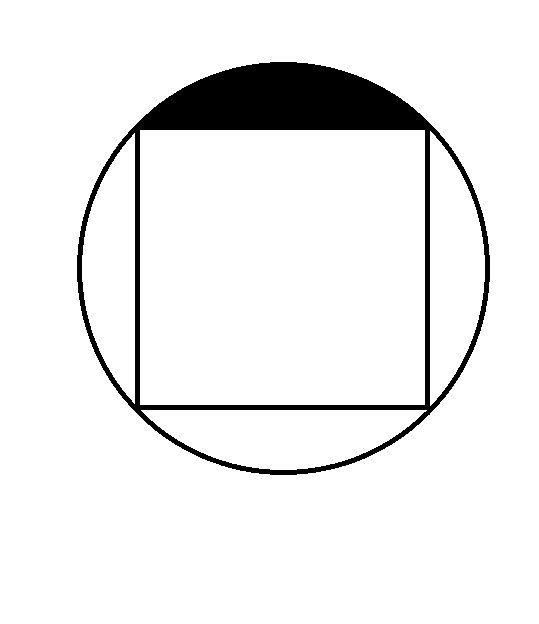
The above figure shows a square inscribed inside a circle. What is the area of the black region?
Statement 1: The square has perimeter 40.
Statement 2: The circle has area  .
.
The above figure shows a square inscribed inside a circle. What is the area of the black region?
Statement 1: The square has perimeter 40.
Statement 2: The circle has area
Tap to reveal answer
The area of the black region is one-fourth the difference of the areas of the circle and the square.
If  is the sidelength of the square, then the length of its diagonal - which is also the diameter of the circle - is, by the Pythagorean Theorem,
  , and the radius
  . Therefore, if you calculate either the radius or the sidelength, you can calculate the other, allowing you to find the areas of the circle and the square.
Statement 1 allows you to find the sidelength; just divide 40 by 4.
Statement 2 allows you to find the radius; just solve for  in the equation
  .
.
Therefore, either one gives you enough information to solve the problem.
The area of the black region is one-fourth the difference of the areas of the circle and the square.
If
Statement 1 allows you to find the sidelength; just divide 40 by 4.
Statement 2 allows you to find the radius; just solve for
Therefore, either one gives you enough information to solve the problem.
← Didn't Know|Knew It →
A circle is inscribed inside Square  . The circle intersects the square at points
  . Give the area of the square.
Statement 1: The circle has circumference  .
.
Statement 2:  is a
is a  arc.
arc.
A circle is inscribed inside Square
Statement 1: The circle has circumference
Statement 2:
Tap to reveal answer
The diameter of the inscribed circle is equal to the the sidelength of the square. From Statement 1, the circumference can be divided by  to obtain this measure, and this can be squared to obtain the area of the square.
Statement 2 gives extraneous information, as, by regularity of the figure, it is already known that  is one fourth of the circle and, subsequently, a
  arc.
arc.
The diameter of the inscribed circle is equal to the the sidelength of the square. From Statement 1, the circumference can be divided by
Statement 2 gives extraneous information, as, by regularity of the figure, it is already known that
← Didn't Know|Knew It →
A circle is inscribed inside Square  . The circle intersects the square at points
  . Give the area of the square.
Statement 1: The circle has area  .
.
Statement 2: Arc  has length
  .
.
A circle is inscribed inside Square
Statement 1: The circle has area
Statement 2: Arc
Tap to reveal answer
From Statement 1, the radius of the circle can be calculated by working backwards from the area formula, and the diameter can be calculated by doubling this.
From Statement 2, since, by the regularity of the square,  is one fourth of the circle, the length of
  can be multiplied by four to get the circumference of the circle. This can be divided by to obtain this diameter.
This diameter is equal to the the sidelength of the square in which it is inscribed, so it can be squared to obtain the area of the square. This makes each statement alone sufficient to answer the question.
From Statement 1, the radius of the circle can be calculated by working backwards from the area formula, and the diameter can be calculated by doubling this.
From Statement 2, since, by the regularity of the square,
This diameter is equal to the the sidelength of the square in which it is inscribed, so it can be squared to obtain the area of the square. This makes each statement alone sufficient to answer the question.
← Didn't Know|Knew It →
Find the area square R
I) The diagonal of square R is  .
.
II) The perimeter of square R is  .
.
Find the area square R
I) The diagonal of square R is
II) The perimeter of square R is
Tap to reveal answer
You can use the diagonal of a square to find its side length via the ratio of a 45/45/90 triangle.
In this case our triangle will have side lengths of 15.
We can also divide our perimeter by 4 to get our side length, which is again 15.
Therefore, each statement alone is sufficient to solve the question.
You can use the diagonal of a square to find its side length via the ratio of a 45/45/90 triangle.
In this case our triangle will have side lengths of 15.
We can also divide our perimeter by 4 to get our side length, which is again 15.
Therefore, each statement alone is sufficient to solve the question.
← Didn't Know|Knew It →
True or false: 
Statement 1: A square with sidelength  has perimeter greater than 100.
Statement 2: A square with sidelength  has area greater than 40.
True or false:
Statement 1: A square with sidelength
Statement 2: A square with sidelength
Tap to reveal answer
Assume Statement 1 alone. The perimeter of a square is four times the length of a side, which here is  ; the perimeter is greater than 100, so



Therefore, the question can be answered in the affirmative from Statement 1 alone.
Statement 2 alone gives insufficient information, however. The area of a square is the square of the length of a side. If the sidelength is  , for example, the area is the square of this, which is 81; if the sidelength is
  , the area is 121. Both areas exceed 40, but only in the second case is
  .
.
Assume Statement 1 alone. The perimeter of a square is four times the length of a side, which here is
Therefore, the question can be answered in the affirmative from Statement 1 alone.
Statement 2 alone gives insufficient information, however. The area of a square is the square of the length of a side. If the sidelength is
← Didn't Know|Knew It →