
Geometry - GMAT Quantitative
Card 1 of 5403
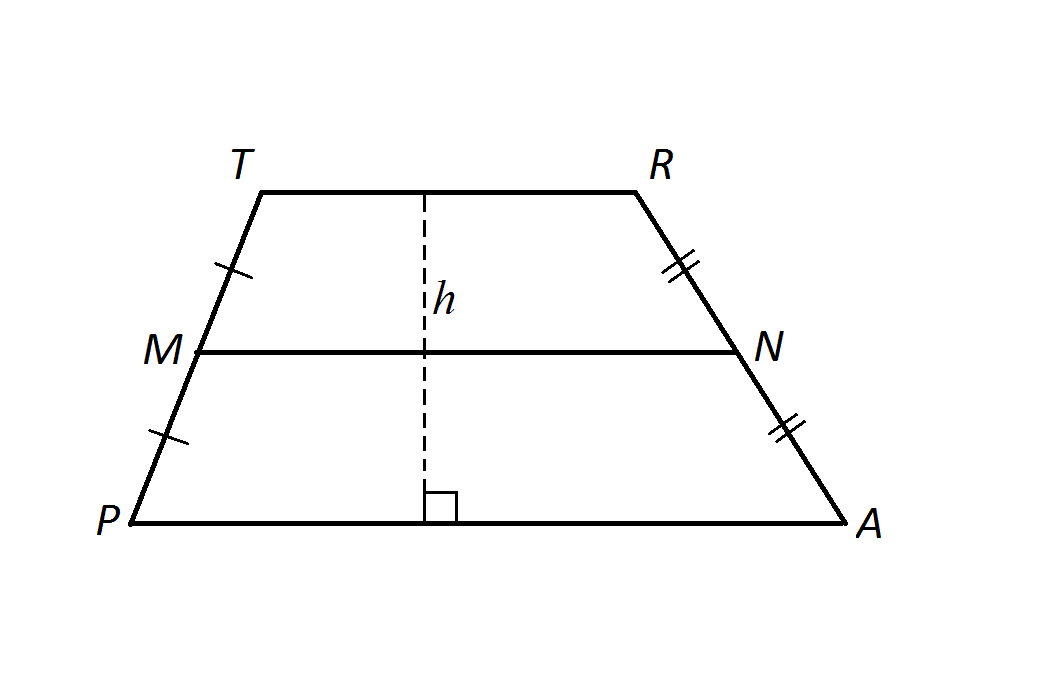
Notes:  refers to the length of the entire dashed line. Figure not drawn to scale.
Calculate  , the height of the large trapezoid.
Statement 1: 
Statement 2: The area of the trapezoid is 7,000.
Notes:
Calculate
Statement 1:
Statement 2: The area of the trapezoid is 7,000.
Tap to reveal answer
Consider the area formula for a trapezoid:
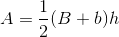
 is the _midsegment_of the trapezoid, which, by the Trapezoid Midsegment Theorem, has length equal to the mean of the bases - in other words,
 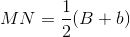 . The area formula can be expressed, after substitution, as

So, if you know both the area and  - but not just one - you can find the height by dividing.
Consider the area formula for a trapezoid:
So, if you know both the area and
← Didn't Know|Knew It →
Consider isosceles trapezoid  .
.
I)  has a perimeter of
  .
.
II) The larger base of  is 45 times bigger than the smaller base.
Find the length of the two legs of  .
.
Consider isosceles trapezoid
I)
II) The larger base of
Find the length of the two legs of
Tap to reveal answer
Consider isosceles trapezoid  .
.
I)  has a perimeter of
  .
.
II) The larger base of  is 45 times bigger than the smaller base.
Find the length of the two legs of  .
.
To find the length of the legs of a trapezoid, we need the perimeter and the two bases. Then, we can subtract the sum of the two bases from the perimeter and divide by two to find the lengths of the sides we are looking for.
Statement I gives us the perimeter of  .
.
Statement II relates the two bases of  .
.
We are told that  is an isosceles trapezoid, which means its two legs are equal; however, we still have too many unknowns and not enough equations. There is no way to solve this without more information.


We still have three unknowns and two equations, so we cannot solve this system of equations.
Consider isosceles trapezoid
I)
II) The larger base of
Find the length of the two legs of
To find the length of the legs of a trapezoid, we need the perimeter and the two bases. Then, we can subtract the sum of the two bases from the perimeter and divide by two to find the lengths of the sides we are looking for.
Statement I gives us the perimeter of
Statement II relates the two bases of
We are told that
We still have three unknowns and two equations, so we cannot solve this system of equations.
← Didn't Know|Knew It →
Consider parallelogram  .
.
I) The perimeter of  is
is  light years.
II) Side  is
is  light years and is equivalent to side
  .
.
Find the length of side  .
.
Consider parallelogram
I) The perimeter of
II) Side
Find the length of side
Tap to reveal answer
We can work backwards from the perimeter to find the length of the unknown side.
I) Gives us the perimeter.
II) Gives us two of the sides.
In a parallelogram there are two sets of corresponding sides. We can use I) and II) to write the following equaiton, where l is the length of our wanted side.

Solve for l to find our final side:
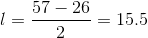
We can work backwards from the perimeter to find the length of the unknown side.
I) Gives us the perimeter.
II) Gives us two of the sides.
In a parallelogram there are two sets of corresponding sides. We can use I) and II) to write the following equaiton, where l is the length of our wanted side.
Solve for l to find our final side:
← Didn't Know|Knew It →
Calculate the side of a square.
Statement 1: A circle with an area of  is enclosed inside the square and touches all four edges of the square.
Statement 2: A circle with a circumference of  encloses the square and touches all four corners of the square.
Calculate the side of a square.
Statement 1: A circle with an area of
Statement 2: A circle with a circumference of
Tap to reveal answer
Statement 1: A circle with an area of  is enclosed inside the square and touches all four edges of the square.
Write the formula for the area of the circle.

After substituting the value of the area and solve for radius, the radius is 1. The side length of the square is double the length of the radius.
Statement 2: A circle with a circumference of  encloses the square and touches all four corners of the square.
Write the formula for the circumference of the circle.

After substituting the value of the circumference and solve for diameter, the diameter of the circle is 1. This diameter represents the diagonal of the square. Because the square length and width are equal dimensions, it is possible to solve for the lengths of the square by Pythagorean Theorem knowing just the length of the square diagonal.
Therefore:

Statement 1: A circle with an area of
Write the formula for the area of the circle.
After substituting the value of the area and solve for radius, the radius is 1. The side length of the square is double the length of the radius.
Statement 2: A circle with a circumference of
Write the formula for the circumference of the circle.
After substituting the value of the circumference and solve for diameter, the diameter of the circle is 1. This diameter represents the diagonal of the square. Because the square length and width are equal dimensions, it is possible to solve for the lengths of the square by Pythagorean Theorem knowing just the length of the square diagonal.
Therefore:
← Didn't Know|Knew It →
True or false: Rhombus  Rhombus
  .
.
Statement 1:  and
and  are both
  angles.
Statement 2: The area of Rhombus  is four times that of Rhombus
  .
.
True or false: Rhombus
Statement 1:
Statement 2: The area of Rhombus
Tap to reveal answer
To prove two figures similar, we must prove that their corresponding angles are congruent, and that their corresponding sides are in proportion.
All four sides of a rhombus are congruent, so it easily follows that corresponding sides of two rhombuses are in proportion, regardless of whether they are similar or not; it is therefore necessary and sufficient to prove that coresponding angles are congruent. Also, since a rhombus is a parallelogram, opposite angles are congruent and consecutive angles are supplementary - that is, their angle measures total  . Therefore, it is neccessary and sufficient to prove just one pair of corresponding angles congruent.
Assume Statement 1 alone.  is a
is a  angle, so any angle consecutive to it, which includes
  , is supplementary to it—that is, the angle measures total
  . This makes
  a
a  angle. Its corresponding angle in Rhombus
  is
is  , which is a
  angle. Since
  and
and  are noncongruent, it follows that Rhombus
  Rhombus
  . (Note that it can be demonstrated that the rhombuses are similar, but the correct statement is Rhombus
  Rhombus
  .)
.)
Statement 2 alone provides no useful information; the relationship between the areas of the rhombuses is irrelevant.
To prove two figures similar, we must prove that their corresponding angles are congruent, and that their corresponding sides are in proportion.
All four sides of a rhombus are congruent, so it easily follows that corresponding sides of two rhombuses are in proportion, regardless of whether they are similar or not; it is therefore necessary and sufficient to prove that coresponding angles are congruent. Also, since a rhombus is a parallelogram, opposite angles are congruent and consecutive angles are supplementary - that is, their angle measures total
Assume Statement 1 alone.
Statement 2 alone provides no useful information; the relationship between the areas of the rhombuses is irrelevant.
← Didn't Know|Knew It →
What is the perimeter of Rhombus  ?
?
Statement 1:  has perimeter
  .
.
Statement 2:  is equilateral.
What is the perimeter of Rhombus
Statement 1:
Statement 2:
Tap to reveal answer
Each diagonal divides Rhombus  into two triangles, both isosceles.
Statement 1 alone establishes the perimeter of one such triangle. However, it does not make it clear what equal side lengths  and
and  and diagonal length
  are. For example,
  fits the perimeter, but so does
  .
.
Statement 2 alone gives no information about the actual lengths of the sides.
Assume both statements are true. Since  is equilateral,
  . It follows that
  , and
, and  . Also, the diagonals of a rhombus bisect their angles and are each other's perpendicular bisectors, so the rhombus, with their diagonals, is given below.
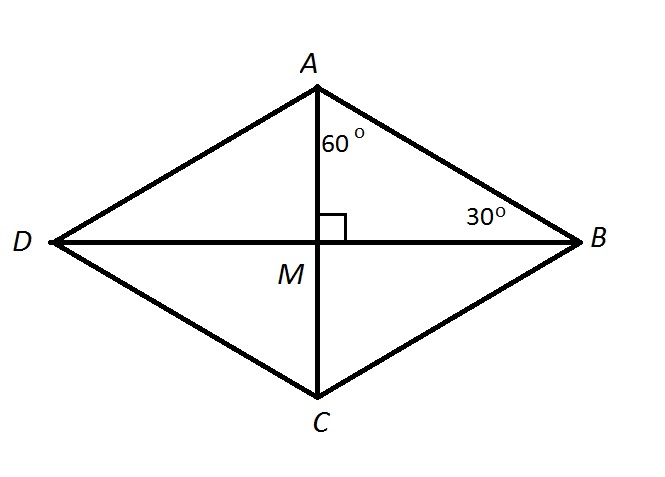
 has perimeter
  , which means that




Since  is known to be a
  triangle, the proportions of the side lengths are known; along with the above equation,
  , and, subsequently, the perimeter, can be determined.
Each diagonal divides Rhombus
Statement 1 alone establishes the perimeter of one such triangle. However, it does not make it clear what equal side lengths
Statement 2 alone gives no information about the actual lengths of the sides.
Assume both statements are true. Since
Since
← Didn't Know|Knew It →
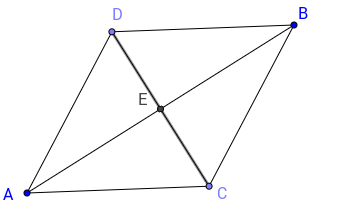
What is the perimeter of quadrilateral  ?
?
(1) Diagonal  and
and are perpendicular with midpoint
  .
.
(2) 
What is the perimeter of quadrilateral
(1) Diagonal
(2)
Tap to reveal answer
To find the perimeter of the quadrilateral, we need to know whether it is of a special type of quadrilaterals and we need to know the length of the sides.
Statement 1 tells us only that the quadrilateral is a rhombus. Indeed, a quadrilateral with perpendicular diagonals intersecting at their midpoint must be a rhombus. However we don't know any length of the sides.
Statement 2 says gives us the length us two consecutive sides. It could be tempting to answer that it is sufficient, however, we can't conclude that the quadrilateral has equal lengths. Therefore this statement alone is insufficient.
Both statements together are sufficient since we can conclude that the quadrilateral is a rhombus, and twice  will give us the perimeter.
To find the perimeter of the quadrilateral, we need to know whether it is of a special type of quadrilaterals and we need to know the length of the sides.
Statement 1 tells us only that the quadrilateral is a rhombus. Indeed, a quadrilateral with perpendicular diagonals intersecting at their midpoint must be a rhombus. However we don't know any length of the sides.
Statement 2 says gives us the length us two consecutive sides. It could be tempting to answer that it is sufficient, however, we can't conclude that the quadrilateral has equal lengths. Therefore this statement alone is insufficient.
Both statements together are sufficient since we can conclude that the quadrilateral is a rhombus, and twice
← Didn't Know|Knew It →
Consider rectangle  .
.
I) Side  is three fourths of side
  .
.
II) Side  is
is  meters long.
What is the perimeter of  ?
?
Consider rectangle
I) Side
II) Side
What is the perimeter of
Tap to reveal answer
To find perimeter, we need to find the length of all the sides. Recall that rectangles are made up of two pairs of equal sides.
I) Relates one side to another non-equivalent side.
II) Gives us side  , which must be equivalent to
  .
.
Use II) and I) to find all the side lengths, then add them up. Both are needed.
Recap:
Consider rectangle CONT
I) Side CO is three fourths of side ON
II) Side NT is 15.7 meters long
What is the perimeter of CONT?
Because we are dealing with a rectangle, we know the following:


Find perimeter with:

Use I) and II) to write the following equation:

So:

And finally:

To find perimeter, we need to find the length of all the sides. Recall that rectangles are made up of two pairs of equal sides.
I) Relates one side to another non-equivalent side.
II) Gives us side
Use II) and I) to find all the side lengths, then add them up. Both are needed.
Recap:
Consider rectangle CONT
I) Side CO is three fourths of side ON
II) Side NT is 15.7 meters long
What is the perimeter of CONT?
Because we are dealing with a rectangle, we know the following:
Find perimeter with:
Use I) and II) to write the following equation:
So:
And finally:
← Didn't Know|Knew It →
Find the perimeter of the rectangle.
Statement 1: The area of the rectangle is 24.
Statement 2: The diagonal of the rectangle is 5.
Find the perimeter of the rectangle.
Statement 1: The area of the rectangle is 24.
Statement 2: The diagonal of the rectangle is 5.
Tap to reveal answer
Statement 1): The area of the rectangle is 24.
Write the area for a rectangle and substitute the value of the area.


The length and width of the rectangle are unknown, and each set of dimensions will provide a different perimeter. This statement is insufficient to find the perimeter of the rectangle.
Statement 2): The diagonal of the rectangle is 5.
Given the diagonal of the rectangle, the Pythagorean Theorem can be used to solve for the diagonal. Express the equation in terms of length and width.

Similar to the case in Statement 1), both the length and width are unknown, and the equation by itself is insufficient to solve for the perimeter of the rectangle.
Attempting to use both equations: and to solve for length and width will yield complex numbers as part of the solution.
Therefore:

Statement 1): The area of the rectangle is 24.
Write the area for a rectangle and substitute the value of the area.
The length and width of the rectangle are unknown, and each set of dimensions will provide a different perimeter. This statement is insufficient to find the perimeter of the rectangle.
Statement 2): The diagonal of the rectangle is 5.
Given the diagonal of the rectangle, the Pythagorean Theorem can be used to solve for the diagonal. Express the equation in terms of length and width.
Similar to the case in Statement 1), both the length and width are unknown, and the equation by itself is insufficient to solve for the perimeter of the rectangle.
Attempting to use both equations:
Therefore:
← Didn't Know|Knew It →
What is the perimeter of Rhombus  ?
?
Statement 1: 
Statement 2: 
What is the perimeter of Rhombus
Statement 1:
Statement 2:
Tap to reveal answer
Each statement gives the length of one diagonal of the rhombus. Knowing one diagonal is not enough to give the perimeter of the rhombus.
Knowing the lengths of both diagonals, which is the case if both statements are assumed, is enough to determine the perimeter. The rhombus in question, along with its diagonals, is as shown below:

As marked in the diagram, the diagonals are perpendicular, and they are also are each other's bisector. It follows from the given lengths that  and
and  , so
, so  can be calculated using the Pythagorean Theorem. The perimeter is four times
  , since all sides of a rhombus are congruent.
Each statement gives the length of one diagonal of the rhombus. Knowing one diagonal is not enough to give the perimeter of the rhombus.
Knowing the lengths of both diagonals, which is the case if both statements are assumed, is enough to determine the perimeter. The rhombus in question, along with its diagonals, is as shown below:
As marked in the diagram, the diagonals are perpendicular, and they are also are each other's bisector. It follows from the given lengths that
← Didn't Know|Knew It →
True or false: Rhombus  Rhombus
  .
.
Statement 1: 
Statement 2: 
True or false: Rhombus
Statement 1:
Statement 2:
Tap to reveal answer
Assume Statement 1 alone. A rhombus being a parallelogram, its opposite angles and its adjacent angles are supplementary. From this fact and Statement 1 alone, it follows that
,  ,
,  , and
, and  .
.
By definition of a rhombus, all of its sides are congruent. By substitution,
 .
.
All side proportions hold as well as all angle congruences, so the similarity statement holds.
Assume Statement 2 alone. Construct the diagonals of the rhombuses, as follows:

In each rhombus, the diagonals are each other's perpendicular bisector. If

then


Since  , both angles being right, it follows via the Side-Angle-Side Smiilarity Theorem that
 ,
,
and , by similarity,
 .
.
By a similar argument,
 ,
,
and by angle addition,
 .
.
As with Statement 1 alone, congruence of one set of corresponding angles in two rhombuses leads to the similarity of the two.
Assume Statement 1 alone. A rhombus being a parallelogram, its opposite angles and its adjacent angles are supplementary. From this fact and Statement 1 alone, it follows that
By definition of a rhombus, all of its sides are congruent. By substitution,
All side proportions hold as well as all angle congruences, so the similarity statement holds.
Assume Statement 2 alone. Construct the diagonals of the rhombuses, as follows:
In each rhombus, the diagonals are each other's perpendicular bisector. If
then
Since
and , by similarity,
By a similar argument,
and by angle addition,
As with Statement 1 alone, congruence of one set of corresponding angles in two rhombuses leads to the similarity of the two.
← Didn't Know|Knew It →
Determine if rectangles  and
and  are similar.
I)  has a perimeter of 16 units and side
  is 3 units long.
II)  has area of 44 units and side
  is 6 units long.
Determine if rectangles
I)
II)
Tap to reveal answer
Similar rectangles (or any shape for that matter) are the same shape but can be different sizes. What that means is that their side lengths all follow a common ratio; if one pair of corresponding sides follow the ratio 2:1, then all corresponding sides must follow the same ratio.
Statement I gives us the perimeter and one side of  .
.
Statement II gives us the area and one side of  .
.
We can find all the sides of both rectangles, but we need both statements to do so. Once we have all side lengths, we can compare them to see if they follow the same ratios.
IF  has perimeter of 16 and one side is 3, we can find the other side using the following:


If  has area of 44 and side of 6, the other side can be found via the following:


Compare the ratios of the sides to find out whether the two rectangles are similar:

Therefore, the rectangles are not similar.
Similar rectangles (or any shape for that matter) are the same shape but can be different sizes. What that means is that their side lengths all follow a common ratio; if one pair of corresponding sides follow the ratio 2:1, then all corresponding sides must follow the same ratio.
Statement I gives us the perimeter and one side of
Statement II gives us the area and one side of
We can find all the sides of both rectangles, but we need both statements to do so. Once we have all side lengths, we can compare them to see if they follow the same ratios.
IF
If
Compare the ratios of the sides to find out whether the two rectangles are similar:
Therefore, the rectangles are not similar.
← Didn't Know|Knew It →
True or false: Rhombus  Rhombus
  .
.
Statement 1:  and
and 
Statement 2: The area of Rhombus  is 49 times that of Rhombus
  .
.
True or false: Rhombus
Statement 1:
Statement 2: The area of Rhombus
Tap to reveal answer
To prove two figures similar, we must prove that their corresponding angles are congruent, and that their corresponding sides are in proportion.
All four sides of a rhombus are congruent, so it easily follows that corresponding sides of two rhombuses are in proportion, regardless of whether they are similar or not; it is therefore necessary and sufficient to prove that corresponding angles are congruent. Also, since a rhombus is a parallelogram, opposite angles are congruent and consecutive angles are supplementary—that is, their angle measures total  . Therefore, it is necessary and sufficient to prove just one pair of corresponding angles congruent.
The two statements together give no information about the measures of any of the angles of the rhombus. Therefore, together, they do not answer the question of whether they are similar or not.
To prove two figures similar, we must prove that their corresponding angles are congruent, and that their corresponding sides are in proportion.
All four sides of a rhombus are congruent, so it easily follows that corresponding sides of two rhombuses are in proportion, regardless of whether they are similar or not; it is therefore necessary and sufficient to prove that corresponding angles are congruent. Also, since a rhombus is a parallelogram, opposite angles are congruent and consecutive angles are supplementary—that is, their angle measures total
The two statements together give no information about the measures of any of the angles of the rhombus. Therefore, together, they do not answer the question of whether they are similar or not.
← Didn't Know|Knew It →
True or false: Rhombus  Rhombus
  .
.
Statement 1: 
Statement 2: 
True or false: Rhombus
Statement 1:
Statement 2:
Tap to reveal answer
To prove two figures similar, we must prove that their corresponding angles are congruent, and that their corresponding sides are in proportion.
All four sides of a rhombus are congruent, so it easily follows that corresponding sides of two rhombuses are in proportion, regardless of whether they are similar or not; it is therefore necessary and sufficient to prove that coresponding angles are congruent. Also, since a rhombus is a parallelogram, opposite angles are congruent and consecutive angles are supplementary—that is, their angle measures total  . Therefore, it is neccessary and sufficient to prove just one pair of corresponding angles congruent.
Assume Statement 1 alone.  and
and  are not corresponding angles, so their congruence does not prove the rhombuses are similar; however it does not prove they are not similar either; for example, two squares are both rhombuses with four right angles, so they are similar and fit this condition.
Assume Statement 2 alone.  and
and  are two angles of the same rhombus, so similarity cannot be proved or disproved without information about the other rhombus.
Now assume both statements.  and
and  are consecutive angles of Rhombus
  ; a rhombus being a parallelogram, the degree measures of the angles total
  . From Statement 2, they are congruent, so each measures
  . Since
  from Statement 1,
  also measures
  . Since each parallelogram has at least one right angle, each has four right angles. Therefore, corresponding angles are congruent, so the rhombuses are similar.
To prove two figures similar, we must prove that their corresponding angles are congruent, and that their corresponding sides are in proportion.
All four sides of a rhombus are congruent, so it easily follows that corresponding sides of two rhombuses are in proportion, regardless of whether they are similar or not; it is therefore necessary and sufficient to prove that coresponding angles are congruent. Also, since a rhombus is a parallelogram, opposite angles are congruent and consecutive angles are supplementary—that is, their angle measures total
Assume Statement 1 alone.
Assume Statement 2 alone.
Now assume both statements.
← Didn't Know|Knew It →
Isosceles Trapezoid  has bases
  and
and  .
.
Isosceles Trapezoid  has bases
  and
and  .
.
True or false:
Trapezoid  Trapezoid
Statement 1:  and
and  are both
  angles.
Statement 2:  and
and 
Isosceles Trapezoid
Isosceles Trapezoid
True or false:
Trapezoid
Statement 1:
Statement 2:
Tap to reveal answer
To prove two figures similar, we must prove that their corresponding angles are congruent and that their corresponding sides are in proportion.
We show that Statement 1 alone provides insufficient information by examining two cases.
Case 1: Trapezoid  Trapezoid , with a angle.
A pair of base angles of an isosceles trapezoid are congruent, so, since  measures
  , so does
  . The leg angles of a trapezoid have measures whose sum is
  , so
, so  and
and  measure
  . By congruence of corresponding angles,
  , so measures
  , and the conditions of Statement 1 are met. Furthermore, two congruent triangles are also similar, so Trapezoid Trapezoid .
Case 2: Examine the figure below, in which  . Note that these congruent upper bases have been superimposed upon each other:

The trapezoids are isosceles since their base angles are congruent; also, the conditions of Statement 1 are met. However,  , but
, but  . The sides are not in proportion, so the trapezoids are not similar.
Assume Statement 2 alone. Two congruent trapezoids whose side lengths fit the conditions of the statement are also similar. But examine this diagram, in which  ,
,  , and
, and  . Note that the congruent upper bases have been superimposed upon each other:

The conditions of Statement 2 are met, but  , so the trapezoids are not similar.
Now assume both statements to be true. As stated before, it follows from Statement 1 that all corresponding angles are congruent.  and
and  , so it follows from the Division Property of Equality that

It remains to be demonstrated that  is equal to the above ratios as well. If the diagonals
  and
and  are constructed,
  and
and  are formed; since
  and
and  , by the Side-Angle-Side Similarity Theorem,
  . It follows that
  , and by angle addition, since
  , it follows that
  . From the Angle-Angle Postulate, the other two triangles formed are similar—that is,
  —and it follows that
  . Therefore, all four sides of the trapezoids are in proportion, and the trapezoids are similar.
To prove two figures similar, we must prove that their corresponding angles are congruent and that their corresponding sides are in proportion.
We show that Statement 1 alone provides insufficient information by examining two cases.
Case 1: Trapezoid
A pair of base angles of an isosceles trapezoid are congruent, so, since
Case 2: Examine the figure below, in which
The trapezoids are isosceles since their base angles are congruent; also, the conditions of Statement 1 are met. However,
Assume Statement 2 alone. Two congruent trapezoids whose side lengths fit the conditions of the statement are also similar. But examine this diagram, in which
The conditions of Statement 2 are met, but
Now assume both statements to be true. As stated before, it follows from Statement 1 that all corresponding angles are congruent.
It remains to be demonstrated that
← Didn't Know|Knew It →
Isosceles Trapezoid  has bases
  and
and  .
.
Isosceles Trapezoid  has bases
  and
and  .
.
True or false:
Trapezoid  Trapezoid
Statement 1: 
Statement 2: 
Isosceles Trapezoid
Isosceles Trapezoid
True or false:
Trapezoid
Statement 1:
Statement 2:
Tap to reveal answer
To prove two figures similar, we must prove that their corresponding angles are congruent and that their corresponding sides are in proportion.
Assume both statements are true. We show that they provide insufficient information by examining two scenarios.
Case 1: Trapezoid  Trapezoid
  , then
  and
and  , so the conditions of both statements are met; also, since the trapezoids are congruent, they are also similar.
Now examine isosceles trapezoid  below, in which
  ,
,  ,
,  , and
, and  are positioned on the bases so that
  and
and  .
.

Since  and
and  , Quadrilateral
  is a parallelogram, and
  ; similarly,
  . Therefore, Trapezoid
  is also isosceles. Also, by the Corresponding Angles Theorem,
  and
and  , and the conditions of both statements are met. However, corresponding sides are not in proportion, since
  , but
, but  ; consequently, the trapezoids are not similar.
To prove two figures similar, we must prove that their corresponding angles are congruent and that their corresponding sides are in proportion.
Assume both statements are true. We show that they provide insufficient information by examining two scenarios.
Case 1: Trapezoid
Now examine isosceles trapezoid
Since
← Didn't Know|Knew It →
Isosceles Trapezoid  has bases
  and
and  .
.
Isosceles Trapezoid  has bases
  and
and  .
.
True or false:
Trapezoid  Trapezoid
Statement 1: 
Statement 2: 
Isosceles Trapezoid
Isosceles Trapezoid
True or false:
Trapezoid
Statement 1:
Statement 2:
Tap to reveal answer
To prove two figures similar, we must prove that their corresponding angles are congruent, and that their corresponding sides are in proportion.
Assume both statements are true. We show that they provide insufficient information by examining two scenarios.
If Trapezoid  Trapezoid
  , then
  and
and  , so the conditions of both statements are met; also, since the trapezoids are congruent, they are also similar.
Now examine isosceles trapezoid  below, in which
  ,
,  ,
,  , and
, and  are positioned on the bases so that
  and
and  .
.
Since  and
and  , Quadrilateral
  is a parallelogram, and
  ; similarly,
  . Therefore, Trapezoid
  is also isosceles, and the conditions of both statements are met. However, corresponding sides are not in proportion, since
  , but
, but  ; consequently, the trapezoids are not similar.
To prove two figures similar, we must prove that their corresponding angles are congruent, and that their corresponding sides are in proportion.
Assume both statements are true. We show that they provide insufficient information by examining two scenarios.
If Trapezoid
Now examine isosceles trapezoid
Since
← Didn't Know|Knew It →
Data sufficiency question- do not actually solve the question
Does the square or rectangle have a greater area?
1. The perimeter of both the square and rectangle are equal.
2. The rectangle does not have four equal sides.
Data sufficiency question- do not actually solve the question
Does the square or rectangle have a greater area?
1. The perimeter of both the square and rectangle are equal.
2. The rectangle does not have four equal sides.
Tap to reveal answer
When a square and rectangle have the same perimeter, the square will have a larger area because having 4 equal sides maximizes the area. However, from statement 1, it is impossible to tell if the rectangle is also a square. When the information from statement 2 is combined, we can conclude that the rectangle is not also a square.
When a square and rectangle have the same perimeter, the square will have a larger area because having 4 equal sides maximizes the area. However, from statement 1, it is impossible to tell if the rectangle is also a square. When the information from statement 2 is combined, we can conclude that the rectangle is not also a square.
← Didn't Know|Knew It →
What is the area of a rectangle?
Statement 1: The length of its diagonal is 25.
Statement 2: The diagonal and either of its longer sides form a  angle.
What is the area of a rectangle?
Statement 1: The length of its diagonal is 25.
Statement 2: The diagonal and either of its longer sides form a
Tap to reveal answer
To find the rectangle, you need the length and the width.
If you know the diagonal  and the angle
  it forms with one of the longer sides, you can use trigonometry to find both length and width:

From there, the area follows.
If you know only the diagonal, you have insufficient information; the length and width can vary according to that angle. If you only know the angle, you can discern the proportions of the sides, but not the actual lengths.
To find the rectangle, you need the length and the width.
If you know the diagonal
From there, the area follows.
If you know only the diagonal, you have insufficient information; the length and width can vary according to that angle. If you only know the angle, you can discern the proportions of the sides, but not the actual lengths.
← Didn't Know|Knew It →
A rectangle has vertices  ,
,
where 
Of the four quadrants, which one includes the greatest portion of the rectangle?
Statement 1: 
Statement 2: 
A rectangle has vertices
where
Of the four quadrants, which one includes the greatest portion of the rectangle?
Statement 1:
Statement 2:
Tap to reveal answer
The portion of the rectangle to the right of the  -axis has area
  ; to the left,
  . From Statement 1 alone, since
  ,
,  , and the portion of the rectangle on the right is greater than the portion on the left. However, this is all we can determine.
By a similar argument, from Statement 2 alone, the portion of the rectangle above is greater than the portion below, but this is all we can determine.
From both statements together, however, we can compare the portions of the rectangles in the four quadrants. The areas of each are:
Quadrant I: 
Quadrant II: 
Quadrant III: 
Quadrant IV: 
Since  and
and  ,
,  is the greatest of the four quantities, and we see that Quadrant I includes the lion's share of the rectangle.
The portion of the rectangle to the right of the
By a similar argument, from Statement 2 alone, the portion of the rectangle above is greater than the portion below, but this is all we can determine.
From both statements together, however, we can compare the portions of the rectangles in the four quadrants. The areas of each are:
Quadrant I:
Quadrant II:
Quadrant III:
Quadrant IV:
Since
← Didn't Know|Knew It →