
Circles - GMAT Quantitative
Card 1 of 712
What is the area of a  sector of a circle?
Statement 1: The diameter of the circle is 48 inches.
Statement 2: The length of the arc is  inches.
What is the area of a
Statement 1: The diameter of the circle is 48 inches.
Statement 2: The length of the arc is
Tap to reveal answer
The area of a  sector of radius
  is
is

From the first statement alone, you can halve the diameter to get radius 24 inches.
From the second alone, note that the length of the  arc is

Given that length, you can find the radius:


Either way, you can get the radius, so you can calculate the area.
The answer is that either statement alone is sufficient to answer the question.
The area of a
From the first statement alone, you can halve the diameter to get radius 24 inches.
From the second alone, note that the length of the
Given that length, you can find the radius:
Either way, you can get the radius, so you can calculate the area.
The answer is that either statement alone is sufficient to answer the question.
← Didn't Know|Knew It →
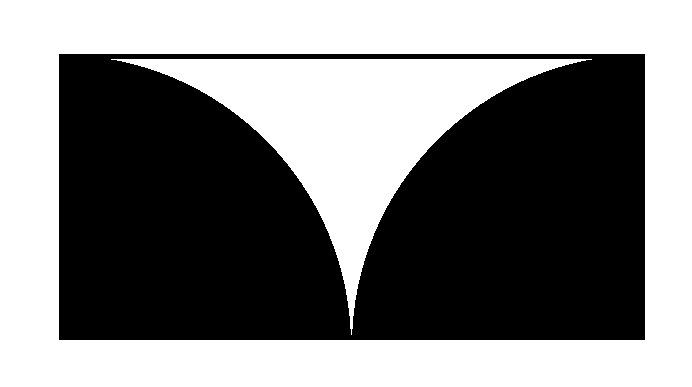
The above figure shows two quarter circles inscribed inside a rectangle. What is the total area of the white region?
Statement 1: The area of the black region is  square centimeters.
Statement 2: The rectangle has perimeter 60 centimeters.
The above figure shows two quarter circles inscribed inside a rectangle. What is the total area of the white region?
Statement 1: The area of the black region is
Statement 2: The rectangle has perimeter 60 centimeters.
Tap to reveal answer
The width of the rectangle is equal to the radius of the quarter circles, which we call  ; the length is twice that, or
  .
.
The area of the rectangle is  ; the total area of the two black quarter circles is
 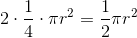 , so the area of the white region is their difference,

Therefore, all that is needed to find the area of the white region is the radius of the quarter circle.
If we know that the area of the black region is  centimeters, then we can deduce
  using this equation:

If we know that the perimeter of the rectangle is 60 centimeters, we can deduce  via the perimeter formula:

Either statement alone allows us to find the radius and, consequently, the area of the white region.
The width of the rectangle is equal to the radius of the quarter circles, which we call
The area of the rectangle is
Therefore, all that is needed to find the area of the white region is the radius of the quarter circle.
If we know that the area of the black region is
If we know that the perimeter of the rectangle is 60 centimeters, we can deduce
Either statement alone allows us to find the radius and, consequently, the area of the white region.
← Didn't Know|Knew It →
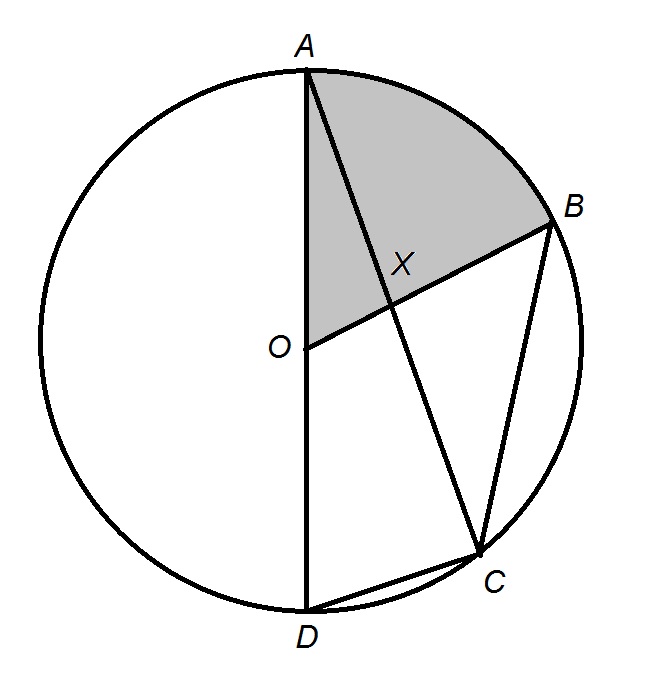
The circle in the above diagram has center  . Give the area of the shaded sector.
Statement 1: The sector with central angle  has area
  .
.
Statement 2:  .
.
The circle in the above diagram has center
Statement 1: The sector with central angle
Statement 2:
Tap to reveal answer
Assume Statement 1 alone. No clues are given about the measure of , so that of  , and, subsequently, the area of the shaded sector, cannot be determined.
Assume Statement 2 alone. Since the circumference of the circle is not given, it cannot be determined what part of the circle  , or, subsequently,
  , is, and therefore, the central angle of the sector cannot be determined. Also, no information about the area of the circle can be determined.
Now assume both statements are true. Let  be the radius of the circle and
  be the measure of
  . Then:

and

The statements can be simplified as

and

From these two statements:

 ; the second statement can be solved for
  :
:

 .
.
 , so
, so  .
.
Since  , the circle has area
  . Since we know the central angle of the shaded sector as well as the area of the circle, we can calculate the area of the sector as
 .
.
Assume Statement 1 alone. No clues are given about the measure of
Assume Statement 2 alone. Since the circumference of the circle is not given, it cannot be determined what part of the circle
Now assume both statements are true. Let
and
The statements can be simplified as
and
From these two statements:
Since
← Didn't Know|Knew It →
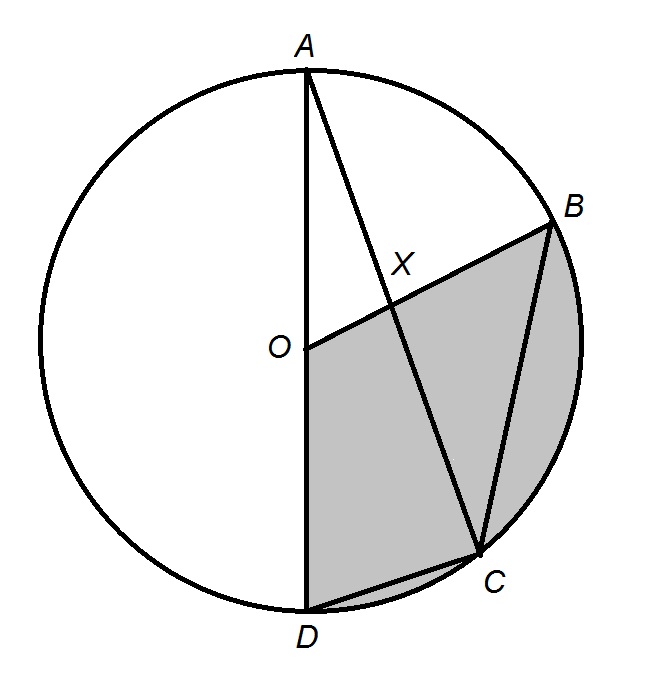
The circle in the above diagram has center  . Give the area of the shaded sector.
Statement 1:  .
.
Statement 2: The circle has circumference  .
.
The circle in the above diagram has center
Statement 1:
Statement 2: The circle has circumference
Tap to reveal answer
To find the area of a sector of a circle, we need a way to find the area of the circle and a way to find the central angle  of the sector.
Statement 1 alone gives us the circumference; this can be divided by  to yield radius
  , and that can be substituted for
  in the formula
  to find the area:
  .
.
However, it provides no clue that might yield  .
.
From Statement 2 alone, we can find  .
.  , an inscribed angle, intercepts an arc twice its measure - this arc is
  , which has measure
  .
.  , the corresponding minor arc, will have measure
  . This gives us
  , but no clue that yields the area.
Now assume both statements are true. The area is  and the shaded sector is
  of the circle, so the area can be calculated to be
  .
.
To find the area of a sector of a circle, we need a way to find the area of the circle and a way to find the central angle
Statement 1 alone gives us the circumference; this can be divided by
However, it provides no clue that might yield
From Statement 2 alone, we can find
Now assume both statements are true. The area is
← Didn't Know|Knew It →
The circle in the above diagram has center  . Give the ratio of the area of the white sector to that of the shaded sector.
Statement 1: 
Statement 2: 
The circle in the above diagram has center
Statement 1:
Statement 2:
Tap to reveal answer
We are asking for the ratio of the areas of the sectors, not the actual areas. The answer is the same regardless of the actual area of the circle, so information about linear measurements such as radius, diameter, and circumference is useless. Statement 2 alone is unhelpful.
Statement 1 alone asserts that .  is an inscribed angle that intercepts the arc
  ; therefore, the arc - and the central angle
  that intercepts it - has twice its measure, or
  . From angle addition, this can be subtracted from
  to yield the measure of central angle
  of the shaded sector, which is
  . That makes that sector
  of the circle. The white sector is
  of the circle, and the ratio of the areas can be determined to be
  , or
, or  .
.
We are asking for the ratio of the areas of the sectors, not the actual areas. The answer is the same regardless of the actual area of the circle, so information about linear measurements such as radius, diameter, and circumference is useless. Statement 2 alone is unhelpful.
Statement 1 alone asserts that
← Didn't Know|Knew It →
The circle in the above diagram has center  . Give the ratio of the area of the white sector to that of the shaded sector.
Statement 1: 
Statement 2: 
The circle in the above diagram has center
Statement 1:
Statement 2:
Tap to reveal answer
Statement 1 alone asserts that  . This is an inscribed angle that intercepts the arc
  ; therefore, the arc - and the central angle
  that intercepts it - has twice this measure, or
  .
.
Statement 2 alone asserts that  . By angle addition,
  .
.
Either statement alone tells us that the shaded sector is  of the circle, and that the white sector is
  of it; it can be subsequently calculated that the ratio of the areas is
  , or
, or  .
.
Statement 1 alone asserts that
Statement 2 alone asserts that
Either statement alone tells us that the shaded sector is
← Didn't Know|Knew It →
The circle in the above diagram has center  . Give the area of the shaded sector.
Statement 1: The circle has circumference  .
.
Statement 2: 
The circle in the above diagram has center
Statement 1: The circle has circumference
Statement 2:
Tap to reveal answer
To find the area of a sector of a circle, we need a way to find the area of the circle and a way to find the central angle of the sector.
Statement 1 alone gives us the circumference; this can be divided by  to yield the radius, and that can be substituted for
  in the formula
  to find the area. However, it provides no clue that might yield
  .
.
Statement 2 alone asserts that  . This is an inscribed angle that intercepts the arc
  ; therefore, the arc - and the central angle that intercepts it - has twice this measure, or
  . Therefore, Statement 2 alone gives the central angle, but does not yield any clues about the area.
Assume both statements are true. The radius is  and the area is
  . The shaded sector is
  of the circle, so the area can be calculated to be
 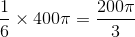 .
.
To find the area of a sector of a circle, we need a way to find the area of the circle and a way to find the central angle of the sector.
Statement 1 alone gives us the circumference; this can be divided by
Statement 2 alone asserts that
Assume both statements are true. The radius is
← Didn't Know|Knew It →
What is the circumference of a circle?
(1)The diameter of this circle is 10
(2)The area of this circle is 
What is the circumference of a circle?
(1)The diameter of this circle is 10
(2)The area of this circle is
Tap to reveal answer
The calculation of the circumference is  . From statement (1) we know that
  . Therefore
  , and we can calculate
  using the formula. From statement (2) we know that
  . Therefore
  , and we can calculate
  using the formula.
The calculation of the circumference is
← Didn't Know|Knew It →
If  and
and  are points on a plane and
  lies inside the circle
  with center
  and radius 5, does
  lie inside circle
  ?
?
(1) The length of line segment  is 7.
is 7.
(2) The length of line segment  is 7.
is 7.
If
(1) The length of line segment
(2) The length of line segment
Tap to reveal answer
(1) The max distance between two points in the circle is twice the length of the
raidus (diameter =  =
=  ). However,
  can still be anywhere on the plane
(outside of the circle) as the statement does not indicate otherwise. Therefore, this statement is insuffieicent.
(2) The length of the line segment from  to
to  is greater than the radius of the circle. Thus,
  must be outside of the circle. This statement is sufficient.
(1) The max distance between two points in the circle is twice the length of the
raidus (diameter =
(outside of the circle) as the statement does not indicate otherwise. Therefore, this statement is insuffieicent.
(2) The length of the line segment from
← Didn't Know|Knew It →
Find the diameter of circle B.
I) Circle B has a circumference of  .
.
II) Circle B has an area of  .
.
Find the diameter of circle B.
I) Circle B has a circumference of
II) Circle B has an area of
Tap to reveal answer
We are given the area and circumference of a circle and asked to find the diameter.
Given the following equations:


We can see that having either area or circumference will allow us to find the radius and in turn the diameter.
Thus, either statement is sufficient by itself.
We are given the area and circumference of a circle and asked to find the diameter.
Given the following equations:
We can see that having either area or circumference will allow us to find the radius and in turn the diameter.
Thus, either statement is sufficient by itself.
← Didn't Know|Knew It →
Find the diameter of circle 
I) The area of  of
of  is
is  .
.
II) An arc making up  of
of  is
is  .
.
Find the diameter of circle
I) The area of
II) An arc making up
Tap to reveal answer
I) Gives us a portion of the area of the circle. From this we can find the total area and solve for the radius. Then we can double our answer to find the diameter.
II) Gives us a portion of the circumference. From this we can find the total circumference and work our way back to the radius and then the diameter.
I) Gives us a portion of the area of the circle. From this we can find the total area and solve for the radius. Then we can double our answer to find the diameter.
II) Gives us a portion of the circumference. From this we can find the total circumference and work our way back to the radius and then the diameter.
← Didn't Know|Knew It →
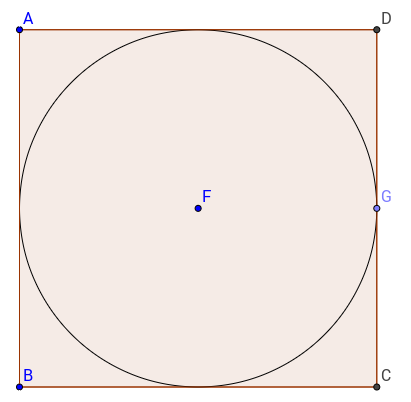
The circle of center  is inscribed in square
  . What is the diameter of the circle?
(1) The ratio of the diameter to the circumference of the circle is  .
.
(2) The area of square  is
is  .
.
The circle of center
(1) The ratio of the diameter to the circumference of the circle is
(2) The area of square
Tap to reveal answer
To find the diameter of the circle we would need information about the square or about the circle itself.
Statement 1 gives us a ratio of the diameter to the circumference  of the circle.
If we write the equation it is  or
or  .
.
Therefore, for all circles, the ratio of the diameter to the circumference will be  .
.
This statement is not helping.
Statement 2 on the other hand gives us the area of the square and therefore allows us to calculate the side of the circle, which is the same as the diameter.
Hence, statement 2 alone is sufficient.
To find the diameter of the circle we would need information about the square or about the circle itself.
Statement 1 gives us a ratio of the diameter to the circumference
If we write the equation it is
Therefore, for all circles, the ratio of the diameter to the circumference will be
This statement is not helping.
Statement 2 on the other hand gives us the area of the square and therefore allows us to calculate the side of the circle, which is the same as the diameter.
Hence, statement 2 alone is sufficient.
← Didn't Know|Knew It →
How far has the tip of the hour hand of a clock traveled since noon?
-
It is now 5:00 PM.
-
The hour hand is half the length of the minute hand.
How far has the tip of the hour hand of a clock traveled since noon?
-
It is now 5:00 PM.
-
The hour hand is half the length of the minute hand.
Tap to reveal answer
The time alone is insufficient without the length of the hand. The second statement does not give us that information, only the relationship between the lengths of the two hands, which is useless without the length of the minute hand.
The answer is that both statements together are insufficient to answer the question.
The time alone is insufficient without the length of the hand. The second statement does not give us that information, only the relationship between the lengths of the two hands, which is useless without the length of the minute hand.
The answer is that both statements together are insufficient to answer the question.
← Didn't Know|Knew It →
Arc  is located on circle
  ;
;  is located on
  Which arc, if either, is longer?
Statement 1: 
Statement 2: 
Arc
Statement 1:
Statement 2:
Tap to reveal answer
 and
and  are the central angles that intercept and , respectively. The measure of an arc is equal to that of its central angle, so, is we are given Statement 2, that
  , we know that
  . The arcs are the same portion of their respective circles. The larger of and determines which arc is longer; this is given in Statement 1, since, if
  , then has the greater radius and circumference.
Both statements together are sufficient to show that is the longer of the two, but neither alone is suffcient. From Statement 1, the relative sizes of the circles are known, but not the degree measures of the arcs; it is possible for an arc on a larger circle to have length less than, equal to, or greater than the arc on the smaller circle. From Statement 2 alone, the degree measures of the arcs can be proved equal, but not thier lengths.
Both statements together are sufficient to show that
← Didn't Know|Knew It →
Arc is located on circle ; is located on . Which arc, if either, has greater degree measure?
Statement 1:  and
and  have the same length.
Statement 2: 
Arc
Statement 1:
Statement 2:
Tap to reveal answer
The arc with the greater degree measure is the one which is the greater part of its circle.
If both arcs have the same length, then the one that is the greater part of its circle must be the one on the smaller circle; Statement 1 alone tells us both have the same length, but not which circle is smaller.
If , then has the greater radius and, sqbsequently, the greater circumference; it is the larger circle. But we know nothing about the measures of the arcs, so Statement 2 alone is insufficient.
If we know both statements, however, we know that, since the arcs have the same length, and is the larger circle - with greater circumference - must be take up the lesser portion of its circle, and have the lesser degree measure of the two.
The arc with the greater degree measure is the one which is the greater part of its circle.
If both arcs have the same length, then the one that is the greater part of its circle must be the one on the smaller circle; Statement 1 alone tells us both have the same length, but not which circle is smaller.
If
If we know both statements, however, we know that, since the arcs have the same length, and
← Didn't Know|Knew It →
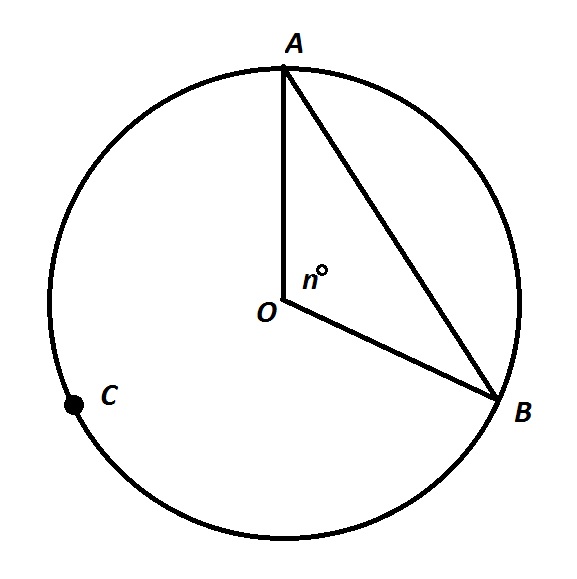
Note: Figure NOT drawn to scale.
In the above figure,  is the center of the circle. Give the length of arc
  .
.
Statement 1: 
Statement 2: 
Note: Figure NOT drawn to scale.
In the above figure,
Statement 1:
Statement 2:
Tap to reveal answer
If either or both Statement 1 and Statement 2 are known, then then only thing about  that can be determined is that it is an arc of measure
  . Without knowing any of the linear measures of the circle, such as the radius or the circumference, it is impossible to determine the length of
  .
.
If either or both Statement 1 and Statement 2 are known, then then only thing about
← Didn't Know|Knew It →
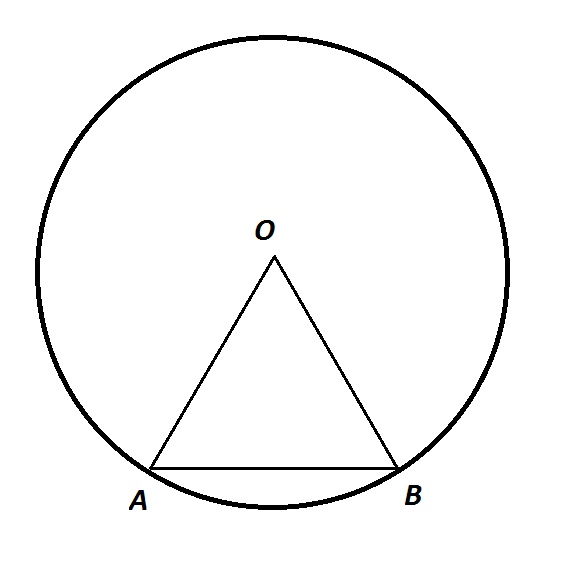
Note: Figure NOT drawn to scale.
In the above figure,  is the center of the circle. Give the length of arc
  .
.
Statement 1:  is an equilateral triangle.
Statement 2:  has area
  .
.
Note: Figure NOT drawn to scale.
In the above figure,
Statement 1:
Statement 2:
Tap to reveal answer
From Statement 1 alone,  , so
, so  can be determined to be a
  arc. But no method is given to find the length of the arc.
From Statement 2 alone, neither  nor radius
  can be determined, as the area of a triangle alone cannot be used to determine any angle or side.
From the two statements together,  , and the common sidelength of the equilateral triangle can be determined from the formula

This sidelength  is the radius of the circle. Once
  is calculated, the circumference can be calculated, and the arc length will be
  of this.
From Statement 1 alone,
From Statement 2 alone, neither
From the two statements together,
This sidelength
← Didn't Know|Knew It →
Note: Figure NOT drawn to scale.
In the above figure,  is the center of the circle. Give the length of arc
  .
.
Statement 1: 
Statement 2: Major arc  has length
  .
.
Note: Figure NOT drawn to scale.
In the above figure,
Statement 1:
Statement 2: Major arc
Tap to reveal answer
Statement 1 only establishes that  is one-third of the circle. Without other information such as the radius, the circumference, or the length of an arc, it is impossible to determine the length of the chord. Statement 2 alone is also insufficient to give the length of the chord, for similar reasons.
The two statements together, however, establish that  is the length of the major arc of a
  central angle, and therefore, two-thirds the circumference. The circumference can therefore be calculated to be
 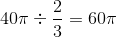 , and minor arc
  is one third of this, or
  .
.
Statement 1 only establishes that
The two statements together, however, establish that
← Didn't Know|Knew It →
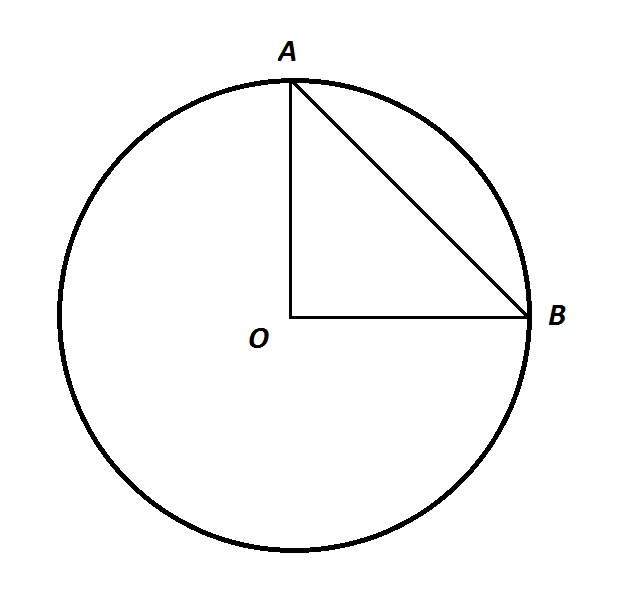
Note: Figure NOT drawn to scale.
In the above figure,  is the center of the circle, and
  . Give the length of arc
  .
.
Statement 1:  .
.
Statement 2: The area of  is
is  .
.
Note: Figure NOT drawn to scale.
In the above figure,
Statement 1:
Statement 2: The area of
Tap to reveal answer
 , making
  a right triangle. Since
  , both segments being radii,
  is also a 45-45-90 triangle.
From Statement 1 alone, it can be determined by way of the 45-45-90 Theorem that  .
.
From Statement 2 alone, since the area of a right triangle is half the product of its legs,
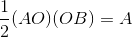
Since  and
and  ,
,
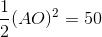


From either statement alone, the radius of the circle can be calculated. From there, the circumference can be calculated, and the length of the arc can be found by multiplying the circumference by 
From Statement 1 alone, it can be determined by way of the 45-45-90 Theorem that
From Statement 2 alone, since the area of a right triangle is half the product of its legs,
Since
From either statement alone, the radius of the circle can be calculated. From there, the circumference can be calculated, and the length of the arc can be found by multiplying the circumference by
← Didn't Know|Knew It →
Data Sufficiency Question
Calculate the area of a circle.
1. The radius of the circle is 4.
2. The circumference of the circle is 24.
Data Sufficiency Question
Calculate the area of a circle.
1. The radius of the circle is 4.
2. The circumference of the circle is 24.
Tap to reveal answer
The area of a circle can be calcuated using the equation:

and the circumference calculated using:

The radius is the only information required for calculating the area of a circle and that can be obtained from the circumference, therefore, either statement is sufficient.
The area of a circle can be calcuated using the equation:
and the circumference calculated using:
The radius is the only information required for calculating the area of a circle and that can be obtained from the circumference, therefore, either statement is sufficient.
← Didn't Know|Knew It →