
Coordinate Geometry - GMAT Quantitative
Card 1 of 2080
Determine whether  and
and 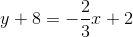 are parallel lines.
Determine whether
Tap to reveal answer
Parallel lines have the same slope. Therefore, we need to find the slope once both equations are in slope intercept form  :
:


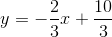

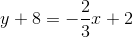
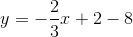
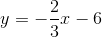

The lines are parallel because the slopes are the same.
Parallel lines have the same slope. Therefore, we need to find the slope once both equations are in slope intercept form
The lines are parallel because the slopes are the same.
← Didn't Know|Knew It →
Find the equation of the line that is perpendicular to the line connecting the points  .
.
Find the equation of the line that is perpendicular to the line connecting the points
Tap to reveal answer
Lines are perpendicular if their slopes are negative reciprocals of each other. First we need to find the slope of the line in the question stem.

The negative reciprocal of 3 is  , so our answer will have a slope of
  . Let's go through the answer choices and see.
 : This line is of the form
  , where
  is the slope. The slope is 3, so this line is parallel, not perpendicular, to our line in question.
 : The slope here is
  , also wrong.
 : The slope of this line is
  . This is the reciprocal, but not the negative reciprocal, so this is also incorrect.
The line between the points  :
: .
.
This is the correct answer! Let's check the last answer choice as well.
The line between points  :
: , which is incorrect.
Lines are perpendicular if their slopes are negative reciprocals of each other. First we need to find the slope of the line in the question stem.
The negative reciprocal of 3 is
The line between the points
This is the correct answer! Let's check the last answer choice as well.
The line between points
← Didn't Know|Knew It →
Determine whether the lines with equations  and
and  are perpendicular.
Determine whether the lines with equations
Tap to reveal answer
If two equations are perpendicular, then they will have inverse negative slopes of each other. So if we compare the slopes of the two equations, then we can find the answer. For the first equation we have 
so the slope is  .
.
So for the equations to be perpendicular, the other equation needs to have a slope of 3. For the second equation, we have

so the slope is  .
.
Since the slope of the second equation is not equal to 3, then the lines are not perpendicular.
If two equations are perpendicular, then they will have inverse negative slopes of each other. So if we compare the slopes of the two equations, then we can find the answer. For the first equation we have
so the slope is
So for the equations to be perpendicular, the other equation needs to have a slope of 3. For the second equation, we have
so the slope is
Since the slope of the second equation is not equal to 3, then the lines are not perpendicular.
← Didn't Know|Knew It →
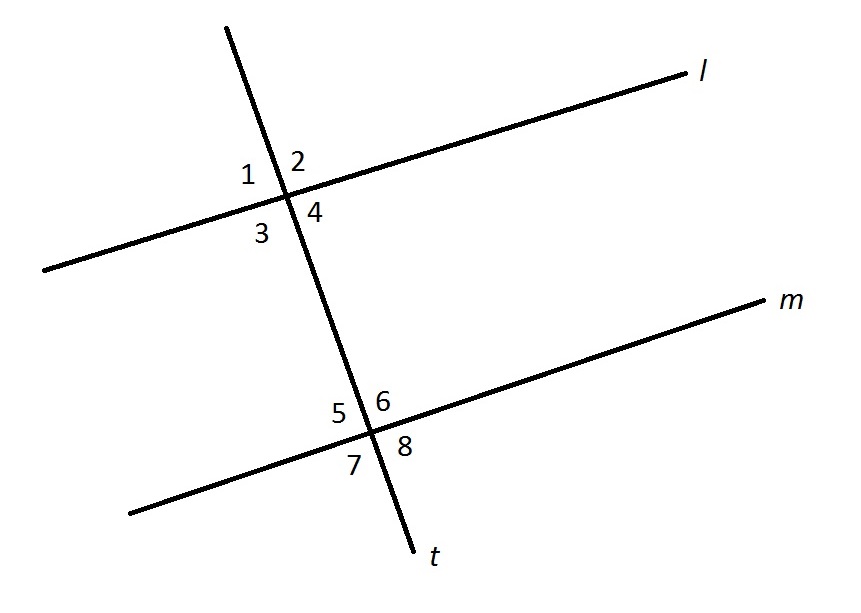
Figure NOT drawn to scale.
Refer to the above figure.
True or false: 
Statement 1:  is a right angle.
Statement 2:  and
and  are supplementary.
Figure NOT drawn to scale.
Refer to the above figure.
True or false:
Statement 1:
Statement 2:
Tap to reveal answer
Statement 1 alone establishes by definition that  , but does not establish any relationship between
  and
and  .
.
By Statement 2 alone, since same-side interior angles are supplementary,  , but no conclusion can be drawn about the relationship of
  , since the actual measures of the angles are not given.
Assume both statements are true. If two lines are parallel, then any line in their plane perpendicular to one must be perpendicular to the other.  and
and  , so it can be established that
  .
.
Statement 1 alone establishes by definition that
By Statement 2 alone, since same-side interior angles are supplementary,
Assume both statements are true. If two lines are parallel, then any line in their plane perpendicular to one must be perpendicular to the other.
← Didn't Know|Knew It →
Refer to the above figure.  . True or false:
Statement 1: 
Statement 2:  and
and  are supplementary.
Refer to the above figure.
Statement 1:
Statement 2:
Tap to reveal answer
If transversal  crosses two parallel lines
  and
and  , then same-side interior angles are supplementary, so
  and
and  are supplementary angles. Also, corresponding angles are congruent, so
  .
.
By Statement 1 alone, angles  and
and  are congruent as well as supplementary; by Statement 2 alone,
  and
and  are also supplementary as well as congruent. Two angles that are both supplementary and congruent are both right angles, so from either statement alone,
  and
and  intersect at right angles, so, consequently,
  .
.
If transversal
By Statement 1 alone, angles
← Didn't Know|Knew It →
Find the equation of the line that is perpendicular to the following equation and passes through the point  .
.

Find the equation of the line that is perpendicular to the following equation and passes through the point
Tap to reveal answer
To solve this equation, we want to begin by recalling how to find the slope of a perpendicular line. In this case, our original line is modeled by the following:

To find the slope of any line perpendicular to the above equation, we simply need to take the reciprocal of the first slope, and then change its sign. Our original slope is  , so
, so

becomes
 .
.
If we flip  , we get
  , and the opposite sign of a negative is a positive; hence, our slope is positive
  .
.
So, we know our perpendicular line should look something like this:

However, we need to find out what  (our
(our  -intercept) is in order to complete our equation. To do so, we need to plug in the ordered pair we received in the question,
  , and solve for
  :
:


So, by putting everything together, we get our final equation:

This equation satisfies the conditions of being perpendicular to our initial equation and passing through  .
.
To solve this equation, we want to begin by recalling how to find the slope of a perpendicular line. In this case, our original line is modeled by the following:
To find the slope of any line perpendicular to the above equation, we simply need to take the reciprocal of the first slope, and then change its sign. Our original slope is
becomes
If we flip
So, we know our perpendicular line should look something like this:
However, we need to find out what
So, by putting everything together, we get our final equation:
This equation satisfies the conditions of being perpendicular to our initial equation and passing through
← Didn't Know|Knew It →
Which of the following lines is perpendicular to  ?
?
Which of the following lines is perpendicular to
Tap to reveal answer
In order for a line  to be perpendicular to another line
  defined by the equation
  , the slope of line
  must be a negative reciprocal of the slope of line
  . Since line
  's slope is
  in the slope-intercept equation above, line
  's slope would therefore be
  .
.
In this instance,  , so
, so  . Therefore, the correct solution is
  .
.
In order for a line
In this instance,
← Didn't Know|Knew It →
A given line  has a slope of
  . What is the slope of any line perpendicular to
  ?
?
A given line
Tap to reveal answer
In order for a line  to be perpendicular to another line
  defined by the equation
  , the slope of line
  must be a negative reciprocal of the slope of line
  . Since line
  's slope is
  in the slope-intercept equation above, line
  's slope would therefore be
  .
.
Given that we have a line  with a slope
  , we can therefore conclude that any perpendicular line would have a slope
  .
.
In order for a line
Given that we have a line
← Didn't Know|Knew It →
Which of the following lines are perpendicular to  ?
?
Which of the following lines are perpendicular to
Tap to reveal answer
In order for a line  to be perpendicular to another line
  defined by the equation
  , the slope of line
  must be a negative reciprocal of the slope of line
  . Since line
  's slope is
  in the slope-intercept equation above, line
  's slope would therefore be
  .
.
Since in this instance the slope  ,
,  . Two of the above answers have this as their slope, so therefore that is the answer to our question.
In order for a line
Since in this instance the slope
← Didn't Know|Knew It →
Find the slope of a line that is perpendicular to the line running through the points  and
and  .
.
Find the slope of a line that is perpendicular to the line running through the points
Tap to reveal answer
To find the slope  of the line running through
  and
and  , we use the following equation:

The slope of any line perpendicular to the given line would have a slope that is the negative reciprocal of  , or
, or  . Therefore,
To find the slope
The slope of any line perpendicular to the given line would have a slope that is the negative reciprocal of
← Didn't Know|Knew It →
Which of the following lines is perpendicular to  ?
?
Which of the following lines is perpendicular to
Tap to reveal answer
Given a line  defined by the equation
  with a slope of
  , any line perpendicular to
  would have a slope that is the negative reciprocal of
  ,
,  . Given our equation
  , we know that
  and that
 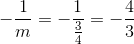 .
.
The only answer choice with this slope is 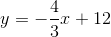 .
.
Given a line
The only answer choice with this slope is
← Didn't Know|Knew It →
Which of the following lines is perpendicular to 
Which of the following lines is perpendicular to
Tap to reveal answer
Given a line  defined by the equation
  with a slope of
  , any line perpendicular to
  would have a slope that is the negative reciprocal of
  ,
,  . Given our equation
  , we know that
  and that
  .
.
There are two answer choices with this slope, 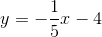 and
and 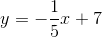 .
.
Given a line
There are two answer choices with this slope,
← Didn't Know|Knew It →
Do the functions  and
and  intersect at a ninety-degree angle, and how can you tell?


Do the functions
Tap to reveal answer
If two lines intersect at a ninety-degree angle, they are said to be perpendicular. Two lines are perpendicular if their slopes are opposite reciprocals. In this case:


The two lines' slopes are reciprocals with opposing signs, so the answer is yes. Of our two yes answers, only one has the right explanation. Eliminate the option dealing with  -intercepts.
If two lines intersect at a ninety-degree angle, they are said to be perpendicular. Two lines are perpendicular if their slopes are opposite reciprocals. In this case:
The two lines' slopes are reciprocals with opposing signs, so the answer is yes. Of our two yes answers, only one has the right explanation. Eliminate the option dealing with
← Didn't Know|Knew It →
A given line  is defined by the equation
  . Which of the following lines would be perpendicular to line
  ?
?
A given line
Tap to reveal answer
For any line  with an equation
  and slope
  , a line that is perpendicular to
  must have a slope of
  , or the negative reciprocal of
  . Given
  , we know that
  and therefore know that
  .
.
Only one equation above has a slope of  :
: 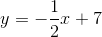 .
.
For any line
Only one equation above has a slope of
← Didn't Know|Knew It →
What is the slope of a line that is perpendicular to 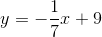
What is the slope of a line that is perpendicular to
Tap to reveal answer
For any line  with an equation
  and slope
  , a line that is perpendicular to
  must have a slope of
  , or the negative reciprocal of
  . Given the equation
 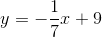 , we know that
  and therefore know that
 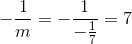 .
.
For any line
← Didn't Know|Knew It →
Which of the following lines is perpendicular to  ?
?
Which of the following lines is perpendicular to
Tap to reveal answer
For any line  with an equation
  and slope
  , a line that is perpendicular to
  must have a slope of
  , or the negative reciprocal of
  . Given the equation
  , we know that
  and therefore know that
  .
.
Given a slope of  , we know that there are two solutions provided:
 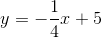 and
and 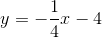 .
.
For any line
Given a slope of
← Didn't Know|Knew It →
What is the slope of a line perpendicular to that of 
What is the slope of a line perpendicular to that of
Tap to reveal answer
First, we need to rearrange the equation into slope-intercept form.  .
.
 Therefore, the slope of this line equals
  Perpendicular lines have slope that are the opposite reciprocal, or
First, we need to rearrange the equation into slope-intercept form.
← Didn't Know|Knew It →
Given the function  , which of the following is the equation of a line perpendicular to
  and has a
  -intercept of
  ?
?
Given the function
Tap to reveal answer
Given a line  defined by the equation
  with slope
  , any line that is perpendicular to
  must have a slope
 , or the negative reciprocal of
  .
.
Since  , the slope
  is
is  and the slope of any line
  parallel to
  must have a slope of
  .
.
Since  also needs to have a
  -intercept of
  , then the equation for
  must be
  .
.
Given a line
Since
Since
← Didn't Know|Knew It →
What is the domain of  ?
?
What is the domain of
Tap to reveal answer
The domain of the function specifies the values that  can take. Here,
  is defined for every value of
  , so the domain is all real numbers.
The domain of the function specifies the values that
← Didn't Know|Knew It →
Define a function  as follows:

Give the  -intercept of the graph of
  .
.
Define a function
Give the
Tap to reveal answer
Set  and evaluate
  to find the
  -coordinate of the
  -intercept.


This can be rewritten in exponential form:


The  -intercept of the graph of
  is
is  .
.
Set
This can be rewritten in exponential form:
The
← Didn't Know|Knew It →