
Arithmetic - GMAT Quantitative
Card 1 of 4488
Subtract nine hundred six ten-thousandths from four tenths.
Subtract nine hundred six ten-thousandths from four tenths.
Tap to reveal answer
Nine hundred six ten-thousandths = 0.0906
Four tenths = 0.4, or 0.4000
The difference:

This is three thousand ninety-four ten-thousandths.
Nine hundred six ten-thousandths = 0.0906
Four tenths = 0.4, or 0.4000
The difference:
This is three thousand ninety-four ten-thousandths.
← Didn't Know|Knew It →
If  and
and  are positive integers such that
  = 4.46, which of the following numbers could be the remainder when
  is divided by
  ?
?
If
Tap to reveal answer
Given that

it follows that  .
.
We don't need to know  or
or  , the only important information is that:

Where the remainder is any one of the answer choices. This is because the remainder for any divisor/dividend pair is the product of the decimal portion of the quotient and the divisor.
Since we don't know y, our answer choice for the remainder is any answer that satisfies the above equation for a positive interger, since  is specified as such in the problem.
The only answer choice that satisfies the constraints on  is 184:
 ==>
==>  ==>
==> 
Given that
it follows that
We don't need to know
Where the remainder is any one of the answer choices. This is because the remainder for any divisor/dividend pair is the product of the decimal portion of the quotient and the divisor.
Since we don't know y, our answer choice for the remainder is any answer that satisfies the above equation for a positive interger, since
The only answer choice that satisfies the constraints on
← Didn't Know|Knew It →
Rewrite as a fraction in lowest terms: 
Rewrite as a fraction in lowest terms:
Tap to reveal answer




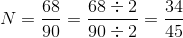
← Didn't Know|Knew It →
Add one hundred seven ten-thousandths to seventeeen one-hundredths.
Add one hundred seven ten-thousandths to seventeeen one-hundredths.
Tap to reveal answer
One hundred seven ten-thousandths = 0.0107
Seventeeen one-hundredths = 0.17, or 0.1700
The sum:

This is one thousand eight hundred seven ten-thousandths.
One hundred seven ten-thousandths = 0.0107
Seventeeen one-hundredths = 0.17, or 0.1700
The sum:
This is one thousand eight hundred seven ten-thousandths.
← Didn't Know|Knew It →
Multiply seventy-seven one-hundredths by sixty-six one-thousandths.
Multiply seventy-seven one-hundredths by sixty-six one-thousandths.
Tap to reveal answer
Seventy-seven one-hundredths = 0.77
Sixty-six one-thousandths = 0.066
The product:


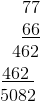
0.77 and 0.066 have a total of five digits to the right of their decimal points, so position the decimal point in the answer so that there are five digits to its right.

This is five thousand eighty-two hundred-thousandths.
Seventy-seven one-hundredths = 0.77
Sixty-six one-thousandths = 0.066
The product:
0.77 and 0.066 have a total of five digits to the right of their decimal points, so position the decimal point in the answer so that there are five digits to its right.
This is five thousand eighty-two hundred-thousandths.
← Didn't Know|Knew It →
Divide eight hundred eighty-eight thousandths by sixty-four ten-thousandths.
Divide eight hundred eighty-eight thousandths by sixty-four ten-thousandths.
Tap to reveal answer
Eight hundred eighty-eight thousandths = 0.888
Sixty-four ten-thousandths = 0.0064
Set up a long division:
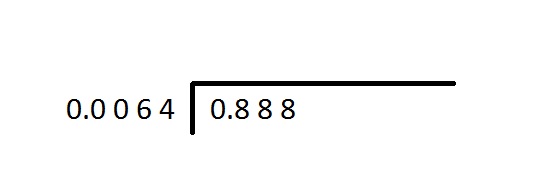
Move the decimal point four places right in both numbers so that the divisor will be a whole number. Note that this will require the use of placeholder zeroes in the dividend.
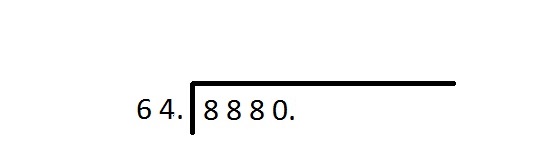
(Note that leading zeroes have been removed.)
Carry out the long division, making sure you align the decimals:
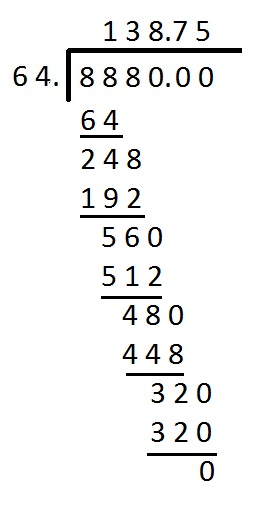
The quotient of this division is that of the original problem, so the correct choice is 138.75.
Eight hundred eighty-eight thousandths = 0.888
Sixty-four ten-thousandths = 0.0064
Set up a long division:
Move the decimal point four places right in both numbers so that the divisor will be a whole number. Note that this will require the use of placeholder zeroes in the dividend.
(Note that leading zeroes have been removed.)
Carry out the long division, making sure you align the decimals:
The quotient of this division is that of the original problem, so the correct choice is 138.75.
← Didn't Know|Knew It →
Which of the following is the square of twenty seven one-thousandths?
Which of the following is the square of twenty seven one-thousandths?
Tap to reveal answer
Twenty-seven one-thousandths = 0.027
Its square is

Multiply without regard to the decimals first:

0.027 and 0.027 have a total of six digits to the right of their decimal points, so position the decimal point in the answer so that there are six digits to its right.

This is seven hundred twenty-nine one-millionths.
Twenty-seven one-thousandths = 0.027
Its square is
Multiply without regard to the decimals first:
0.027 and 0.027 have a total of six digits to the right of their decimal points, so position the decimal point in the answer so that there are six digits to its right.
This is seven hundred twenty-nine one-millionths.
← Didn't Know|Knew It →
Which of the following is the cube of fifteen one-hundredths?
Which of the following is the cube of fifteen one-hundredths?
Tap to reveal answer
Fifteen one-hundredths = 0.15
Its cube is 
Multiply without regard to the decimals first:

0.15, 0.15, and 0.15 have a total of six digits to the right of their decimal points, so position the decimal point in the answer so that there are six digits to its right.

This is three thousand three hundred seventy-five one-millionths.
Fifteen one-hundredths = 0.15
Its cube is
Multiply without regard to the decimals first:
0.15, 0.15, and 0.15 have a total of six digits to the right of their decimal points, so position the decimal point in the answer so that there are six digits to its right.
This is three thousand three hundred seventy-five one-millionths.
← Didn't Know|Knew It →
Which of these equations is not correct?
Which of these equations is not correct?
Tap to reveal answer
Although tempting, a calculator is not required to spot the correct answer.
 is equal to
  as it is
  parts of
  . And therefore
  must be slightly different. (It's it actually
  )
)
Although tempting, a calculator is not required to spot the correct answer.
← Didn't Know|Knew It →
If we divide 10 by 3, what is the 10th digit after the decimal point of the quotient?
If we divide 10 by 3, what is the 10th digit after the decimal point of the quotient?
Tap to reveal answer
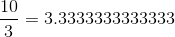
The tenth digit after the decimal point is 3.
When dividing 1 by 3 or 10 by 3, we get repeating 3s. So, there must be a 3 in the tenths digit.
The tenth digit after the decimal point is 3.
When dividing 1 by 3 or 10 by 3, we get repeating 3s. So, there must be a 3 in the tenths digit.
← Didn't Know|Knew It →
Given the sets A = {2, 3, 4, 5} and B = {3, 5, 7}, what is  ?
?
Given the sets A = {2, 3, 4, 5} and B = {3, 5, 7}, what is
Tap to reveal answer
We are looking for the union of the sets. That means we want the elements of A OR B.
So  = {2, 3, 4, 5, 7}.
We are looking for the union of the sets. That means we want the elements of A OR B.
So
← Didn't Know|Knew It →
Define three sets as follows:


How many elements does the set  have?
have?
Define three sets as follows:
How many elements does the set
Tap to reveal answer
 comprises the set of elements common to all three sets. However, since
  is the set of all even integers and
  comprises the set of all odd integers, no element can be common to all three sets. The correct response is 0.
← Didn't Know|Knew It →
Define two sets as follows:


 . Which is a possible value of
  ?
?
Define two sets as follows:
Tap to reveal answer
 comprises the set of all odd integers except 1;
  comprises the set of all integers of the form
  ,
,  a natural number. Therefore, any number that is not in the union of these two sets must be in neither one.
 , so
, so  is even or 1 (although 1 is not a choice). We can eliminate odd choices 147, 149, and 151 immediately.
 , so we determine which number cannot be expressed as
  ,
,  a natural number.


148 is elminated, since it is two less than a multiple of 3. 150 is the correct choice.
148 is elminated, since it is two less than a multiple of 3. 150 is the correct choice.
← Didn't Know|Knew It →
There exists two sets  and
and  .
.  = {1, 4} and
  = {3, 4, 6}. What is
  ?
?
There exists two sets
Tap to reveal answer
Add each element of  to each element of
  .
.
 = {1 + 3, 1 + 4, 1 + 6, 4 + 3, 4 + 4, 4 + 6} = {4, 5, 7, 8, 10}
Add each element of
← Didn't Know|Knew It →
Let  be the set
  , and
, and  be the set
  .
.
What are the elements in the set  ?
?
Let
What are the elements in the set
Tap to reveal answer
 is the set of all elements that are in both
  and
and  . So in this case the elements that are the same for both sets are
  , Note that the order that you present the elements in your set doesn't matter. What matters is that you don't exclude any necessary elements, or add any that don't belong.
← Didn't Know|Knew It →
How many functions map from  to
to  ?
?
How many functions map from
Tap to reveal answer
There are three choices for  (1, 2, and 3), and similarly there are three choices for
  (also 1, 2, and 3). Together there are
  possible functions from
  to
to  . Remember to multiply, NOT add.
There are three choices for
← Didn't Know|Knew It →
Let the univeraal set  be the set of all positive integers.
Define the sets
 ,
,
 ,
,
 .
.
If the elements in  were ordered in ascending order, what would be the fourth element?
Let the univeraal set
Define the sets
If the elements in
Tap to reveal answer
 are the sets of all positive integers that are one greater than a multiple of five, four, and three, respectively. Therefore, for a number to be in all three sets, and subsequently,
  , the number has to be one greater than a number that is a multiple of five, four, and three. Since
  , the number has to be one greater than a multiple of 60. The first four numbers that fit this description are 1, 61, 121, and 181, the last of which is the correct choice.
← Didn't Know|Knew It →
Define three sets as follows:


How many elements does the set  have?
have?
Define three sets as follows:
How many elements does the set
Tap to reveal answer
 comprises the set of elements common to all three sets. Only 5 fulfills that condition, so the correct choice is 1.
← Didn't Know|Knew It →
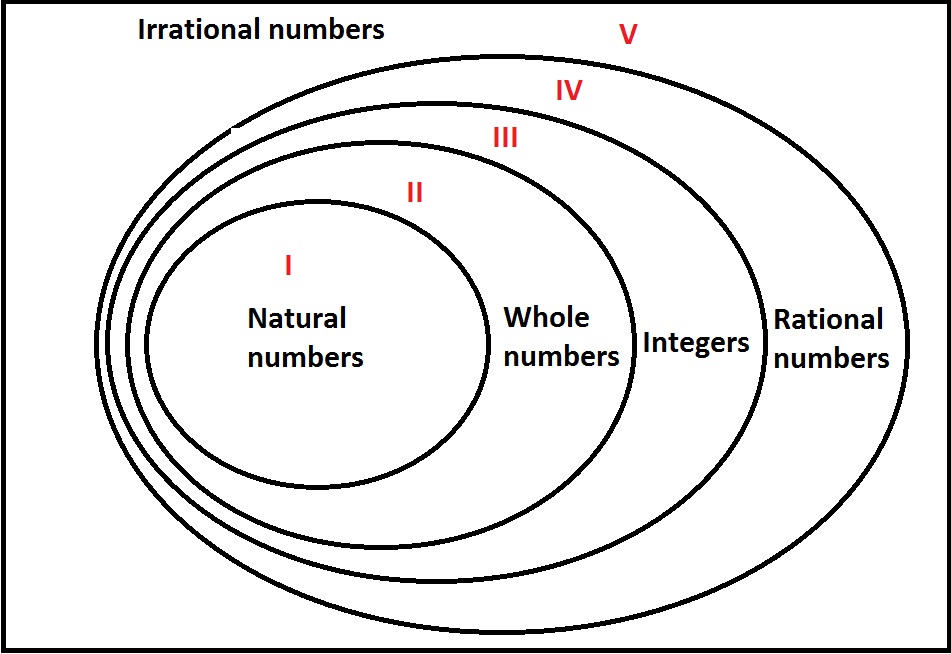
Examine the above diagram, which shows a Venn diagram representing the sets of real numbers.
 and
and  are both numbers in Region I; also,
  . In how many of the five regions could the number
  possibly fall?
Examine the above diagram, which shows a Venn diagram representing the sets of real numbers.
Tap to reveal answer
The numbers in Region I are exactly the natural numbers  . All natural numbers are integers, and the integers are closed under subtraction, so
  cannot fall in Region IV or Region V. Also, since it is given in the problem that
  , it follows that
  , so the difference cannot be in Region II (the only whole number that is not a natural number is
  ).
).
It is possible for  to be in Region I. Example:

It is possible for to be in Region III (the integers that are not whole numbers, or the negative integers). Example:

 can fall in either of two different regions.
The numbers in Region I are exactly the natural numbers
It is possible for
It is possible for
← Didn't Know|Knew It →
Given five sets  , you are given that:


All of the following must be true if  except:
Given five sets
All of the following must be true if
Tap to reveal answer
The subset relation is transitive, so  and
and  together imply that
  .
.
Since all three of  are subsets of
  , then any element of any of those four sets is an element of
  . Contrapositively, any nonelement of
  cannot be an element of any of
  .
.
However, it is possible for a nonelement of  to be an element of
  if
if  . A simple example:
 and
and  .
.
 ,
,  , and
, and  .
.
The subset relation is transitive, so
Since all three of
However, it is possible for a nonelement of
← Didn't Know|Knew It →