
Understanding arithmetic sets - GMAT Quantitative
Card 1 of 224
Given the sets A = {2, 3, 4, 5} and B = {3, 5, 7}, what is  ?
?
Given the sets A = {2, 3, 4, 5} and B = {3, 5, 7}, what is
Tap to reveal answer
We are looking for the union of the sets. That means we want the elements of A OR B.
So  = {2, 3, 4, 5, 7}.
We are looking for the union of the sets. That means we want the elements of A OR B.
So
← Didn't Know|Knew It →
Define three sets as follows:


How many elements does the set  have?
have?
Define three sets as follows:
How many elements does the set
Tap to reveal answer
 comprises the set of elements common to all three sets. However, since
  is the set of all even integers and
  comprises the set of all odd integers, no element can be common to all three sets. The correct response is 0.
← Didn't Know|Knew It →
Define two sets as follows:


 . Which is a possible value of
  ?
?
Define two sets as follows:
Tap to reveal answer
 comprises the set of all odd integers except 1;
  comprises the set of all integers of the form
  ,
,  a natural number. Therefore, any number that is not in the union of these two sets must be in neither one.
 , so
, so  is even or 1 (although 1 is not a choice). We can eliminate odd choices 147, 149, and 151 immediately.
 , so we determine which number cannot be expressed as
  ,
,  a natural number.


148 is elminated, since it is two less than a multiple of 3. 150 is the correct choice.
148 is elminated, since it is two less than a multiple of 3. 150 is the correct choice.
← Didn't Know|Knew It →
There exists two sets  and
and  .
.  = {1, 4} and
  = {3, 4, 6}. What is
  ?
?
There exists two sets
Tap to reveal answer
Add each element of  to each element of
  .
.
 = {1 + 3, 1 + 4, 1 + 6, 4 + 3, 4 + 4, 4 + 6} = {4, 5, 7, 8, 10}
Add each element of
← Didn't Know|Knew It →
Let  be the set
  , and
, and  be the set
  .
.
What are the elements in the set  ?
?
Let
What are the elements in the set
Tap to reveal answer
 is the set of all elements that are in both
  and
and  . So in this case the elements that are the same for both sets are
  , Note that the order that you present the elements in your set doesn't matter. What matters is that you don't exclude any necessary elements, or add any that don't belong.
← Didn't Know|Knew It →
How many functions map from  to
to  ?
?
How many functions map from
Tap to reveal answer
There are three choices for  (1, 2, and 3), and similarly there are three choices for
  (also 1, 2, and 3). Together there are
  possible functions from
  to
to  . Remember to multiply, NOT add.
There are three choices for
← Didn't Know|Knew It →
Let the univeraal set  be the set of all positive integers.
Define the sets
 ,
,
 ,
,
 .
.
If the elements in  were ordered in ascending order, what would be the fourth element?
Let the univeraal set
Define the sets
If the elements in
Tap to reveal answer
 are the sets of all positive integers that are one greater than a multiple of five, four, and three, respectively. Therefore, for a number to be in all three sets, and subsequently,
  , the number has to be one greater than a number that is a multiple of five, four, and three. Since
  , the number has to be one greater than a multiple of 60. The first four numbers that fit this description are 1, 61, 121, and 181, the last of which is the correct choice.
← Didn't Know|Knew It →
Define three sets as follows:


How many elements does the set  have?
have?
Define three sets as follows:
How many elements does the set
Tap to reveal answer
 comprises the set of elements common to all three sets. Only 5 fulfills that condition, so the correct choice is 1.
← Didn't Know|Knew It →
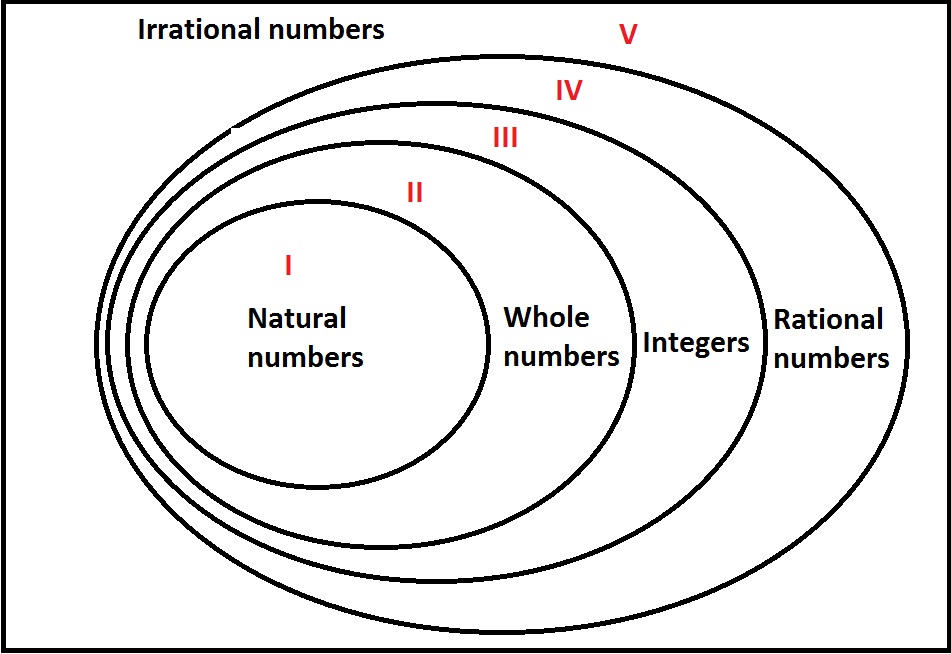
Examine the above diagram, which shows a Venn diagram representing the sets of real numbers.
 and
and  are both numbers in Region I; also,
  . In how many of the five regions could the number
  possibly fall?
Examine the above diagram, which shows a Venn diagram representing the sets of real numbers.
Tap to reveal answer
The numbers in Region I are exactly the natural numbers  . All natural numbers are integers, and the integers are closed under subtraction, so
  cannot fall in Region IV or Region V. Also, since it is given in the problem that
  , it follows that
  , so the difference cannot be in Region II (the only whole number that is not a natural number is
  ).
).
It is possible for  to be in Region I. Example:

It is possible for to be in Region III (the integers that are not whole numbers, or the negative integers). Example:

 can fall in either of two different regions.
The numbers in Region I are exactly the natural numbers
It is possible for
It is possible for
← Didn't Know|Knew It →
Given five sets  , you are given that:


All of the following must be true if  except:
Given five sets
All of the following must be true if
Tap to reveal answer
The subset relation is transitive, so  and
and  together imply that
  .
.
Since all three of  are subsets of
  , then any element of any of those four sets is an element of
  . Contrapositively, any nonelement of
  cannot be an element of any of
  .
.
However, it is possible for a nonelement of  to be an element of
  if
if  . A simple example:
 and
and  .
.
 ,
,  , and
, and  .
.
The subset relation is transitive, so
Since all three of
However, it is possible for a nonelement of
← Didn't Know|Knew It →
Which set is NOT equal to the other sets?
Which set is NOT equal to the other sets?
Tap to reveal answer
Order and repetition do NOT change a set. Therefore, the set we want to describe contains the numbers 1, 3, and 4. The only set that doesn't contain all 3 of these numbers is  , so it is the set that does not equal the rest of the sets.
Order and repetition do NOT change a set. Therefore, the set we want to describe contains the numbers 1, 3, and 4. The only set that doesn't contain all 3 of these numbers is
← Didn't Know|Knew It →
Given the set  = {2, 3, 4, 5}, what is the value of
  ?
?
Given the set
Tap to reveal answer
We need to add 3 to every element in  .
.
Then:

We need to add 3 to every element in
Then:
← Didn't Know|Knew It →
A six-sided die is rolled, and a coin is flipped. If the coin comes up heads, the roll is considered to be the number that appears face up on the die; if the coin comes up tails, the outcome is considered to be half that number, with any fraction simply thrown out. What is the sample space of the experiment?
A six-sided die is rolled, and a coin is flipped. If the coin comes up heads, the roll is considered to be the number that appears face up on the die; if the coin comes up tails, the outcome is considered to be half that number, with any fraction simply thrown out. What is the sample space of the experiment?
Tap to reveal answer
If heads comes up on the coin, the number on the die is recorded. This can be any element of the set  .
.
If tails comes up on the coin, half the number on the die is recorded, and any fraction is thrown out. Half the elements of the set  comprise the set
 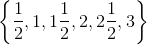 , but since we are throwing out the fractional parts, this becomes the set
  .
.
The sample space is the union of these two sets, which is  .
.
If heads comes up on the coin, the number on the die is recorded. This can be any element of the set
If tails comes up on the coin, half the number on the die is recorded, and any fraction is thrown out. Half the elements of the set
The sample space is the union of these two sets, which is
← Didn't Know|Knew It →
A six-sided die is rolled, and a coin is flipped. If the coin comes up heads, the roll is considered to be the number that appears face up on the die; if the coin comes up tails, the outcome is considered to be twice that number. What is the sample space of the experiment?
A six-sided die is rolled, and a coin is flipped. If the coin comes up heads, the roll is considered to be the number that appears face up on the die; if the coin comes up tails, the outcome is considered to be twice that number. What is the sample space of the experiment?
Tap to reveal answer
If heads comes up on the coin, the number on the die is recorded. This can be any element of the set  .
.
If tails comes up on the coin, twice the number on the die is recorded. This can be twice any element of the set  - that is, any element of the set
  .
.
The sample space is the union of these two sets:

If heads comes up on the coin, the number on the die is recorded. This can be any element of the set
If tails comes up on the coin, twice the number on the die is recorded. This can be twice any element of the set
The sample space is the union of these two sets:
← Didn't Know|Knew It →
Define three sets as follows:


How many elements does the set  have?
have?
Define three sets as follows:
How many elements does the set
Tap to reveal answer
The intersection of  and
and  is the set of all elements in
  that are also in
  - namely,
  . The union of this set and
  is the set of all elements in one or the other set, or
  .
.
The set has seven elements.
The intersection of
The set has seven elements.
← Didn't Know|Knew It →
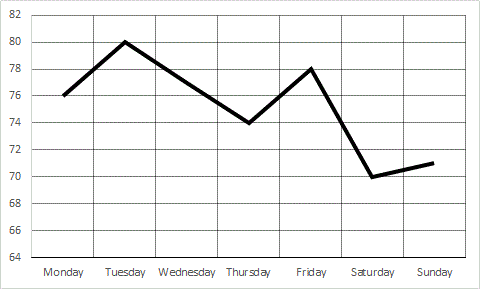
Refer to the above graph, which shows the peak temperature in Smithville for each of seven days in a one-week period.
Between which two consecutuve days did the peak temperature see its greatest decrease?
Refer to the above graph, which shows the peak temperature in Smithville for each of seven days in a one-week period.
Between which two consecutuve days did the peak temperature see its greatest decrease?
Tap to reveal answer
You only need to look for the portion of the line with the greatest negative slope, which is that which represents Friday to Saturday.
You only need to look for the portion of the line with the greatest negative slope, which is that which represents Friday to Saturday.
← Didn't Know|Knew It →
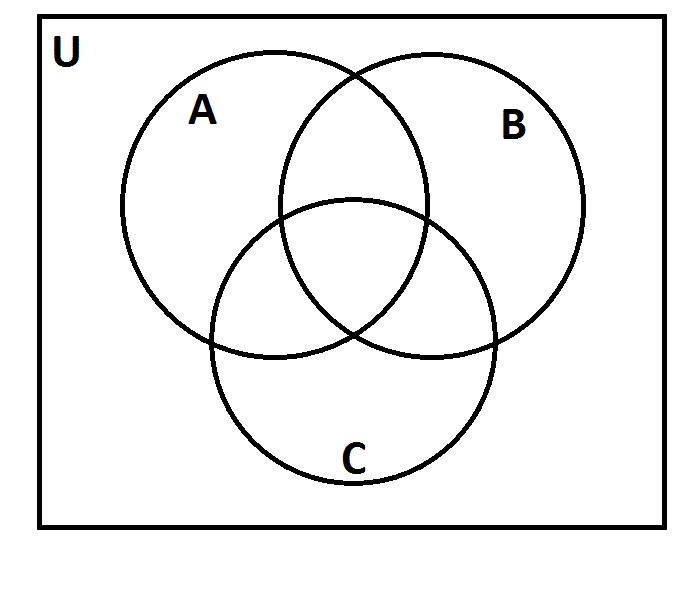
The above represents a Venn diagram. The universal set  is the set of all positive integers.
Let  be the set of all multiples of 3; let
  be the set of all multiples of 5; let
  be the set of all multiples of 7.
As you can see, the three sets divide the universal set into eight regions. Suppose each positive integer was placed in the correct region. Which of the following numbers would be in the same region as 728?
The above represents a Venn diagram. The universal set
Let
As you can see, the three sets divide the universal set into eight regions. Suppose each positive integer was placed in the correct region. Which of the following numbers would be in the same region as 728?
Tap to reveal answer


728 is divisible by 7, but not 3 or 5; therefore, 728 is in  but not
  or
or  . To be in the same region, a number must also be in
  but not
  or
or  - that is, divisible by 7 but not 3 or 5.
510 and 595 can be eliminated as multiples of 5 (from the last digit); 777 can be eliminated as a multiple of 3 (digit sum is 21).
Now let's look at the two reminaing choices.
736 is not divisible by 7, since  .
.
476 is not divisible by 3 or 5, but it is divisible by 7:


476 is the correct choice.
728 is divisible by 7, but not 3 or 5; therefore, 728 is in
510 and 595 can be eliminated as multiples of 5 (from the last digit); 777 can be eliminated as a multiple of 3 (digit sum is 21).
Now let's look at the two reminaing choices.
736 is not divisible by 7, since
476 is not divisible by 3 or 5, but it is divisible by 7:
476 is the correct choice.
← Didn't Know|Knew It →
How many elements are in a set from which exactly 768 unique subsets can be formed?
How many elements are in a set from which exactly 768 unique subsets can be formed?
Tap to reveal answer
The number of subsets that can be formed from a set with  elements is
  . However,
  and
and  , so there is no integer
  for which
  . Therefore, a set with exactly 768 elements cannot exist.
The number of subsets that can be formed from a set with
← Didn't Know|Knew It →
The above represents a Venn diagram. The universal set  is the set of all positive integers.
Let  be the set of all multiples of 5; let
  be the set of all perfect squares; let
  be the set of perfect cubes.
As you can see, the three sets divide the universal set into eight regions. Suppose each positive integer was placed in the correct region. Which of the following numbers would be in the same region as 1,225?
The above represents a Venn diagram. The universal set
Let
As you can see, the three sets divide the universal set into eight regions. Suppose each positive integer was placed in the correct region. Which of the following numbers would be in the same region as 1,225?
Tap to reveal answer
1,225 is divisible by 5 (last digit is 5). It is a perfect square, since  . It is not a perfect cube, however, since
  .
.
Therefore, 1,225 is an element in  and
and  , but not
  . We are looking for an element in
  and
and  , but not
  - that is, a multiple of 5 and a perfect square but not a perfect cube.
By looking at the last digits, we can immediately eliminate 1,764 and 4,356, since neither is a multiple of 5. We can eliminate 15,625, since it s a perfect cube -  .
.
Of the two remaining numbers, 3,375 is not a perfect square, since

3,025 is a perfect square: 
3,025 is not a perfect cube: 
3,025 is a multiple of 5, as can be seen from the last digit.
This is the correct choice.
1,225 is divisible by 5 (last digit is 5). It is a perfect square, since
Therefore, 1,225 is an element in
By looking at the last digits, we can immediately eliminate 1,764 and 4,356, since neither is a multiple of 5. We can eliminate 15,625, since it s a perfect cube -
Of the two remaining numbers, 3,375 is not a perfect square, since
3,025 is a perfect square:
3,025 is not a perfect cube:
3,025 is a multiple of 5, as can be seen from the last digit.
This is the correct choice.
← Didn't Know|Knew It →
If  is the set of the multiples of
  between
  and
and  and
and  is the set of multiples of
  between
  and
and  ; what is
  ?
?
If
Tap to reveal answer


So the intersection of A and B is the numbers that are in both A and B.
Thus 
So the intersection of A and B is the numbers that are in both A and B.
Thus
← Didn't Know|Knew It →