
Algebra - GRE Quantitative Reasoning
Card 1 of 3896
For how many integers,  , between 26 and 36 is it true that
 and
and  are all in lowest terms?
For how many integers,
Tap to reveal answer
If  is even, then
  is not in lowest terms, since both
  and 4 are divisible by 2. Therefore, the only possibilities are 27,29,31,33, and 35. But
  ,
,  , and
, and  , so only two integers satisfy the given condition: 29 and 31.
If
← Didn't Know|Knew It →
Mrs. Lawrence's class has  students,
  of which are girls. If you were to choose a student at random, what's the probability that the student chosen would be a boy?
Mrs. Lawrence's class has
Tap to reveal answer
In order to find out the probability of choosing a boy, you must first find out how many boys there are. Since there are  girls out of
  students,
  students should be boys.
Therefore, the probability of choosing a boy is,
 .
.
However, this is not one of the answer choices; therefore, you must reduce the fraction.
In order to reduce a fraction, you have to find their GCM, or greatest common multiple. This is the biggest number that will go into both the numerator  and denominator
  . The largest number is
  . Divide both the top and bottom by
  , and you will get the answer:

In order to find out the probability of choosing a boy, you must first find out how many boys there are. Since there are
Therefore, the probability of choosing a boy is,
However, this is not one of the answer choices; therefore, you must reduce the fraction.
In order to reduce a fraction, you have to find their GCM, or greatest common multiple. This is the biggest number that will go into both the numerator
← Didn't Know|Knew It →
Simplify the fraction:

Simplify the fraction:
Tap to reveal answer
To simplify the fraction

It may be helpful to write it in terms of scientific notation:


To simplify the fraction
It may be helpful to write it in terms of scientific notation:
← Didn't Know|Knew It →
Simply the fraction:

Simply the fraction:
Tap to reveal answer
To simplify the fraction

Begin by factoring out common terms in the numerator and denominator:

Now notice that the coefficients for the polynomials in the numerator and denominator match the form of Pascal's Triangle:


The fraction can be rewritten as:

And finally reduced to

To simplify the fraction
Begin by factoring out common terms in the numerator and denominator:
Now notice that the coefficients for the polynomials in the numerator and denominator match the form of Pascal's Triangle:
The fraction can be rewritten as:
And finally reduced to
← Didn't Know|Knew It →
Simplify: y3x4(yx3 + y2x2 + y15 + x22)
Simplify: y3x4(yx3 + y2x2 + y15 + x22)
Tap to reveal answer
When you multiply exponents, you add the common bases:
y4 x7 + y5x6 + y18x4 + y3x26
When you multiply exponents, you add the common bases:
y4 x7 + y5x6 + y18x4 + y3x26
← Didn't Know|Knew It →
Indicate whether Quantity A or Quantity B is greater, or if they are equal, or if there is not enough information given to determine the relationship.

Quantity A: 
Quantity B: 
Indicate whether Quantity A or Quantity B is greater, or if they are equal, or if there is not enough information given to determine the relationship.
Quantity A:
Quantity B:
Tap to reveal answer
By using exponent rules, we can simplify Quantity B.






Also, we can simplify Quantity A.


Since n is positive, 
By using exponent rules, we can simplify Quantity B.
Also, we can simplify Quantity A.
Since n is positive,
← Didn't Know|Knew It →
If  , what is the value of
  ?
?
If
Tap to reveal answer
Since the base is 5 for each term, we can say 2 + n =12. Solve the equation for n by subtracting 2 from both sides to get n = 10.
Since the base is 5 for each term, we can say 2 + n =12. Solve the equation for n by subtracting 2 from both sides to get n = 10.
← Didn't Know|Knew It →
If 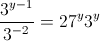 , what is the value of
  ?
?
If
Tap to reveal answer
Rewrite the term on the left as a product. Remember that negative exponents shift their position in a fraction (denominator to numerator).

The term on the right can be rewritten, as 27 is equal to 3 to the third power.

Exponent rules dictate that multiplying terms allows us to add their exponents, while one term raised to another allows us to multiply exponents.


We now know that the exponents must be equal, and can solve for  .
.


Rewrite the term on the left as a product. Remember that negative exponents shift their position in a fraction (denominator to numerator).
The term on the right can be rewritten, as 27 is equal to 3 to the third power.
Exponent rules dictate that multiplying terms allows us to add their exponents, while one term raised to another allows us to multiply exponents.
We now know that the exponents must be equal, and can solve for
← Didn't Know|Knew It →
Simplify  .
.
Simplify
Tap to reveal answer
First, simplify  by adding the exponents to get
  .
.
Then simplify  by multiplying the exponents to get
  .
.
This gives us  . We cannot simplify any further.
First, simplify
Then simplify
This gives us
← Didn't Know|Knew It →
Simplify  .
.
Simplify
Tap to reveal answer
Start by simplifying each individual term between the plus signs. We can add the exponents in  and
and  so each of those terms becomes
  . Then multiply the exponents in
  so that term also becomes
  . Thus, we have simplified the expression to
  which is
  .
.
Start by simplifying each individual term between the plus signs. We can add the exponents in
← Didn't Know|Knew It →
If  , what is the value of
If
Tap to reveal answer
To attempt this problem, note that  .
.
Now note that when multiplying numbers, if the base is the same, we may add the exponents:

This can in turn be written in terms of nine as follows (recall above)



To attempt this problem, note that
Now note that when multiplying numbers, if the base is the same, we may add the exponents:
This can in turn be written in terms of nine as follows (recall above)
← Didn't Know|Knew It →
If  , what is the value of
If
Tap to reveal answer
When dealing with exponenents, when multiplying two like bases together, add their exponents:

However, when an exponent appears outside of a parenthesis, or if the entire number itself is being raised by a power, multiply:



When dealing with exponenents, when multiplying two like bases together, add their exponents:
However, when an exponent appears outside of a parenthesis, or if the entire number itself is being raised by a power, multiply:
← Didn't Know|Knew It →
If  , then
If
Tap to reveal answer
Start by simplifying the numerator and denominator separately. In the numerator, (c3)2 is equal to c6. In the denominator, c2 * c4 equals c6 as well. Dividing the numerator by the denominator, c6/c6, gives an answer of 1, because the numerator and the denominator are the equivalent.
Start by simplifying the numerator and denominator separately. In the numerator, (c3)2 is equal to c6. In the denominator, c2 * c4 equals c6 as well. Dividing the numerator by the denominator, c6/c6, gives an answer of 1, because the numerator and the denominator are the equivalent.
← Didn't Know|Knew It →
Evaluate:
Evaluate:
Tap to reveal answer
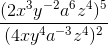
Distribute the outside exponents first:
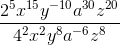
Divide the coefficient by subtracting the denominator exponents from the corresponding numerator exponents:

Distribute the outside exponents first:
Divide the coefficient by subtracting the denominator exponents from the corresponding numerator exponents:
← Didn't Know|Knew It →
If  , which of the following is equal to
  ?
?
If
Tap to reveal answer
The numerator is simplified to  (by adding the exponents), then cube the result. a24/a6 can then be simplified to
  .
.
The numerator is simplified to
← Didn't Know|Knew It →
\[641/2 + (–8)1/3\] * \[43/16 – 3171/3169\] =
\[641/2 + (–8)1/3\] * \[43/16 – 3171/3169\] =
Tap to reveal answer
Let's look at the two parts of the multiplication separately. Remember that (–8)1/3 will be negative. Then 641/2 + (–8)1/3 = 8 – 2 = 6.
For the second part, we can cancel some exponents to make this much easier. 43/16 = 43/42 = 4. Similarly, 3171/3169 = 3171–169 = 32 = 9. So 43/16 – 3171/3169 = 4 – 9 = –5.
Together, \[641/2 + (–8)1/3\] * \[43/16 – 3171/3169\] = 6 * (–5) = –30.
Let's look at the two parts of the multiplication separately. Remember that (–8)1/3 will be negative. Then 641/2 + (–8)1/3 = 8 – 2 = 6.
For the second part, we can cancel some exponents to make this much easier. 43/16 = 43/42 = 4. Similarly, 3171/3169 = 3171–169 = 32 = 9. So 43/16 – 3171/3169 = 4 – 9 = –5.
Together, \[641/2 + (–8)1/3\] * \[43/16 – 3171/3169\] = 6 * (–5) = –30.
← Didn't Know|Knew It →

Tap to reveal answer
The easiest way to solve this is to simplify the fraction as much as possible. We can do this by factoring out the greatest common factor of the numerator and the denominator. In this case, the GCF is  .
.

Now, we can cancel out the  from the numerator and denominator and continue simplifying the expression.

The easiest way to solve this is to simplify the fraction as much as possible. We can do this by factoring out the greatest common factor of the numerator and the denominator. In this case, the GCF is
Now, we can cancel out the
← Didn't Know|Knew It →
(b * b4 * b7)1/2/(b3 * bx) = b5
If b is not negative then x = ?
(b * b4 * b7)1/2/(b3 * bx) = b5
If b is not negative then x = ?
Tap to reveal answer
Simplifying the equation gives b6/(b3+x) = b5.
In order to satisfy this case, x must be equal to –2.
Simplifying the equation gives b6/(b3+x) = b5.
In order to satisfy this case, x must be equal to –2.
← Didn't Know|Knew It →
If〖7/8〗n= √(〖7/8〗5),then what is the value of n?
If〖7/8〗n= √(〖7/8〗5),then what is the value of n?
Tap to reveal answer
7/8 is being raised to the 5th power and to the 1/2 power at the same time. We multiply these to find n.
7/8 is being raised to the 5th power and to the 1/2 power at the same time. We multiply these to find n.
← Didn't Know|Knew It →
 is a real number such that
  .
.
Quantity A: 
Quantity B: 
Quantity A:
Quantity B:
Tap to reveal answer
(y2)(y4) = y2+4 = y6
Plug in two different values for y.
Plug in y = 1: y8 = y6
Plug in y = 2: y8 > y6
Since the results differ, the relationship cannot be determined from the information given.
(y2)(y4) = y2+4 = y6
Plug in two different values for y.
Plug in y = 1: y8 = y6
Plug in y = 2: y8 > y6
Since the results differ, the relationship cannot be determined from the information given.
← Didn't Know|Knew It →