
Fractions - GRE Quantitative Reasoning
Card 1 of 1968
Column A: 
Column B: 
Column A:
Column B:
Tap to reveal answer
2/5% = 0.40% = 0.004. Therefore, Column B is greater.
2/5% = 0.40% = 0.004. Therefore, Column B is greater.
← Didn't Know|Knew It →
For every 1000 cookies baked, 34 are oatmeal raisin.
Quantity A: Percent of cookies baked that are oatmeal raisin
Quantity B: 3.4%
For every 1000 cookies baked, 34 are oatmeal raisin.
Quantity A: Percent of cookies baked that are oatmeal raisin
Quantity B: 3.4%
Tap to reveal answer
Simplify Quantity A by dividing the number of oatmeal raisin cookies by the total number of cookies to find the percentage of oatmeal raisin cookies. Since a percentage is defined as being out of 100, either multiply the resulting decimal by 100 or reduce the fraction until the denominator is 100. You will find that the two quantities are equal.
Simplify Quantity A by dividing the number of oatmeal raisin cookies by the total number of cookies to find the percentage of oatmeal raisin cookies. Since a percentage is defined as being out of 100, either multiply the resulting decimal by 100 or reduce the fraction until the denominator is 100. You will find that the two quantities are equal.
← Didn't Know|Knew It →
50 students took an exam. There were 4 A's, 9 B's, 15 C's, 8 D's, and the rest of the students failed. What percent of the students failed?
50 students took an exam. There were 4 A's, 9 B's, 15 C's, 8 D's, and the rest of the students failed. What percent of the students failed?
Tap to reveal answer
 students failed.
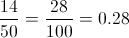
which equals 28%.
which equals 28%.
← Didn't Know|Knew It →
36 is x% of 133. What is x
36 is x% of 133. What is x
Tap to reveal answer
36 is x% of 133
that means that 36 = (x%)(133)
x% = 36/133 X 100 = 27%
36 is x% of 133
that means that 36 = (x%)(133)
x% = 36/133 X 100 = 27%
← Didn't Know|Knew It →
 is
is  percent of
 is
is  percent of
Quantity A: 
Quantity B: 
Quantity A:
Quantity B:
Tap to reveal answer
To do this problem, translate each expression into mathematical terms:
 is
is  percent of
  :
:
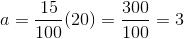
 is
is  percent of
  :
:
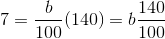
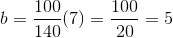
Quantity B is greater.
To do this problem, translate each expression into mathematical terms:
Quantity B is greater.
← Didn't Know|Knew It →
Quantity A: 20% of 
Quantity B: 30% of 
Quantity A: 20% of
Quantity B: 30% of
Tap to reveal answer
To solve this problem, consider writing the quantities in terms of only fractions:
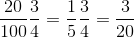
Quantity A: 20% of 
Quantity B: 30% of 
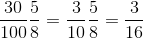
Quantity B has the smaller denominator for an equal numerator. There is no need for calculation beyond this, and time on the GRE would be best spent elsewhere.
Quantity B is greater.
To solve this problem, consider writing the quantities in terms of only fractions:
Quantity A: 20% of
Quantity B: 30% of
Quantity B has the smaller denominator for an equal numerator. There is no need for calculation beyond this, and time on the GRE would be best spent elsewhere.
Quantity B is greater.
← Didn't Know|Knew It →
What percentage of a solution is blood if it contains  ml blood and
  ml water? Round to the nearest thousandth?
What percentage of a solution is blood if it contains
Tap to reveal answer
First, you must find the total amount of solution. This is  , or
, or  .
.
Now, the percentage of the solution that is blood can be represented:
 , or
, or 
This is the same as  % Rounded, it is
  %
%
First, you must find the total amount of solution. This is
Now, the percentage of the solution that is blood can be represented:
This is the same as
← Didn't Know|Knew It →
What is the percentage increase of an account that began with a balance of  and increased to
  ?
?
What is the percentage increase of an account that began with a balance of
Tap to reveal answer
Recall that the formula for percentage increase is:
 , where
  is your ending value and
  is your starting value.
For our numbers, this would be:

Recall that to find a percentage from a decimal, you multiply by  :
:

Recall that the formula for percentage increase is:
For our numbers, this would be:
Recall that to find a percentage from a decimal, you multiply by
← Didn't Know|Knew It →
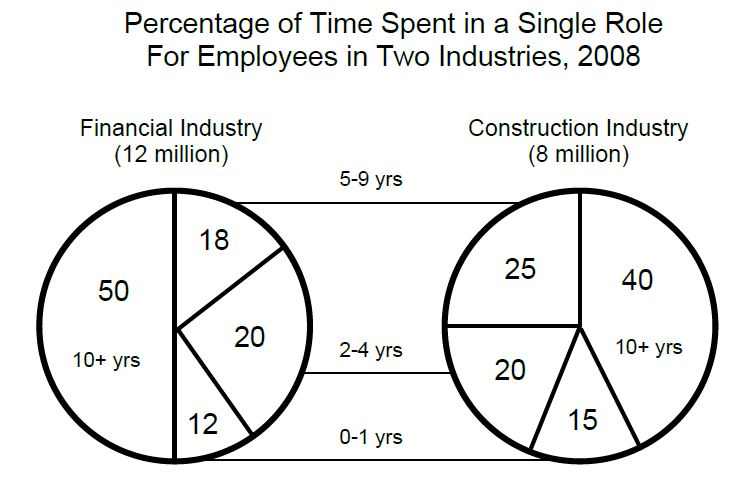
If one of the employees across both industries were to be selected at random, what is the probability that the employee will be a construction industry worker who stayed in the same role for 5 years or more?
If one of the employees across both industries were to be selected at random, what is the probability that the employee will be a construction industry worker who stayed in the same role for 5 years or more?
Tap to reveal answer
The first step is to figure out the percentage of construction employees that have stayed in the same role for 5 years or more—this would include both the "5 to 9 year" and "10+ years" ranges. This would be 0.25 + 0.4 = 65% of all construction employees. To convert to the number of employees, we take the percentage of their total, 0.65 * 8,000,000 = 5,200,000 workers. However, since the probability we are attempting to find is of workers between both industries, we must add the 8 million to the 12 million = 20 million workers total. 5,200,000/20,000,000 = 0.26, or a 26% chance.
The first step is to figure out the percentage of construction employees that have stayed in the same role for 5 years or more—this would include both the "5 to 9 year" and "10+ years" ranges. This would be 0.25 + 0.4 = 65% of all construction employees. To convert to the number of employees, we take the percentage of their total, 0.65 * 8,000,000 = 5,200,000 workers. However, since the probability we are attempting to find is of workers between both industries, we must add the 8 million to the 12 million = 20 million workers total. 5,200,000/20,000,000 = 0.26, or a 26% chance.
← Didn't Know|Knew It →
Quantitative Comparison
Quantity A: 10% of $45
Quantity B: 45% of $10
Quantitative Comparison
Quantity A: 10% of $45
Quantity B: 45% of $10
Tap to reveal answer
Quantity A: .1 * 45 = $4.50
Quantity B: .45 * 10 = $4.50
Therefore the two quantities are equal. This is always true: a% of $b = b% of $a.
Quantity A: .1 * 45 = $4.50
Quantity B: .45 * 10 = $4.50
Therefore the two quantities are equal. This is always true: a% of $b = b% of $a.
← Didn't Know|Knew It →
What percent of 5 is  ?
?
What percent of 5 is
Tap to reveal answer

← Didn't Know|Knew It →
Quantity A:
 , where
  is
is  of
of 
Quantity B:
 , where
  is
is  of
of 
Which of the following is true?
Quantity A:
Quantity B:
Which of the following is true?
Tap to reveal answer
This type of problem is very easy. You merely need to translate the text into the form of an equation. For this, remember that "of" is translated as multiplication and "is" as equality. This gives us the following.
Quantity A:
 is
is  of
of 
Becomes...

Quantity B:
 is
is  of
of 
Becomes...

Therefore, quantity B is larger.
This type of problem is very easy. You merely need to translate the text into the form of an equation. For this, remember that "of" is translated as multiplication and "is" as equality. This gives us the following.
Quantity A:
Becomes...
Quantity B:
Becomes...
Therefore, quantity B is larger.
← Didn't Know|Knew It →
Quantity A:
 , where
  is
is  of
of 
Quantity B:
 , where
  is
is  of
of 
Which of the following is true?
Quantity A:
Quantity B:
Which of the following is true?
Tap to reveal answer
This type of problem is very easy. You merely need to translate the text into the form of an equation. For this, remember that "of" is translated as multiplication and "is" as equality. This gives us the following.
Quantity A:
 is
is  of
of 
Becomes...

Quantity B:
 is
is  of
of 
Becomes...

Therefore, quantity B is larger.
This type of problem is very easy. You merely need to translate the text into the form of an equation. For this, remember that "of" is translated as multiplication and "is" as equality. This gives us the following.
Quantity A:
Becomes...
Quantity B:
Becomes...
Therefore, quantity B is larger.
← Didn't Know|Knew It →
Quantity A:
 , where
  is
is  of
of 
Quantity B:
 , where
  is
is  of
of 
Which of the following is true?
Quantity A:
Quantity B:
Which of the following is true?
Tap to reveal answer
This type of problem is very easy. You merely need to translate the text into the form of an equation. For this, remember that "of" is translated as multiplication and "is" as equality. This gives us the following.
Quantity A:
 is
is  of
of 
Becomes...

Quantity B:
 is
is  of
of 
Becomes...

Therefore, the two quantities are equal.
This type of problem is very easy. You merely need to translate the text into the form of an equation. For this, remember that "of" is translated as multiplication and "is" as equality. This gives us the following.
Quantity A:
Becomes...
Quantity B:
Becomes...
Therefore, the two quantities are equal.
← Didn't Know|Knew It →
A bag contains  .
.  are quarters,
  are dimes and the rest are nickels. How much money is in the bag in nickels?
A bag contains
Tap to reveal answer
To solve this problem we must first find what percent of the money in the bag is in nickels. We know that combined, quarters and dimes make up 40% of the coins and that the rest are nickels. Therefore 60% of the money in the bag are nickels. We then multiply the total amount of coins in the bag with that percentage in order to find out how many nickels are in the bag.  . There are 300 nickels in the bag and nickels are worth 5 cents each. Therefore
  worth of nickels in the bag.
To solve this problem we must first find what percent of the money in the bag is in nickels. We know that combined, quarters and dimes make up 40% of the coins and that the rest are nickels. Therefore 60% of the money in the bag are nickels. We then multiply the total amount of coins in the bag with that percentage in order to find out how many nickels are in the bag.
← Didn't Know|Knew It →
36 is what percent of 145
36 is what percent of 145
Tap to reveal answer
divide: 36/145 = 0.248; multiply by 100 to get percent
24.8%
divide: 36/145 = 0.248; multiply by 100 to get percent
24.8%
← Didn't Know|Knew It →
If  ,
,  is what percent of
  ?
?
If
Tap to reveal answer
Let's first pick numbers. If y = 25, x = 100. It's tempting to pick 25% as the answer, but x is greater than y, so the percentage must be greater than 100%. x is four times y, or 400% of y.
Let's first pick numbers. If y = 25, x = 100. It's tempting to pick 25% as the answer, but x is greater than y, so the percentage must be greater than 100%. x is four times y, or 400% of y.
← Didn't Know|Knew It →
Max walks 1 mile in 15 minutes. Belinda takes only 12 minutes to walk 1 mile. If Max and Belinda leave their homes at the same time, how far has Belinda walked when Max has walked 1 mile?
Max walks 1 mile in 15 minutes. Belinda takes only 12 minutes to walk 1 mile. If Max and Belinda leave their homes at the same time, how far has Belinda walked when Max has walked 1 mile?
Tap to reveal answer
Belinda walks faster than Max, so she should walk over a mile in the same time that Max walks 1 mile. We can eliminate the answer choices that aren't over a mile. It takes Max 3 minutes longer to walk a mile, so Belinda will walk for 3 more minutes after she finishes her first mile. If she walks 1 mile in 12 minutes, she walks 1/12 miles in 1 minute, or 3/12 = 1/4 mile in 3 minutes. So she walks 1 1/4 miles, or 5/4 miles.
Belinda walks faster than Max, so she should walk over a mile in the same time that Max walks 1 mile. We can eliminate the answer choices that aren't over a mile. It takes Max 3 minutes longer to walk a mile, so Belinda will walk for 3 more minutes after she finishes her first mile. If she walks 1 mile in 12 minutes, she walks 1/12 miles in 1 minute, or 3/12 = 1/4 mile in 3 minutes. So she walks 1 1/4 miles, or 5/4 miles.
← Didn't Know|Knew It →
An elevated train traveling its night route drops off exactly 2/3 of all passengers currently on board at each stop. Assuming no more passengers board the train tonight, if two passengers get off at the fifth stop, how many passengers were originally on the train when it started its route?
An elevated train traveling its night route drops off exactly 2/3 of all passengers currently on board at each stop. Assuming no more passengers board the train tonight, if two passengers get off at the fifth stop, how many passengers were originally on the train when it started its route?
Tap to reveal answer
This problem requires you to work backwards from stop 5 to the passengers present at stop 1. If 2 person gets out at stop 5, that means there were 3 people on board at stop 5. This means there were 9 people present at stop 4 (9 total, 2/3 (6) got off, leaving the 3 for stop 5), 27 people present at stop 3 (27 total, 2/3 (18) got off, leaving 9 for stop 4), 81 people present at stop 2 and 243 passengers present at stop 1. That is, the number of passengers on board the train at any stop follows a logarithmic reduction along powers of three, from 35 at stop 1 to 31 at stop 5.
This problem requires you to work backwards from stop 5 to the passengers present at stop 1. If 2 person gets out at stop 5, that means there were 3 people on board at stop 5. This means there were 9 people present at stop 4 (9 total, 2/3 (6) got off, leaving the 3 for stop 5), 27 people present at stop 3 (27 total, 2/3 (18) got off, leaving 9 for stop 4), 81 people present at stop 2 and 243 passengers present at stop 1. That is, the number of passengers on board the train at any stop follows a logarithmic reduction along powers of three, from 35 at stop 1 to 31 at stop 5.
← Didn't Know|Knew It →
For every two pounds of fudge are bought at the regular price of $4.25 per pound, the store gives a free pound of fudge to the customer. Lauren’s fudge bill was $21.25. How many pounds of fudge did she leave the store with?
For every two pounds of fudge are bought at the regular price of $4.25 per pound, the store gives a free pound of fudge to the customer. Lauren’s fudge bill was $21.25. How many pounds of fudge did she leave the store with?
Tap to reveal answer
21.21/ 4.25 = 5 pounds paid for. Since a pound is given for every 2 pounds sold, that is 5/2 = 2.5 so an extra 2 pounds is given to Lauren, totaling 7 pounds.
21.21/ 4.25 = 5 pounds paid for. Since a pound is given for every 2 pounds sold, that is 5/2 = 2.5 so an extra 2 pounds is given to Lauren, totaling 7 pounds.
← Didn't Know|Knew It →