
Geometry - GRE Quantitative Reasoning
Card 1 of 2800
Quantitative Comparison
Quantity A: The degree measure of any angle in an equilateral triangle
Quantity B: The degree measure of any angle in a regular hexagon
Quantitative Comparison
Quantity A: The degree measure of any angle in an equilateral triangle
Quantity B: The degree measure of any angle in a regular hexagon
Tap to reveal answer
We know the three angles in a triangle add up to 180 degrees, and all three angles are 60 degrees in an equilateral triangle.
A hexagon has six sides, and we can use the formula degrees = (# of sides – 2) * 180. Then degrees = (6 – 2) * 180 = 720 degrees. Each angle is 720/6 = 120 degrees.
Quantity B is greater.
We know the three angles in a triangle add up to 180 degrees, and all three angles are 60 degrees in an equilateral triangle.
A hexagon has six sides, and we can use the formula degrees = (# of sides – 2) * 180. Then degrees = (6 – 2) * 180 = 720 degrees. Each angle is 720/6 = 120 degrees.
Quantity B is greater.
← Didn't Know|Knew It →
Quantity A: Double the measure of a single interior angle of an equilateral triangle.
Quantity B: The measure of a single interior angle of a hexagon.
Quantity A: Double the measure of a single interior angle of an equilateral triangle.
Quantity B: The measure of a single interior angle of a hexagon.
Tap to reveal answer
Begin with Quantity A. We know the measure of one angle in an equilateral triangle is 60. Therefore, double the angle is 120 degrees.
For the hexagon, use the formula for the sum of the interior angles:

where n= number of sides in a regular polygon



If the sum of the interior angles of a regular hexagon is  degrees, then one angle is
  degrees.
The two quantities are equal.
Begin with Quantity A. We know the measure of one angle in an equilateral triangle is 60. Therefore, double the angle is 120 degrees.
For the hexagon, use the formula for the sum of the interior angles:
where n= number of sides in a regular polygon
If the sum of the interior angles of a regular hexagon is
The two quantities are equal.
← Didn't Know|Knew It →
Quantitative Comparison
Quantity A: The degree measure of any angle in an equilateral triangle
Quantity B: The degree measure of any angle in a regular hexagon
Quantitative Comparison
Quantity A: The degree measure of any angle in an equilateral triangle
Quantity B: The degree measure of any angle in a regular hexagon
Tap to reveal answer
We know the three angles in a triangle add up to 180 degrees, and all three angles are 60 degrees in an equilateral triangle.
A hexagon has six sides, and we can use the formula degrees = (# of sides – 2) * 180. Then degrees = (6 – 2) * 180 = 720 degrees. Each angle is 720/6 = 120 degrees.
Quantity B is greater.
We know the three angles in a triangle add up to 180 degrees, and all three angles are 60 degrees in an equilateral triangle.
A hexagon has six sides, and we can use the formula degrees = (# of sides – 2) * 180. Then degrees = (6 – 2) * 180 = 720 degrees. Each angle is 720/6 = 120 degrees.
Quantity B is greater.
← Didn't Know|Knew It →
Quantity A: Double the measure of a single interior angle of an equilateral triangle.
Quantity B: The measure of a single interior angle of a hexagon.
Quantity A: Double the measure of a single interior angle of an equilateral triangle.
Quantity B: The measure of a single interior angle of a hexagon.
Tap to reveal answer
Begin with Quantity A. We know the measure of one angle in an equilateral triangle is 60. Therefore, double the angle is 120 degrees.
For the hexagon, use the formula for the sum of the interior angles:
where n= number of sides in a regular polygon
If the sum of the interior angles of a regular hexagon is degrees, then one angle is degrees.
The two quantities are equal.
Begin with Quantity A. We know the measure of one angle in an equilateral triangle is 60. Therefore, double the angle is 120 degrees.
For the hexagon, use the formula for the sum of the interior angles:
where n= number of sides in a regular polygon
If the sum of the interior angles of a regular hexagon is
The two quantities are equal.
← Didn't Know|Knew It →
Quantitative Comparison
Quantity A: The degree measure of any angle in an equilateral triangle
Quantity B: The degree measure of any angle in a regular hexagon
Quantitative Comparison
Quantity A: The degree measure of any angle in an equilateral triangle
Quantity B: The degree measure of any angle in a regular hexagon
Tap to reveal answer
We know the three angles in a triangle add up to 180 degrees, and all three angles are 60 degrees in an equilateral triangle.
A hexagon has six sides, and we can use the formula degrees = (# of sides – 2) * 180. Then degrees = (6 – 2) * 180 = 720 degrees. Each angle is 720/6 = 120 degrees.
Quantity B is greater.
We know the three angles in a triangle add up to 180 degrees, and all three angles are 60 degrees in an equilateral triangle.
A hexagon has six sides, and we can use the formula degrees = (# of sides – 2) * 180. Then degrees = (6 – 2) * 180 = 720 degrees. Each angle is 720/6 = 120 degrees.
Quantity B is greater.
← Didn't Know|Knew It →
Quantity A: Double the measure of a single interior angle of an equilateral triangle.
Quantity B: The measure of a single interior angle of a hexagon.
Quantity A: Double the measure of a single interior angle of an equilateral triangle.
Quantity B: The measure of a single interior angle of a hexagon.
Tap to reveal answer
Begin with Quantity A. We know the measure of one angle in an equilateral triangle is 60. Therefore, double the angle is 120 degrees.
For the hexagon, use the formula for the sum of the interior angles:
where n= number of sides in a regular polygon
If the sum of the interior angles of a regular hexagon is degrees, then one angle is degrees.
The two quantities are equal.
Begin with Quantity A. We know the measure of one angle in an equilateral triangle is 60. Therefore, double the angle is 120 degrees.
For the hexagon, use the formula for the sum of the interior angles:
where n= number of sides in a regular polygon
If the sum of the interior angles of a regular hexagon is
The two quantities are equal.
← Didn't Know|Knew It →
In a given parallelogram, the measure of one of the interior angles is 25 degrees less than another. What is the approximate measure rounded to the nearest degree of the larger angle?
In a given parallelogram, the measure of one of the interior angles is 25 degrees less than another. What is the approximate measure rounded to the nearest degree of the larger angle?
Tap to reveal answer
There are two components to solving this geometry puzzle. First, one must be aware that the sum of the measures of the interior angles of a parallelogram is 360 degrees (sum of the interior angles of a figure = 180(n-2), where n is the number of sides of the figure). Second, one must know that the other two interior angles are doubles of those given here. Thus if we assign one interior angle as x and the other as x-25, we find that x + x + (x-25) + (x-25) = 360. Combining like terms leads to the equation 4x-50=360. Solving for x we find that x = 410/4, 102.5, or approximately 103 degrees. Since x is the measure of the larger angle, this is our answer.
There are two components to solving this geometry puzzle. First, one must be aware that the sum of the measures of the interior angles of a parallelogram is 360 degrees (sum of the interior angles of a figure = 180(n-2), where n is the number of sides of the figure). Second, one must know that the other two interior angles are doubles of those given here. Thus if we assign one interior angle as x and the other as x-25, we find that x + x + (x-25) + (x-25) = 360. Combining like terms leads to the equation 4x-50=360. Solving for x we find that x = 410/4, 102.5, or approximately 103 degrees. Since x is the measure of the larger angle, this is our answer.
← Didn't Know|Knew It →
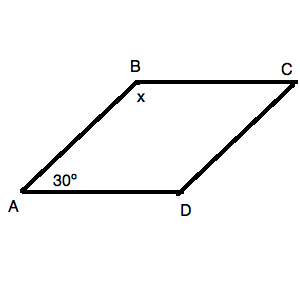
Figure  is a parallelogram.
What is  in the figure above?
Figure
What is
Tap to reveal answer
Because of the character of parallelograms, we know that our figure can be redrawn as follows:
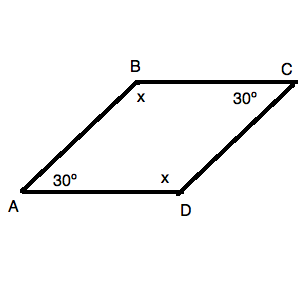
Because it is a four-sided figure, we know that the sum of the angles must be  . Thus, we know:

Solving for  , we get:


Because of the character of parallelograms, we know that our figure can be redrawn as follows:
Because it is a four-sided figure, we know that the sum of the angles must be
Solving for
← Didn't Know|Knew It →
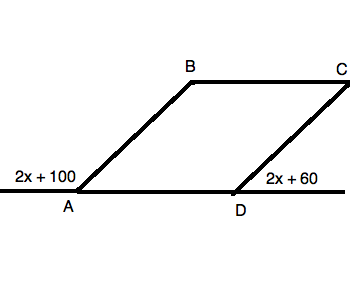
Figure  is a parallelogram.
Quantity A: The largest angle of  .
.
Quantity B: 
Which of the following is true?
Figure
Quantity A: The largest angle of
Quantity B:
Which of the following is true?
Tap to reveal answer
By using the properties of parallelograms along with those of supplementary angles, we can rewrite our figure as follows:
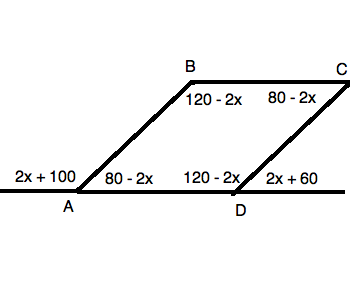
Recall, for example, that angle  is equal to:
 , hence
Now, you know that these angles can all be added up to  . You should also know that
Therefore, you can write:

Simplifying, you get:



Now, this means that:
 and
and  . Thus, the two values are equal.
By using the properties of parallelograms along with those of supplementary angles, we can rewrite our figure as follows:
Recall, for example, that angle
Now, you know that these angles can all be added up to
Therefore, you can write:
Simplifying, you get:
Now, this means that:
← Didn't Know|Knew It →
In a given parallelogram, the measure of one of the interior angles is 25 degrees less than another. What is the approximate measure rounded to the nearest degree of the larger angle?
In a given parallelogram, the measure of one of the interior angles is 25 degrees less than another. What is the approximate measure rounded to the nearest degree of the larger angle?
Tap to reveal answer
There are two components to solving this geometry puzzle. First, one must be aware that the sum of the measures of the interior angles of a parallelogram is 360 degrees (sum of the interior angles of a figure = 180(n-2), where n is the number of sides of the figure). Second, one must know that the other two interior angles are doubles of those given here. Thus if we assign one interior angle as x and the other as x-25, we find that x + x + (x-25) + (x-25) = 360. Combining like terms leads to the equation 4x-50=360. Solving for x we find that x = 410/4, 102.5, or approximately 103 degrees. Since x is the measure of the larger angle, this is our answer.
There are two components to solving this geometry puzzle. First, one must be aware that the sum of the measures of the interior angles of a parallelogram is 360 degrees (sum of the interior angles of a figure = 180(n-2), where n is the number of sides of the figure). Second, one must know that the other two interior angles are doubles of those given here. Thus if we assign one interior angle as x and the other as x-25, we find that x + x + (x-25) + (x-25) = 360. Combining like terms leads to the equation 4x-50=360. Solving for x we find that x = 410/4, 102.5, or approximately 103 degrees. Since x is the measure of the larger angle, this is our answer.
← Didn't Know|Knew It →
Figure is a parallelogram.
What is in the figure above?
Figure
What is
Tap to reveal answer
Because of the character of parallelograms, we know that our figure can be redrawn as follows:
Because it is a four-sided figure, we know that the sum of the angles must be . Thus, we know:
Solving for , we get:
Because of the character of parallelograms, we know that our figure can be redrawn as follows:
Because it is a four-sided figure, we know that the sum of the angles must be
Solving for
← Didn't Know|Knew It →
Figure is a parallelogram.
Quantity A: The largest angle of .
Quantity B:
Which of the following is true?
Figure
Quantity A: The largest angle of
Quantity B:
Which of the following is true?
Tap to reveal answer
By using the properties of parallelograms along with those of supplementary angles, we can rewrite our figure as follows:
Recall, for example, that angle is equal to:
, hence
Now, you know that these angles can all be added up to . You should also know that
Therefore, you can write:
Simplifying, you get:
Now, this means that:
and . Thus, the two values are equal.
By using the properties of parallelograms along with those of supplementary angles, we can rewrite our figure as follows:
Recall, for example, that angle
Now, you know that these angles can all be added up to
Therefore, you can write:
Simplifying, you get:
Now, this means that:
← Didn't Know|Knew It →
In a given parallelogram, the measure of one of the interior angles is 25 degrees less than another. What is the approximate measure rounded to the nearest degree of the larger angle?
In a given parallelogram, the measure of one of the interior angles is 25 degrees less than another. What is the approximate measure rounded to the nearest degree of the larger angle?
Tap to reveal answer
There are two components to solving this geometry puzzle. First, one must be aware that the sum of the measures of the interior angles of a parallelogram is 360 degrees (sum of the interior angles of a figure = 180(n-2), where n is the number of sides of the figure). Second, one must know that the other two interior angles are doubles of those given here. Thus if we assign one interior angle as x and the other as x-25, we find that x + x + (x-25) + (x-25) = 360. Combining like terms leads to the equation 4x-50=360. Solving for x we find that x = 410/4, 102.5, or approximately 103 degrees. Since x is the measure of the larger angle, this is our answer.
There are two components to solving this geometry puzzle. First, one must be aware that the sum of the measures of the interior angles of a parallelogram is 360 degrees (sum of the interior angles of a figure = 180(n-2), where n is the number of sides of the figure). Second, one must know that the other two interior angles are doubles of those given here. Thus if we assign one interior angle as x and the other as x-25, we find that x + x + (x-25) + (x-25) = 360. Combining like terms leads to the equation 4x-50=360. Solving for x we find that x = 410/4, 102.5, or approximately 103 degrees. Since x is the measure of the larger angle, this is our answer.
← Didn't Know|Knew It →
Figure is a parallelogram.
What is in the figure above?
Figure
What is
Tap to reveal answer
Because of the character of parallelograms, we know that our figure can be redrawn as follows:
Because it is a four-sided figure, we know that the sum of the angles must be . Thus, we know:
Solving for , we get:
Because of the character of parallelograms, we know that our figure can be redrawn as follows:
Because it is a four-sided figure, we know that the sum of the angles must be
Solving for
← Didn't Know|Knew It →
Figure is a parallelogram.
Quantity A: The largest angle of .
Quantity B:
Which of the following is true?
Figure
Quantity A: The largest angle of
Quantity B:
Which of the following is true?
Tap to reveal answer
By using the properties of parallelograms along with those of supplementary angles, we can rewrite our figure as follows:
Recall, for example, that angle is equal to:
, hence
Now, you know that these angles can all be added up to . You should also know that
Therefore, you can write:
Simplifying, you get:
Now, this means that:
and . Thus, the two values are equal.
By using the properties of parallelograms along with those of supplementary angles, we can rewrite our figure as follows:
Recall, for example, that angle
Now, you know that these angles can all be added up to
Therefore, you can write:
Simplifying, you get:
Now, this means that:
← Didn't Know|Knew It →
In a five-sided polygon, one angle measures  . What are the possible measurements of the other angles?
In a five-sided polygon, one angle measures
Tap to reveal answer
To find the sum of the interior angles of any polygon, use the formula  , where n represents the number of sides of a polygon.
In this case:

The sum of the interior angles will be 540. Go through each answer choice and see which one adds up to 540 (including the original angle given in the problem).
The only one that does is 120, 115, 95, 105 and the original angle of 105.
To find the sum of the interior angles of any polygon, use the formula
In this case:
The sum of the interior angles will be 540. Go through each answer choice and see which one adds up to 540 (including the original angle given in the problem).
The only one that does is 120, 115, 95, 105 and the original angle of 105.
← Didn't Know|Knew It →
In a particular heptagon (a seven-sided polygon) the sum of four equal interior angles, each equal to  degrees, is equivalent to the sum of the remaining three interior angles.
Quantity A: 
Quantity B: 
In a particular heptagon (a seven-sided polygon) the sum of four equal interior angles, each equal to
Quantity A:
Quantity B:
Tap to reveal answer
The sum of interior angles in a heptagon is  degrees. Note that to find the sum of interior angles of any polygon, it is given by the formula:
 degrees, where
  is the number of sides of the polygon.
Three interior angles (call them  ) are unknown, but we are told that the sum of them is equal to the sum of four other equivalent angles (which we'll designate
  ):
):

Further more, all of these angles must sum up to  degrees:

We may not be able to find  ,
,  , or
, or  , indvidually, but the problem does not call for that, and we need only use their relation to
  , as stated in the first equation with them. Utilizing this in the second, we find:

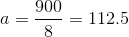
The sum of interior angles in a heptagon is
Three interior angles (call them
Further more, all of these angles must sum up to
We may not be able to find
← Didn't Know|Knew It →
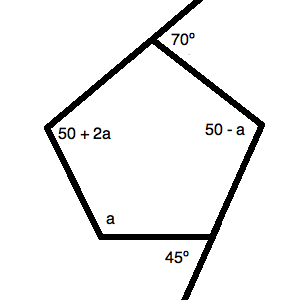
What is the value of  in the figure above?
What is the value of
Tap to reveal answer
Always begin working through problems like this by filling in all available information. We know that we can fill in two of the angles, giving us the following figure:
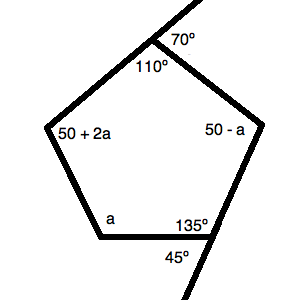
Now, we know that for any polygon, the total number of degrees in the figure can be calculated by the equation:
 , where
  is the number of sides.
Thus, for our figure, we have:

Based on this, we know:

Simplifying, we get:

Solving for  , we get:
 or
or 
Always begin working through problems like this by filling in all available information. We know that we can fill in two of the angles, giving us the following figure:
Now, we know that for any polygon, the total number of degrees in the figure can be calculated by the equation:
Thus, for our figure, we have:
Based on this, we know:
Simplifying, we get:
Solving for
← Didn't Know|Knew It →
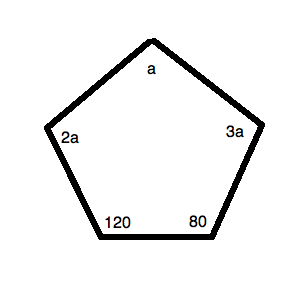
Quantity A: The measure of the largest angle in the figure above.
Quantity B: 
Which of the following is true?
Quantity A: The measure of the largest angle in the figure above.
Quantity B:
Which of the following is true?
Tap to reveal answer
To begin, recall that the total degrees in any figure can be calculated by:
 , where
  represents the total number of sides. Thus, we know for our figure that:

Now, based on our figure, we can make the equation:

Simplifying, we get:
 or
or 
This means that  is
is  . Quantity A is larger.
To begin, recall that the total degrees in any figure can be calculated by:
Now, based on our figure, we can make the equation:
Simplifying, we get:
This means that
← Didn't Know|Knew It →
In a five-sided polygon, one angle measures . What are the possible measurements of the other angles?
In a five-sided polygon, one angle measures
Tap to reveal answer
To find the sum of the interior angles of any polygon, use the formula , where n represents the number of sides of a polygon.
In this case:
The sum of the interior angles will be 540. Go through each answer choice and see which one adds up to 540 (including the original angle given in the problem).
The only one that does is 120, 115, 95, 105 and the original angle of 105.
To find the sum of the interior angles of any polygon, use the formula
In this case:
The sum of the interior angles will be 540. Go through each answer choice and see which one adds up to 540 (including the original angle given in the problem).
The only one that does is 120, 115, 95, 105 and the original angle of 105.
← Didn't Know|Knew It →