
Quadrilaterals - GRE Quantitative Reasoning
Card 1 of 520
The sum of the two bases in a parallelogram is  An adjacent side to the bases is
  the length of one of the two base measurements. Find the length of one side that is adjacent to the bases.
The sum of the two bases in a parallelogram is
Tap to reveal answer
In this problem, you are told that the sum of the two bases in a parallelogram is  Since the two bases must be equivalent, each side must equal:
  . Additionally, the problem states that the adjacent sides are
  the length of the bases. Therefore, an adjacent side to the base must equal:

In this problem, you are told that the sum of the two bases in a parallelogram is
← Didn't Know|Knew It →
A parallelogram has a base of  . The perimeter of the parallelogram is
  . Find the length of an adjacent side to the base.
A parallelogram has a base of
Tap to reveal answer
A parallelogram must have two sets of congruent/parallel opposite sides. Therefore, this parallelogram must have two sides with a measurement of  and two base sides each with a length of
  Since the perimeter and one base length is provided in the question, work backwards using the perimeter formula:
 , where
  and
and  are the measurements of adjacent sides.
Thus, the solution is:


Check:


A parallelogram must have two sets of congruent/parallel opposite sides. Therefore, this parallelogram must have two sides with a measurement of
Thus, the solution is:
Check:
← Didn't Know|Knew It →

Using the parallelogram shown above, find thesum of the two sides adjacent to the base.
Using the parallelogram shown above, find thesum of the two sides adjacent to the base.
Tap to reveal answer
To find one of the adjacent sides to the base, first note that the interior triangles represented by the red vertical lines must have a height of  and a base length of
  Then, apply the formula:
  to find the length of one side.
Thus, the solution is:


Therefore, the sum of the two sides is:

To find one of the adjacent sides to the base, first note that the interior triangles represented by the red vertical lines must have a height of
Thus, the solution is:
Therefore, the sum of the two sides is:
← Didn't Know|Knew It →
A parallelogram has a base of  . The perimeter of the parallelogram is
  . Find the sum of the two adjacent sides to the base.
A parallelogram has a base of
Tap to reveal answer
A parallelogram must have two sets of congruent/parallel opposite sides. This parallelogram must have two sides with a measurement of  and two base sides each with a length of
  . In this question, you are provided with the information that the parallelogram has a base of
  and a total perimeter of
  . Thus, work backwards using the perimeter formula in order to find the sum of the two adjacent sides to the base.
 , where and are the measurements of adjacent sides.
Thus, the solution is:


A parallelogram must have two sets of congruent/parallel opposite sides. This parallelogram must have two sides with a measurement of
Thus, the solution is:
← Didn't Know|Knew It →
A parallelogram has a base measurement of  . The perimeter of the parallelogram is
  . Find the measurement of an adjacent side to the base.
A parallelogram has a base measurement of
Tap to reveal answer
A parallelogram must have two sets of congruent/parallel opposite sides. This parallelogram must have two sides with a measurement of  and two base sides each with a length of
  . In this question, you are provided with the information that the parallelogram has a base of
  and a total perimeter of
  . Thus, work backwards using the perimeter formula in order to find the length of one missing side that is adjacent to the base.
 , where and are the measurements of adjacent sides.
Thus, the solution is:


A parallelogram must have two sets of congruent/parallel opposite sides. This parallelogram must have two sides with a measurement of
Thus, the solution is:
← Didn't Know|Knew It →
A parallelogram has a base of  . The perimeter of the parallelogram is
  . Find the sum of the two adjacent sides to the base.
A parallelogram has a base of
Tap to reveal answer
A parallelogram must have two sets of congruent/parallel opposite sides. This parallelogram must have two sides with a measurement of  and two base sides each with a length of
  . In this question, you are given the information that the parallelogram has a base of
  and a total perimeter of
  . Thus, work backwards using the perimeter formula in order to find the sum of the two adjacent sides to the base.
 , where and are the measurements of adjacent sides.
Thus, the solution is:


A parallelogram must have two sets of congruent/parallel opposite sides. This parallelogram must have two sides with a measurement of
Thus, the solution is:
← Didn't Know|Knew It →
A parallelogram has a base of  . An adjacent side to the base has a length of
  . Find the perimeter of the parallelogram.
A parallelogram has a base of
Tap to reveal answer
A parallelogram must have two sets of congruent/parallel opposite sides. Therefore, this parallelogram must have two sides with a measurement of  and two base sides each with a length of
  . To find the perimeter of the parallelogram apply the formula:
 , where and are the measurements of adjacent sides.
Thus, the solution is:


A parallelogram must have two sets of congruent/parallel opposite sides. Therefore, this parallelogram must have two sides with a measurement of
Thus, the solution is:
← Didn't Know|Knew It →
A parallelogram has a base measurement of  . The perimeter of the parallelogram is
  . Find the measurement for an adjacent side to the base.
A parallelogram has a base measurement of
Tap to reveal answer
A parallelogram must have two sets of congruent/parallel opposite sides. Therefore, this parallelogram must have two sides with a measurement of  and two base sides each with a length of
  . However, to solve this problem you must first convert the provided perimeter measurement from feet to inches. Since an inch is
  of
of  foot,
foot,  feet is equal to
 inches.
Now, you can work backwards using the formula:
 , where and are the measurements of adjacent sides.
Thus, the solution is:


A parallelogram must have two sets of congruent/parallel opposite sides. Therefore, this parallelogram must have two sides with a measurement of
Now, you can work backwards using the formula:
Thus, the solution is:
← Didn't Know|Knew It →

Using the parallelogram shown above, find the length of side 
Using the parallelogram shown above, find the length of side
Tap to reveal answer
A parallelogram must have two sets of congruent/parallel opposite sides. Therefore, this parallelogram must have two sides with a measurement of  and two base sides each with a length of
  Since the perimeter and one base length is provided in the question, work backwards using the perimeter formula:
 , where and are the measurements of adjacent sides.
Thus, the solution is:


A parallelogram must have two sets of congruent/parallel opposite sides. Therefore, this parallelogram must have two sides with a measurement of
Thus, the solution is:
← Didn't Know|Knew It →
A parallelogram has a base of  . The perimeter of the parallelogram is
  . Find the sum of the two adjacent sides to the base.
A parallelogram has a base of
Tap to reveal answer
A parallelogram must have two sets of congruent/parallel opposite sides. This parallelogram must have two sides with a measurement of  and two base sides each with a length of
  . In this question, you are provided with the information that the parallelogram has a base of
  and a total perimeter of
  . Thus, work backwards using the perimeter formula in order to find the sum of the two adjacent sides to the base.
 , where and are the measurements of adjacent sides.
Thus, the solution is:


A parallelogram must have two sets of congruent/parallel opposite sides. This parallelogram must have two sides with a measurement of
Thus, the solution is:
← Didn't Know|Knew It →
A parallelogram has a base of  . An adjacent side to the base has a length of
  . Find the perimeter of the parallelogram.
A parallelogram has a base of
Tap to reveal answer
A parallelogram must have two sets of congruent/parallel opposite sides. Therefore, this parallelogram must have two sides with a measurement of  and two base sides each with a length of
  To find the perimeter of the parallelogram apply the formula:
 , where and are the measurements of adjacent sides.
Thus, the solution is:


A parallelogram must have two sets of congruent/parallel opposite sides. Therefore, this parallelogram must have two sides with a measurement of
Thus, the solution is:
← Didn't Know|Knew It →
A parallelogram has a base of  . The perimeter of the parallelogram is
  . Find the length for an adjacent side to the base.
A parallelogram has a base of
Tap to reveal answer
A parallelogram must have two sets of congruent/parallel opposite sides. Therefore, this parallelogram must have two sides with a measurement of  and two base sides each with a length of
  . To solve for the missing side, work backwards using the perimeter formula:
 , where and are the measurements of adjacent sides.
Thus, the solution is:


A parallelogram must have two sets of congruent/parallel opposite sides. Therefore, this parallelogram must have two sides with a measurement of
Thus, the solution is:
← Didn't Know|Knew It →
Given Rectangle ABCD.
Quantity A: The length of diagonal AC times the length of diagonal BD
Quantity B: The square of half of ABCD's perimeter
Given Rectangle ABCD.
Quantity A: The length of diagonal AC times the length of diagonal BD
Quantity B: The square of half of ABCD's perimeter
Tap to reveal answer
Suppose ABCD has sides a and b.
The length of one of ABCD's diagonals is given by a2+ b2 = c2, where c is one of the diagonals.
Note that both diagonals are of the same length.
Quantity A: The length of diagonal AC times the length of diagonal BD
This is c * c = c2.
Quantity A = c2 = a2+ b2
Now for Quantity B, remember that the perimeter of a rectangle with sides a and b is Perimeter = 2(a + b).
Half of Perimeter = (a + b)
Square Half of Perimeter = (a + b)2
Use FOIL: (a + b)2 = a2+ 2ab + b2
Quantity B = (a + b)2 = a2+ 2ab + b2
The question is asking us to compare a2+ b2 with a2+ 2ab + b2.
Note that as long as a and b are positive numbers (in this case a and b are dimensions of a rectangle, so they must be positive), the second quantity will be greater.
Suppose ABCD has sides a and b.
The length of one of ABCD's diagonals is given by a2+ b2 = c2, where c is one of the diagonals.
Note that both diagonals are of the same length.
Quantity A: The length of diagonal AC times the length of diagonal BD
This is c * c = c2.
Quantity A = c2 = a2+ b2
Now for Quantity B, remember that the perimeter of a rectangle with sides a and b is Perimeter = 2(a + b).
Half of Perimeter = (a + b)
Square Half of Perimeter = (a + b)2
Use FOIL: (a + b)2 = a2+ 2ab + b2
Quantity B = (a + b)2 = a2+ 2ab + b2
The question is asking us to compare a2+ b2 with a2+ 2ab + b2.
Note that as long as a and b are positive numbers (in this case a and b are dimensions of a rectangle, so they must be positive), the second quantity will be greater.
← Didn't Know|Knew It →
If rectangle  has a perimeter of
  , and the longer edge is
  times longer than the shorter edge, then how long is the diagonal
  ?
?
If rectangle
Tap to reveal answer
Lets call our longer side L and our shorter side W.
If the perimeter is equal to 68, then
 .
.
We also have that
 .
.
If we then plug this into our equation for perimeter, we get  .
.
Therefore,  and
and  . Using the Pythagorean Theorem, we have
  so
so  .
.
Lets call our longer side L and our shorter side W.
If the perimeter is equal to 68, then
We also have that
If we then plug this into our equation for perimeter, we get
Therefore,
← Didn't Know|Knew It →
If a square has a side length of √2, how long is the diagonal of the square?
If a square has a side length of √2, how long is the diagonal of the square?
Tap to reveal answer
A diagonal divides a square into two 45-45-90 triangles, which have lengths adhering to the ratio of x: x: x√2. Therefore, 2 is the correct answer as the diagonal represents the hypotenuse of the triangle. the Pythagorean theorem can also be used: √22+ √22 = c2.
A diagonal divides a square into two 45-45-90 triangles, which have lengths adhering to the ratio of x: x: x√2. Therefore, 2 is the correct answer as the diagonal represents the hypotenuse of the triangle. the Pythagorean theorem can also be used: √22+ √22 = c2.
← Didn't Know|Knew It →
If a square has a side length of 4, how long is the diagonal of the square?
If a square has a side length of 4, how long is the diagonal of the square?
Tap to reveal answer
A diagonal divides a square into two 45-45-90 triangles, which have lengths adhering to the ratio of x: x: x√2. Therefore, 4√2 is the correct answer as the diagonal represents the hypotenuse of the triangle. the Pythagorean theorem can also be used: 42+ 42 = c2.
A diagonal divides a square into two 45-45-90 triangles, which have lengths adhering to the ratio of x: x: x√2. Therefore, 4√2 is the correct answer as the diagonal represents the hypotenuse of the triangle. the Pythagorean theorem can also be used: 42+ 42 = c2.
← Didn't Know|Knew It →
A square has a side of length 5. What is the length of its diagonal?
A square has a side of length 5. What is the length of its diagonal?
Tap to reveal answer
The diagonal separates the square into two 45-45-90 right triangles. The problem can be solved by using the Pythagorean Theorem, _a_2 + _b_2 = _c_2. It can also be solved by recognizing the 45-45-90 special triangles, which have side ratios of x : x : x√2.
The diagonal separates the square into two 45-45-90 right triangles. The problem can be solved by using the Pythagorean Theorem, _a_2 + _b_2 = _c_2. It can also be solved by recognizing the 45-45-90 special triangles, which have side ratios of x : x : x√2.
← Didn't Know|Knew It →
A square with width of  is inscribed in a circle. What is the total area inside the circle?
A square with width of
Tap to reveal answer
We know that each side of the square is 6, so use the Pythagorean Theorem to solve for the diagonal of the square. The diagonal of the square is also the diameter of the circle.




Therefore the radius must be 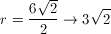
Now let's find the area inside the circle using the radius.



 meters2
We know that each side of the square is 6, so use the Pythagorean Theorem to solve for the diagonal of the square. The diagonal of the square is also the diameter of the circle.
Therefore the radius must be
Now let's find the area inside the circle using the radius.
← Didn't Know|Knew It →
Quantity A:
The diagonal of a square with a side-length of  .
.
Quantity B:
The side-length of a square with a diagonal of  .
.
Quantity A:
The diagonal of a square with a side-length of
Quantity B:
The side-length of a square with a diagonal of
Tap to reveal answer
Quantity A: The diagonal of a square with a side-length of 7.
Quantity B: The side-length of a square with a diagonal of 14.
Both quantities can be determined, so can the relationship.
Quantity A:
To determine the diagonal of a square, it's important to remember that a diagonal directly bisects a square from corner to corner. In other words, it bisects the corners, creating two triangles with 45:45:90 proportions, with the diagonal serving as the hypotenuses . If you remember your special triangles, then the side-side-hypotenuse measurements have a ratio of  .
.
In Quantity A, the side-length is 7. Following the proportion:

The diagonal equals  .
.
Quantity B:
We can use the same ratio to figure out quantity B by substituting x for the unknown side-length quantity, which looks like this:

To find x in this ratio, just isolate x in the hypotenuse:

Divide by 

Now, how does Quantity A and Quantity B match up?


On the surface, it looks like the two quanties are equal. But how do we prove it? Well, we know that  . Therefore, we know that:

Divide both sides by 

Therefore, both quantities are equal.
Quantity A: The diagonal of a square with a side-length of 7.
Quantity B: The side-length of a square with a diagonal of 14.
Both quantities can be determined, so can the relationship.
Quantity A:
To determine the diagonal of a square, it's important to remember that a diagonal directly bisects a square from corner to corner. In other words, it bisects the corners, creating two triangles with 45:45:90 proportions, with the diagonal serving as the hypotenuses . If you remember your special triangles, then the side-side-hypotenuse measurements have a ratio of
In Quantity A, the side-length is 7. Following the proportion:
The diagonal equals
Quantity B:
We can use the same ratio to figure out quantity B by substituting x for the unknown side-length quantity, which looks like this:
To find x in this ratio, just isolate x in the hypotenuse:
Divide by
Now, how does Quantity A and Quantity B match up?
On the surface, it looks like the two quanties are equal. But how do we prove it? Well, we know that
Divide both sides by
Therefore, both quantities are equal.
← Didn't Know|Knew It →
A quadrilateral has equal sides, each with a length of  .
.
Quantity A: The area of the quadrilateral.
Quantity B: The perimeter of the quadrilateral.
A quadrilateral has equal sides, each with a length of
Quantity A: The area of the quadrilateral.
Quantity B: The perimeter of the quadrilateral.
Tap to reveal answer
We are told that the shape is a quadrilateral and that the sides are equal; beyond that, we do not know what specific kind of kind of quadrilateral it is, outside of the fact that it is a rhombus. The perimeter, the sum of the sides, is  .
.
If this shape were a square, the area would also be  ; however, if the interior angles were not all equivalent, the area would be smaller than this.
The relationship cannot be determined.
We are told that the shape is a quadrilateral and that the sides are equal; beyond that, we do not know what specific kind of kind of quadrilateral it is, outside of the fact that it is a rhombus. The perimeter, the sum of the sides, is
If this shape were a square, the area would also be
The relationship cannot be determined.
← Didn't Know|Knew It →