
Spheres - GRE Quantitative Reasoning
Card 1 of 104
What is the radius of a sphere with volume  cubed units?
What is the radius of a sphere with volume
Tap to reveal answer
The volume of a sphere is represented by the equation  . Set this equation equal to the volume given and solve for r:


Therefore, the radius of the sphere is 3.
The volume of a sphere is represented by the equation
Therefore, the radius of the sphere is 3.
← Didn't Know|Knew It →
If a sphere has a volume of  cubic inches, what is the approximate radius of the sphere?
If a sphere has a volume of
Tap to reveal answer
The formula for the volume of a sphere is
 where
where  is the radius of the sphere.
Therefore,

 , giving us
  .
.
The formula for the volume of a sphere is
Therefore,
← Didn't Know|Knew It →
A rectangular prism has the dimensions  . What is the volume of the largest possible sphere that could fit within this solid?
A rectangular prism has the dimensions
Tap to reveal answer
For a sphere to fit into the rectangular prism, its dimensions are constrained by the prism's smallest side, which forms its diameter. Therefore, the largest sphere will have a diameter of  , and a radius of
  .
.
The volume of a sphere is given as:

And thus the volume of the largest possible sphere to fit into this prism is

For a sphere to fit into the rectangular prism, its dimensions are constrained by the prism's smallest side, which forms its diameter. Therefore, the largest sphere will have a diameter of
The volume of a sphere is given as:
And thus the volume of the largest possible sphere to fit into this prism is
← Didn't Know|Knew It →
What is the volume of a sphere with a radius of 3?
What is the volume of a sphere with a radius of 3?
Tap to reveal answer
Volume of a sphere = 4/3 * πr_3 = 4/3 * π * 33 = 36_π
Volume of a sphere = 4/3 * πr_3 = 4/3 * π * 33 = 36_π
← Didn't Know|Knew It →
How much does the volume of a sphere increase if its radius is increased by 50%?
How much does the volume of a sphere increase if its radius is increased by 50%?
Tap to reveal answer
Recall the equation for the volume of a sphere:
V = (4/3)πr3
If we increase the radius by 50%, we can represent the new radius as being equal to r + 0.5r = 1.5r.
Replace this into the equation for the volume and simplify:
V2 = (4/3)π(1.5r)3 = (4/3)π(3.375r3)
Rewrite this so that you can compare the two volumes:
V2 = 3.375 * (4/3)πr3 = 3.375 * \[(4/3)πr3\]
This is the same as:
V2 = 3.375 * V
This means that the new volume is 337.5% of the original. However, note that the question asked for the increase, which would be an increase by 237.5%.
Recall the equation for the volume of a sphere:
V = (4/3)πr3
If we increase the radius by 50%, we can represent the new radius as being equal to r + 0.5r = 1.5r.
Replace this into the equation for the volume and simplify:
V2 = (4/3)π(1.5r)3 = (4/3)π(3.375r3)
Rewrite this so that you can compare the two volumes:
V2 = 3.375 * (4/3)πr3 = 3.375 * \[(4/3)πr3\]
This is the same as:
V2 = 3.375 * V
This means that the new volume is 337.5% of the original. However, note that the question asked for the increase, which would be an increase by 237.5%.
← Didn't Know|Knew It →
A cube weighs 216 grams. If you carve a sphere out of the cube such that the diameter of the sphere is equal to one of the sides of the square, how many grams is the weight of the resulting sphere?
A cube weighs 216 grams. If you carve a sphere out of the cube such that the diameter of the sphere is equal to one of the sides of the square, how many grams is the weight of the resulting sphere?
Tap to reveal answer
Remember that the weight of an object is analogous to the volume. Since the weight of the sphere is 216, the volume of the sphere is proportional to 216. Remember the equation for volume of a sphere:
V = a * a * a = 216
Take the cube root of 216 to find that the length of one of the cubes is proportional to 6. According to the question, one of the sides of the cube is equivalent to the diameter of the sphere.
Thus d = 6 and r = d/2 = 3 for the sphere.
Remember the volume equation for a sphere:
V = 4/3 * π * r3
Plug in r = 3 to find V = 36π
Remember that the weight of an object is analogous to the volume. Since the weight of the sphere is 216, the volume of the sphere is proportional to 216. Remember the equation for volume of a sphere:
V = a * a * a = 216
Take the cube root of 216 to find that the length of one of the cubes is proportional to 6. According to the question, one of the sides of the cube is equivalent to the diameter of the sphere.
Thus d = 6 and r = d/2 = 3 for the sphere.
Remember the volume equation for a sphere:
V = 4/3 * π * r3
Plug in r = 3 to find V = 36π
← Didn't Know|Knew It →
How many times greater is the volume of a sphere with radius of 3 than the volume of a sphere with radius of  ?
?
How many times greater is the volume of a sphere with radius of 3 than the volume of a sphere with radius of
Tap to reveal answer
The formula for the volume of a sphere is  .
.
Use this to find the volume of each sphere, then take the quotient of the two volumes to determine the relationship between the two.
For the first sphere, 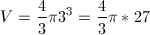 .
.
For the second sphere,  .
.
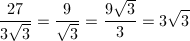
Since both volumes have factors of 4/3 and pi, we'll ignore those and divide by the remaining factors. Keep in mind that the volume of the first sphere must be in the numerator due to the wording of the question.
The formula for the volume of a sphere is
Use this to find the volume of each sphere, then take the quotient of the two volumes to determine the relationship between the two.
For the first sphere,
For the second sphere,
Since both volumes have factors of 4/3 and pi, we'll ignore those and divide by the remaining factors. Keep in mind that the volume of the first sphere must be in the numerator due to the wording of the question.
← Didn't Know|Knew It →
What is the radius of a sphere with volume cubed units?
What is the radius of a sphere with volume
Tap to reveal answer
The volume of a sphere is represented by the equation . Set this equation equal to the volume given and solve for r:
Therefore, the radius of the sphere is 3.
The volume of a sphere is represented by the equation
Therefore, the radius of the sphere is 3.
← Didn't Know|Knew It →
If a sphere has a volume of cubic inches, what is the approximate radius of the sphere?
If a sphere has a volume of
Tap to reveal answer
The formula for the volume of a sphere is
where is the radius of the sphere.
Therefore,
, giving us .
The formula for the volume of a sphere is
Therefore,
← Didn't Know|Knew It →
A rectangular prism has the dimensions . What is the volume of the largest possible sphere that could fit within this solid?
A rectangular prism has the dimensions
Tap to reveal answer
For a sphere to fit into the rectangular prism, its dimensions are constrained by the prism's smallest side, which forms its diameter. Therefore, the largest sphere will have a diameter of , and a radius of .
The volume of a sphere is given as:
And thus the volume of the largest possible sphere to fit into this prism is
For a sphere to fit into the rectangular prism, its dimensions are constrained by the prism's smallest side, which forms its diameter. Therefore, the largest sphere will have a diameter of
The volume of a sphere is given as:
And thus the volume of the largest possible sphere to fit into this prism is
← Didn't Know|Knew It →
A cube with a surface area of 216 square units has a side length that is equal to the diameter of a certain sphere. What is the surface area of the sphere?
A cube with a surface area of 216 square units has a side length that is equal to the diameter of a certain sphere. What is the surface area of the sphere?
Tap to reveal answer
Begin by solving for the length of one side of the cube. Use the formula for surface area to do this:

s= length of one side of the cube


The length of the side of the cube is equal to the diameter of the sphere. Therefore, the radius of the sphere is 3. Now use the formula for the surface area of a sphere:




The surface area of the sphere is  .
.
Begin by solving for the length of one side of the cube. Use the formula for surface area to do this:
s= length of one side of the cube
The length of the side of the cube is equal to the diameter of the sphere. Therefore, the radius of the sphere is 3. Now use the formula for the surface area of a sphere:
The surface area of the sphere is
← Didn't Know|Knew It →
The surface area of a sphere is  . What is its diameter?
The surface area of a sphere is
Tap to reveal answer
The surface area of a sphere is defined by the equation:

For our data, this means:

Solving for  , we get:
 or
or 
The diameter of the sphere is  .
.
The surface area of a sphere is defined by the equation:
For our data, this means:
Solving for
The diameter of the sphere is
← Didn't Know|Knew It →
The volume of one sphere is  . What is the diameter of a sphere of half that volume?
The volume of one sphere is
Tap to reveal answer
Do not assume that the diameter will be half of the diameter of a sphere with volume of  . Instead, begin with the sphere with a volume of
  . Such a simple action will prevent a vexing error!
Thus, we know from our equation for the volume of a sphere that:
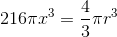
Solving for  , we get:

If you take the cube-root of both sides, you have:

First, you can factor out an  :
:

Next, factor the  :
:

Which simplifies to:

Thus, the diameter is double that or:

Do not assume that the diameter will be half of the diameter of a sphere with volume of
Thus, we know from our equation for the volume of a sphere that:
Solving for
If you take the cube-root of both sides, you have:
First, you can factor out an
Next, factor the
Which simplifies to:
Thus, the diameter is double that or:
← Didn't Know|Knew It →
A sphere has a surface area of  square inches. If the radius is doubled, what is the surface area of the larger sphere?
A sphere has a surface area of
Tap to reveal answer
The surface area of the larger sphere is NOT merely doubled from the smaller sphere, so we cannot double  to find the answer.
We can use the surface area formula to find the radius of the original sphere.

_r_2 = 4
r = 2
Therefore the larger sphere has a radius of 2 * 2 = 4.
The new surface area is then  square inches.
The surface area of the larger sphere is NOT merely doubled from the smaller sphere, so we cannot double
We can use the surface area formula to find the radius of the original sphere.
_r_2 = 4
r = 2
Therefore the larger sphere has a radius of 2 * 2 = 4.
The new surface area is then
← Didn't Know|Knew It →
Find the surface area of a sphere with a diameter of 14. Use π = 22/7.
Find the surface area of a sphere with a diameter of 14. Use π = 22/7.
Tap to reveal answer
Surface Area = 4_πr_2 = 4 * 22/7 * 72 = 616
Surface Area = 4_πr_2 = 4 * 22/7 * 72 = 616
← Didn't Know|Knew It →
If a sphere has a volume of  cubic inches, what is its surface area?
If a sphere has a volume of
Tap to reveal answer
The volume of a cube is equal to  .
.
So we mutiply our volume by  and divide by
  , giving us
  .
.
The surface area of a sphere is equal to  , giving us
  .
.
The volume of a cube is equal to
So we mutiply our volume by
The surface area of a sphere is equal to
← Didn't Know|Knew It →
A sphere has a surface area of square inches. If the radius is doubled, what is the surface area of the larger sphere?
A sphere has a surface area of
Tap to reveal answer
The surface area of the larger sphere is NOT merely doubled from the smaller sphere, so we cannot double to find the answer.
We can use the surface area formula to find the radius of the original sphere.
_r_2 = 4
r = 2
Therefore the larger sphere has a radius of 2 * 2 = 4.
The new surface area is then square inches.
The surface area of the larger sphere is NOT merely doubled from the smaller sphere, so we cannot double
We can use the surface area formula to find the radius of the original sphere.
_r_2 = 4
r = 2
Therefore the larger sphere has a radius of 2 * 2 = 4.
The new surface area is then
← Didn't Know|Knew It →
Find the surface area of a sphere with a diameter of 14. Use π = 22/7.
Find the surface area of a sphere with a diameter of 14. Use π = 22/7.
Tap to reveal answer
Surface Area = 4_πr_2 = 4 * 22/7 * 72 = 616
Surface Area = 4_πr_2 = 4 * 22/7 * 72 = 616
← Didn't Know|Knew It →
If a sphere has a volume of cubic inches, what is its surface area?
If a sphere has a volume of
Tap to reveal answer
The volume of a cube is equal to .
So we mutiply our volume by and divide by , giving us .
The surface area of a sphere is equal to , giving us .
The volume of a cube is equal to
So we mutiply our volume by
The surface area of a sphere is equal to
← Didn't Know|Knew It →
A cube with a surface area of 216 square units has a side length that is equal to the diameter of a certain sphere. What is the surface area of the sphere?
A cube with a surface area of 216 square units has a side length that is equal to the diameter of a certain sphere. What is the surface area of the sphere?
Tap to reveal answer
Begin by solving for the length of one side of the cube. Use the formula for surface area to do this:
s= length of one side of the cube
The length of the side of the cube is equal to the diameter of the sphere. Therefore, the radius of the sphere is 3. Now use the formula for the surface area of a sphere:
The surface area of the sphere is .
Begin by solving for the length of one side of the cube. Use the formula for surface area to do this:
s= length of one side of the cube
The length of the side of the cube is equal to the diameter of the sphere. Therefore, the radius of the sphere is 3. Now use the formula for the surface area of a sphere:
The surface area of the sphere is
← Didn't Know|Knew It →