
Algebraic Concepts - HiSET
Card 1 of 232
 is a linear function defined on the set of real numbers. Four values of
  are given in the following table:

Give the definition for  .
.

Give the definition for
Tap to reveal answer
By the two-point formula, the equation of a line through points  is
is
 ,
,
where  , the slope of the line. The choice of the two points from the given four is arbitrary, so we will select the middle two ordered pairs. Substituting
  , then

The first formula becomes

Since  , solve for
  . First, distribute
  throughout the difference at right:
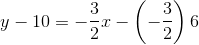


Isolate  by adding 10 to both sides:


Replacing, the definition of  is
is
 .
.
By the two-point formula, the equation of a line through points
where 
The first formula becomes
Since
Isolate
Replacing, the definition of
← Didn't Know|Knew It →
Identify the terms in the following equation:

Identify the terms in the following equation:
Tap to reveal answer
In an equation, a term is a single number or a variable. in our equation we have the following terms:

In an equation, a term is a single number or a variable. in our equation we have the following terms:
← Didn't Know|Knew It →
How many terms are in the following expression:  ?
?
How many terms are in the following expression: 
Tap to reveal answer
Step 1: We need to separate and arrange the terms in the jumbled expression given to us in the question..
We will separate the terms by the exponent value.
For  , there is only one term:
For  , there are no terms.
For  , there is two terms:
For  , there are two terms:
For  , there are two terms:
For  , there is only one term:
For  , there are two terms:
For  , there are three terms:
There are four constant terms: 
Step 2: We will now add up the coefficients in each designation of terms. This will give us the answer.

Step 1: We need to separate and arrange the terms in the jumbled expression given to us in the question..
We will separate the terms by the exponent value.
For 

For 
For 

For 

For 

For 

For 

For 

There are four constant terms:

Step 2: We will now add up the coefficients in each designation of terms. This will give us the answer.

← Didn't Know|Knew It →
Simplify the polynomial
 .
.
How many terms does the simplified form have?
Simplify the polynomial

How many terms does the simplified form have?
Tap to reveal answer
Arrange and combine like terms (those with the same variable) as follows:


Since each term now has a different exponent for the variable, no further combining is possible. The simplified form has four terms.
Arrange and combine like terms (those with the same variable) as follows:


Since each term now has a different exponent for the variable, no further combining is possible. The simplified form has four terms.
← Didn't Know|Knew It →
The equation

has two distinct solutions. What is their sum?
The equation
has two distinct solutions. What is their sum?
Tap to reveal answer
It is not necessary to actually find the solutions to a quadratic equation to determine the sum of its solutions.
First, get the equation in standard form  by subtracting
  from both sides:


If a quadratic equation has two distinct solutions, which we are given here, their sum is the linear coefficient  . In this problem,
  , making
  the correct choice.
It is not necessary to actually find the solutions to a quadratic equation to determine the sum of its solutions.
First, get the equation in standard form
If a quadratic equation has two distinct solutions, which we are given here, their sum is the linear coefficient
← Didn't Know|Knew It →
The graph of the polynomial function

has one and only one zero on the interval  . On which subinterval is it located?
The graph of the polynomial function

has one and only one zero on the interval 
Tap to reveal answer
The Intermediate Value Theorem (IVT) states that if the graph of a function  is continuous on an interval
  , and
, and  and
and  differ in sign, then
  has a zero on
  . Consequently, the way to answer this question is to determine the signs of
  on the endpoints of the subintervals -
  . We can do this by substituting each value for
  as follows:





 assumes positive values for
  and negative values for
  . By the IVT,
  has a zero on
  .
.
The Intermediate Value Theorem (IVT) states that if the graph of a function 


← Didn't Know|Knew It →
Add or subtract: 
Add or subtract:

Tap to reveal answer
Step 1: Find the Least Common Denominator of these fraction. We will list out multiples of each denominator until we find a common number for all three fractions...


The smallest common denominator is  .
.
Step 2: Since the denominator is  , we will convert all denominators to
  .
.



Step 3: Add up all the values of x...

Step 4: The result from step  is the numerator and
  is the denominator. We will put these together.
Final Answer: 
Step 1: Find the Least Common Denominator of these fraction. We will list out multiples of each denominator until we find a common number for all three fractions...


The smallest common denominator is 
Step 2: Since the denominator is 


Step 3: Add up all the values of x...

Step 4: The result from step 

Final Answer:

← Didn't Know|Knew It →
Solve.

Solve.
Tap to reveal answer
In order to solve for the variable,  , we need to isolate it on the left side of the equation. We will do this by reversing the operations done to the variable by performing the opposite of each operation on both sides of the equation.
Let's begin by rewriting the given equation.

Subtract  from both sides of the equation.

Simplify.

Multiply both sides of the equation by  .
.

Solve.

In order to solve for the variable,
Let's begin by rewriting the given equation.
Subtract
Simplify.
Multiply both sides of the equation by
Solve.
← Didn't Know|Knew It →
Give the solution set of the inequality

Give the solution set of the inequality
Tap to reveal answer
 can be rewritten as the compound inequality
 .
.
The solution set will be the union of the two individual solution sets. Find the solution set of the first inequality as follows:
Isolate  by first subtracting
  from both sides:


Divide both sides by  , reversing the direction of the inequality symbol, since you are dividing by a negative number:

 .
.
In interval notation, this is the set  .
.
Find the solution set of the other inequality similarly:


In interval notation, this is the set  .
.
The union of these sets is the solution set:  .
.
The solution set will be the union of the two individual solution sets. Find the solution set of the first inequality as follows:
Isolate
Divide both sides by
In interval notation, this is the set
Find the solution set of the other inequality similarly:
In interval notation, this is the set
The union of these sets is the solution set:
← Didn't Know|Knew It →
The daily pay in U.S. Dollars for a certain job is defined as the following function  , where
  equals time in hours:

If an employee works for 7 hours in a day, how much is he or she paid?
The daily pay in U.S. Dollars for a certain job is defined as the following function 


If an employee works for 7 hours in a day, how much is he or she paid?
Tap to reveal answer

The above function can be understood as, "An employee is paid $15 for each hour he or she works, plus a flat amount of $10."
If an employee works 7 hours, we can find the amount that he or she is paid by plugging in 7 for "Hours" in the equation:

Adhering to order of operations, we next find the product of 15 and 7:

Finally, we find the sum of 105 and 10:

The employee is paid $115.00 for seven hours' work.

The above function can be understood as, "An employee is paid $15 for each hour he or she works, plus a flat amount of $10."
If an employee works 7 hours, we can find the amount that he or she is paid by plugging in 7 for "Hours" in the equation:

Adhering to order of operations, we next find the product of 15 and 7:

Finally, we find the sum of 105 and 10:

The employee is paid $115.00 for seven hours' work.
← Didn't Know|Knew It →
Consider the scenario below:
Helen is a painter. It takes her 3 days to make each painting. She has already made 6 paintings. Which of the following functions best models the number of paintings she will have after  days?
days?
Consider the scenario below:
Helen is a painter. It takes her 3 days to make each painting. She has already made 6 paintings. Which of the following functions best models the number of paintings she will have after
Tap to reveal answer
The question asks, "Which of the following functions best models the number of paintings she will have after  days?"
From this, you know that the variable  represents the number of days, and that
  represents the number of paintings she makes as a function of days spent working.
If it takes 3 days to make a painting, each day results in  paintings. Therefore, we have a linear relationship with slope
  .
.
Additionally, she begins with 6 paintings. Therefore, even when zero days are spent working on paintings, she will have 6 paintings. In other words,  . This means the y-intercept is 6.
As a result, the function will be

which can be rewritten as

The question asks, "Which of the following functions best models the number of paintings she will have after
From this, you know that the variable 
If it takes 3 days to make a painting, each day results in
Additionally, she begins with 6 paintings. Therefore, even when zero days are spent working on paintings, she will have 6 paintings. In other words,
As a result, the function will be
which can be rewritten as
← Didn't Know|Knew It →
is a linear function defined on the set of real numbers. Four values of are given in the following table:
Give the definition for .
Give the definition for
Tap to reveal answer
By the two-point formula, the equation of a line through points is
,
where , the slope of the line. The choice of the two points from the given four is arbitrary, so we will select the middle two ordered pairs. Substituting , then
The first formula becomes
Since , solve for . First, distribute throughout the difference at right:
Isolate by adding 10 to both sides:
Replacing, the definition of is
.
By the two-point formula, the equation of a line through points
where
The first formula becomes
Since
Isolate
Replacing, the definition of
← Didn't Know|Knew It →
What is the vertex of the following quadratic polynomial?

What is the vertex of the following quadratic polynomial?
Tap to reveal answer
Given a quadratic function

the vertex will always be
 .
.
Thus, since our function is

 ,
,  , and
, and  .
.
We plug these variables into the formula to get the vertex as


 .
.
Hence, the vertex of

is
 .
.
Given a quadratic function
the vertex will always be
Thus, since our function is


We plug these variables into the formula to get the vertex as


Hence, the vertex of
is
← Didn't Know|Knew It →
Which of the following expressions represents the discriminant of the following polynomial?

Which of the following expressions represents the discriminant of the following polynomial?
Tap to reveal answer
The discriminant of a quadratic polynomial

is given by
 .
.
Thus, since our quadratic polynomial is
 ,
,
 ,
,  , and
, and  .
.
Plugging these values into the discriminant equation, we find that the discriminant is
 .
.
The discriminant of a quadratic polynomial
is given by

Thus, since our quadratic polynomial is


Plugging these values into the discriminant equation, we find that the discriminant is

← Didn't Know|Knew It →
Give the nature of the solution set of the equation

Give the nature of the solution set of the equation

Tap to reveal answer
To determine the nature of the solution set of a quadratic equation, it is necessary to first express it in standard form

This can be done by adding 17 to both sides:


The key to determining the nature of the solution set is to examine the discriminant
 . Setting
  , the value of the discriminant is

This value is negative. Consequently, the solution set comprises two imaginary numbers.
To determine the nature of the solution set of a quadratic equation, it is necessary to first express it in standard form

This can be done by adding 17 to both sides:


The key to determining the nature of the solution set is to examine the discriminant


This value is negative. Consequently, the solution set comprises two imaginary numbers.
← Didn't Know|Knew It →
Which of the following polynomial equations has exactly one solution?
Which of the following polynomial equations has exactly one solution?
Tap to reveal answer
A polynomial equation of the form

has one and only one (real) solution if and only if its discriminant is equal to zero - that is, if its coefficients satisfy the equation

In each of the choices,  and
and  , so it suffices to determine the value of
  which satisfies this equation. Substituting, we get


Solve for  by first adding 400 to both sides:


Take the square root of both sides:

The choice that matches this value of  is the equation

A polynomial equation of the form

has one and only one (real) solution if and only if its discriminant is equal to zero - that is, if its coefficients satisfy the equation

In each of the choices, 


Solve for 


Take the square root of both sides:

The choice that matches this value of 

← Didn't Know|Knew It →
Give the nature of the solution set of the equation

Give the nature of the solution set of the equation

Tap to reveal answer
To determine the nature of the solution set of a quadratic equation, it is necessary to first express it in standard form

To accomplish this, first, multiply the binomials on the left using the FOIL technique:


Collect like terms:

Now, subtract 18 from both sides:


The key to determining the nature of the solution set is to examine the discriminant  . Setting
  , the value of the discriminant is

The discriminant is a positive number, so there are two real solutions. Since 73 is not a perfect square, the solutions are irrational.
To determine the nature of the solution set of a quadratic equation, it is necessary to first express it in standard form

To accomplish this, first, multiply the binomials on the left using the FOIL technique:


Collect like terms:

Now, subtract 18 from both sides:


The key to determining the nature of the solution set is to examine the discriminant 


The discriminant is a positive number, so there are two real solutions. Since 73 is not a perfect square, the solutions are irrational.
← Didn't Know|Knew It →
Give the nature of the solution set of the equation

Give the nature of the solution set of the equation

Tap to reveal answer
To determine the nature of the solution set of a quadratic equation, it is necessary to first express it in standard form
To accomplish this, first, multiply the binomials on the left using the FOIL technique:


Collect like terms:

Add 6 to both sides:


The key to determining the nature of the solution set is to examine the discriminant . Setting  , the value of the discriminant is

The discriminant is a positive number; furthermore, it is a perfect square, being equal to the square of 11. Therefore, the solution set comprises two rational solutions.
To determine the nature of the solution set of a quadratic equation, it is necessary to first express it in standard form
To accomplish this, first, multiply the binomials on the left using the FOIL technique:


Collect like terms:

Add 6 to both sides:


The key to determining the nature of the solution set is to examine the discriminant 

The discriminant is a positive number; furthermore, it is a perfect square, being equal to the square of 11. Therefore, the solution set comprises two rational solutions.
← Didn't Know|Knew It →
Give the nature of the solution set of the equation
 .
.
Give the nature of the solution set of the equation

Tap to reveal answer
To determine the nature of the solution set of a quadratic equation, it is necessary to first express it in standard form

This can be done by simply switching the first and second terms:


The key to determining the nature of the solution set is to examine the discriminant  . Setting
  , the value of the discriminant is

The discriminant has a negative value. It follows that the solution set comprises two imaginary values.
To determine the nature of the solution set of a quadratic equation, it is necessary to first express it in standard form
This can be done by simply switching the first and second terms:


The key to determining the nature of the solution set is to examine the discriminant 

The discriminant has a negative value. It follows that the solution set comprises two imaginary values.
← Didn't Know|Knew It →
Which of the following polynomial equations has exactly one solution?
Which of the following polynomial equations has exactly one solution?
Tap to reveal answer
A polynomial equation of the standard form

has one and only one (real) solution if and only if its discriminant is equal to zero - that is, if its coefficients satisfy the equation

Each of the choices can be rewritten in standard form by subtracting the term on the right from both sides. One of the choices can be rewritten as follows:


By similar reasoning, the other four choices can be written:


In each of the five standard forms,  and
and  , so it is necessary to determine the value of
  that produces a zero discriminant. Substituting accordingly:


Add 900 to both sides and take the square root:


Of the five standard forms,

fits this condition. This is the standard form of the equation
 ,
,
the correct choice.
A polynomial equation of the standard form
has one and only one (real) solution if and only if its discriminant is equal to zero - that is, if its coefficients satisfy the equation
Each of the choices can be rewritten in standard form by subtracting the term on the right from both sides. One of the choices can be rewritten as follows:


By similar reasoning, the other four choices can be written:


In each of the five standard forms, 


Add 900 to both sides and take the square root:


Of the five standard forms,

fits this condition. This is the standard form of the equation

the correct choice.
← Didn't Know|Knew It →