
Sets - ISEE Middle Level Quantitative Reasoning
Card 0 of 195

Refer to the above diagram. The top row gives a sequence of figures. Which figure on the bottom row comes next, thereby replacing the question mark?
Refer to the above diagram. The top row gives a sequence of figures. Which figure on the bottom row comes next, thereby replacing the question mark?
There are three things going on with these patterns.
First, the number of dots in the pattern is increasing by one, so there must be four dots in the correct choice. However, this does not eliminate any of the choices.
Second, the sector that included the dots alternates between lower right and upper left, so the correct choice must have its dots in the upper left sector. This eliminates figures (c) and (d) and leaves (a) and (b) as possible choices.
Third, the shaded sector is rotating clockwise. The shaded sector in the correct choice must be the one at the lower left, thereby eliminating (b) and leaving (a) as the correct choice.
There are three things going on with these patterns.
First, the number of dots in the pattern is increasing by one, so there must be four dots in the correct choice. However, this does not eliminate any of the choices.
Second, the sector that included the dots alternates between lower right and upper left, so the correct choice must have its dots in the upper left sector. This eliminates figures (c) and (d) and leaves (a) and (b) as possible choices.
Third, the shaded sector is rotating clockwise. The shaded sector in the correct choice must be the one at the lower left, thereby eliminating (b) and leaving (a) as the correct choice.
Compare your answer with the correct one above
What are the next two numbers of this sequence?

What are the next two numbers of this sequence?
The sequence is formed by alternately adding  and adding
  to each term to get the next term.

 and
and  are the next two numbers.
The sequence is formed by alternately adding
Compare your answer with the correct one above
Find the missing part of the list:

Find the missing part of the list:
To find the next number in the list, multiply the previous number by  .
.

To find the next number in the list, multiply the previous number by
Compare your answer with the correct one above
Seven students are running for student council; each member of the student body will vote for three. Derreck does not want to vote for Anne, whom he does not like. How many ways can he cast a ballot so as not to include Anne among his choices?
Seven students are running for student council; each member of the student body will vote for three. Derreck does not want to vote for Anne, whom he does not like. How many ways can he cast a ballot so as not to include Anne among his choices?
Derreck is choosing three students from a field of six (seven minus Anne) without respect to order, making this a combination. He has  ways to choose. This is:

Derreck has 20 ways to fill the ballot.
Derreck is choosing three students from a field of six (seven minus Anne) without respect to order, making this a combination. He has
Derreck has 20 ways to fill the ballot.
Compare your answer with the correct one above
Ten students are running for Senior Class President. Each member of the student body will choose four candidates, and mark them 1-4 in order of preference.
How many ways are there to fill out the ballot?
Ten students are running for Senior Class President. Each member of the student body will choose four candidates, and mark them 1-4 in order of preference.
How many ways are there to fill out the ballot?
Four candidates are being selected from ten, with order being important; this means that we are looking for the number of permutations of four chosen from a set of ten. This is

There are 5,040 ways to complete the ballot.
Four candidates are being selected from ten, with order being important; this means that we are looking for the number of permutations of four chosen from a set of ten. This is
There are 5,040 ways to complete the ballot.
Compare your answer with the correct one above
Ten students are running for Senior Class President. Each member of the student body will choose five candidates, and mark them 1-5 in order of preference.
Roy wants Mike to win. How many ways can Roy fill out the ballot so that Mike is his first choice?
Ten students are running for Senior Class President. Each member of the student body will choose five candidates, and mark them 1-5 in order of preference.
Roy wants Mike to win. How many ways can Roy fill out the ballot so that Mike is his first choice?
Since Mike is already chosen, Roy is in essence choosing four candidates from nine, with order being important. This is a permutation of four elements out of nine. The number of these is

Roy can fill out the ballot 3,024 times and have Mike be his first choice.
Since Mike is already chosen, Roy is in essence choosing four candidates from nine, with order being important. This is a permutation of four elements out of nine. The number of these is
Roy can fill out the ballot 3,024 times and have Mike be his first choice.
Compare your answer with the correct one above
The junior class elections have four students running for President, five running for Vice-President, four running for Secretary-Treasurer, and seven running for Student Council Representative. How many ways can a student fill out a ballot?
The junior class elections have four students running for President, five running for Vice-President, four running for Secretary-Treasurer, and seven running for Student Council Representative. How many ways can a student fill out a ballot?
These are four independent events, so by the multiplication principle, the ballot can be filled out  ways.
ways.
These are four independent events, so by the multiplication principle, the ballot can be filled out
Compare your answer with the correct one above
The sophomore class elections have six students running for President, five running for Vice-President, and six running for Secretary-Treasurer. How many ways can a student fill out a ballot if he is allowed to select one name per office?
The sophomore class elections have six students running for President, five running for Vice-President, and six running for Secretary-Treasurer. How many ways can a student fill out a ballot if he is allowed to select one name per office?
These are three independent events, so by the multiplication principle, the ballot can be filled out  ways.
ways.
These are three independent events, so by the multiplication principle, the ballot can be filled out
Compare your answer with the correct one above
What is the value of y in the pattern below?

What is the value of y in the pattern below?
What that the fractions in this pattern have in common is that they are all the equivalent of  .
.
The value of y should be a number that is the equivalent of  when divided by 12.
Given that  of 12 is 4,
  of 12 would be equal to 8, the correct answer.
What that the fractions in this pattern have in common is that they are all the equivalent of
The value of y should be a number that is the equivalent of
Given that
Compare your answer with the correct one above
Mary is making a very long necklace with a variety of beads. The beads are white, blue, and black, and she strings them on the necklace, in that order. What color is the 213th bead?
Mary is making a very long necklace with a variety of beads. The beads are white, blue, and black, and she strings them on the necklace, in that order. What color is the 213th bead?
A number is divisible by 3 when the sum of its digits is divisble by 3. The sum of the digits of 213 equals 6, which is evenly divisible by 3.
Therefore, because 213 is a number that is evenly divisble by 3, the 213th bead is going to be the third color that Mary uses, which is black.
A number is divisible by 3 when the sum of its digits is divisble by 3. The sum of the digits of 213 equals 6, which is evenly divisible by 3.
Therefore, because 213 is a number that is evenly divisble by 3, the 213th bead is going to be the third color that Mary uses, which is black.
Compare your answer with the correct one above

On the top row in the above diagram is a sequence of figures. Which of the figures in the bottom row is the next one in the sequence?
On the top row in the above diagram is a sequence of figures. Which of the figures in the bottom row is the next one in the sequence?
Taking only shapes into account, the sequence is:
Triangle, circle, square,
Triangle, circle, square,
Triangle, ?
To continue the cycle, the next shape must be a circle.
Now, taking only coloration into account, the sequence is:
Left half shaded, unshaded,
Top half shaded, unshaded,
Left half shaded, unshaded,
Top half shaded, ?
To continue the cycle, the next shape must be unshaded.
Therefore, the correct choice is the unshaded circle, Figure (c).
Taking only shapes into account, the sequence is:
Triangle, circle, square,
Triangle, circle, square,
Triangle, ?
To continue the cycle, the next shape must be a circle.
Now, taking only coloration into account, the sequence is:
Left half shaded, unshaded,
Top half shaded, unshaded,
Left half shaded, unshaded,
Top half shaded, ?
To continue the cycle, the next shape must be unshaded.
Therefore, the correct choice is the unshaded circle, Figure (c).
Compare your answer with the correct one above
What is the value of  in the sequence below?

What is the value of
In this sequence, every subsequent number is equal to one third of the preceding number:


Given that  , that is the correct answer.
In this sequence, every subsequent number is equal to one third of the preceding number:
Given that
Compare your answer with the correct one above
The sum of three consecutive odd numbers is 81. What is the largest number?
The sum of three consecutive odd numbers is 81. What is the largest number?
In order to solve this problem, it is best to work backwards by "plugging in" the answer choices to see which one yields a correct answer.
If 29 is the largest of the three odd consecutive numbers, then that means that the numbers being added together would be 25, 27, and 29.
Given that  ,
,  is the correct answer.
In order to solve this problem, it is best to work backwards by "plugging in" the answer choices to see which one yields a correct answer.
If 29 is the largest of the three odd consecutive numbers, then that means that the numbers being added together would be 25, 27, and 29.
Given that
Compare your answer with the correct one above
Find the next number that should appear in the set below:

Find the next number that should appear in the set below:
In this set, each subsequent fraction is half the size of the preceding fraction; (the denominator is doubled for each successive fraction, but the numerator stays the same). Given that the last fraction in the set is  , it follows that the subsequent fraction will be
  .
.
In this set, each subsequent fraction is half the size of the preceding fraction; (the denominator is doubled for each successive fraction, but the numerator stays the same). Given that the last fraction in the set is
Compare your answer with the correct one above
If every number in set  appears in set
  , which consists of multiples of
  , which of the following could describe set
  ?
?
If every number in set
If every number that appears in set  also appears in set
  , that means that set
  must be broader than set
  .
.
Any number that is a multiple of 16 will also be a multiple of 8 (characteristic of set  ); therefore, if set
  consists of multiples of 16, set
  will include all those numbers.
Therefore, Set  can consist of multiples of 16.
If every number that appears in set
Any number that is a multiple of 16 will also be a multiple of 8 (characteristic of set
Therefore, Set
Compare your answer with the correct one above
The mean of a set is  . What is the missing value?

The mean of a set is
The equation for the average would be
 .
.
To work backwards you must first multiple both sides by  .
.
This gives us  .
.
To solve for  , you must subtract all the other values from
  .
.
This gives us an answer of  .
.
The equation for the average would be
To work backwards you must first multiple both sides by
This gives us
To solve for
This gives us an answer of
Compare your answer with the correct one above
What number replaces the circle in the sequence below?

What number replaces the circle in the sequence below?
Add 5 to the first element to get the second element. The increment increases by two with each successive entry. The pattern can be seen below:


 - this is the correct response
This is confirmed by noting:

Add 5 to the first element to get the second element. The increment increases by two with each successive entry. The pattern can be seen below:
This is confirmed by noting:
Compare your answer with the correct one above
What number replaces the square in the sequence below?

What number replaces the square in the sequence below?
The way to get from one entry of the sequence to the next alternates between multiplying by two and adding one, as follows:


Continuing the pattern:

 , the correct choice.
The way to get from one entry of the sequence to the next alternates between multiplying by two and adding one, as follows:
Continuing the pattern:
Compare your answer with the correct one above

On the top row in the above diagram is a sequence of figures. Which of the figures in the bottom row is the next one in the sequence?
On the top row in the above diagram is a sequence of figures. Which of the figures in the bottom row is the next one in the sequence?
Taking only shapes into account, the sequence is:
Triangle(s), square(s). circle(s),
Triangle(s), square(s). circle(s),
Triangle(s)...
To continue the pattern, the next figure must comprise one or two squares.
Taking only number and color of shapes into account, the sequence is
One white, one black over one white, one black, one white over one black,
One white, One black over one white, one black,...
To continue the pattern, the next figure must comprise one white shape over one black.
Therefore, the correct choice is one white square over one black square, which is Figure (b).
Taking only shapes into account, the sequence is:
Triangle(s), square(s). circle(s),
Triangle(s), square(s). circle(s),
Triangle(s)...
To continue the pattern, the next figure must comprise one or two squares.
Taking only number and color of shapes into account, the sequence is
One white, one black over one white, one black, one white over one black,
One white, One black over one white, one black,...
To continue the pattern, the next figure must comprise one white shape over one black.
Therefore, the correct choice is one white square over one black square, which is Figure (b).
Compare your answer with the correct one above
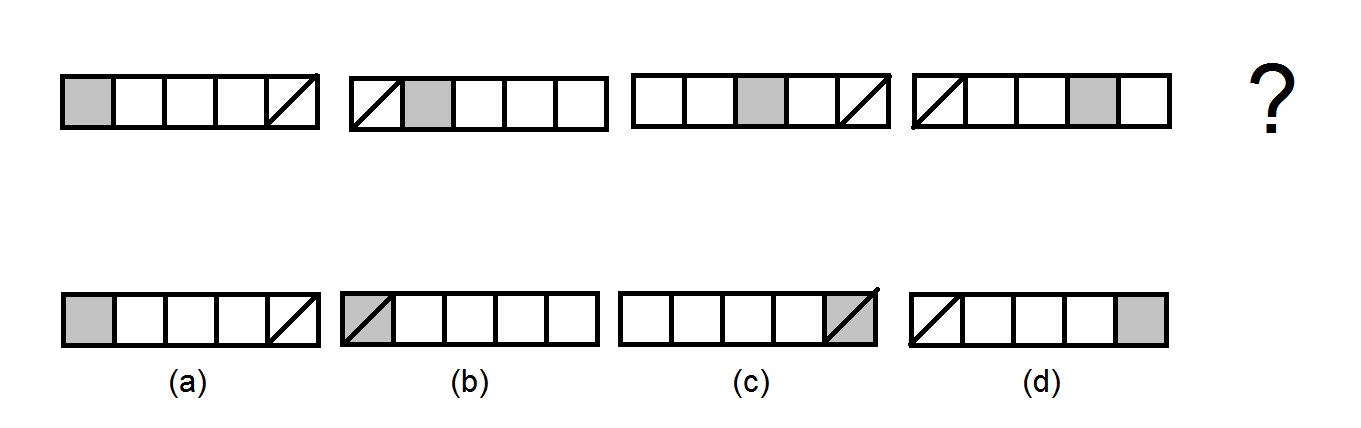
Refer to the above diagram. The top row gives a sequence of figures. Which figure on the bottom row comes next?
Refer to the above diagram. The top row gives a sequence of figures. Which figure on the bottom row comes next?
The square with the diagonal line alternates between the square on the left and the square on the right. Therefore, the next figure in the sequence will have its diagonal line in the rightmost square, eliminating Figures (b) and (d) and leaving Figures (a) and (c).
Also, the shaded square moves one position to the right from figure to figure, so in the next figure, the shaded square must be the one at the extreme right. Figure (c) matches that description.
The square with the diagonal line alternates between the square on the left and the square on the right. Therefore, the next figure in the sequence will have its diagonal line in the rightmost square, eliminating Figures (b) and (d) and leaving Figures (a) and (c).
Also, the shaded square moves one position to the right from figure to figure, so in the next figure, the shaded square must be the one at the extreme right. Figure (c) matches that description.
Compare your answer with the correct one above