
How to find the perimeter of the rectangle
ISEE Middle Level Quantitative Reasoning · Learn by Concept
Help Questions
ISEE Middle Level Quantitative Reasoning › How to find the perimeter of the rectangle
A rectangular postage stamp has a width of 3 cm and a height of 12 cm. Find the perimeter of the stamp.


Explanation
A rectangular postage stamp has a width of 3 cm and a height of 12 cm. Find the perimeter of the stamp.
To find the perimeter of a rectangle (or any shape) simply add up all the sides.
In this case, we have two sides that are 3 cm and two sides that are 12 cm.

Now, our answer must be in centimeters and not centimeters squared, because we are dealing with perimeter, which is a measure of length.
Use the following image to answer the question:
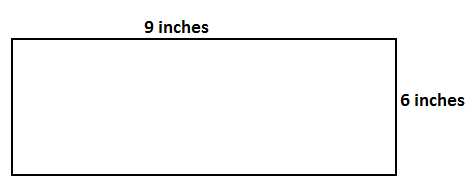
Find the perimeter of the rectangle.


Explanation
To find the perimeter of a rectangle, we will use the following formula:

where a, b, c, and d are the lengths of the sides of the rectangle.
Now, let's look at the rectangle.
We can see the length is 9 inches. Because it is a rectangle, the opposite side is also 9 inches. We can see the width is 6 inches. Because it is a rectangle, the opposite side is also 6 inches.
Knowing this, we can substitute into the formula. We get


Find the perimeter of a rectangle with a length of 12cm and a width that is a quarter of the length.


Explanation
To find the perimeter of a rectangle, we will use the following formula:

Where a, b, c, and d are the lengths of the sides of the rectangle.
Now, we know the length of the rectangle is 12cm. Because it is a rectangle, the opposite side is also 12cm. We also know the width of the rectangle is a quarter of the length. To find the width, we will divide 12 by 4. Therefore, the width is 3cm. Because it is a rectangle, the opposite side is also 3cm.
Knowing this, we can substitute into the formula. We get


Find the perimeter of a rectangle with a length of 16cm and a width that is a quarter of the length.


Explanation
To find the perimeter of a rectangle, we will use the following formula:

Where a, b, c, and d are the lengths of the sides of the rectangle.
Now, we know the length of the rectangle is 16cm. Because it is a rectangle, the opposite side is also 16cm. We also know the width of the rectangle is a quarter of the length. To find the width, we will divide 16 by 4. Therefore, the width is 4cm. Because it is a rectangle, the opposite side is also 4cm.
Knowing this, we can substitute into the formula. We get


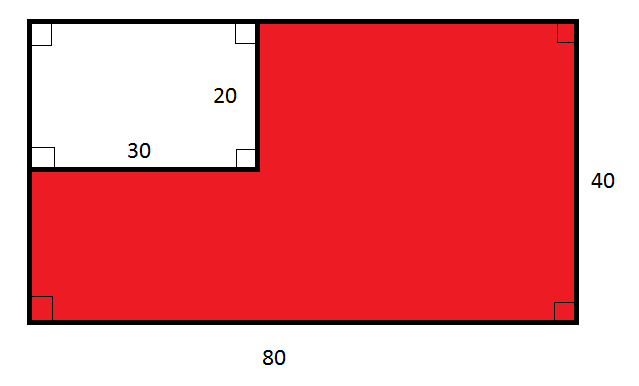
Note: Figure NOT drawn to scale.
Refer to the above diagram. Give the ratio of the perimeter of the large rectangle to that of the smaller rectangle.


The correct answer is not given among the other choices.
Explanation
Opposite sides of a rectangle are congruent.
The large rectangle has perimeter

The smaller rectangle has perimeter

The ratio is

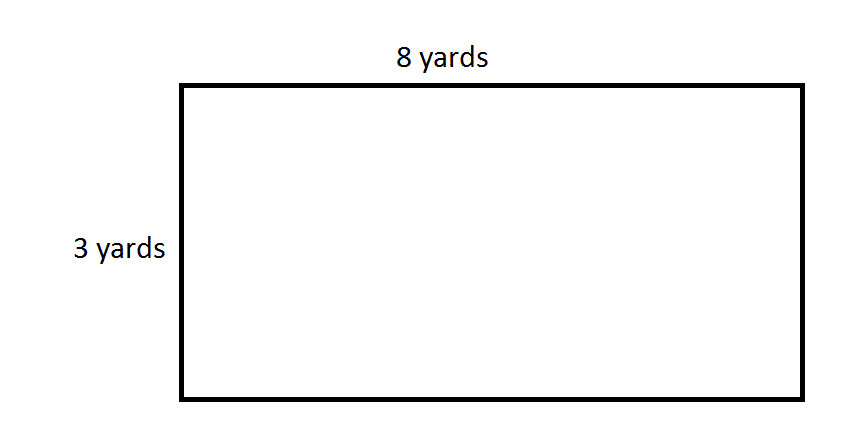
Give the perimeter of the above rectangle in centimeters, using the conversion factor 


Explanation
The perimeter of the rectangle is 

Find the perimeter of a rectangle with a width of 7in and a length that is two times the width.


Explanation
To find the perimeter of a rectangle, we will use the following formula:

Where a, b, c, and d are the lengths of the sides of the rectangle.
Now, we know the width of the rectangle is 7in. Because it is a rectangle, the opposite side is also 7in.
We know the length is two times the width. Therefore, the length is 14in. Because it is a rectangle, the opposite side is also 14in.
Knowing this, we can substitute into the formula. We get


Find the perimeter of a rectangle with a length of 7in and a width of 4in.


Explanation
To find the perimeter of a rectangle, we will use the following formula:

where a, b, c, and d are the lengths of the sides of the rectangle.
Now, we know the length of the rectangle is 7in. Because it is a rectangle, the opposite side is also 7in.
We also know the width of the rectangle is 4in. Because it is a rectangle, the opposite side is also 4in.
Knowing this, we can substitute into the formula. We get


Find the perimeter of a rectangle with a width of 8cm and a length that is three times the width.


Explanation
To find the perimeter of a rectangle, we will use the following formula:

where a, b, c, and d are the lengths of the sides of the rectangle.
Now, we know the width of the rectangle is 8cm. Because it is a rectangle, we know the opposite side is also 8cm. We also know the length is three times the width. Therefore, the length is 24cm. Because it is a rectangle, we know the opposite side is also 24cm.
Knowing all of this, we can substitute into the formula. We get


Note: Figure NOT drawn to scale.
Refer to the above diagram. Give the perimeter of the red polygon.


The perimeter cannot be determined from the information given.
Explanation
Since opposite sides of a rectangle have the same measure, the missing sidelengths can be calculated as in the diagram below:

The sidelengths of the red polygon can now be added to find the perimeter:
