
Numbers and Operations - ISEE Middle Level Quantitative Reasoning
Card 0 of 6205
Arrange these numbers from least to greatest:

Arrange these numbers from least to greatest:
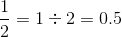
Rewrite all three numbers as their decimal equivalents by dividing numerator by denominator.
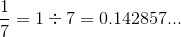
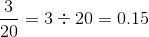
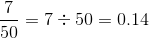
From the decimal equivalents, the fractions can be arranged as follows:

Rewrite all three numbers as their decimal equivalents by dividing numerator by denominator.
From the decimal equivalents, the fractions can be arranged as follows:
Compare your answer with the correct one above
How many of the following four numbers are elements of the set
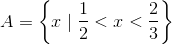
(A) 
(B) 
(C) 
(D) 
How many of the following four numbers are elements of the set
(A)
(B)
(C)
(D)
 and
and 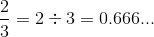 , so we choose the numbers that fall between these two. Of the four choices, only 0.67 is not between these two numbers. The correct response is "three".
Compare your answer with the correct one above
How many of the following four numbers are elements of the set
(A)
(B)
(C)
(D)
How many of the following four numbers are elements of the set
(A)
(B)
(C)
(D)
and , so we choose the numbers that fall between these two. Of the four choices, only 0.67 is not between these two numbers. The correct response is "three".
Compare your answer with the correct one above
How many of the following four numbers are elements of the set
(A)
(B)
(C)
(D)
How many of the following four numbers are elements of the set
(A)
(B)
(C)
(D)
and , so we choose the numbers that fall between these two. Of the four choices, only 0.67 is not between these two numbers. The correct response is "three".
Compare your answer with the correct one above
How many of the following four numbers are elements of the set
(A)
(B)
(C)
(D)
How many of the following four numbers are elements of the set
(A)
(B)
(C)
(D)
and , so we choose the numbers that fall between these two. Of the four choices, only 0.67 is not between these two numbers. The correct response is "three".
Compare your answer with the correct one above
How many of the following four numbers are elements of the set
(A)
(B)
(C)
(D)
How many of the following four numbers are elements of the set
(A)
(B)
(C)
(D)
and , so we choose the numbers that fall between these two. Of the four choices, only 0.67 is not between these two numbers. The correct response is "three".
Compare your answer with the correct one above
Arrange these numbers from least to greatest:
Arrange these numbers from least to greatest:
Rewrite all three numbers as their decimal equivalents by dividing numerator by denominator.
From the decimal equivalents, the fractions can be arranged as follows:
Rewrite all three numbers as their decimal equivalents by dividing numerator by denominator.
From the decimal equivalents, the fractions can be arranged as follows:
Compare your answer with the correct one above
Arrange these numbers from least to greatest:
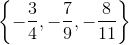
Arrange these numbers from least to greatest:
Rewrite all three numbers as their decimal equivalents by dividing numerator by denominator.
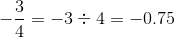


To arrange negative numbers from least to greatest, we must arrange them so that their absolute values (values without the negative symbol) go from greatest to least. In descending order, the absolute values are
 ,
,
so, in ascending order, the numbers themselves are
 ,
,
or, in their fractional equivalents,
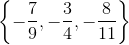 .
.
Rewrite all three numbers as their decimal equivalents by dividing numerator by denominator.
To arrange negative numbers from least to greatest, we must arrange them so that their absolute values (values without the negative symbol) go from greatest to least. In descending order, the absolute values are
so, in ascending order, the numbers themselves are
or, in their fractional equivalents,
Compare your answer with the correct one above
Arrange these numbers from least to greatest:
Arrange these numbers from least to greatest:
Rewrite all three numbers as their decimal equivalents by dividing numerator by denominator.
From the decimal equivalents, the fractions can be arranged as follows:
Rewrite all three numbers as their decimal equivalents by dividing numerator by denominator.
From the decimal equivalents, the fractions can be arranged as follows:
Compare your answer with the correct one above
Arrange these numbers from least to greatest:
Arrange these numbers from least to greatest:
Rewrite all three numbers as their decimal equivalents by dividing numerator by denominator.
To arrange negative numbers from least to greatest, we must arrange them so that their absolute values (values without the negative symbol) go from greatest to least. In descending order, the absolute values are
,
so, in ascending order, the numbers themselves are
,
or, in their fractional equivalents,
.
Rewrite all three numbers as their decimal equivalents by dividing numerator by denominator.
To arrange negative numbers from least to greatest, we must arrange them so that their absolute values (values without the negative symbol) go from greatest to least. In descending order, the absolute values are
so, in ascending order, the numbers themselves are
or, in their fractional equivalents,
Compare your answer with the correct one above
Arrange these numbers from least to greatest:
Arrange these numbers from least to greatest:
Rewrite all three numbers as their decimal equivalents by dividing numerator by denominator.
From the decimal equivalents, the fractions can be arranged as follows:
Rewrite all three numbers as their decimal equivalents by dividing numerator by denominator.
From the decimal equivalents, the fractions can be arranged as follows:
Compare your answer with the correct one above
Arrange these numbers from least to greatest:
Arrange these numbers from least to greatest:
Rewrite all three numbers as their decimal equivalents by dividing numerator by denominator.
To arrange negative numbers from least to greatest, we must arrange them so that their absolute values (values without the negative symbol) go from greatest to least. In descending order, the absolute values are
,
so, in ascending order, the numbers themselves are
,
or, in their fractional equivalents,
.
Rewrite all three numbers as their decimal equivalents by dividing numerator by denominator.
To arrange negative numbers from least to greatest, we must arrange them so that their absolute values (values without the negative symbol) go from greatest to least. In descending order, the absolute values are
so, in ascending order, the numbers themselves are
or, in their fractional equivalents,
Compare your answer with the correct one above
Arrange these numbers from least to greatest:
Arrange these numbers from least to greatest:
Rewrite all three numbers as their decimal equivalents by dividing numerator by denominator.
To arrange negative numbers from least to greatest, we must arrange them so that their absolute values (values without the negative symbol) go from greatest to least. In descending order, the absolute values are
,
so, in ascending order, the numbers themselves are
,
or, in their fractional equivalents,
.
Rewrite all three numbers as their decimal equivalents by dividing numerator by denominator.
To arrange negative numbers from least to greatest, we must arrange them so that their absolute values (values without the negative symbol) go from greatest to least. In descending order, the absolute values are
so, in ascending order, the numbers themselves are
or, in their fractional equivalents,
Compare your answer with the correct one above
Arrange these numbers from least to greatest:
Arrange these numbers from least to greatest:
Rewrite all three numbers as their decimal equivalents by dividing numerator by denominator.
From the decimal equivalents, the fractions can be arranged as follows:
Rewrite all three numbers as their decimal equivalents by dividing numerator by denominator.
From the decimal equivalents, the fractions can be arranged as follows:
Compare your answer with the correct one above
Arrange these numbers from least to greatest:
Arrange these numbers from least to greatest:
Rewrite all three numbers as their decimal equivalents by dividing numerator by denominator.
To arrange negative numbers from least to greatest, we must arrange them so that their absolute values (values without the negative symbol) go from greatest to least. In descending order, the absolute values are
,
so, in ascending order, the numbers themselves are
,
or, in their fractional equivalents,
.
Rewrite all three numbers as their decimal equivalents by dividing numerator by denominator.
To arrange negative numbers from least to greatest, we must arrange them so that their absolute values (values without the negative symbol) go from greatest to least. In descending order, the absolute values are
so, in ascending order, the numbers themselves are
or, in their fractional equivalents,
Compare your answer with the correct one above
Find the decimal equivalent of 95%.
Find the decimal equivalent of 95%.
Divide: 
Answer: 
Divide:
Answer:
Compare your answer with the correct one above
Find the decimal equivalent of 33%.
Find the decimal equivalent of 33%.
Divide: 
Answer: .33
Divide:
Answer: .33
Compare your answer with the correct one above
Find the decimal equivalent of 58%.
Find the decimal equivalent of 58%.
Divide:

Divide:
Compare your answer with the correct one above
Which of these is equivalent to 29%?
Which of these is equivalent to 29%?
Divide: 
Answer: 
Divide:
Answer:
Compare your answer with the correct one above


In order to solve this problem, we first have to find common denominators.


Now that we have common denominators, we can add the fractions. Remember, when we add and subtract fractions, we only add or subtract the numerator.

 because
  can go into
  one time, with one left over.
In order to solve this problem, we first have to find common denominators.
Now that we have common denominators, we can add the fractions. Remember, when we add and subtract fractions, we only add or subtract the numerator.
Compare your answer with the correct one above