
How to add exponential variables - ISEE Upper Level: Quantitative Reasoning
Card 1 of 60
Rewrite the polynomial in standard form:

Rewrite the polynomial in standard form:
Tap to reveal answer
The degree of a term of a polynomial with one variable is the exponent of that variable. The terms of a polynomial in standard form are written in descending order of degree. Therefore, we rearrange the terms by their exponent, from 5 down to 0, noting that we can rewrite the  and constant terms with exponents 1 and 0, respectively:


The degree of a term of a polynomial with one variable is the exponent of that variable. The terms of a polynomial in standard form are written in descending order of degree. Therefore, we rearrange the terms by their exponent, from 5 down to 0, noting that we can rewrite the
← Didn't Know|Knew It →
Simplify:

Simplify:
Tap to reveal answer


← Didn't Know|Knew It →
Assume that  . Simplify:

Assume that
Tap to reveal answer


← Didn't Know|Knew It →
If  , simplify:

If
Tap to reveal answer


← Didn't Know|Knew It →
If  , simplify:

If
Tap to reveal answer


← Didn't Know|Knew It →
Define 
What is  ?
?
Define
What is
Tap to reveal answer
Substitute  for
for  in the definition:


Substitute
← Didn't Know|Knew It →
Add:

Add:
Tap to reveal answer


← Didn't Know|Knew It →
Simplify:

Simplify:
Tap to reveal answer
Start by reordering the expression to group like-terms together.


Combine like-terms to simplify.


Start by reordering the expression to group like-terms together.
Combine like-terms to simplify.
← Didn't Know|Knew It →
Simplify:

Simplify:
Tap to reveal answer
We can expand the first term using FOIL:


Reorder the expression to group like-terms together.

Simplify by combining like-terms.

We can expand the first term using FOIL:
Reorder the expression to group like-terms together.
Simplify by combining like-terms.
← Didn't Know|Knew It →
Simplify:

Simplify:
Tap to reveal answer
Expand each term by using FOIL:


Rearrange to group like-terms together.

Simplify by combining like-terms.

Expand each term by using FOIL:
Rearrange to group like-terms together.
Simplify by combining like-terms.
← Didn't Know|Knew It →
Simplify:

Simplify:
Tap to reveal answer
Group and combine like terms  :
:




Group and combine like terms
← Didn't Know|Knew It →
Assume that  and
and  are not both zero. Which is the greater quantity?
(a) 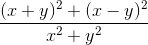
(b) 
Assume that
(a)
(b)
Tap to reveal answer
Simplify the expression in (a):
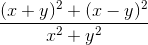



Therefore, whether (a) or (b) is greater depends on the values of  and
and  , neither of which are known.
Simplify the expression in (a):
Therefore, whether (a) or (b) is greater depends on the values of
← Didn't Know|Knew It →

Which is the greater quantity?
(a) 
(b) 
Which is the greater quantity?
(a)
(b)
Tap to reveal answer

Since  and
and  have different signs,
 , and, subsequently,

Therefore,

This makes (b) the greater quantity.
Since
Therefore,
This makes (b) the greater quantity.
← Didn't Know|Knew It →

Which is the greater quantity?
(a) 
(b) 
Which is the greater quantity?
(a)
(b)
Tap to reveal answer
We give at least one positive value of  for which (a) is greater and at least one positive value of
  for which (b) is greater.
Case 1: 
(a) 
(b) 
Case 2: 
(a) 
(b) 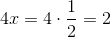
Therefore, either (a) or (b) can be greater.
We give at least one positive value of
Case 1:
(a)
(b)
Case 2:
(a)
(b)
Therefore, either (a) or (b) can be greater.
← Didn't Know|Knew It →
Assume all variables to be nonzero.
Simplify: 
Assume all variables to be nonzero.
Simplify:
Tap to reveal answer
Any nonzero expression raised to the power of 0 is equal to 1. Therefore,
 .
.
None of the given expressions are correct.
Any nonzero expression raised to the power of 0 is equal to 1. Therefore,
None of the given expressions are correct.
← Didn't Know|Knew It →
Simplify:
Simplify:
Tap to reveal answer
Group and combine like terms :
Group and combine like terms
← Didn't Know|Knew It →
Assume that and are not both zero. Which is the greater quantity?
(a)
(b)
Assume that
(a)
(b)
Tap to reveal answer
Simplify the expression in (a):
Therefore, whether (a) or (b) is greater depends on the values of and , neither of which are known.
Simplify the expression in (a):
Therefore, whether (a) or (b) is greater depends on the values of
← Didn't Know|Knew It →
Which is the greater quantity?
(a)
(b)
Which is the greater quantity?
(a)
(b)
Tap to reveal answer
Since and have different signs,
, and, subsequently,
Therefore,
This makes (b) the greater quantity.
Since
Therefore,
This makes (b) the greater quantity.
← Didn't Know|Knew It →
Which is the greater quantity?
(a)
(b)
Which is the greater quantity?
(a)
(b)
Tap to reveal answer
We give at least one positive value of for which (a) is greater and at least one positive value of for which (b) is greater.
Case 1:
(a)
(b)
Case 2:
(a)
(b)
Therefore, either (a) or (b) can be greater.
We give at least one positive value of
Case 1:
(a)
(b)
Case 2:
(a)
(b)
Therefore, either (a) or (b) can be greater.
← Didn't Know|Knew It →
Assume all variables to be nonzero.
Simplify:
Assume all variables to be nonzero.
Simplify:
Tap to reveal answer
Any nonzero expression raised to the power of 0 is equal to 1. Therefore,
.
None of the given expressions are correct.
Any nonzero expression raised to the power of 0 is equal to 1. Therefore,
None of the given expressions are correct.
← Didn't Know|Knew It →