
How to divide exponential variables - ISEE Upper Level: Quantitative Reasoning
Card 1 of 84
Half of one hundred divided by five and multiplied by one-tenth is .
Half of one hundred divided by five and multiplied by one-tenth is .
Tap to reveal answer
Let's take this step by step. "Half of one hundred" is 100/2 = 50. Then "half of one hundred divided by five" is 50/5 = 10. "Multiplied by one-tenth" really is the same as dividing by ten, so the last step gives us 10/10 = 1.
Let's take this step by step. "Half of one hundred" is 100/2 = 50. Then "half of one hundred divided by five" is 50/5 = 10. "Multiplied by one-tenth" really is the same as dividing by ten, so the last step gives us 10/10 = 1.
← Didn't Know|Knew It →
Simplify: 
Simplify:
Tap to reveal answer

← Didn't Know|Knew It →
Simplify:

Simplify:
Tap to reveal answer
Break the fraction up and apply the quotient of powers rule:

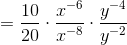
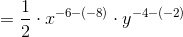
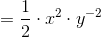


Break the fraction up and apply the quotient of powers rule:
← Didn't Know|Knew It →
Simplify: 
Simplify:
Tap to reveal answer
To simplify this expression, look at the like terms separately. First, simplify  . This becomes
  . Then, deal with the
  . Since the bases are the same and you're dividing, you can subtract exponents. This gives you
  Since the exponent is positive, you put in the numerator. This gives you a final answer of
  .
.
To simplify this expression, look at the like terms separately. First, simplify
← Didn't Know|Knew It →
 is a negative number.
Which is the greater quantity?
(a) The reciprocal of 
(b) The reciprocal of 
Which is the greater quantity?
(a) The reciprocal of
(b) The reciprocal of
Tap to reveal answer
A negative number raised to an odd power is negative; a negative number raised to an even power is positive. It follows that  is negative and
  is positive. Also, the reciprocal of a nonzero number assumes the same sign as the number itself, so the reciprocal of
  is positive and that of
  is negative. It follows that the reciprocal of
  is the greater of the two.
A negative number raised to an odd power is negative; a negative number raised to an even power is positive. It follows that
← Didn't Know|Knew It →
Simplify:
Simplify:
Tap to reveal answer
Break the fraction up and apply the quotient of powers rule:
Break the fraction up and apply the quotient of powers rule:
← Didn't Know|Knew It →
Simplify the following:

Simplify the following:
Tap to reveal answer
To divide a variable with an exponent, you can write out all the multiplies, which for this question would look like:

Then cancel out the matching p's, leaving:

Or, if the top and bottom are the same variable, you can simply subtract the bottom exponent from the top exponent.

To divide a variable with an exponent, you can write out all the multiplies, which for this question would look like:
Then cancel out the matching p's, leaving:
Or, if the top and bottom are the same variable, you can simply subtract the bottom exponent from the top exponent.
← Didn't Know|Knew It →
Simplify the following:

Simplify the following:
Tap to reveal answer
To divide variables with exponents, either:
Write out the multiplies, then reduce

or subtract the bottom exponent from the top, like so

Remember, negative exponent means dividing.  would also be correct, but you should know that is equivalent to
To divide variables with exponents, either:
Write out the multiplies, then reduce
or subtract the bottom exponent from the top, like so
Remember, negative exponent means dividing.
← Didn't Know|Knew It →
If  , simplify:

If
Tap to reveal answer


← Didn't Know|Knew It →
Simplify:

Simplify:
Tap to reveal answer

← Didn't Know|Knew It →
Simplify if  .
.

Simplify if
Tap to reveal answer
Start by factoring the numerator.  can be removed from each term.

Next, expand the denominator.

Simplify by canceling terms.

Start by factoring the numerator.
Next, expand the denominator.
Simplify by canceling terms.
← Didn't Know|Knew It →
Simplify:

Simplify:
Tap to reveal answer
In the denominator, apply the exponent to the terms in parentheses.

Terms with negative exponents can be inverted within the fraction to eliminate the negative.

Simplify by canceling variables and mulitplying.

In the denominator, apply the exponent to the terms in parentheses.
Terms with negative exponents can be inverted within the fraction to eliminate the negative.
Simplify by canceling variables and mulitplying.
← Didn't Know|Knew It →
Simplify:

Simplify:
Tap to reveal answer
Break up the fraction into components with like-terms.

Simplify by combining exponents. Remember that exponents in the denominator will become negative.


Finally, put any negative exponent terms into the denominator.

Break up the fraction into components with like-terms.
Simplify by combining exponents. Remember that exponents in the denominator will become negative.
Finally, put any negative exponent terms into the denominator.
← Didn't Know|Knew It →
Simplify:

Simplify:
Tap to reveal answer


← Didn't Know|Knew It →
Divide the following:

Divide the following:
Tap to reveal answer
To divide variables with exponents, we will use the following formula:

Now, let’s combine the following:


To divide variables with exponents, we will use the following formula:
Now, let’s combine the following:
← Didn't Know|Knew It →
Divide the following:

Divide the following:
Tap to reveal answer
When dividing variables, we can only divide like variable.
Also, when dividing variables with exponents, we subtract the exponents. In other words:

So, we get


When dividing variables, we can only divide like variable.
Also, when dividing variables with exponents, we subtract the exponents. In other words:
So, we get
← Didn't Know|Knew It →
Simplify:

Simplify:
Tap to reveal answer
To simplify, we will use the following formula:

So, given the problem, we get


To simplify, we will use the following formula:
So, given the problem, we get
← Didn't Know|Knew It →
Divide the following:

Divide the following:
Tap to reveal answer
To divide like terms with exponents, we will use the following formula:

So, we get


To divide like terms with exponents, we will use the following formula:
So, we get
← Didn't Know|Knew It →
Divide the following:

Divide the following:
Tap to reveal answer
To divide like variables with exponents, we will use the following formula:

So, we get


To divide like variables with exponents, we will use the following formula:
So, we get
← Didn't Know|Knew It →
Solve the following:

Solve the following:
Tap to reveal answer
To divide like variables with exponents, we will use the following formula:

Also, we divide the coefficients like normal.
So, we get


To divide like variables with exponents, we will use the following formula:
Also, we divide the coefficients like normal.
So, we get
← Didn't Know|Knew It →