
How to use a Venn Diagram - ISEE Upper Level: Quantitative Reasoning
Card 1 of 64
In a school of  students,
  students take Greek,
  take Old English, and
  take neither. How many take both?
In a school of
Tap to reveal answer
Based on the information given, you can construct the following Venn Diagram:

In order to find the overlap, you need to find out how many are in the circles together. This is easy. Subtract:  . Now, since the overlap represents a duplication, you need to subtract out one of those duplicate values. Let's call that
  ; therefore, we know that:

Solving for  , you get:


Based on the information given, you can construct the following Venn Diagram:
In order to find the overlap, you need to find out how many are in the circles together. This is easy. Subtract:
Solving for
← Didn't Know|Knew It →
In a group of  people,
  have a laptop and
  have a tablet. Of those people who have a laptop or a tablet,
  have both. How many people in the total group have neither a laptop nor a tablet?
In a group of
Tap to reveal answer
Based on the information given, you can draw the following Venn Diagram:

To solve this, remember that the total number of values in the two circles is:

(We must do this because of the overlap. You need to subtract out one instance of that overlap.)
If we assign the value  for the unknown region, we know:


Based on the information given, you can draw the following Venn Diagram:
To solve this, remember that the total number of values in the two circles is:
(We must do this because of the overlap. You need to subtract out one instance of that overlap.)
If we assign the value
← Didn't Know|Knew It →
In a group of plants,  are green,
  have large leaves, and
  are both green and have large leaves. How many plants are green without large leaves?
In a group of plants,
Tap to reveal answer
Based on the information, you can draw the following Venn Diagram:

It is very easy to solve for the number of plants that have green leaves but not large ones. This is merely  . We find this by eliminating the large-leaved plants from the green ones (by subtracting the overlap from the green ones).
Based on the information, you can draw the following Venn Diagram:
It is very easy to solve for the number of plants that have green leaves but not large ones. This is merely
← Didn't Know|Knew It →
In a group of  people,
  have books,
  have pens, and
  have neither books nor pens. How many people in the group have only books?
In a group of
Tap to reveal answer
Based on the information given, you can draw the following Venn Diagram:

Now, you must begin by solving for  . You know that the two circles together will have
  in them. This is arrived at by subtracting the people who have neither books nor pens (
 ) from the "universe" of people in the sample space (
 ). Now, we know that
  . This is because of the overlap of
  in both groups. We have to get rid of one instance of that. Thus we can solve for
  :
:


Now, we can find the number of people with only books by subtracting  from the
  to get
  .
.
Based on the information given, you can draw the following Venn Diagram:
Now, you must begin by solving for
Now, we can find the number of people with only books by subtracting
← Didn't Know|Knew It →
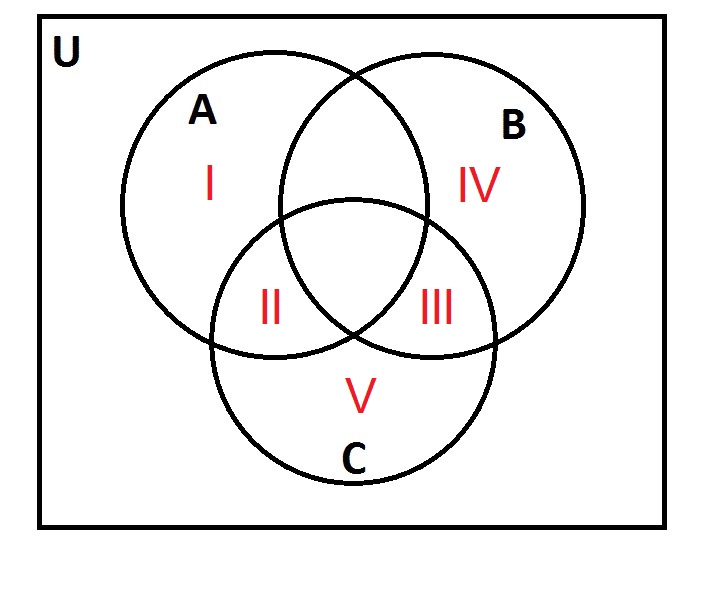
Examine the above Venn diagram. Let  be the universal set of the Presidents of the United States.
  is the set of all Presidents born in Virginia;
  is the set of all Presidents born after 1850;
  is the set of all Presidents whose first name was or is James.
James Abram Garfield was born in Ohio in 1831. In which region would he fall?
Examine the above Venn diagram. Let
James Abram Garfield was born in Ohio in 1831. In which region would he fall?
Tap to reveal answer
Carter would not fall in set A, since he was not a President born in Virginia.
He would not fall in B, since he was born before 1850.
He would fall in C, since his first name is James.
He would fall in the region included in set C, but not A or B - this is Region V.
Carter would not fall in set A, since he was not a President born in Virginia.
He would not fall in B, since he was born before 1850.
He would fall in C, since his first name is James.
He would fall in the region included in set C, but not A or B - this is Region V.
← Didn't Know|Knew It →
Examine the above Venn diagram. Let  be the universal set of the Presidents of the United States.
  is the set of all Presidents born in Virginia;
  is the set of all Presidents born after 1850;
  is the set of all Presidents whose first name was or is James.
James Earl Carter was born in Georgia in 1924. In which region would he fall?
Examine the above Venn diagram. Let
James Earl Carter was born in Georgia in 1924. In which region would he fall?
Tap to reveal answer
Carter would not fall in set A, since he was not a President born in Virginia.
He would fall in B, since he was born after 1850.
He would fall in C, since his first name is James.
He would fall in the region included in sets B and C, but not A - this is Region III.
Carter would not fall in set A, since he was not a President born in Virginia.
He would fall in B, since he was born after 1850.
He would fall in C, since his first name is James.
He would fall in the region included in sets B and C, but not A - this is Region III.
← Didn't Know|Knew It →

Examine the above Venn diagram. Let universal set  represent the set of all words in the English language.
Let  be the set of all words whose last letter is a vowel. Let
  be the set of all words whose first letter is a consonant. Let
  be the set of all words exactly six letters in length.
Which of the following would be a subset of the set represented by the shaded region in the diagram?
Note: for purposes of this question, "Y" is considered a consonant.
Examine the above Venn diagram. Let universal set
Let
Which of the following would be a subset of the set represented by the shaded region in the diagram?
Note: for purposes of this question, "Y" is considered a consonant.
Tap to reveal answer
The subset must comprise words that fall inside sets  and
and  , but not
  . Therefore, all of the words in the subset must begin with a consonant, end with a vowel, and not have six letters.
Of the given choices, the only set whose elements fit this description is {plateau, portmanteau, calliope, marionette, taco}.
The subset must comprise words that fall inside sets
Of the given choices, the only set whose elements fit this description is {plateau, portmanteau, calliope, marionette, taco}.
← Didn't Know|Knew It →

Examine the above Venn diagram. Let universal set  represent the set of all words in the English language.
Let  be the set of all words whose last letter is a consonant. Let
  be the set of all words whose first letter is a vowel. Let
  be the set of all words exactly five letters in length.
Which of the following would be a subset of the set represented by the shaded region in the diagram?
Note: for purposes of this question, "Y" is considered a consonant.
Examine the above Venn diagram. Let universal set
Let
Which of the following would be a subset of the set represented by the shaded region in the diagram?
Note: for purposes of this question, "Y" is considered a consonant.
Tap to reveal answer
The subset must comprise words that fall inside set  , but neither
 nor
nor  .
.
Therefore, all of the words in the subset must have exactly five letters, but cannot begin with a vowel or end with a consonant - that is, we are looking for a set of five-letter words that begin with a consonant and end with a vowel.
The only set among the five choices that matches this description is the set
{price, value, pinna, trove, three}.
The subset must comprise words that fall inside set
Therefore, all of the words in the subset must have exactly five letters, but cannot begin with a vowel or end with a consonant - that is, we are looking for a set of five-letter words that begin with a consonant and end with a vowel.
The only set among the five choices that matches this description is the set
{price, value, pinna, trove, three}.
← Didn't Know|Knew It →

Let the universal set  be the set of all positive integers. Define:


Examine the above Venn diagram. If each integer was to be placed in its correct region, which of the following would be placed in the gray area?
Let the universal set
Examine the above Venn diagram. If each integer was to be placed in its correct region, which of the following would be placed in the gray area?
Tap to reveal answer
The grayed portion of the Venn diagram corresponds to those integers which are not in any of  ,
,  , or
, or  . Therefore, we eliminate any choices that are in any of the three sets.
 is the set of integers which end in 1 or 6; we can eliminate 166 and 176 immediately.
 is the set of perfect square integers; we can eliminate 144, since
  .
.
 is the set of integers which, when divided by 4, yields remainder 2. Since
  , we can eliminate 154.
All four choices have been eliminated.
The grayed portion of the Venn diagram corresponds to those integers which are not in any of
All four choices have been eliminated.
← Didn't Know|Knew It →
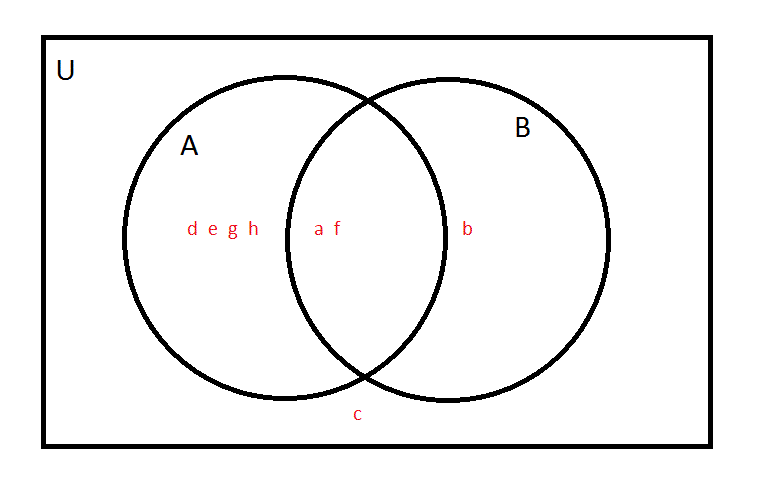
In the above Venn diagram, the universal set is defined as  . Each of the eight letters is placed in its correct region.
What is  ?
?
In the above Venn diagram, the universal set is defined as
What is
Tap to reveal answer
 is the union of sets
  and
and  - that is, the set of all elements of
  that are elements of either
  or
or  . We want all of the letters that fall in either circle, which from the diagram can be seen to be all of the letters except
  . Therefore,

← Didn't Know|Knew It →
The following Venn diagram depicts the number of students who play hockey, football, and baseball. How many students play football and baseball?
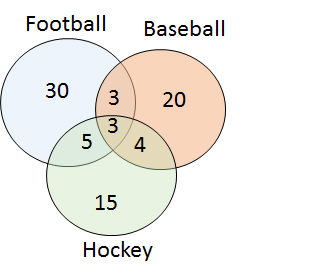
The following Venn diagram depicts the number of students who play hockey, football, and baseball. How many students play football and baseball?
Tap to reveal answer
The number of students who play football or baseball can by finding the summer of the number of students who play football alone, baseball alone, baseball and football, and all three sports.

The number of students who play football or baseball can by finding the summer of the number of students who play football alone, baseball alone, baseball and football, and all three sports.
← Didn't Know|Knew It →
A class of  students was asked whether they have cats, dogs, or both.The results are depicted in the following Venn diagram. How many students do not have a dog?
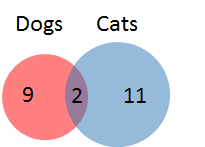
A class of
Tap to reveal answer
First, calculate the number of students with a dog:

Next, subtract the number of students with a dog from the total number of students.

First, calculate the number of students with a dog:
Next, subtract the number of students with a dog from the total number of students.
← Didn't Know|Knew It →
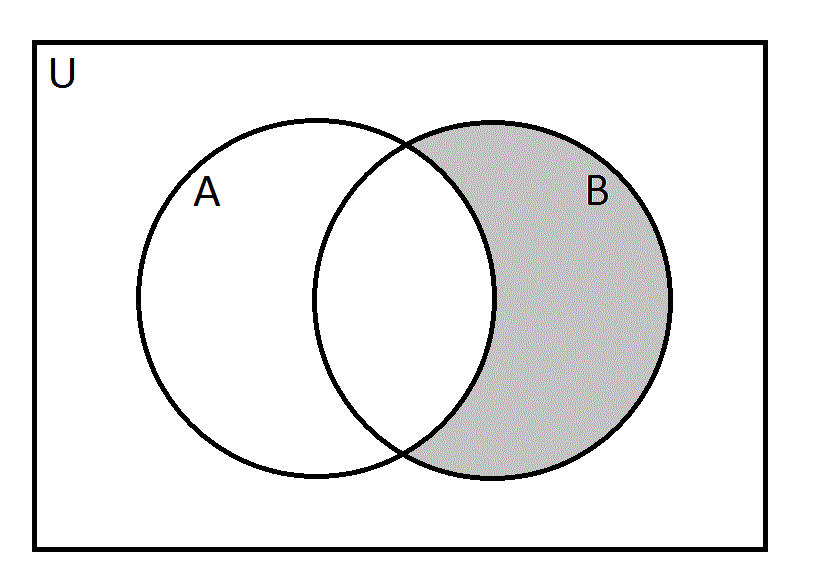
Refer to the above Venn diagram.
Define universal set  , the set of natural numbers.
Define sets  and
and  as follows:


Which of the following numbers is an element of the set represented by the gray area in the diagram?
Refer to the above Venn diagram.
Define universal set
Define sets
Which of the following numbers is an element of the set represented by the gray area in the diagram?
Tap to reveal answer
The gray area represents the set of all elements that are in  but not in
  .
.
 is the set of integers that, when divided by 3, yield remainder 2. Therefore, we can eliminate 102 and 105, both multiples of 3, and 103, which, when divided by 3, yields remainder 1.
 is the set of integers that, when divided by 4, yield remainder 1. Since we do not want an element from this set, we can eliminate 101, but not 104.
104 is the correct choice.
The gray area represents the set of all elements that are in
104 is the correct choice.
← Didn't Know|Knew It →
In the above Venn diagram, the universal set is defined as  . Each of the eight letters is placed in its correct region.
What is  ?
?
In the above Venn diagram, the universal set is defined as
What is
Tap to reveal answer
 is the intersection of sets
  and
and  - that is, the set of all elements of
  that are elements of both
  and
and  . We want all of the letters that fall in both circles, which from the diagram can be seen to be
  and
and  . Therefore,

← Didn't Know|Knew It →
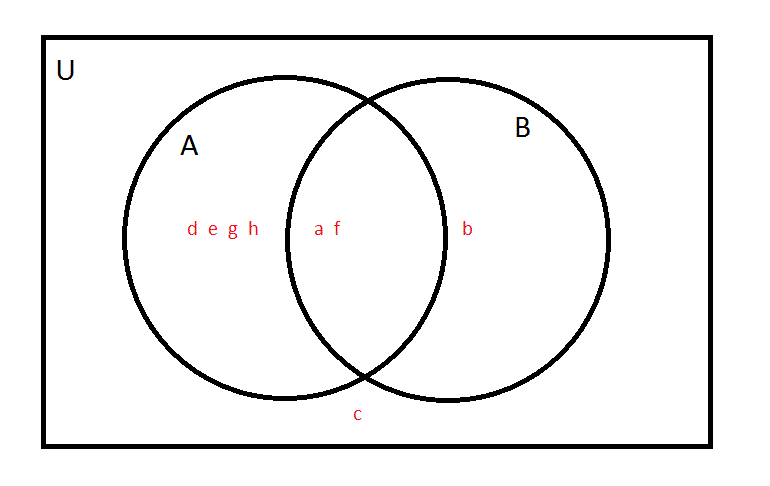
In the above Venn diagram, the universal set is defined as  . Each of the eight letters is placed in its correct region. Which of the following is equal to
  ?
?
In the above Venn diagram, the universal set is defined as
Tap to reveal answer
 is the complement of
  - the set of all elements in
  not in
  .
.
 is the intersection of sets
  and
and  - that is, the set of all elements of
  that are elements of both
  and
and  . Therefore,
  is the set of all elements that are not in both
  and
and  , which can be seen from the diagram to be all elements except
  and
and  . Therefore,
 .
.
← Didn't Know|Knew It →
In the above Venn diagram, the universal set is defined as  . Each of the eight letters is placed in its correct region. Which of the following is equal to
  ?
?
In the above Venn diagram, the universal set is defined as
Tap to reveal answer
 is the complement of
  - the set of all elements in
  not in
  .
.
 is the union of sets
  and
and  - the set of all elements in either
  or
or  . Therefore,
  is the set of all elements in neither
  nor
nor  , which can be seen from the diagram to be only one element -
  . Therefore,

← Didn't Know|Knew It →
The following Venn diagram depicts the number of students who play hockey, football, and baseball. How many students play football and baseball?
The following Venn diagram depicts the number of students who play hockey, football, and baseball. How many students play football and baseball?
Tap to reveal answer
The number of students who play football or baseball can by finding the summer of the number of students who play football alone, baseball alone, baseball and football, and all three sports.
The number of students who play football or baseball can by finding the summer of the number of students who play football alone, baseball alone, baseball and football, and all three sports.
← Didn't Know|Knew It →
A class of students was asked whether they have cats, dogs, or both.The results are depicted in the following Venn diagram. How many students do not have a dog?
A class of
Tap to reveal answer
First, calculate the number of students with a dog:
Next, subtract the number of students with a dog from the total number of students.
First, calculate the number of students with a dog:
Next, subtract the number of students with a dog from the total number of students.
← Didn't Know|Knew It →
Refer to the above Venn diagram.
Define universal set , the set of natural numbers.
Define sets and as follows:
Which of the following numbers is an element of the set represented by the gray area in the diagram?
Refer to the above Venn diagram.
Define universal set
Define sets
Which of the following numbers is an element of the set represented by the gray area in the diagram?
Tap to reveal answer
The gray area represents the set of all elements that are in but not in .
is the set of integers that, when divided by 3, yield remainder 2. Therefore, we can eliminate 102 and 105, both multiples of 3, and 103, which, when divided by 3, yields remainder 1.
is the set of integers that, when divided by 4, yield remainder 1. Since we do not want an element from this set, we can eliminate 101, but not 104.
104 is the correct choice.
The gray area represents the set of all elements that are in
104 is the correct choice.
← Didn't Know|Knew It →
In the above Venn diagram, the universal set is defined as . Each of the eight letters is placed in its correct region.
What is ?
In the above Venn diagram, the universal set is defined as
What is
Tap to reveal answer
is the intersection of sets and - that is, the set of all elements of that are elements of both and . We want all of the letters that fall in both circles, which from the diagram can be seen to be and . Therefore,
← Didn't Know|Knew It →