
Parallelograms - ISEE Upper Level: Quantitative Reasoning
Card 1 of 48
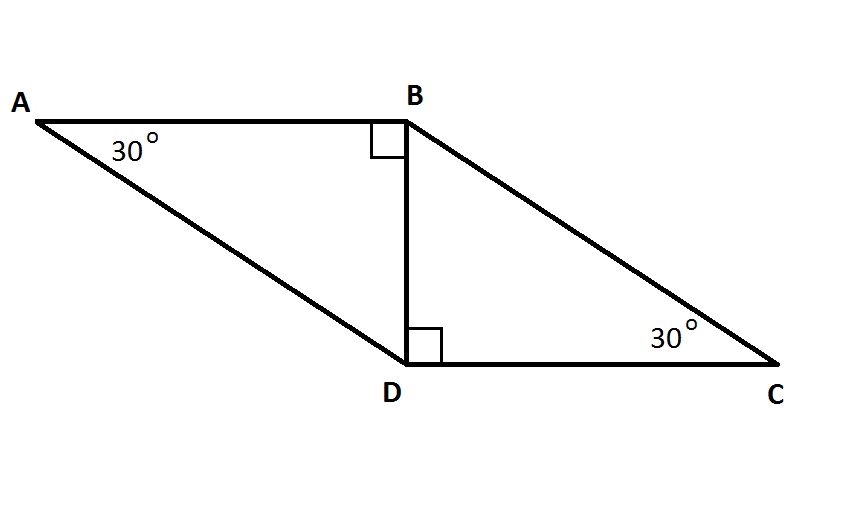
Give the area of the above parallelogram if  .
.
Give the area of the above parallelogram if
Tap to reveal answer
Multiply height  by base
  to get the area.
By the 30-60-90 Theorem:
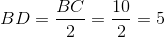
and

The area is therefore

Multiply height
By the 30-60-90 Theorem:
and
The area is therefore
← Didn't Know|Knew It →
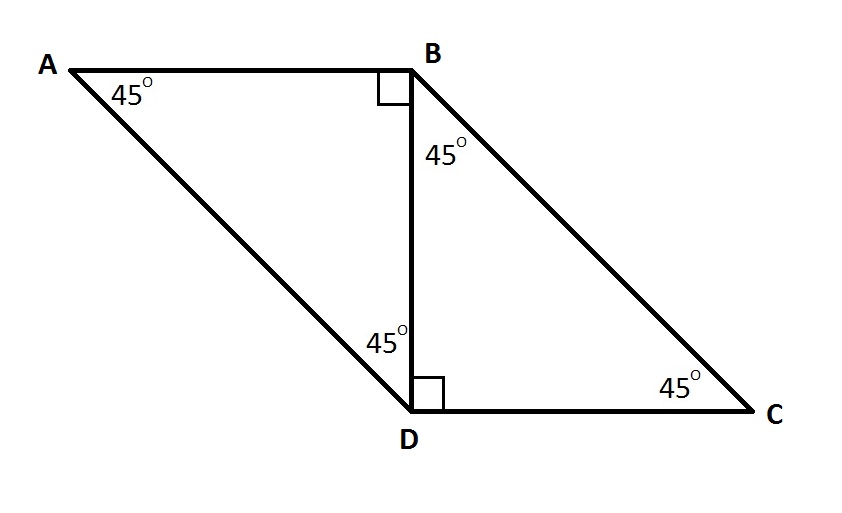
Give the area of the above parallelogram if  .
.
Give the area of the above parallelogram if
Tap to reveal answer
Multiply height  by base
  to get the area.
By the 45-45-90 Theorem,
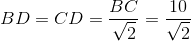 .
.
The area is therefore

Multiply height
By the 45-45-90 Theorem,
The area is therefore
← Didn't Know|Knew It →
Three of the vertices of a parallelogram on the coordinate plane are  . What is the area of the parallelogram?
Three of the vertices of a parallelogram on the coordinate plane are
Tap to reveal answer
As can be seen in the diagram, there are three possible locations of the fourth point of the parallelogram:
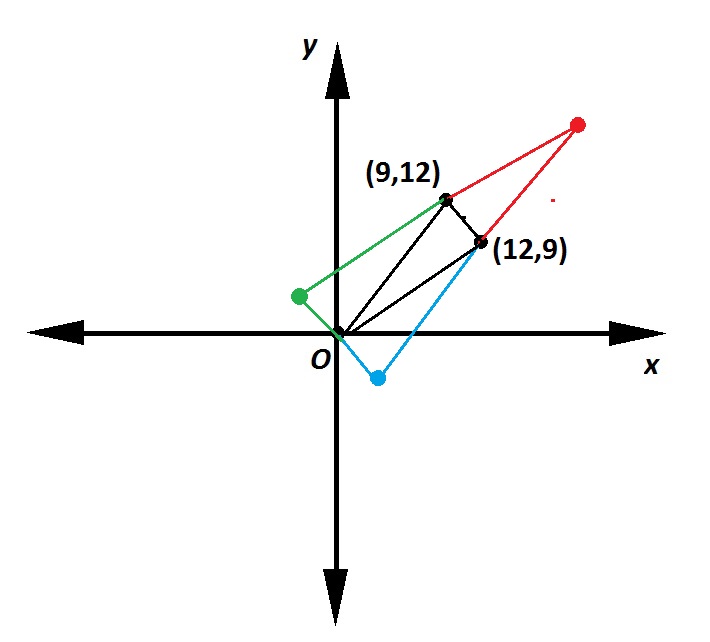
Regardless of the location of the fourth point, however, the triangle with the given three vertices comprises exactly half the parallelogram. Therefore, the parallelogram has double that of the triangle.
The area of the triangle can be computed by noting that the triangle is actually a part of a 12-by-12 square with three additional right triangles cut out:
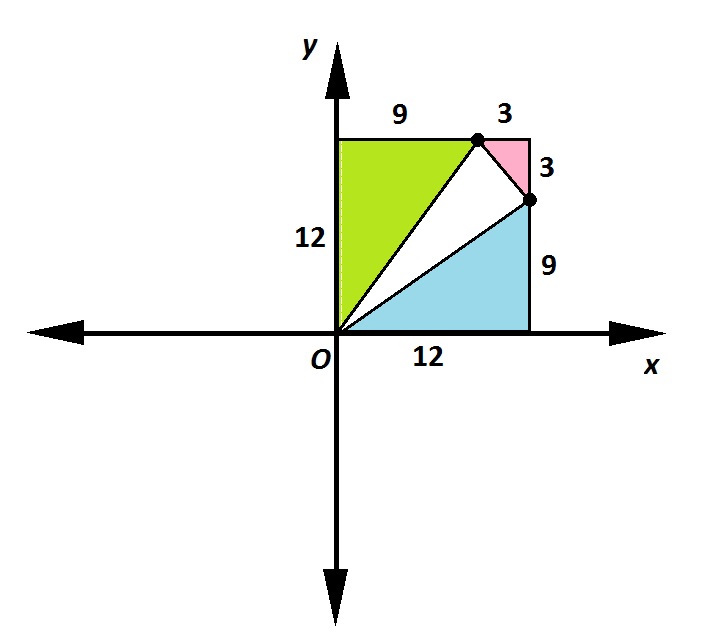
The area of the 12 by 12 square is 
The area of the green triangle is 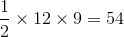 .
.
The area of the blue triangle is 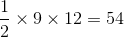 .
.
The area of the pink triangle is 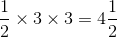 .
.
The area of the main triangle is therefore

The parallelogram has area twice this, or 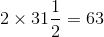 .
.
As can be seen in the diagram, there are three possible locations of the fourth point of the parallelogram:
Regardless of the location of the fourth point, however, the triangle with the given three vertices comprises exactly half the parallelogram. Therefore, the parallelogram has double that of the triangle.
The area of the triangle can be computed by noting that the triangle is actually a part of a 12-by-12 square with three additional right triangles cut out:
The area of the 12 by 12 square is
The area of the green triangle is
The area of the blue triangle is
The area of the pink triangle is
The area of the main triangle is therefore
The parallelogram has area twice this, or
← Didn't Know|Knew It →
One of the sides of a square on the coordinate plane has an endpoint at the point with coordinates  ; it has the origin as its other endpoint. What is the area of this square?
One of the sides of a square on the coordinate plane has an endpoint at the point with coordinates
Tap to reveal answer
The length of a segment with endpoints  and
and  can be found using the distance formula with
  ,
,  ,
,  :
:




This is the length of one side of the square, so the area is the square of this, or 41.
The length of a segment with endpoints
This is the length of one side of the square, so the area is the square of this, or 41.
← Didn't Know|Knew It →
Solve for  :
:
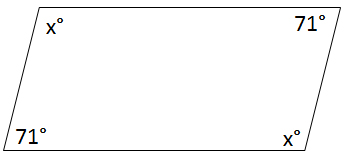
Solve for
Tap to reveal answer
Find the sum of the interior angles of the polygon using the following equation where n is equal to the number of sides.


The sum of the angles must equal 360.




Find the sum of the interior angles of the polygon using the following equation where n is equal to the number of sides.
The sum of the angles must equal 360.
← Didn't Know|Knew It →
The area of the Parallelogram  is
is  . Give its perimeter in terms of
  .
.
The area of the Parallelogram
Tap to reveal answer
The height of the parallelogram is  , and the base is
  . By the 45-45-90 Theorem,
  . Since the product of the height and the base of a parallelogram is its area,



Also by the 45-45-90 Theorem,
 , and
, and

The perimeter of the parallelogram is

The height of the parallelogram is
Also by the 45-45-90 Theorem,
The perimeter of the parallelogram is
← Didn't Know|Knew It →
Calculate the perimeter of the above parallelogram if  .
.
Calculate the perimeter of the above parallelogram if
Tap to reveal answer
By the 45-45-90 Theorem,


The perimeter of the parallelogram is

By the 45-45-90 Theorem,
The perimeter of the parallelogram is
← Didn't Know|Knew It →
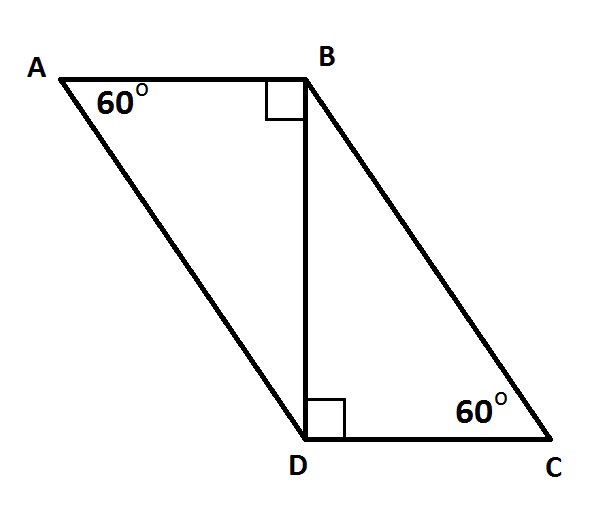
Calculate the perimeter of the above parallelogram if  .
.
Calculate the perimeter of the above parallelogram if
Tap to reveal answer
By the 30-60-90 Theorem:
 , and
, and

The perimeter of the parallelogram is

By the 30-60-90 Theorem:
The perimeter of the parallelogram is
← Didn't Know|Knew It →
Find the perimeter of a parallelogram with a base of 6in and a side of length 8in.
Find the perimeter of a parallelogram with a base of 6in and a side of length 8in.
Tap to reveal answer
A parallelogram has 4 sides. A base (where the opposite side is equal) and a side (where the opposite side is equal). So, we will use the following formula:

where b is the base and s is the side of the parallelogram.
We know the base has a length of 6in. We also know the side has a length of 8in.
Knowing this, we can substitute into the formula. We get


A parallelogram has 4 sides. A base (where the opposite side is equal) and a side (where the opposite side is equal). So, we will use the following formula:
where b is the base and s is the side of the parallelogram.
We know the base has a length of 6in. We also know the side has a length of 8in.
Knowing this, we can substitute into the formula. We get
← Didn't Know|Knew It →
The area of the Parallelogram is . Give its perimeter in terms of .
The area of the Parallelogram
Tap to reveal answer
The height of the parallelogram is , and the base is . By the 45-45-90 Theorem, . Since the product of the height and the base of a parallelogram is its area,
Also by the 45-45-90 Theorem,
, and
The perimeter of the parallelogram is
The height of the parallelogram is
Also by the 45-45-90 Theorem,
The perimeter of the parallelogram is
← Didn't Know|Knew It →
Calculate the perimeter of the above parallelogram if .
Calculate the perimeter of the above parallelogram if
Tap to reveal answer
By the 45-45-90 Theorem,
The perimeter of the parallelogram is
By the 45-45-90 Theorem,
The perimeter of the parallelogram is
← Didn't Know|Knew It →
Calculate the perimeter of the above parallelogram if .
Calculate the perimeter of the above parallelogram if
Tap to reveal answer
By the 30-60-90 Theorem:
, and
The perimeter of the parallelogram is
By the 30-60-90 Theorem:
The perimeter of the parallelogram is
← Didn't Know|Knew It →
Find the perimeter of a parallelogram with a base of 6in and a side of length 8in.
Find the perimeter of a parallelogram with a base of 6in and a side of length 8in.
Tap to reveal answer
A parallelogram has 4 sides. A base (where the opposite side is equal) and a side (where the opposite side is equal). So, we will use the following formula:
where b is the base and s is the side of the parallelogram.
We know the base has a length of 6in. We also know the side has a length of 8in.
Knowing this, we can substitute into the formula. We get
A parallelogram has 4 sides. A base (where the opposite side is equal) and a side (where the opposite side is equal). So, we will use the following formula:
where b is the base and s is the side of the parallelogram.
We know the base has a length of 6in. We also know the side has a length of 8in.
Knowing this, we can substitute into the formula. We get
← Didn't Know|Knew It →
Solve for :
Solve for
Tap to reveal answer
Find the sum of the interior angles of the polygon using the following equation where n is equal to the number of sides.
The sum of the angles must equal 360.
Find the sum of the interior angles of the polygon using the following equation where n is equal to the number of sides.
The sum of the angles must equal 360.
← Didn't Know|Knew It →
Solve for :
Solve for
Tap to reveal answer
Find the sum of the interior angles of the polygon using the following equation where n is equal to the number of sides.
The sum of the angles must equal 360.
Find the sum of the interior angles of the polygon using the following equation where n is equal to the number of sides.
The sum of the angles must equal 360.
← Didn't Know|Knew It →
Give the area of the above parallelogram if .
Give the area of the above parallelogram if
Tap to reveal answer
Multiply height by base to get the area.
By the 30-60-90 Theorem:
and
The area is therefore
Multiply height
By the 30-60-90 Theorem:
and
The area is therefore
← Didn't Know|Knew It →
Give the area of the above parallelogram if .
Give the area of the above parallelogram if
Tap to reveal answer
Multiply height by base to get the area.
By the 45-45-90 Theorem,
.
The area is therefore
Multiply height
By the 45-45-90 Theorem,
The area is therefore
← Didn't Know|Knew It →
Three of the vertices of a parallelogram on the coordinate plane are . What is the area of the parallelogram?
Three of the vertices of a parallelogram on the coordinate plane are
Tap to reveal answer
As can be seen in the diagram, there are three possible locations of the fourth point of the parallelogram:
Regardless of the location of the fourth point, however, the triangle with the given three vertices comprises exactly half the parallelogram. Therefore, the parallelogram has double that of the triangle.
The area of the triangle can be computed by noting that the triangle is actually a part of a 12-by-12 square with three additional right triangles cut out:
The area of the 12 by 12 square is
The area of the green triangle is .
The area of the blue triangle is .
The area of the pink triangle is .
The area of the main triangle is therefore
The parallelogram has area twice this, or .
As can be seen in the diagram, there are three possible locations of the fourth point of the parallelogram:
Regardless of the location of the fourth point, however, the triangle with the given three vertices comprises exactly half the parallelogram. Therefore, the parallelogram has double that of the triangle.
The area of the triangle can be computed by noting that the triangle is actually a part of a 12-by-12 square with three additional right triangles cut out:
The area of the 12 by 12 square is
The area of the green triangle is
The area of the blue triangle is
The area of the pink triangle is
The area of the main triangle is therefore
The parallelogram has area twice this, or
← Didn't Know|Knew It →
One of the sides of a square on the coordinate plane has an endpoint at the point with coordinates ; it has the origin as its other endpoint. What is the area of this square?
One of the sides of a square on the coordinate plane has an endpoint at the point with coordinates
Tap to reveal answer
The length of a segment with endpoints and can be found using the distance formula with , , :
This is the length of one side of the square, so the area is the square of this, or 41.
The length of a segment with endpoints
This is the length of one side of the square, so the area is the square of this, or 41.
← Didn't Know|Knew It →
Give the area of the above parallelogram if .
Give the area of the above parallelogram if
Tap to reveal answer
Multiply height by base to get the area.
By the 30-60-90 Theorem:
and
The area is therefore
Multiply height
By the 30-60-90 Theorem:
and
The area is therefore
← Didn't Know|Knew It →