
Squares - ISEE Upper Level: Quantitative Reasoning
Card 1 of 224
Which is the greater quantity?
(a) The length of a diagonal of a square with sidelength 10 inches
(b) The hypotenuse of an isosceles right triangle with legs 10 inches each
Which is the greater quantity?
(a) The length of a diagonal of a square with sidelength 10 inches
(b) The hypotenuse of an isosceles right triangle with legs 10 inches each
Tap to reveal answer
A diagonal of a square cuts the square into two isosceles right triangles, of which the diagonal is the common hypotenuse. Therefore, each figure is the hypotenuse of an isosceles right triangle with legs 10 inches, making them equal in length.
A diagonal of a square cuts the square into two isosceles right triangles, of which the diagonal is the common hypotenuse. Therefore, each figure is the hypotenuse of an isosceles right triangle with legs 10 inches, making them equal in length.
← Didn't Know|Knew It →
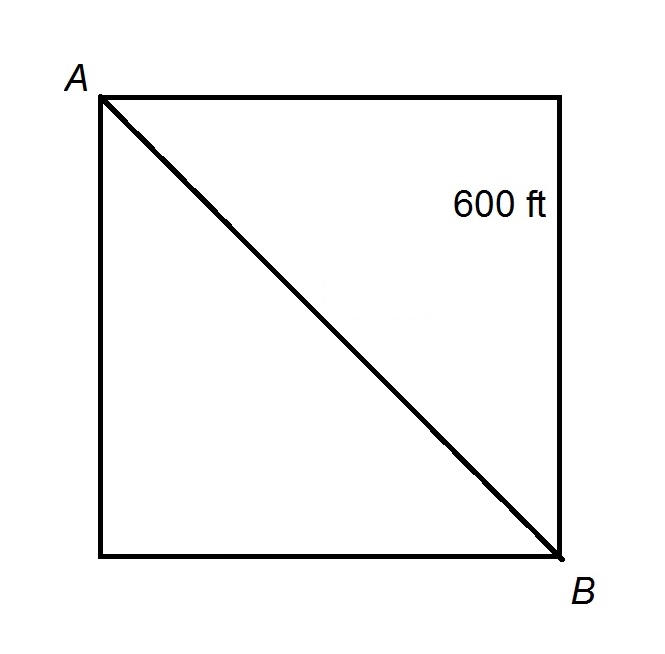
The track at Peter Stuyvesant High School is a perfect square, as seen above, with sides of length 600 feet and a diagonal connecting two of the corners.
Les begins at Point A, takes the diagonal path directly to Point B, then runs counterclockwise around the square track twice. He then takes the diagonal from Point B back to Point A. Which of the following is closest to the distance he runs?
A hint: 
The track at Peter Stuyvesant High School is a perfect square, as seen above, with sides of length 600 feet and a diagonal connecting two of the corners.
Les begins at Point A, takes the diagonal path directly to Point B, then runs counterclockwise around the square track twice. He then takes the diagonal from Point B back to Point A. Which of the following is closest to the distance he runs?
A hint:
Tap to reveal answer
The diagonal of a square has length  , or about 1.414, times the length of a side, which here is 600 feet; this makes the diagonal path about
 feet long.
Les runs around the square track twice, meaning that he runs the length of one side eight times; he also runs the length of the diagonal twice, This is a total of about
 feet.
feet.
Divide by 5,280 to convert to miles:

Of the given responses,  miles comes closest to the correct distance.
The diagonal of a square has length
Les runs around the square track twice, meaning that he runs the length of one side eight times; he also runs the length of the diagonal twice, This is a total of about
Divide by 5,280 to convert to miles:
Of the given responses,
← Didn't Know|Knew It →
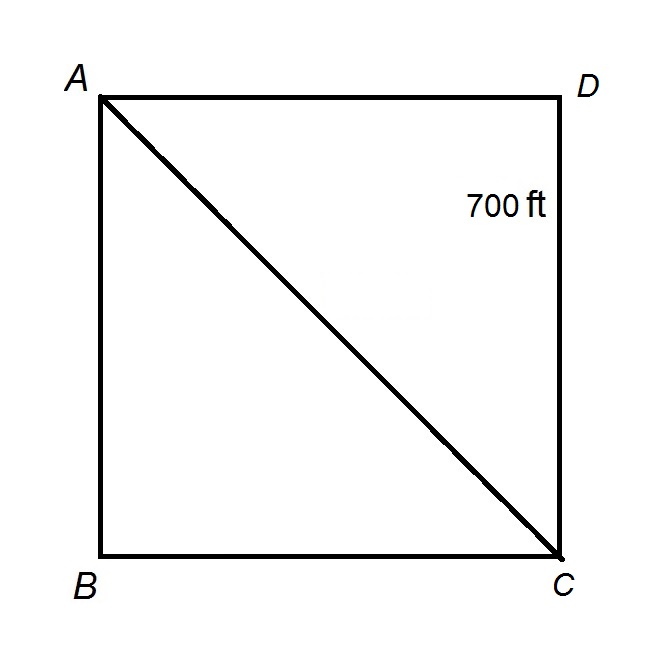
The track at Franklin Pierce High School is a perfect square, as seen above, with sides of length 700 feet and a diagonal path connecting Points A and C.
Ellen wants to run three miles. Her plan is to begin at Point A, run along the diagonal path, run clockwise around the square track once, run along the diagonal path, run clockwise around the square track once, then repeat this pattern until she has run three miles. Where will she be when she is done?
A hint: 
The track at Franklin Pierce High School is a perfect square, as seen above, with sides of length 700 feet and a diagonal path connecting Points A and C.
Ellen wants to run three miles. Her plan is to begin at Point A, run along the diagonal path, run clockwise around the square track once, run along the diagonal path, run clockwise around the square track once, then repeat this pattern until she has run three miles. Where will she be when she is done?
A hint:
Tap to reveal answer
The diagonal of a square has length  , or about 1.414, times the length of a side, which here is 700 feet; this makes the diagonal path about
 feet long.
We will call one complete circuit one running of the diagonal, which is 990 feet long, and one running around the square; the completion of one complete circuit amounts to running a distance of
 feet.
feet.
Ellen seeks to run three miles, or
 feet, which, divided by 3,790 feet, is about:
 ,
,
or four complete circuits and 0.17 of a fifth.
After four complete circuits, Ellen is backat Point A. She has yet to run
 feet.
feet.
She will now run along the diagonal from Point A to Point C, but since the diagonal has length 990 feet, which is greater than 629 feet, she will finish running three miles when she is on this diagonal path.
The diagonal of a square has length
We will call one complete circuit one running of the diagonal, which is 990 feet long, and one running around the square; the completion of one complete circuit amounts to running a distance of
Ellen seeks to run three miles, or
or four complete circuits and 0.17 of a fifth.
After four complete circuits, Ellen is backat Point A. She has yet to run
She will now run along the diagonal from Point A to Point C, but since the diagonal has length 990 feet, which is greater than 629 feet, she will finish running three miles when she is on this diagonal path.
← Didn't Know|Knew It →
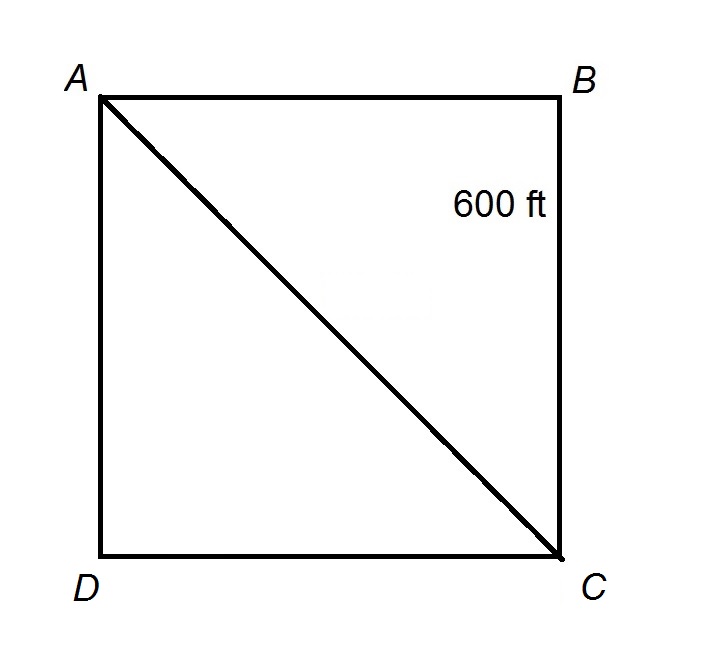
The track at Grant High School is a perfect square, as seen above, with sides of length 600 feet and a diagonal path connecting two of the corners.
Kenny begins at Point A, runs the path to Point C, and proceeds to run counterclockwise around the square track one complete time. He then runs again along the diagonal path from Point C to Point A.
Which is the greater quantity?
(a) The length of Kenny's run
(b) One mile
A hint: 
The track at Grant High School is a perfect square, as seen above, with sides of length 600 feet and a diagonal path connecting two of the corners.
Kenny begins at Point A, runs the path to Point C, and proceeds to run counterclockwise around the square track one complete time. He then runs again along the diagonal path from Point C to Point A.
Which is the greater quantity?
(a) The length of Kenny's run
(b) One mile
A hint:
Tap to reveal answer
The diagonal of a square has length , or about 1.414, times the length of a side, which here is 600 feet; this makes the diagonal path about
feet long.
Kenny runs along this path twice, and he runs along the entire perimeter of the square path, so his run is about
 feet. Since one mile is equal to 5,280 feet, the greater quantity is (b).
The diagonal of a square has length
Kenny runs along this path twice, and he runs along the entire perimeter of the square path, so his run is about
← Didn't Know|Knew It →
What is the diagonal of a square with a side of 4?
What is the diagonal of a square with a side of 4?
Tap to reveal answer
Squares have all congruent sides. To find the diagonal, first recognize that you're dealing with an isoceles triangle when you draw the diagonal in the square. That means that two of the sides are congruent in the triangle. Thus, it's a special 45-45-90 triangle. In such triangles, the sides are x and the hypotenuse is  . Since we know x is 4, we can plug in 4 to the expression
  . Thus, the answer is
  .
.
Squares have all congruent sides. To find the diagonal, first recognize that you're dealing with an isoceles triangle when you draw the diagonal in the square. That means that two of the sides are congruent in the triangle. Thus, it's a special 45-45-90 triangle. In such triangles, the sides are x and the hypotenuse is
← Didn't Know|Knew It →
You recently bought some special filter paper for a laboratory apparatus. The paper comes in square sheets, but you want to cut it into two equal triangle-shaped pieces. If the square sheets have a side length of  , what will the length of the hypotenuse of the triangles be?
You recently bought some special filter paper for a laboratory apparatus. The paper comes in square sheets, but you want to cut it into two equal triangle-shaped pieces. If the square sheets have a side length of
Tap to reveal answer
You recently bought some special filter paper for a laboratory apparatus. The paper comes in square sheets, but you want to cut it into two equal triangle-shaped pieces. If the square sheets have a side length of  , what will the length of the hypotenuse of the triangles be?
This problem is trying to distract you by thinking of triangles. What we are really asked to find here is the length of the diagonal of a square with sides of 15 inches.
Splitting a square along its diagonal yields two 45/45/90 triangles. If you know the ratios for 45/45/90 triangles, you can find the answer very quickly.
Think:

Meaning that if the two short sides are x units long, the hypotenuse will be x times the square root of two units long.
In our current case, our short sides are 15 inches long, so our hypotenuse will be

You could also solve this with Pythagorean Theorem.

a and b are both 15 in, so we can solve.


So,our answer is

You recently bought some special filter paper for a laboratory apparatus. The paper comes in square sheets, but you want to cut it into two equal triangle-shaped pieces. If the square sheets have a side length of
This problem is trying to distract you by thinking of triangles. What we are really asked to find here is the length of the diagonal of a square with sides of 15 inches.
Splitting a square along its diagonal yields two 45/45/90 triangles. If you know the ratios for 45/45/90 triangles, you can find the answer very quickly.
Think:
Meaning that if the two short sides are x units long, the hypotenuse will be x times the square root of two units long.
In our current case, our short sides are 15 inches long, so our hypotenuse will be
You could also solve this with Pythagorean Theorem.
a and b are both 15 in, so we can solve.
So,our answer is
← Didn't Know|Knew It →
While out walking, you find a strange, square-shaped piece of metal. If the side length of the piece is 26 inches, what is the length of the diagonal?
While out walking, you find a strange, square-shaped piece of metal. If the side length of the piece is 26 inches, what is the length of the diagonal?
Tap to reveal answer
While out walking, you find a strange, square-shaped piece of metal. If the side length of the piece is 26 inches, what is the length of the diagonal?
To find the diagonal of a square, we can recognize one of two things.
-
The diagonal of a square creates a right triangle, and we can use Pythagorean theorem to find our diagonal.
-
The diagonal of a square creates two 45/45/90 triangles, with side length ratios of 
Using 2), we can find that the diagonal of the square must be 
While out walking, you find a strange, square-shaped piece of metal. If the side length of the piece is 26 inches, what is the length of the diagonal?
To find the diagonal of a square, we can recognize one of two things.
-
The diagonal of a square creates a right triangle, and we can use Pythagorean theorem to find our diagonal.
-
The diagonal of a square creates two 45/45/90 triangles, with side length ratios of
Using 2), we can find that the diagonal of the square must be
← Didn't Know|Knew It →
Your new friend has a very small, square-shaped dorm room. She tells you that it is only 225 square feet. Assuming this is true, what is the diagonal distance from one corner of her room to the other?
Your new friend has a very small, square-shaped dorm room. She tells you that it is only 225 square feet. Assuming this is true, what is the diagonal distance from one corner of her room to the other?
Tap to reveal answer
Your new friend has a very small, square-shaped dorm room. She tells you that it is only 225 square feet. Assuming this is true, what is the diagonal distance from one corner of her room to the other?
So, we need to find the diagonal of a square. First, we need to find the side length.
Let's begin with our formula for the area of a square:

where s is our side length and A is our area.
With this formula, we can solve for our side length by plugging in our area and square rooting both sides.


Now, to find the diagonal, we can think of an isosceles right triangle, where the two equal sides are 15 ft. This is also a 45/45/90 triangle, which means the side lengths follow the ratio of  .
.
This means our answer is  .
.
We could also find this by using Pythagorean Theorem.



Your new friend has a very small, square-shaped dorm room. She tells you that it is only 225 square feet. Assuming this is true, what is the diagonal distance from one corner of her room to the other?
So, we need to find the diagonal of a square. First, we need to find the side length.
Let's begin with our formula for the area of a square:
where s is our side length and A is our area.
With this formula, we can solve for our side length by plugging in our area and square rooting both sides.
Now, to find the diagonal, we can think of an isosceles right triangle, where the two equal sides are 15 ft. This is also a 45/45/90 triangle, which means the side lengths follow the ratio of
This means our answer is
We could also find this by using Pythagorean Theorem.
← Didn't Know|Knew It →
The perimeter of a square is one yard. Which is the greater quantity?
(a) The area of the square
(b)  square foot
The perimeter of a square is one yard. Which is the greater quantity?
(a) The area of the square
(b)
Tap to reveal answer
One yard is equal to three feet, so the length of one side of a square with this perimeter is  feet. The area of the square is
  square feet.
  , making (a) greater.
One yard is equal to three feet, so the length of one side of a square with this perimeter is
← Didn't Know|Knew It →
Square 1 is inscribed inside a circle. The circle is inscribed inside Square 2.
Which is the greater quantity?
(a) Twice the area of Square 1
(b) The area of Square 2
Square 1 is inscribed inside a circle. The circle is inscribed inside Square 2.
Which is the greater quantity?
(a) Twice the area of Square 1
(b) The area of Square 2
Tap to reveal answer
Let  be the sidelength of Square 1. Then the length of a diagonal of this square - which is
  times this sidelength, or
  , by the
  Theorem - is the same as the diameter of this circle, which, in turn, is equal to the sidelength of Square 2.
Therefore, Square 1 has area  , and Square 2 has area
 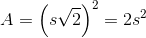 , twice that of Square 1.
Let
Therefore, Square 1 has area
← Didn't Know|Knew It →
Which is the greater quantity?
(A) The area of a square with sidelength one foot
(B) The area of a rectangle with length nine inches and height fourteen inches
Which is the greater quantity?
(A) The area of a square with sidelength one foot
(B) The area of a rectangle with length nine inches and height fourteen inches
Tap to reveal answer
The area of a square is the square of its sidelength, which here is 12 inches:
 square inches.
The area of a rectangle is its length multiplied by its height, which, respectively, are 9 inches and 14 inches:
 square inches.
The square has the greater area.
The area of a square is the square of its sidelength, which here is 12 inches:
The area of a rectangle is its length multiplied by its height, which, respectively, are 9 inches and 14 inches:
The square has the greater area.
← Didn't Know|Knew It →
A square lawn has sidelength twenty yards. Give its area in square feet.
A square lawn has sidelength twenty yards. Give its area in square feet.
Tap to reveal answer
20 yards converts to  feet. The area of a square is the square of its sidelength, so the area in square feet is
  square feet.
20 yards converts to
← Didn't Know|Knew It →
Four squares have sidelengths one meter, 120 centimeters, 140 centimeters, and 140 centimeters. Which is the greater quantity?
(A) The mean of their areas
(B) The median of their areas
Four squares have sidelengths one meter, 120 centimeters, 140 centimeters, and 140 centimeters. Which is the greater quantity?
(A) The mean of their areas
(B) The median of their areas
Tap to reveal answer
The areas of the squares are:
 square centimeters (one meter being 100 centimeters)
 square centimeters
 square centimeters
 square centimeters
The mean of these four areas is their sum divided by four:

 square centimeters.
The median is the mean of the two middle values, or
 square centimeters.
The median, (B), is greater.
The areas of the squares are:
The mean of these four areas is their sum divided by four:
The median is the mean of the two middle values, or
The median, (B), is greater.
← Didn't Know|Knew It →
Rectangle A and Square B both have perimeter 2 meters. Rectangle A has width 25 centimeters. The area of Rectangle A is what percent of the area of Square B?
Rectangle A and Square B both have perimeter 2 meters. Rectangle A has width 25 centimeters. The area of Rectangle A is what percent of the area of Square B?
Tap to reveal answer
The perimeter of a rectangle can be given by the formula

Rectangle A has perimeter 2 meters, which is equal to 200 centimeters, and width 25 centimeters, so the length is:





The dimensions of Rectangle A are 75 centimeters and 25 centimeters, so its area is
 square centimeters.
The sidelength of a square is one-fourth its perimeter, which here is
 centimeters; its area is therefore
 square centimeters.
The area of Rectangle A is therefore
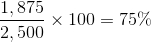
that of Square B.
The perimeter of a rectangle can be given by the formula
Rectangle A has perimeter 2 meters, which is equal to 200 centimeters, and width 25 centimeters, so the length is:
The dimensions of Rectangle A are 75 centimeters and 25 centimeters, so its area is
The sidelength of a square is one-fourth its perimeter, which here is
The area of Rectangle A is therefore
that of Square B.
← Didn't Know|Knew It →
The sidelength of Square A is three-sevenths that of Square B. What is the ratio of the area of Square B to that of Square A?
The sidelength of Square A is three-sevenths that of Square B. What is the ratio of the area of Square B to that of Square A?
Tap to reveal answer
Since the ratio is the same regardless of the sidelengths, then for simplicity's sake, assume the sidelength of Square B is 7. The area of Square B is therefore the square of this, or 49.
Then the sidelength of Square A is three-sevenths of 7, or 3. Its area is the square of 3, or 9.
The ratio of the area of Square B to that of Square A is therefore 49 to 9.
Since the ratio is the same regardless of the sidelengths, then for simplicity's sake, assume the sidelength of Square B is 7. The area of Square B is therefore the square of this, or 49.
Then the sidelength of Square A is three-sevenths of 7, or 3. Its area is the square of 3, or 9.
The ratio of the area of Square B to that of Square A is therefore 49 to 9.
← Didn't Know|Knew It →
The lengths of the sides of ten squares form an arithmetic sequence. One side of the smallest square measures sixty centimeters; one side of the second-smallest square measures one meter.
Give the area of the largest square, rounded to the nearest square meter.
The lengths of the sides of ten squares form an arithmetic sequence. One side of the smallest square measures sixty centimeters; one side of the second-smallest square measures one meter.
Give the area of the largest square, rounded to the nearest square meter.
Tap to reveal answer
Let  be the lengths of the sides of the squares in meters.
  and
and  , so their common difference is

The arithmetic sequence formula is

The length of a side of the largest square - square 10 - can be found by substituting  :
:

The largest square has sides of length 4.2 meters, so its area is the square of this, or  square meters.
Of the choices, 18 square meters is closest.
Let
The arithmetic sequence formula is
The length of a side of the largest square - square 10 - can be found by substituting
The largest square has sides of length 4.2 meters, so its area is the square of this, or
Of the choices, 18 square meters is closest.
← Didn't Know|Knew It →
The areas of six squares form an arithmetic sequence. The smallest square has perimeter 16; the second smallest square has perimeter 20. Give the area of the largest of the six squares.
The areas of six squares form an arithmetic sequence. The smallest square has perimeter 16; the second smallest square has perimeter 20. Give the area of the largest of the six squares.
Tap to reveal answer
The two smallest squares have perimeters 16 and 20, so their sidelengths are one fourth of these, or, respectively, 4 and 5. Their areas are the squares of these, or, respectively, 16 and 25. Therefore, in the arithmetic sequence,


and the common difference is  .
.
The area of the  th smallest square is

Setting  , the area of the largest (or sixth-smallest) square is

The two smallest squares have perimeters 16 and 20, so their sidelengths are one fourth of these, or, respectively, 4 and 5. Their areas are the squares of these, or, respectively, 16 and 25. Therefore, in the arithmetic sequence,
and the common difference is
The area of the
Setting
← Didn't Know|Knew It →
The perimeter of a square is  . Give the area of the square in terms of
  .
.
The perimeter of a square is
Tap to reveal answer
The length of one side of a square is one fourth its perimeter. Since the perimeter of the square is  , the length of one side is

The area of the square is the square of this sidelength, or

The length of one side of a square is one fourth its perimeter. Since the perimeter of the square is
The area of the square is the square of this sidelength, or
← Didn't Know|Knew It →
The sidelength of a square is  . Give its area in terms of
  .
.
The sidelength of a square is
Tap to reveal answer
The area of a square is the square of its sidelength. Therefore, square  :
:

The area of a square is the square of its sidelength. Therefore, square
← Didn't Know|Knew It →
A diagonal of a square has length  . Give its area.
A diagonal of a square has length
Tap to reveal answer
A square being a rhombus, its area can be determined by taking half the product of the lengths of its (congruent) diagonals:

A square being a rhombus, its area can be determined by taking half the product of the lengths of its (congruent) diagonals:
← Didn't Know|Knew It →