
How to find mean - ISEE Upper Level Quantitative Reasoning
Card 0 of 288
This semester, Mary had five quizzes that were each worth 10% of her grade. She scored 89, 74, 84, 92, and 90 on those five quizzes. Mary also scored a 92 on her midterm that was worth 25% of her grade, and a 91 on her final that was also worth 25% of her class grade. What was Mary's final grade in the class?
This semester, Mary had five quizzes that were each worth 10% of her grade. She scored 89, 74, 84, 92, and 90 on those five quizzes. Mary also scored a 92 on her midterm that was worth 25% of her grade, and a 91 on her final that was also worth 25% of her class grade. What was Mary's final grade in the class?
To find her average grade for the class, we need to multiply Mary's test scores by their corresponding weights and then add them up.
The five quizzes were each worth 10%, or 0.1, of her grade, and the midterm and final were both worth 25%, or 0.25.
average = (0.1 * 89) + (0.1 * 74) + (0.1 * 84) + (0.1 * 92) + (0.1 * 90) + (0.25 * 92) + (0.25 * 91) = 88.95 = 89.
Looking at the answer choices, they are all spaced 2 percentage points apart, so clearly the closest answer choice to 88.95 is 89.
To find her average grade for the class, we need to multiply Mary's test scores by their corresponding weights and then add them up.
The five quizzes were each worth 10%, or 0.1, of her grade, and the midterm and final were both worth 25%, or 0.25.
average = (0.1 * 89) + (0.1 * 74) + (0.1 * 84) + (0.1 * 92) + (0.1 * 90) + (0.25 * 92) + (0.25 * 91) = 88.95 = 89.
Looking at the answer choices, they are all spaced 2 percentage points apart, so clearly the closest answer choice to 88.95 is 89.
Compare your answer with the correct one above
Mark's numeric grade in his Spanish class is determined by five equally weighted hourly tests and a final, weighted twice as much as an hourly test. The highest score possible on each is 100.
Going into finals week, Mark's hourly test scores are 92, 66, 84, 77, and 87. What must Mark score on his final, at minimum, in order to achieve a grade of 80 or better for the term?
Mark's numeric grade in his Spanish class is determined by five equally weighted hourly tests and a final, weighted twice as much as an hourly test. The highest score possible on each is 100.
Going into finals week, Mark's hourly test scores are 92, 66, 84, 77, and 87. What must Mark score on his final, at minimum, in order to achieve a grade of 80 or better for the term?
Mark's grade is a weighted mean in which his hourly tests have weight 1 and his final has weight 2. If we call  his final, then his term average will be
 ,
,
which simplifies to
 .
.
Since Mark wants his score to be 80 or better, we solve this inequality:
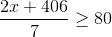
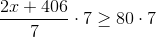





Mark must score 77 or better on his final.
Mark's grade is a weighted mean in which his hourly tests have weight 1 and his final has weight 2. If we call
which simplifies to
Since Mark wants his score to be 80 or better, we solve this inequality:
Mark must score 77 or better on his final.
Compare your answer with the correct one above
The course average for a chemistry class is the mean of five test scores. Anne has scores  so far; Barb has scores
  so far. Which is the greater quantity?
(a) The score Anne must make to average 
(b) The score Barb must make to average 
The course average for a chemistry class is the mean of five test scores. Anne has scores
(a) The score Anne must make to average
(b) The score Barb must make to average
The only real comparison that needs to be made is between the two students' totals; the one with the lesser total needs a greater score to average  .
.
(a) Anne's total: 
(b) Barb's total: 
Barb has fewer points so she needs more points to average  . This makes (b) greater.
The only real comparison that needs to be made is between the two students' totals; the one with the lesser total needs a greater score to average .
(a) Anne's total:
(b) Barb's total:
Barb has fewer points so she needs more points to average
Compare your answer with the correct one above
A student's course average is determined by calculating the mean of five tests. Chuck is trying for an average of  in the course; his first four test scores are
Which is the greater quantity?
(a) The score Chuck needs on the fifth test to achieve his goal
(b) 
A student's course average is determined by calculating the mean of five tests. Chuck is trying for an average of
Which is the greater quantity?
(a) The score Chuck needs on the fifth test to achieve his goal
(b)
For Chuck to achieve an average of  , his scores on the five tests must total
  . At current, his scores total
  , so he needs
  points to achieve his average. This makes (a) greater.
For Chuck to achieve an average of
Compare your answer with the correct one above
A gymnastics contest has seven judges, each of whom rates each contestant's performance on a scale from 0 to 10. A contestant's score is calculated by disregarding the highest and lowest scores, and taking the mean of the remaining five scores.
The seven judges rated Sally's performance with the following seven scores:  They rated Sue's performance with the following seven scores:
Which of these quantities is the greater?
(a) Sally's score
(b) Sue's score
A gymnastics contest has seven judges, each of whom rates each contestant's performance on a scale from 0 to 10. A contestant's score is calculated by disregarding the highest and lowest scores, and taking the mean of the remaining five scores.
The seven judges rated Sally's performance with the following seven scores:
Which of these quantities is the greater?
(a) Sally's score
(b) Sue's score
To calculate whether Sally or Sue has the higher average, it is only necessary to add, for each contestant, all of their scores except for their highest and lowest. Since both sums are divided by 5, the higher sum will result in the higher mean score.
(a) For Sally, the highest and lowest scores are 9.7 and 9.1. The sum of the other five scores is:

(b) For Sue, the highest and lowest scores are 10.0 and 9.1. The sum of the other five scores is:

Sue's total - and, subsequently, her score - is higher than Sally's, so (b) is the greater quantity.
To calculate whether Sally or Sue has the higher average, it is only necessary to add, for each contestant, all of their scores except for their highest and lowest. Since both sums are divided by 5, the higher sum will result in the higher mean score.
(a) For Sally, the highest and lowest scores are 9.7 and 9.1. The sum of the other five scores is:
(b) For Sue, the highest and lowest scores are 10.0 and 9.1. The sum of the other five scores is:
Sue's total - and, subsequently, her score - is higher than Sally's, so (b) is the greater quantity.
Compare your answer with the correct one above
A gymnastics meet has seven judges. After each routine, each judge assigns a merit-based score from 0 to 10; a contestant's score for the routine is the mean of all the judges' scores except for the highest and the lowest.
The seven judges individually assigned the following scores to one of Kathy's routines: 
Which is the greater quantity?
(a) Kathy's score for the routine
(b) 9.5
A gymnastics meet has seven judges. After each routine, each judge assigns a merit-based score from 0 to 10; a contestant's score for the routine is the mean of all the judges' scores except for the highest and the lowest.
The seven judges individually assigned the following scores to one of Kathy's routines:
Which is the greater quantity?
(a) Kathy's score for the routine
(b) 9.5
The highest and lowest scores of the seven are 9.9 and 9.3, so Kathy's score is the mean of the other five:

This makes (a) greater.
The highest and lowest scores of the seven are 9.9 and 9.3, so Kathy's score is the mean of the other five:
This makes (a) greater.
Compare your answer with the correct one above
A student's grade in Professor Kalton's abstract algebra class is the mean of his or her five test scores.
Philip outscored Kellie on the first test by 8 points and on the second test by 5 points. They scored the same on the third test. Kellie outscored Philip by 7 points on the fourth test and by 6 points on the fifth.
Which is the greater quantity?
(a) Philip's grade
(b) Kellie's grade
A student's grade in Professor Kalton's abstract algebra class is the mean of his or her five test scores.
Philip outscored Kellie on the first test by 8 points and on the second test by 5 points. They scored the same on the third test. Kellie outscored Philip by 7 points on the fourth test and by 6 points on the fifth.
Which is the greater quantity?
(a) Philip's grade
(b) Kellie's grade
You do not need to take the two means; just compare the sums, since each will be divided by 5.
Let  be Kellie's total points. Then since Philip outscored Kellie by 8 points and 5 points on two tests and scored fewer than Kellie by 7 points and 6 points on two tests, Philip's score is
 .
.
Philip and Kellie scored the same number of points, making their mean test scores the same.
You do not need to take the two means; just compare the sums, since each will be divided by 5.
Let
Philip and Kellie scored the same number of points, making their mean test scores the same.
Compare your answer with the correct one above
A student's grade in Professor Jackson's Shakespeare class is the mean of his or her four best test scores out of five.
Craig and his brother Jerry have been in a friendly competition to see who can get the best grade in the class.
Craig outscored Jerry on the first test by 9 points and on the fifth test by 5 points. Jerry outscored Craig by 6 points on the second test and by 8 points on the fourth. Their scores were identical on the third.
Which is the greater quantity?
(a) Craig's grade
(b) Jerry's grade
A student's grade in Professor Jackson's Shakespeare class is the mean of his or her four best test scores out of five.
Craig and his brother Jerry have been in a friendly competition to see who can get the best grade in the class.
Craig outscored Jerry on the first test by 9 points and on the fifth test by 5 points. Jerry outscored Craig by 6 points on the second test and by 8 points on the fourth. Their scores were identical on the third.
Which is the greater quantity?
(a) Craig's grade
(b) Jerry's grade
This question cannot be answered.
Let  stand for Jerry's total score after his lowest test is thrown out.
We need to compare the sums after the lowest test for each student is disregarded, since each will be divided by the four tests. But it is not known which test will be thrown out for each student.
If, for example, the first test is thrown out for both Craig and Jerry, Craig's total will be
 ,
,
and Jerry's score will be higher.
If the second test is thrown out for both Craig and Jerry, Craig's total will be
 ,
,
and Craig's score will be higher.
This question cannot be answered.
Let
We need to compare the sums after the lowest test for each student is disregarded, since each will be divided by the four tests. But it is not known which test will be thrown out for each student.
If, for example, the first test is thrown out for both Craig and Jerry, Craig's total will be
and Jerry's score will be higher.
If the second test is thrown out for both Craig and Jerry, Craig's total will be
and Craig's score will be higher.
Compare your answer with the correct one above
Katie's grade in her Shakespeare class is the mean of her best five test scores out of six tests taken.
Her test scores are  .
.
Which is the greater quantity?
(a) Katie's grade
(b) 
Katie's grade in her Shakespeare class is the mean of her best five test scores out of six tests taken.
Her test scores are
Which is the greater quantity?
(a) Katie's grade
(b)
Take the sum of all of her test scores except for her lowest and divide that by the number of test scores included.

Take the sum of all of her test scores except for her lowest and divide that by the number of test scores included.
Compare your answer with the correct one above
John's grade in his economics class is the mean of his best five test scores out of the six tests he takes.
John's first five test scores are: 
Which is the greater quantity?
(a) The lowest score John must take to achieve a score of at least a score of  for the term
(b)
John's grade in his economics class is the mean of his best five test scores out of the six tests he takes.
John's first five test scores are:
Which is the greater quantity?
(a) The lowest score John must take to achieve a score of at least a score of
(b)
John's current point sum is  .
.
Even if John achieves a score lower than  on his sixth test, he will have at least
  points and a minimum mean of at least
  . He can even score zero points on his last test and keep his average above what he wants, making (b) greater.
John's current point sum is
Even if John achieves a score lower than
Compare your answer with the correct one above
Compare  and
and  :
:
 The average of
 The average of
Compare
The average of a list of terms can be found as follows:

So we can write:


So  is greater than
The average of a list of terms can be found as follows:
So we can write:
So
Compare your answer with the correct one above
A set of four numbers has a mean of 21. If one more number was added and the new mean was 20, what was the number that was added?
A set of four numbers has a mean of 21. If one more number was added and the new mean was 20, what was the number that was added?
Start by writing out what you know. We know that four numbers had a mean of 21. That would look like this:  . Therefore, we can determine what the sum of the four numbers was by soliving for x. The sum is 84. If we know that info, we can make a new equation for the new mean, which looks like this:
  . Since we don't know what the new number is, we can just call it x. Solve this proportion to get your missing number.
  then yields x as 16.
Start by writing out what you know. We know that four numbers had a mean of 21. That would look like this:
Compare your answer with the correct one above
You are given the following data set:

Which of the following is the greater quantity?
(A) The mean of the data set
(B) The median of the data set
You are given the following data set:
Which of the following is the greater quantity?
(A) The mean of the data set
(B) The median of the data set
The mean of the data set is the sum of the elements divided by the quantity - eight, in this case:


The median of the data set is the value in the middle - or, since there is an even number of elements, it is the mean of the fourth-highest and the fourth-lowest elements. We arrange the elements in ascending order:

The median is the arithmetic mean of 18 and 19:

(B) is the greater quantity
The mean of the data set is the sum of the elements divided by the quantity - eight, in this case:
The median of the data set is the value in the middle - or, since there is an even number of elements, it is the mean of the fourth-highest and the fourth-lowest elements. We arrange the elements in ascending order:
The median is the arithmetic mean of 18 and 19:
(B) is the greater quantity
Compare your answer with the correct one above
Sally's final score in economics is calculated by taking the mean of the best four of her five test scores. Sally received a final score of 78. Her first four test scores were 90, 80, 65, and 70. Which is the greater quantity?
(A) Her fifth test score
(B) 65
Sally's final score in economics is calculated by taking the mean of the best four of her five test scores. Sally received a final score of 78. Her first four test scores were 90, 80, 65, and 70. Which is the greater quantity?
(A) Her fifth test score
(B) 65
Had Sally scored 65 or less on her fifth test, that would have been the dropped score, and her final score would have been the mean of 90, 80, 65, and 70. This is the sum of the scores divided by four:

Since Sally's mean was greater than this (78), it can be deduced that her fifth score was better than 65, and that the 65 was dropped. Therefore, (A) is greater.
Had Sally scored 65 or less on her fifth test, that would have been the dropped score, and her final score would have been the mean of 90, 80, 65, and 70. This is the sum of the scores divided by four:
Since Sally's mean was greater than this (78), it can be deduced that her fifth score was better than 65, and that the 65 was dropped. Therefore, (A) is greater.
Compare your answer with the correct one above
Julie's final score in psychology is calculated by taking the mean of the best five of her six test scores. Julie received a final score of 85. Her first four test scores were 85, 98, 78, 80, and 84. Which is the greater quantity?
(A) Her sixth test score
(B) 75
Julie's final score in psychology is calculated by taking the mean of the best five of her six test scores. Julie received a final score of 85. Her first four test scores were 85, 98, 78, 80, and 84. Which is the greater quantity?
(A) Her sixth test score
(B) 75
The mean of Julie's first five test scores is
 .
.
Since Julie's final score is 85, it can be deduced that Julie's fifth test score was the one that was dropped, so it must have been less than or equal to the least of the first five scores, 78. However, no further information can be determined; the score may have been greater than, less than, or equal to 75.
The mean of Julie's first five test scores is
Since Julie's final score is 85, it can be deduced that Julie's fifth test score was the one that was dropped, so it must have been less than or equal to the least of the first five scores, 78. However, no further information can be determined; the score may have been greater than, less than, or equal to 75.
Compare your answer with the correct one above
What is the average of the three numbers in the set below?

What is the average of the three numbers in the set below?
The average is calculated by adding together the numbers in a set and dividing by the number of items:
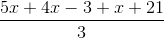


The average is calculated by adding together the numbers in a set and dividing by the number of items:
Compare your answer with the correct one above
Alice's numeric grade in her physics class is determined by four equally weighted hourly tests and a final, weighted twice as much as an hourly test. The highest score possible on each is 100.
Going into finals week, Alice's hourly test scores are 76, 85, 82, and 87. What must Alice make on her final, at minimum, in order to average 90 or more for the term?
Alice's numeric grade in her physics class is determined by four equally weighted hourly tests and a final, weighted twice as much as an hourly test. The highest score possible on each is 100.
Going into finals week, Alice's hourly test scores are 76, 85, 82, and 87. What must Alice make on her final, at minimum, in order to average 90 or more for the term?
Alice's grade is a weighted mean in which her hourly tests have weight 1 and her final has weight 2. If we call  her final, then her term score will be
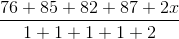 ,
,
which simplifies to
 .
.
Since she wants her score to be 90 or better, we solve this inequality:
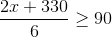
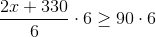





Since it is established that 100 is the maximum score, Alice cannot achieve an average of 90 or more for the term.
Alice's grade is a weighted mean in which her hourly tests have weight 1 and her final has weight 2. If we call
which simplifies to
Since she wants her score to be 90 or better, we solve this inequality:
Since it is established that 100 is the maximum score, Alice cannot achieve an average of 90 or more for the term.
Compare your answer with the correct one above
Sally's numeric grade in her economics class is determined by four equally weighted hourly tests, a midterm weighted twice as much as an hourly test, and a final weighted three times as much as an hourly test. The highest score possible on each is 100.
Going into finals week, Sally's hourly test scores are 89, 85, 84, and 87, and her midterm score is 93. What must Sally make on her final at minimum in order to average 90 or more for the term?
Sally's numeric grade in her economics class is determined by four equally weighted hourly tests, a midterm weighted twice as much as an hourly test, and a final weighted three times as much as an hourly test. The highest score possible on each is 100.
Going into finals week, Sally's hourly test scores are 89, 85, 84, and 87, and her midterm score is 93. What must Sally make on her final at minimum in order to average 90 or more for the term?
Sally's grade is a weighted mean in which her hourly tests have weight 1, her midterm has weight 2, and her final has weight 3. If we call  her score on the final, then her course score will be
 ,
,
which simplifies to
 .
.
Since Sally wants at least a 90 average for the term, we can set up and solve the inequality:
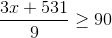
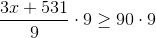





Sally must score at least 93 on the final.
Sally's grade is a weighted mean in which her hourly tests have weight 1, her midterm has weight 2, and her final has weight 3. If we call
which simplifies to
Since Sally wants at least a 90 average for the term, we can set up and solve the inequality:
Sally must score at least 93 on the final.
Compare your answer with the correct one above
Fred's course average in French class is the average of the best five of his six hourly test scores. Going into finals week, Fred has scores of 78, 77, 84, 89, and 72. How much, at minimum, must Fred score on his sixth test in order to make an average of 80 or better for the term?
Fred's course average in French class is the average of the best five of his six hourly test scores. Going into finals week, Fred has scores of 78, 77, 84, 89, and 72. How much, at minimum, must Fred score on his sixth test in order to make an average of 80 or better for the term?
If Fred does not take the sixth test or gets a 0 on it, he will receive the average of his first five tests. This is
 .
.
Since he can only improve his class grade by taking the sixth test, Fred is already assured of an average of 80 or better.
If Fred does not take the sixth test or gets a 0 on it, he will receive the average of his first five tests. This is
Since he can only improve his class grade by taking the sixth test, Fred is already assured of an average of 80 or better.
Compare your answer with the correct one above
The mean of six numbers is 77. What is their sum?
The mean of six numbers is 77. What is their sum?
The mean of six numbers is their sum divided by 6, so the sum is the mean multiplied by 6. This is:

The mean of six numbers is their sum divided by 6, so the sum is the mean multiplied by 6. This is:
Compare your answer with the correct one above