
How to find mode - ISEE Upper Level Quantitative Reasoning
Card 0 of 152
Consider the data set 
Which is the greater quantity?
(a) The median of the data set
(b) The mode of the data set
Consider the data set
Which is the greater quantity?
(a) The median of the data set
(b) The mode of the data set
(a) The median of a data set with ten elements is the arithmetic mean of the fifth-highest and sixth-highest elements. These elements are 13 and 15, so the median is 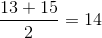
(b) The mode of a data set is the element that occurs most frequently. Since 13 is the only repeated element, it is the mode.
This makes (a) the greater quantity.
(a) The median of a data set with ten elements is the arithmetic mean of the fifth-highest and sixth-highest elements. These elements are 13 and 15, so the median is
(b) The mode of a data set is the element that occurs most frequently. Since 13 is the only repeated element, it is the mode.
This makes (a) the greater quantity.
Compare your answer with the correct one above
Compare the mean and the mode in the following set of data:

Compare the mean and the mode in the following set of data:
The mode of a set of data is the value which occurs most frequently, which in this case is  .
.
The mean of a set of data is given by the sum of the data, divided by the total number of values in the set. So we can write:

So the mean of is greater than the mode.
The mode of a set of data is the value which occurs most frequently, which in this case is
The mean of a set of data is given by the sum of the data, divided by the total number of values in the set. So we can write:
So the mean of is greater than the mode.
Compare your answer with the correct one above
Compare the mean and the mode in the following set of data:
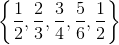
Compare the mean and the mode in the following set of data:
The mode of a set of data is the value which occurs most frequently, which in this case is  .
.
The mean of a set of data is given by the sum of the data, divided by the total number of values in the set. So we can write:

So the mean is greater than the mode.
The mode of a set of data is the value which occurs most frequently, which in this case is
The mean of a set of data is given by the sum of the data, divided by the total number of values in the set. So we can write:
So the mean is greater than the mode.
Compare your answer with the correct one above
Consider the data set  .
.
Which of the following elements replaces the box to make the data set bimodal?
(A) 
(B) 
(C) 
Consider the data set
Which of the following elements replaces the box to make the data set bimodal?
(A)
(B)
(C)
At current, 40 appears four times, more than any other value. For a set to be bimodal, it needs to have two modes; that is, another value would have to appear four times as well. Regardless of whether 30, 50, 60, or any other value replaces the box, this is impossible. The set cannot be made bimodal by adding one element.
At current, 40 appears four times, more than any other value. For a set to be bimodal, it needs to have two modes; that is, another value would have to appear four times as well. Regardless of whether 30, 50, 60, or any other value replaces the box, this is impossible. The set cannot be made bimodal by adding one element.
Compare your answer with the correct one above
Give the mode(s) of the data set

Give the mode(s) of the data set
The mode of a data set is the element that appears the most frequently. When two numbers both appear most frequently, there are two modes:

The mode of a data set is the element that appears the most frequently. When two numbers both appear most frequently, there are two modes:
Compare your answer with the correct one above
Consider the data set
Which is the greater quantity?
(a) The median of the data set
(b) The mode of the data set
Consider the data set
Which is the greater quantity?
(a) The median of the data set
(b) The mode of the data set
(a) The median of a data set with ten elements is the arithmetic mean of the fifth-highest and sixth-highest elements. These elements are 13 and 15, so the median is
(b) The mode of a data set is the element that occurs most frequently. Since 13 is the only repeated element, it is the mode.
This makes (a) the greater quantity.
(a) The median of a data set with ten elements is the arithmetic mean of the fifth-highest and sixth-highest elements. These elements are 13 and 15, so the median is
(b) The mode of a data set is the element that occurs most frequently. Since 13 is the only repeated element, it is the mode.
This makes (a) the greater quantity.
Compare your answer with the correct one above
Compare the mean and the mode in the following set of data:
Compare the mean and the mode in the following set of data:
The mode of a set of data is the value which occurs most frequently, which in this case is .
The mean of a set of data is given by the sum of the data, divided by the total number of values in the set. So we can write:
So the mean of is greater than the mode.
The mode of a set of data is the value which occurs most frequently, which in this case is
The mean of a set of data is given by the sum of the data, divided by the total number of values in the set. So we can write:
So the mean of is greater than the mode.
Compare your answer with the correct one above
Compare the mean and the mode in the following set of data:
Compare the mean and the mode in the following set of data:
The mode of a set of data is the value which occurs most frequently, which in this case is .
The mean of a set of data is given by the sum of the data, divided by the total number of values in the set. So we can write:
So the mean is greater than the mode.
The mode of a set of data is the value which occurs most frequently, which in this case is
The mean of a set of data is given by the sum of the data, divided by the total number of values in the set. So we can write:
So the mean is greater than the mode.
Compare your answer with the correct one above
Consider the data set .
Which of the following elements replaces the box to make the data set bimodal?
(A)
(B)
(C)
Consider the data set
Which of the following elements replaces the box to make the data set bimodal?
(A)
(B)
(C)
At current, 40 appears four times, more than any other value. For a set to be bimodal, it needs to have two modes; that is, another value would have to appear four times as well. Regardless of whether 30, 50, 60, or any other value replaces the box, this is impossible. The set cannot be made bimodal by adding one element.
At current, 40 appears four times, more than any other value. For a set to be bimodal, it needs to have two modes; that is, another value would have to appear four times as well. Regardless of whether 30, 50, 60, or any other value replaces the box, this is impossible. The set cannot be made bimodal by adding one element.
Compare your answer with the correct one above
Give the mode(s) of the data set
Give the mode(s) of the data set
The mode of a data set is the element that appears the most frequently. When two numbers both appear most frequently, there are two modes:
The mode of a data set is the element that appears the most frequently. When two numbers both appear most frequently, there are two modes:
Compare your answer with the correct one above
Examine the data set  . You are given that
  can be any integer from 1 to 10.
Which value(s) of  would make 7 the only mode of the data set?
Examine the data set
Which value(s) of
The mode of a data set is the element that appears most frequently.
The data set has ten elements - one 2, one 3, three 4's, two 7's, one 9, one 10, and an element of unknown value.
If that unknown element is 7, there are two modes of the set, 4 and 7, which would occur three times each, as opposed to the other elements, which would appear once each.
If that unknown element is any other integer, then the only mode of the data set is 4, which would occur three times, as opposed to the other elements, which would appear once or twice each.
The correct choice is that this impossible.
The mode of a data set is the element that appears most frequently.
The data set has ten elements - one 2, one 3, three 4's, two 7's, one 9, one 10, and an element of unknown value.
If that unknown element is 7, there are two modes of the set, 4 and 7, which would occur three times each, as opposed to the other elements, which would appear once each.
If that unknown element is any other integer, then the only mode of the data set is 4, which would occur three times, as opposed to the other elements, which would appear once or twice each.
The correct choice is that this impossible.
Compare your answer with the correct one above
Examine the data set  . You are given that
  can be any integer from 1 to 10.
Which value(s) of  would give the data set exactly one mode?
Examine the data set
Which value(s) of
The mode of a data set is the element that appears most frequently.
Two values of the data set, 2 and 9, are known to appear twice; the others appear exactly once.
If  is 6, 7, or 8, this does not change, and 2 and 9 are both modes.
If  is 1, 3, 4, 5, or 10, then three different values appear twice, and 2, 9, and the choice of
  are the three modes.
If  is 2 or 9, then that number appears three times, the other number appears twice, and all others appear once. That makes the choice of
  the only mode.
This makes the correct choice 2 or 9.
The mode of a data set is the element that appears most frequently.
Two values of the data set, 2 and 9, are known to appear twice; the others appear exactly once.
If
If
If
This makes the correct choice 2 or 9.
Compare your answer with the correct one above
Compare the mean and the mode in the following set of data:
Compare the mean and the mode in the following set of data:
The mode of a set of data is the value which occurs most frequently, which in this case is .
The mean of a set of data is given by the sum of the data, divided by the total number of values in the set. So we can write:
So the mean of is greater than the mode.
The mode of a set of data is the value which occurs most frequently, which in this case is
The mean of a set of data is given by the sum of the data, divided by the total number of values in the set. So we can write:
So the mean of is greater than the mode.
Compare your answer with the correct one above
Compare the mean and the mode in the following set of data:
Compare the mean and the mode in the following set of data:
The mode of a set of data is the value which occurs most frequently, which in this case is .
The mean of a set of data is given by the sum of the data, divided by the total number of values in the set. So we can write:
So the mean is greater than the mode.
The mode of a set of data is the value which occurs most frequently, which in this case is
The mean of a set of data is given by the sum of the data, divided by the total number of values in the set. So we can write:
So the mean is greater than the mode.
Compare your answer with the correct one above
Consider the data set .
Which of the following elements replaces the box to make the data set bimodal?
(A)
(B)
(C)
Consider the data set
Which of the following elements replaces the box to make the data set bimodal?
(A)
(B)
(C)
At current, 40 appears four times, more than any other value. For a set to be bimodal, it needs to have two modes; that is, another value would have to appear four times as well. Regardless of whether 30, 50, 60, or any other value replaces the box, this is impossible. The set cannot be made bimodal by adding one element.
At current, 40 appears four times, more than any other value. For a set to be bimodal, it needs to have two modes; that is, another value would have to appear four times as well. Regardless of whether 30, 50, 60, or any other value replaces the box, this is impossible. The set cannot be made bimodal by adding one element.
Compare your answer with the correct one above
Give the mode(s) of the data set
Give the mode(s) of the data set
The mode of a data set is the element that appears the most frequently. When two numbers both appear most frequently, there are two modes:
The mode of a data set is the element that appears the most frequently. When two numbers both appear most frequently, there are two modes:
Compare your answer with the correct one above
Examine the data set . You are given that can be any integer from 1 to 10.
Which value(s) of would give the data set exactly one mode?
Examine the data set
Which value(s) of
The mode of a data set is the element that appears most frequently.
Two values of the data set, 2 and 9, are known to appear twice; the others appear exactly once.
If is 6, 7, or 8, this does not change, and 2 and 9 are both modes.
If is 1, 3, 4, 5, or 10, then three different values appear twice, and 2, 9, and the choice of are the three modes.
If is 2 or 9, then that number appears three times, the other number appears twice, and all others appear once. That makes the choice of the only mode.
This makes the correct choice 2 or 9.
The mode of a data set is the element that appears most frequently.
Two values of the data set, 2 and 9, are known to appear twice; the others appear exactly once.
If
If
If
This makes the correct choice 2 or 9.
Compare your answer with the correct one above
Compare the mean and the mode in the following set of data:
Compare the mean and the mode in the following set of data:
The mode of a set of data is the value which occurs most frequently, which in this case is .
The mean of a set of data is given by the sum of the data, divided by the total number of values in the set. So we can write:
So the mean of is greater than the mode.
The mode of a set of data is the value which occurs most frequently, which in this case is
The mean of a set of data is given by the sum of the data, divided by the total number of values in the set. So we can write:
So the mean of is greater than the mode.
Compare your answer with the correct one above
Give the mode(s) of the data set
Give the mode(s) of the data set
The mode of a data set is the element that appears the most frequently. When two numbers both appear most frequently, there are two modes:
The mode of a data set is the element that appears the most frequently. When two numbers both appear most frequently, there are two modes:
Compare your answer with the correct one above
Compare the median and the mode in the following set of data:

Compare the median and the mode in the following set of data:
If a data set has an even number of values, the median is the average of the two middle values. First we should put the numbers in order:

So the median is:

The mode of a set of data is the value which occurs most frequently, which is  in this problem. So the mode is greater than the median.
If a data set has an even number of values, the median is the average of the two middle values. First we should put the numbers in order:
So the median is:
The mode of a set of data is the value which occurs most frequently, which is
Compare your answer with the correct one above