
Diameter and Chords - Math
Card 1 of 36
Let  represent the area of a circle and
  represent its circumference. Which of the following equations expresses
  in terms of
  ?
?
Let
Tap to reveal answer
The formula for the area of a circle is  , and the formula for circumference is
  . If we solve for C in terms of r, we get
 .
.
We can then substitute this value of r into the formula for the area:


The formula for the area of a circle is
We can then substitute this value of r into the formula for the area:
← Didn't Know|Knew It →
What is the ratio of the diameter of a circle to the circumference of the same circle?
What is the ratio of the diameter of a circle to the circumference of the same circle?
Tap to reveal answer
To find the ratio we must know the equation for the circumference of a circle. In this equation,  is the circumference and
  is the diameter.

Once we know the equation, we can solve for the ratio of the diameter to circumference by solving the equation for  . We do this by dividing both sides by
  .
.


Then we divide both sides by the circumference.
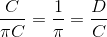
We now know that the ratio of the diameter to circumference is equal to  .
.
To find the ratio we must know the equation for the circumference of a circle. In this equation,
Once we know the equation, we can solve for the ratio of the diameter to circumference by solving the equation for
Then we divide both sides by the circumference.
We now know that the ratio of the diameter to circumference is equal to
← Didn't Know|Knew It →
What is the ratio of the diameter and circumference of a circle?
What is the ratio of the diameter and circumference of a circle?
Tap to reveal answer
To find the ratio we must know the equation for the circumference of a circle is

Once we know the equation we can solve for the ratio of the diameter to circumference by solving the equation for 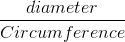
we divide both sides by the circumference giving us

We now know that the ratio of the diameter to circumference is equal to  .
.
To find the ratio we must know the equation for the circumference of a circle is
Once we know the equation we can solve for the ratio of the diameter to circumference by solving the equation for
we divide both sides by the circumference giving us
We now know that the ratio of the diameter to circumference is equal to
← Didn't Know|Knew It →
What is the ratio of any circle's circumference to its radius?
What is the ratio of any circle's circumference to its radius?
Tap to reveal answer
The circumference of any circle is

So the ratio of its circumference to its radius r, is


The circumference of any circle is
So the ratio of its circumference to its radius r, is
← Didn't Know|Knew It →
Let represent the area of a circle and represent its circumference. Which of the following equations expresses in terms of ?
Let
Tap to reveal answer
The formula for the area of a circle is , and the formula for circumference is . If we solve for C in terms of r, we get
.
We can then substitute this value of r into the formula for the area:
The formula for the area of a circle is
We can then substitute this value of r into the formula for the area:
← Didn't Know|Knew It →
What is the ratio of the diameter of a circle to the circumference of the same circle?
What is the ratio of the diameter of a circle to the circumference of the same circle?
Tap to reveal answer
To find the ratio we must know the equation for the circumference of a circle. In this equation, is the circumference and is the diameter.
Once we know the equation, we can solve for the ratio of the diameter to circumference by solving the equation for . We do this by dividing both sides by .
Then we divide both sides by the circumference.
We now know that the ratio of the diameter to circumference is equal to .
To find the ratio we must know the equation for the circumference of a circle. In this equation,
Once we know the equation, we can solve for the ratio of the diameter to circumference by solving the equation for
Then we divide both sides by the circumference.
We now know that the ratio of the diameter to circumference is equal to
← Didn't Know|Knew It →
What is the ratio of the diameter and circumference of a circle?
What is the ratio of the diameter and circumference of a circle?
Tap to reveal answer
To find the ratio we must know the equation for the circumference of a circle is
Once we know the equation we can solve for the ratio of the diameter to circumference by solving the equation for
we divide both sides by the circumference giving us
We now know that the ratio of the diameter to circumference is equal to .
To find the ratio we must know the equation for the circumference of a circle is
Once we know the equation we can solve for the ratio of the diameter to circumference by solving the equation for
we divide both sides by the circumference giving us
We now know that the ratio of the diameter to circumference is equal to
← Didn't Know|Knew It →
What is the ratio of any circle's circumference to its radius?
What is the ratio of any circle's circumference to its radius?
Tap to reveal answer
The circumference of any circle is
So the ratio of its circumference to its radius r, is
The circumference of any circle is
So the ratio of its circumference to its radius r, is
← Didn't Know|Knew It →
If the area of a circle is four times larger than the circumference of that same circle, what is the diameter of the circle?
If the area of a circle is four times larger than the circumference of that same circle, what is the diameter of the circle?
Tap to reveal answer
Set the area of the circle equal to four times the circumference πr_2 = 4(2_πr).
Cross out both π symbols and one r on each side leaves you with r = 4(2) so r = 8 and therefore d = 16.
Set the area of the circle equal to four times the circumference πr_2 = 4(2_πr).
Cross out both π symbols and one r on each side leaves you with r = 4(2) so r = 8 and therefore d = 16.
← Didn't Know|Knew It →
Two legs of a right triangle measure 3 and 4, respectively. What is the area of the circle that circumscribes the triangle?
Two legs of a right triangle measure 3 and 4, respectively. What is the area of the circle that circumscribes the triangle?
Tap to reveal answer
For the circle to contain all 3 vertices, the hypotenuse must be the diameter of the circle. The hypotenuse, and therefore the diameter, is 5, since this must be a 3-4-5 right triangle.
The equation for the area of a circle is A = πr2.

For the circle to contain all 3 vertices, the hypotenuse must be the diameter of the circle. The hypotenuse, and therefore the diameter, is 5, since this must be a 3-4-5 right triangle.
The equation for the area of a circle is A = πr2.
← Didn't Know|Knew It →
The perimeter of a circle is 36 π. What is the diameter of the circle?
The perimeter of a circle is 36 π. What is the diameter of the circle?
Tap to reveal answer
The perimeter of a circle = 2 πr = πd
Therefore d = 36
The perimeter of a circle = 2 πr = πd
Therefore d = 36
← Didn't Know|Knew It →
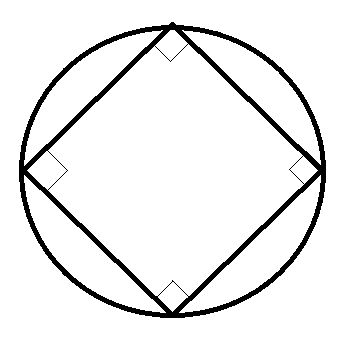
If the area of the circle touching the square in the picture above is  , what is the closest value to the area of the square?
If the area of the circle touching the square in the picture above is
Tap to reveal answer
Obtain the radius of the circle from the area.



Split the square up into 4 triangles by connecting opposite corners. These triangles will have a right angle at the center of the square, formed by two radii of the circle, and two 45-degree angles at the square's corners. Because you have a 45-45-90 triangle, you can calculate the sides of the triangles to be  ,
,  , and
, and  . The radii of the circle (from the center to the corners of the square) will be 9. The hypotenuse (side of the square) must be
  .
.
The area of the square is then 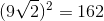 .
.
Obtain the radius of the circle from the area.
Split the square up into 4 triangles by connecting opposite corners. These triangles will have a right angle at the center of the square, formed by two radii of the circle, and two 45-degree angles at the square's corners. Because you have a 45-45-90 triangle, you can calculate the sides of the triangles to be
The area of the square is then
← Didn't Know|Knew It →
What is the diameter of a circle with a circumference of  ?
?
What is the diameter of a circle with a circumference of
Tap to reveal answer
To find the diameter we must understand the diameter in terms of circumference. The equation for the circumference of a circle is  , where
  is the circumference and
  is the diameter. The circumference is equal to the diameter multiplied by
  .
.
We can rearrange  to solve for
  .
.

All we have to do is plug in the circumference and divide by  , and it will yield the diameter.
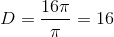
The  s cancel and the diameter is
  .
.
To find the diameter we must understand the diameter in terms of circumference. The equation for the circumference of a circle is
We can rearrange
All we have to do is plug in the circumference and divide by
The
← Didn't Know|Knew It →
If the area of a circle is four times larger than the circumference of that same circle, what is the diameter of the circle?
If the area of a circle is four times larger than the circumference of that same circle, what is the diameter of the circle?
Tap to reveal answer
Set the area of the circle equal to four times the circumference πr_2 = 4(2_πr).
Cross out both π symbols and one r on each side leaves you with r = 4(2) so r = 8 and therefore d = 16.
Set the area of the circle equal to four times the circumference πr_2 = 4(2_πr).
Cross out both π symbols and one r on each side leaves you with r = 4(2) so r = 8 and therefore d = 16.
← Didn't Know|Knew It →
Two legs of a right triangle measure 3 and 4, respectively. What is the area of the circle that circumscribes the triangle?
Two legs of a right triangle measure 3 and 4, respectively. What is the area of the circle that circumscribes the triangle?
Tap to reveal answer
For the circle to contain all 3 vertices, the hypotenuse must be the diameter of the circle. The hypotenuse, and therefore the diameter, is 5, since this must be a 3-4-5 right triangle.
The equation for the area of a circle is A = πr2.
For the circle to contain all 3 vertices, the hypotenuse must be the diameter of the circle. The hypotenuse, and therefore the diameter, is 5, since this must be a 3-4-5 right triangle.
The equation for the area of a circle is A = πr2.
← Didn't Know|Knew It →
The perimeter of a circle is 36 π. What is the diameter of the circle?
The perimeter of a circle is 36 π. What is the diameter of the circle?
Tap to reveal answer
The perimeter of a circle = 2 πr = πd
Therefore d = 36
The perimeter of a circle = 2 πr = πd
Therefore d = 36
← Didn't Know|Knew It →
If the area of the circle touching the square in the picture above is , what is the closest value to the area of the square?
If the area of the circle touching the square in the picture above is
Tap to reveal answer
Obtain the radius of the circle from the area.
Split the square up into 4 triangles by connecting opposite corners. These triangles will have a right angle at the center of the square, formed by two radii of the circle, and two 45-degree angles at the square's corners. Because you have a 45-45-90 triangle, you can calculate the sides of the triangles to be , , and . The radii of the circle (from the center to the corners of the square) will be 9. The hypotenuse (side of the square) must be .
The area of the square is then .
Obtain the radius of the circle from the area.
Split the square up into 4 triangles by connecting opposite corners. These triangles will have a right angle at the center of the square, formed by two radii of the circle, and two 45-degree angles at the square's corners. Because you have a 45-45-90 triangle, you can calculate the sides of the triangles to be
The area of the square is then
← Didn't Know|Knew It →
What is the diameter of a circle with a circumference of ?
What is the diameter of a circle with a circumference of
Tap to reveal answer
To find the diameter we must understand the diameter in terms of circumference. The equation for the circumference of a circle is , where is the circumference and is the diameter. The circumference is equal to the diameter multiplied by .
We can rearrange to solve for .
All we have to do is plug in the circumference and divide by , and it will yield the diameter.
The s cancel and the diameter is .
To find the diameter we must understand the diameter in terms of circumference. The equation for the circumference of a circle is
We can rearrange
All we have to do is plug in the circumference and divide by
The
← Didn't Know|Knew It →
Let represent the area of a circle and represent its circumference. Which of the following equations expresses in terms of ?
Let
Tap to reveal answer
The formula for the area of a circle is , and the formula for circumference is . If we solve for C in terms of r, we get
.
We can then substitute this value of r into the formula for the area:
The formula for the area of a circle is
We can then substitute this value of r into the formula for the area:
← Didn't Know|Knew It →
What is the ratio of the diameter of a circle to the circumference of the same circle?
What is the ratio of the diameter of a circle to the circumference of the same circle?
Tap to reveal answer
To find the ratio we must know the equation for the circumference of a circle. In this equation, is the circumference and is the diameter.
Once we know the equation, we can solve for the ratio of the diameter to circumference by solving the equation for . We do this by dividing both sides by .
Then we divide both sides by the circumference.
We now know that the ratio of the diameter to circumference is equal to .
To find the ratio we must know the equation for the circumference of a circle. In this equation,
Once we know the equation, we can solve for the ratio of the diameter to circumference by solving the equation for
Then we divide both sides by the circumference.
We now know that the ratio of the diameter to circumference is equal to
← Didn't Know|Knew It →