
Plane Geometry - Math
Card 1 of 2152
What is the magnitude of the interior angle of a regular nonagon?
What is the magnitude of the interior angle of a regular nonagon?
Tap to reveal answer
The equation to calculate the magnitude of an interior angle is 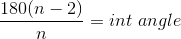 , where
  is equal to the number of sides.
For our question,  .
.

The equation to calculate the magnitude of an interior angle is
For our question,
← Didn't Know|Knew It →
What is the interior angle measure of any regular heptagon?
What is the interior angle measure of any regular heptagon?
Tap to reveal answer
To find the angle of any regular polygon you find the number of sides,  . In this example,
  .
.
You then subtract 2 from the number of sides yielding 5.
Take 5 and multiply it by 180 degrees to yield the total number of degrees in the regular heptagon. 
Then to find one individual angle we divide 900 by the total number of angles, 7.

The answer is  .
.
To find the angle of any regular polygon you find the number of sides,
You then subtract 2 from the number of sides yielding 5.
Take 5 and multiply it by 180 degrees to yield the total number of degrees in the regular heptagon.
Then to find one individual angle we divide 900 by the total number of angles, 7.
The answer is
← Didn't Know|Knew It →
A regular polygon with  sides has exterior angles that measure
  each. How many sides does the polygon have?
A regular polygon with
Tap to reveal answer
The sum of the exterior angles of any polygon, one per vertex, is  . As each angle measures
  , just divide 360 by 1.5 to get the number of angles.

The sum of the exterior angles of any polygon, one per vertex, is
← Didn't Know|Knew It →
What is the interior angle measure of any regular nonagon?
What is the interior angle measure of any regular nonagon?
Tap to reveal answer
To find the angle of any regular polygon you find the number of sides  , which in this example is
  .
.
You then subtract  from the number of sides yielding
  .
.
Take  and multiply it by
  degrees to yield a total number of degrees in the regular nonagon.

Then to find one individual angle we divide  by the total number of angles
  .
.

The answer is  .
.
To find the angle of any regular polygon you find the number of sides
You then subtract
Take
Then to find one individual angle we divide
The answer is
← Didn't Know|Knew It →
What is the measure of one exterior angle of a regular seventeen-sided polygon (nearest tenth of a degree)?
What is the measure of one exterior angle of a regular seventeen-sided polygon (nearest tenth of a degree)?
Tap to reveal answer
The sum of the measures of the exterior angles of any polygon, one per vertex, is  . In a regular polygon, all of these angles are congruent, so divide 360 by 17 to get the measure of one exterior angle:

The sum of the measures of the exterior angles of any polygon, one per vertex, is
← Didn't Know|Knew It →
What is the measure of one exterior angle of a regular twenty-three-sided polygon (nearest tenth of a degree)?
What is the measure of one exterior angle of a regular twenty-three-sided polygon (nearest tenth of a degree)?
Tap to reveal answer
The sum of the measures of the exterior angles of any polygon, one per vertex, is  . In a regular polygon, all of these angles are congruent, so divide 360 by 23 to get the measure of one exterior angle:

The sum of the measures of the exterior angles of any polygon, one per vertex, is
← Didn't Know|Knew It →
What is the measure of one interior angle of a regular twenty-three-sided polygon (nearest tenth of a degree)?
What is the measure of one interior angle of a regular twenty-three-sided polygon (nearest tenth of a degree)?
Tap to reveal answer
The measure of each interior angle of a regular polygon with  sides is
  . We can substitute
  to obtain the angle measure:

The measure of each interior angle of a regular polygon with
← Didn't Know|Knew It →
A regular polygon has interior angles which measure  each. How many sides does the polygon have?
A regular polygon has interior angles which measure
Tap to reveal answer
The easiest way to answer this is to note that, since an interior angle and an exterior angle form a linear pair - and thus, a supplementary pair - each exterior angle would have measure  . Since 360 divided by the number of sides of a regular polygon is equal to the measure of one of its exterior angles, we are seeking
  such that

Solve for  :
:
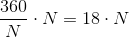



The polygon has 20 sides.
The easiest way to answer this is to note that, since an interior angle and an exterior angle form a linear pair - and thus, a supplementary pair - each exterior angle would have measure
Solve for
The polygon has 20 sides.
← Didn't Know|Knew It →
What is the area of a regular heptagon with an apothem of 4 and a side length of 6?
What is the area of a regular heptagon with an apothem of 4 and a side length of 6?
Tap to reveal answer
What is the area of a regular heptagon with an apothem of 4 and a side length of 6?
To find the area of any polygon with the side length and the apothem we must know the equation for the area of a polygon which is

First, we must calculate the perimeter using the side length.
To find the perimeter of a regular polygon we take the length of each side and multiply it by the number of sides.
In a heptagon the number of sides is 7 and in this example the side length is 6 so 
The perimeter is  .
.
Then we plug in the numbers for the apothem and perimeter into the equation yielding 
We then multiply giving us the area of  .
.
What is the area of a regular heptagon with an apothem of 4 and a side length of 6?
To find the area of any polygon with the side length and the apothem we must know the equation for the area of a polygon which is
First, we must calculate the perimeter using the side length.
To find the perimeter of a regular polygon we take the length of each side and multiply it by the number of sides.
In a heptagon the number of sides is 7 and in this example the side length is 6 so
The perimeter is
Then we plug in the numbers for the apothem and perimeter into the equation yielding
We then multiply giving us the area of
← Didn't Know|Knew It →
What is the area of a regular decagon with an apothem of 15 and a side length of 25?
What is the area of a regular decagon with an apothem of 15 and a side length of 25?
Tap to reveal answer
To find the area of any polygon with the side length and the apothem we must know the equation for the area of a polygon which is
First, we must calculate the perimeter using the side length.
To find the perimeter of a regular polygon we take the length of each side and multiply it by the number of sides.
In a decagon the number of sides is 10 and in this example the side length is 25 so 
The perimeter is  .
.
Then we plug in the numbers for the apothem and perimeter into the equation yielding 
We then multiply giving us the area of  .
.
To find the area of any polygon with the side length and the apothem we must know the equation for the area of a polygon which is
First, we must calculate the perimeter using the side length.
To find the perimeter of a regular polygon we take the length of each side and multiply it by the number of sides.
In a decagon the number of sides is 10 and in this example the side length is 25 so
The perimeter is
Then we plug in the numbers for the apothem and perimeter into the equation yielding
We then multiply giving us the area of
← Didn't Know|Knew It →
What is the area of a regular heptagon with an apothem of  and a side length of
  ?
?
What is the area of a regular heptagon with an apothem of
Tap to reveal answer
To find the area of any polygon with the side length and the apothem we must know the equation for the area of a polygon which is
We must then calculate the perimeter using the side length.
To find the perimeter of a regular polygon we take the length of each side and multiply it by the number of sides  .
.
In a heptagon the number of sides  is
is  and in this example the side length is
  so
so 
The perimeter is 56.
Then we plug in the numbers for the apothem and perimeter into the equation yielding 
We then multiply giving us the area of  .
.
To find the area of any polygon with the side length and the apothem we must know the equation for the area of a polygon which is
We must then calculate the perimeter using the side length.
To find the perimeter of a regular polygon we take the length of each side and multiply it by the number of sides
In a heptagon the number of sides
The perimeter is 56.
Then we plug in the numbers for the apothem and perimeter into the equation yielding
We then multiply giving us the area of
← Didn't Know|Knew It →
Find the area of the shaded region:

Find the area of the shaded region:
Tap to reveal answer
To find the area of the shaded region, you must subtract the area of the circle from the area of the square.
The formula for the shaded area is:

 ,
,
where  is the side of the square and
  is the radius of the circle.
Plugging in our values, we get:


To find the area of the shaded region, you must subtract the area of the circle from the area of the square.
The formula for the shaded area is:
where
Plugging in our values, we get:
← Didn't Know|Knew It →
Find the area of the shaded region:

Find the area of the shaded region:
Tap to reveal answer
To find the area of the shaded region, you need to subtract the area of the triangle from the area of the sector:


Where  is the radius of the circle,
  is the fraction of the circle,
  is the base of the triangle, and
  is the height of the triangle
Plugging in our values, we get


To find the area of the shaded region, you need to subtract the area of the triangle from the area of the sector:
Where
Plugging in our values, we get
← Didn't Know|Knew It →
Find the area of the shaded region:

Find the area of the shaded region:
Tap to reveal answer
To find the area of the shaded region, you need to subtract the area of the equilateral triangle from the area of the sector:


Where  is the radius of the circle,
  is the fraction of the circle, and
  is the side of the triangle
Plugging in our values, we get


To find the area of the shaded region, you need to subtract the area of the equilateral triangle from the area of the sector:
Where
Plugging in our values, we get
← Didn't Know|Knew It →
Find the area of the shaded region:

Find the area of the shaded region:
Tap to reveal answer
The formula for the area of the shaded region is

where  is the radius of the circle.
Plugging in our values, we get:


The formula for the area of the shaded region is
where
Plugging in our values, we get:
← Didn't Know|Knew It →
Find the area of the following octagon:
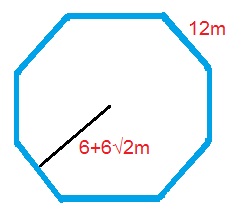
Find the area of the following octagon:
Tap to reveal answer
The formula for the area of a regular octagon is:

Plugging in our values, we get:


The formula for the area of a regular octagon is:
Plugging in our values, we get:
← Didn't Know|Knew It →
Find the area of a rectangle with a base of  and a width of
  in terms of
  .
.
Find the area of a rectangle with a base of
Tap to reveal answer
This problem simply becomes a matter of FOILing (first outer inner last)
The area of the shape is Base times Height.
So, multiplying  and
and  using FOIL, we get an area of
This problem simply becomes a matter of FOILing (first outer inner last)
The area of the shape is Base times Height.
So, multiplying
← Didn't Know|Knew It →
Find the area of a square whose diagonal is  .
.
Find the area of a square whose diagonal is
Tap to reveal answer
If the diagonal of a square is  , we can use the pythagorean theorem to solve for the length of the sides.
 = length of side of the square
Doing so, we get 

To find the area of the square, we square  , resulting in
  .
.
If the diagonal of a square is
Doing so, we get
To find the area of the square, we square
← Didn't Know|Knew It →
If the area of a regular octagon is 160 and the apothem is 8, what is the side length?
If the area of a regular octagon is 160 and the apothem is 8, what is the side length?
Tap to reveal answer
To find the side length from the area of an octagon and the apothem we must use the area of a polygon which is
First plug in our numbers for area and the apothem to get
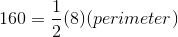
Then multiply to get 
Then divide both sides by 4 to get the perimeter of the figure. 
When we have the perimeter of a regular polygon, to find the side length we must divide by the number of sides of the polygon, in this case 8. 
After dividing we find the side length is 
To find the side length from the area of an octagon and the apothem we must use the area of a polygon which is
First plug in our numbers for area and the apothem to get
Then multiply to get
Then divide both sides by 4 to get the perimeter of the figure.
When we have the perimeter of a regular polygon, to find the side length we must divide by the number of sides of the polygon, in this case 8.
After dividing we find the side length is
← Didn't Know|Knew It →
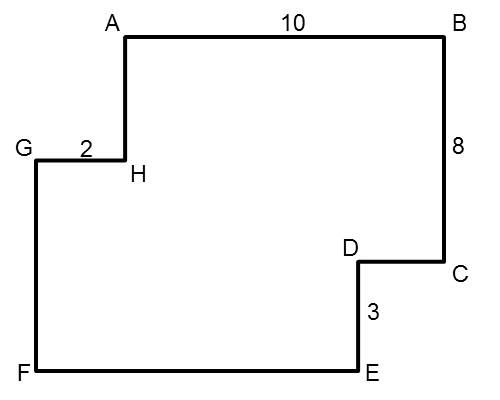
All segments of the polygon meet at right angles (90 degrees). The length of segment  is 10. The length of segment
  is 8. The length of segment
  is 3. The length of segment
  is 2.
is 2.
Find the perimeter of the polygon.
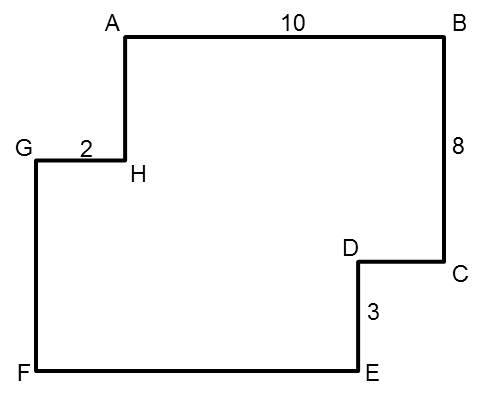
All segments of the polygon meet at right angles (90 degrees). The length of segment
Find the perimeter of the polygon.
Tap to reveal answer
The perimeter of the polygon is 46. Think of this polygon as a rectangle with two of its corners "flipped" inwards. This "flipping" changes the area of the rectangle, but not its perimeter; therefore, the top and bottom sides of the original rectangle would be 12 units long  . The left and right sides would be 11 units long
  . Adding all four sides, we find that the perimeter of the recangle (and therefore, of this polygon) is 46.
The perimeter of the polygon is 46. Think of this polygon as a rectangle with two of its corners "flipped" inwards. This "flipping" changes the area of the rectangle, but not its perimeter; therefore, the top and bottom sides of the original rectangle would be 12 units long
← Didn't Know|Knew It →