
How to find an angle in a trapezoid - Math
Card 1 of 4
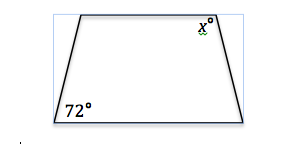
Find the measure of angle  in the isosceles trapezoid pictured below.
Find the measure of angle
Tap to reveal answer
The sum of the angles in any quadrilateral is 360**°, and the properties of an isosceles trapezoid dictate that the sets of angles adjoined by parallel lines (in this case, the bottom set and top set of angles) are equal. Subtracting 2(72°) from 360°** gives the sum of the two top angles, and dividing the resulting 216**°** by 2 yields the measurement of x, which is 108**°**.
The sum of the angles in any quadrilateral is 360**°, and the properties of an isosceles trapezoid dictate that the sets of angles adjoined by parallel lines (in this case, the bottom set and top set of angles) are equal. Subtracting 2(72°) from 360°** gives the sum of the two top angles, and dividing the resulting 216**°** by 2 yields the measurement of x, which is 108**°**.
← Didn't Know|Knew It →
Find the measure of angle in the isosceles trapezoid pictured below.
Find the measure of angle
Tap to reveal answer
The sum of the angles in any quadrilateral is 360**°, and the properties of an isosceles trapezoid dictate that the sets of angles adjoined by parallel lines (in this case, the bottom set and top set of angles) are equal. Subtracting 2(72°) from 360°** gives the sum of the two top angles, and dividing the resulting 216**°** by 2 yields the measurement of x, which is 108**°**.
The sum of the angles in any quadrilateral is 360**°, and the properties of an isosceles trapezoid dictate that the sets of angles adjoined by parallel lines (in this case, the bottom set and top set of angles) are equal. Subtracting 2(72°) from 360°** gives the sum of the two top angles, and dividing the resulting 216**°** by 2 yields the measurement of x, which is 108**°**.
← Didn't Know|Knew It →
Find the measure of angle in the isosceles trapezoid pictured below.
Find the measure of angle
Tap to reveal answer
The sum of the angles in any quadrilateral is 360**°, and the properties of an isosceles trapezoid dictate that the sets of angles adjoined by parallel lines (in this case, the bottom set and top set of angles) are equal. Subtracting 2(72°) from 360°** gives the sum of the two top angles, and dividing the resulting 216**°** by 2 yields the measurement of x, which is 108**°**.
The sum of the angles in any quadrilateral is 360**°, and the properties of an isosceles trapezoid dictate that the sets of angles adjoined by parallel lines (in this case, the bottom set and top set of angles) are equal. Subtracting 2(72°) from 360°** gives the sum of the two top angles, and dividing the resulting 216**°** by 2 yields the measurement of x, which is 108**°**.
← Didn't Know|Knew It →
Find the measure of angle in the isosceles trapezoid pictured below.
Find the measure of angle
Tap to reveal answer
The sum of the angles in any quadrilateral is 360**°, and the properties of an isosceles trapezoid dictate that the sets of angles adjoined by parallel lines (in this case, the bottom set and top set of angles) are equal. Subtracting 2(72°) from 360°** gives the sum of the two top angles, and dividing the resulting 216**°** by 2 yields the measurement of x, which is 108**°**.
The sum of the angles in any quadrilateral is 360**°, and the properties of an isosceles trapezoid dictate that the sets of angles adjoined by parallel lines (in this case, the bottom set and top set of angles) are equal. Subtracting 2(72°) from 360°** gives the sum of the two top angles, and dividing the resulting 216**°** by 2 yields the measurement of x, which is 108**°**.
← Didn't Know|Knew It →